
Opening your dashboard
Class 5 Maths Chapter 9 Fractions: Competency-Based Questions (CBQ)
40 questions on Chapter 9, each worked through on its own page with the AI tutor. Class 5 Maths, ICSE 2026-27.
40 questions
1–5 marks · Mixed difficulty
- 11 mark
Question 1
Competency: Understanding
Two parathas of the same size are each cut into 4 equal pieces. The shaded pieces in the picture were eaten.
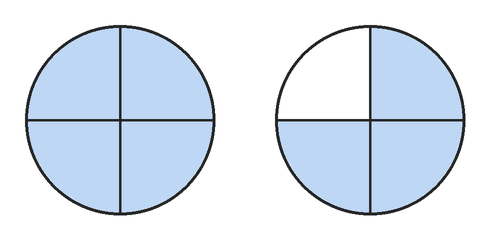
What fraction of a paratha was eaten?
- 21 mark
Question 2
Competency: Application
Rahul's school is km from his home. One morning his cycle got a puncture after he had covered of the way. How far had he cycled?
- 31 mark
Question 3
Competency: Analysis
Three friends are reading the same storybook. Anu has read of the book, Charu has read of it and Bala has read of it. Who has the most left to read?
- 41 mark
Question 4
Competency: Analysis
A shopkeeper packs 5 kg of tea into packets of kg each. Before working it out, four children guess the number of packets. Whose guess is sensible?
- 51 mark
Question 5
Competency: Application
In the morning a water tank was full. By the evening it was only full. No water was added during the day. What fraction of the tank was used?
- 61 mark
Question 6
Competency: Application
In a quiz, Nisha has to find quickly. Which of these is a correct way to think?
- 72 marks
Question 7
Competency: Application
Kiran practises the tabla for hour every day. His teacher wants him to complete 6 hours of practice before the school concert.
(a) How many minutes does he practise each day?
(b) How many days will he need to complete 6 hours?
- 82 marks
Question 8
Competency: Analysis & Evaluation
Dev makes a rule: "Of two fractions, the one with the bigger denominator is always the smaller fraction."
Test Dev's rule on these two pairs.
Pair 1: and
Pair 2: and
Is his rule always, sometimes or never true? Say when it works.
- 92 marks
Question 9
Competency: Application & Evaluation
For a party, Mother mixes litres of orange juice, litre of pineapple juice and litre of soda water to make fruit punch. Her jug holds exactly 3 litres. Will all the punch fit in the jug? Show your working.
- 102 marks
Question 10
Competency: Analysis
Lata went to a book fair. She spent of her money on books. She then had ₹ 80 left. How much money did Lata have at the start? Check your answer.
- 113 marks
Question 11
Competency: Evaluation
Ravi walked km to the park and then km to the library. He worked out the total distance like this:
km
(a) Compare with . How does this show that Ravi's answer must be wrong?
(b) What mistake did Ravi make?
(c) Find the correct total distance.
- 123 marks
Question 12
Competency: Analysis & Evaluation
Two shops sell the same pair of sports shoes.
Shop A: The price is ₹ 960. The shop takes off the price.
Shop B: The price is ₹ 840. You pay only of the price.
(a) How much do you pay in Shop A?
(b) How much do you pay in Shop B?
(c) Shop B has the lower price on its tag. Is it really the cheaper shop? By how much?
- 133 marks
Question 13
Competency: Creativity
You are designing a flag for your school house on a sheet of 24 equal squares.
Choose three colours. Give each colour a different fraction of the flag. The three fractions must have different denominators. Some squares may stay white.
(a) Write your three fractions and find how many squares each colour gets.
(b) What fraction of your flag stays white? Show your working.
- 145 marks
Question 14
Competency: Understanding & Analysis
Case study — Arjun's school day
The strip shows how Arjun spends one school day of 24 hours. The strip is divided into 12 equal parts.
S = sleep, C = school, P = play, H = homework, O = other things

(a) What fraction of the day does Arjun spend sleeping? What fraction does he spend at school? Write each in its lowest term.
(b) What fraction of the day do sleep and school take together? How many hours is that?
(c) On Sunday there is no school. Arjun shares the school time equally between play and homework. What fraction of Sunday does he now spend on play, and what fraction on homework?
- 154 marks
Question 15
Competency: Application & Evaluation
Case study — Painting the classroom wall
A painter is painting a long classroom wall. On Monday he paints of the wall. On Tuesday he paints of the wall. The whole wall needs litres of paint.
(a) What fraction of the wall is painted in the two days?
(b) What fraction of the wall is still left to be painted?
(c) The painter has litres of paint left in his tin. Is this enough to finish the wall? If not, how much more paint does he need?
- 161 mark
Question 16
Competency: Understanding
The number line below is marked in equal parts. The point P is on one of the marks.

Which number does P stand for?
- 171 mark
Question 17
Competency: Evaluation
Assertion (A): and are equivalent fractions.
Reason (R): If we add the same number to the numerator and to the denominator of a fraction, we get an equivalent fraction.
- 181 mark
Question 18
Competency: Analysis
Before adding, Meera wants to estimate the sum . Which of these statements about the sum is correct?
- 191 mark
Question 19
Competency: Application
Rice costs ₹ 48 per kg. Mother buys kg of rice. How much money does she pay?
- 201 mark
Question 20
Competency: Application & Analysis
A bus moves at a steady speed and covers 45 km in hour. How far does it go in 1 hour at the same speed?
- 211 mark
Question 21
Competency: Application
Mother has kg of grapes. She shares them equally among 6 children. How many kilograms of grapes does each child get?
- 221 mark
Question 22
Competency: Analysis
Four friends ride on a 1 km straight track for the same time. Ria covers of the track, Sam covers of it, Tej covers of it and Uma covers of it.
Who covers the second longest distance?
- 231 mark
Question 23
Competency: Application
Mother had litres of milk in the morning. She used litres for making tea. In the evening she bought litres more. How much milk does she have now?
- 241 mark
Question 24
Competency: Evaluation & Understanding
Assertion (A): The reciprocal of 1 is 0.
Reason (R): The product of a fraction and its reciprocal is 1.
- 251 mark
Question 25
Competency: Analysis
Which of these products is smaller than both of the numbers that are multiplied?
- 262 marks
Question 26
Competency: Evaluation & Analysis
Sana ate of a small pizza that weighed 200 g. Raj ate of a large pizza that weighed 500 g. (Hypothetical data.)
Sana says, "My fraction is bigger, so I ate more pizza than Raj."
Is Sana's conclusion correct? Support your answer with the weight of pizza each child ate.
- 272 marks
Question 27
Competency: Application
A bean plant in the school garden was cm tall on Monday and cm tall on Friday.
(a) How much did the plant grow in these four days?
(b) Suppose it grows by the same amount in the next four days. How tall will it be then?
- 282 marks
Question 28
Competency: Evaluation & Analysis
Ribbon A is of a ribbon that is m long. Ribbon B is of a ribbon that is m long.
Tara says, "Ribbon B is shorter, because is bigger than ." Is Tara right? Find the length of each ribbon.
- 292 marks
Question 29
Competency: Analysis & Evaluation
A fruit seller sells apples in two packs. Pack P weighs 1 kg and costs ₹ 120. Pack Q weighs kg and costs ₹ 96.
Find the price of 1 kg of apples in each pack. Which pack is the better buy?
- 302 marks
Question 30
Competency: Understanding & Application
In a number game, Aman starts with the fraction . He multiplies it by three different numbers.
The first product is itself. The second product is 0. The third product is 1.
Find the three numbers that Aman used.
- 312 marks
Question 31
Competency: Application & Analysis
School starts at 8:00 a.m. with an assembly that lasts hour. Then three periods follow, one after another with no gaps. Each period lasts hour.
At what time does the third period end?
- 323 marks
Question 32
Competency: Analysis
P, Q, R and S are four identical beakers. Each beaker holds exactly 1 litre when full. The beakers are marked in 12 equal parts. The picture shows how much juice each beaker holds.

(a) Write the amount of juice in each beaker as a fraction of 1 litre, in its lowest terms.
(b) Arrange the beakers in order, from the one with the least juice to the one with the most.
(c) What fraction of a litre of juice must be added to the beaker with the least juice so that it holds as much as the fullest beaker?
- 333 marks
Question 33
Competency: Analysis
A cook needs exactly kg of vegetables. The shop has four bags that weigh kg, kg, kg and kg. The cook wants to buy two bags.
(a) Find the total weight of the bags of kg and kg. How far is it from kg?
(b) Which two bags together weigh exactly kg?
(c) Which pair of bags weighs the most, and by how much is it more than kg?
- 343 marks
Question 34
Competency: Application & Evaluation
A shopkeeper has 14 m of thread. He needs m of thread to make one kite.
(a) How many whole kites can he make?
(b) How much thread is left after making them?
(c) He says, "The left-over thread is enough for one more kite." Is he right? If not, how much more thread does he need?
- 353 marks
Question 35
Competency: Creativity & Analysis
A tape that is 1 m long is to be cut into 4 pieces. Each piece must be a fraction of a metre, and the pieces must follow these rules:
- the longest piece is exactly twice as long as the shortest piece;
- the pieces have at least three different lengths.
(a) Choose the lengths of the four pieces.
(b) Show by adding that the four pieces use the whole tape.
(c) Show that your longest piece is twice your shortest piece.
- 363 marks
Question 36
Competency: Analysis & Understanding
Riya gives a number puzzle. "I am an improper fraction with denominator 12. I am greater than and smaller than ."
(a) Write and as improper fractions with denominator 12.
(b) Find the number in the puzzle and write it as a mixed number.
(c) Can an improper fraction with denominator 6 fit the puzzle? Give a reason.
- 375 marks
Question 37
Competency: Application & Analysis
Case study — Meena's laddoo stall
Meena sells laddoos at the school fair. The table shows the ingredients she needs for one batch of laddoos. (Hypothetical data.)
Ingredient Weight for one batch (kg) Gram flour Sugar Ghee She plans to make batches.
(a) How much of each ingredient does she need for batches?
(b) What is the total weight of the three ingredients for one batch? What is it for batches?
(c) She has one sugar packet of kg. How much sugar is left after batches? How many full batches could the packet make?
- 385 marks
Question 38
Competency: Understanding & Application
Case study — A railway line
A small railway line has five stations A, B, C, D and E in a straight line. The picture shows the distances between the stations in kilometres. The distance from D to E is not shown. The whole line from A to E is 8 km. (Hypothetical data.)
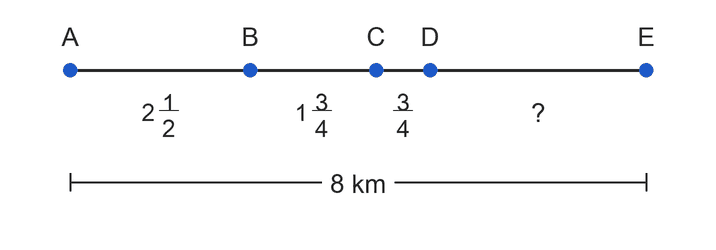
(a) How far is it from A to D?
(b) How far is it from D to E?
(c) A train covers km in every minute. How long does it take to go from A to E? How long does it take to go from A to D?
- 394 marks
Question 39
Competency: Analysis & Evaluation
Case study — The newspaper drive
Three classes of a school collect old newspapers for recycling. The target for the three classes together is 40 kg. The table shows what each class has collected so far. (Hypothetical data.)
Class Newspapers collected (kg) 5A 5B 5C (a) How many kilograms of newspapers have been collected in all?
(b) How much more did the class that collected the most bring than the class that collected the least?
(c) The teacher says, "If each class brings 3 kg more, the target will be reached." Is the teacher right? Show by how much the target is missed or passed.
- 404 marks
Question 40
Competency: Analysis & Evaluation
Case study — Folding a paper strip
Anaya has a paper strip that is 1 m long. She folds it in half. Then she folds it in half again, and again. After each fold, the length of the folded strip is of its length before that fold.
(a) After 1 fold the strip is m long. How long is it after 2 folds and after 3 folds? Write each answer as a fraction of a metre, using multiplication.
(b) How long is the strip after 3 folds, in centimetres?
(c) Anaya says, "After 5 folds the strip will be m long." Is she right? Find the length after 5 folds.