
Opening your dashboard
Class 5 Maths Chapter 8 Factors and Multiples: Competency-Based Questions (CBQ)
40 questions on Chapter 8, each worked through on its own page with the AI tutor. Class 5 Maths, ICSE 2026-27.
40 questions
1–5 marks · Mixed difficulty
- 11 mark
Question 1
Competency: Application
138 children have come for a nature camp. The teacher wants to put them into teams of equal size, with no child left out. Use the divisibility tests. Which team size will work?
- 21 mark
Question 2
Competency: Application
Riya is making snack plates for a party. Each plate gets one samosa and one juice box. Samosas are sold in boxes of 6. Juice is sold in packs of 8. What is the smallest number of plates she can make so that no samosa and no juice box is left over?
- 31 mark
Question 3
Competency: Analysis
Karan's cycle lock opens with a 2-digit number. He gives these clues.
"My number is between 40 and 50."
"My number is a prime number."
"The number that is 2 more than my number is also prime."
What is Karan's number?
- 41 mark
Question 4
Competency: Application
A milkman has 40 litres of cow's milk in one can and 56 litres of buffalo's milk in another can. He wants one measuring jug that can measure out both cans exactly, with no milk left over. He wants the jug to be as big as possible. How much should the jug hold?
- 51 mark
Question 5
Competency: Evaluation
Four children talk about factors and multiples. Whose statement is correct?
- 61 mark
Question 6
Competency: Understanding
24 chairs are to be put in equal rows for a class play. No chair should be left over. Which number of rows is not possible?
- 72 marks
Question 7
Competency: Application
Asha waters her tulsi plant every 4 days and her money plant every 6 days. She watered both plants on 1 March. On which date will she next water both plants on the same day?
- 82 marks
Question 8
Competency: Analysis & Evaluation
Rohan says, "3, 5 and 7 are odd numbers and they are all prime. So every odd number greater than 1 is a prime number."
Is Rohan's statement always, sometimes or never true? Give two examples to support your answer.
- 92 marks
Question 9
Competency: Evaluation
Tina found the H.C.F. and the L.C.M. of 16 and 24. She wrote: H.C.F. and L.C.M. .
Use the relation between the H.C.F., the L.C.M. and the two numbers to check her answers. Her H.C.F. is right. Is her L.C.M. right? If not, find the correct L.C.M.
- 102 marks
Question 10
Competency: Application
A poultry farm has 1,236 eggs. Use divisibility tests (do not divide) to answer.
(a) The eggs are packed in trays of 12. Will any eggs be left over?
(b) Instead, the eggs are packed in boxes of 15. Will any eggs be left over?
- 113 marks
Question 11
Competency: Application & Analysis
The floor of a room is a rectangle 420 cm long and 300 cm wide. It is to be covered with square tiles of the same size. No tile may be cut.
(a) Find the side of the largest square tile that can be used.
(b) How many tiles will fit along the length, and how many along the width?
(c) How many tiles are needed in all?
- 123 marks
Question 12
Competency: Analysis
Meena's house number is a secret. She gives four clues.
Clue 1: It is a factor of 60.
Clue 2: It is a multiple of 4.
Clue 3: It is greater than 10.
Clue 4: It is not a multiple of 3.
(a) List all the factors of 60.
(b) Use the clues one by one to cut down your list.
(c) What is Meena's house number? Check it against all four clues.
- 133 marks
Question 13
Competency: Creativity
You have 24 laddoos and 36 barfis for Diwali gift boxes. Every box must have the same number of laddoos and the same number of barfis as every other box. All the sweets must be used.
(a) Design two different packing plans. For each plan write the number of boxes and what goes into one box.
(b) Which plan gives the greatest possible number of boxes? What is this number called for 24 and 36?
- 145 marks
Question 14
Competency: Analysis & Evaluation
Case study — Rani's number chart
Rani wanted to find all the prime numbers from 1 to 50. She coloured every number that she thought was composite in blue. She coloured 1 in yellow. The numbers she left white are the ones she thinks are prime.

(a) Why did Rani give the number 1 a colour of its own?
(b) Rani made two mistakes in her chart. Find them. Give a reason for each.
(c) Correct the chart in your mind. Now write all the pairs of twin prime numbers from 1 to 50.
- 154 marks
Question 15
Competency: Application & Analysis
Case study — The Republic Day parade
The PT teacher is choosing children for the Republic Day parade. On different days they will march in rows of 6, rows of 8 and rows of 10. Each time, every row must be full and no child may be left out.
(a) What is the smallest number of children the teacher can choose?
(b) The principal wants more than 200 but fewer than 300 children in the parade. How many children should be chosen now?
(c) On the day of the parade, 2 of these children are absent. Use divisibility tests to check whether the others can march in rows of 6 or in rows of 10. The teacher then tries rows of 7. Will that work?
- 161 mark
Question 16
Competency: Application
Aarav has 18 identical square tiles. He wants to use all of them, with none left over, to lay a rectangle. A rectangle 2 tiles by 9 tiles and a rectangle 9 tiles by 2 tiles are the same shape turned round, so they count as one. How many different rectangles can he make?
- 171 mark
Question 17
Competency: Evaluation
Sunita says, "A number that is divisible by both 4 and 6 is always divisible by 24, because 4 times 6 is 24." Which number shows that Sunita is wrong?
- 181 mark
Question 18
Competency: Analysis
Two numbers are co-prime. Their product is 56. What is their L.C.M.?
- 191 mark
Question 19
Competency: Analysis
Mira writes down the number that lies exactly in the middle of each of these twin prime pairs.
Twin primes 5 and 7 11 and 13 17 and 19 29 and 31 41 and 43 Middle number 6 12 18 30 42 Which pattern is true for all five middle numbers?
- 201 mark
Question 20
Competency: Evaluation
Assertion (A): Every multiple of 12 is also a multiple of 4.
Reason (R): 12 is an even number.
- 211 mark
Question 21
Competency: Application
A tile-maker has rectangular tiles 15 cm long and 20 cm wide. He lays many of them all the same way round, side by side, to make the smallest possible square. What is the side of this square?
- 221 mark
Question 22
Competency: Analysis
Twelve cards are numbered 1 to 12. Neha takes out every card that has a prime number on it. Of the cards that are left, how many have a composite number on them?
- 231 mark
Question 23
Competency: Analysis
Four houses in a lane have the numbers 12, 16, 18 and 20. Riya lists all the factors of each house number. Which house number gives her a list with an odd number of factors?
- 241 mark
Question 24
Competency: Analysis & Evaluation
Assertion (A): The H.C.F. of 12 and 18 is 36.
Reason (R): The H.C.F. of two numbers divides both of the numbers exactly.
- 251 mark
Question 25
Competency: Analysis
The H.C.F. of two numbers is 4 and their L.C.M. is 48. Tara knows that the product of the two numbers is therefore . She finds four pairs of numbers whose product is 192. Which pair has H.C.F. 4 and L.C.M. 48?
- 262 marks
Question 26
Competency: Application
Zoya has four digit cards: 1, 5, 6 and 9. She uses each card exactly once to make the greatest possible 4-digit number that is divisible by 5.
(a) Write the number Zoya makes.
(b) Use a test of divisibility to say whether her number is also divisible by 3.
- 272 marks
Question 27
Competency: Understanding & Analysis
A teacher asks, "Why is 2 the only even prime number?"
Answer her question by writing the factors of 2, 4, 14 and 26.
- 282 marks
Question 28
Competency: Application & Analysis
The sum of two twin prime numbers is 60. Find the two numbers and show that both are prime.
- 292 marks
Question 29
Competency: Creativity
Write two composite numbers between 20 and 30 that are co-prime. Show by listing their factors that they are co-prime.
- 302 marks
Question 30
Competency: Application
Neha wants to write the fraction in its lowest terms in one step.
(a) Find the H.C.F. of 36 and 48.
(b) Divide the top and the bottom of the fraction by this H.C.F. and write the answer.
- 312 marks
Question 31
Competency: Evaluation & Analysis
Gita says, "The product of the H.C.F. and the L.C.M. of some numbers is always equal to the product of the numbers." She tests it on the three numbers 4, 6 and 10.
Find the H.C.F. and the L.C.M. of 4, 6 and 10 and decide whether her test supports her statement.
- 323 marks
Question 32
Competency: Analysis
A basket has more than 30 but fewer than 70 mangoes. Ritu counts them in groups of 4 and 1 mango is left over. She counts them in groups of 6 and 1 is left over. She counts them in groups of 9 and again 1 is left over. How many mangoes are in the basket?
- 333 marks
Question 33
Competency: Understanding & Analysis
Arun and Bela each draw a factor tree for 72, as shown. In each tree the numbers that cannot be split any more are circled.

(a) Write 72 as a product of prime numbers using Arun's tree.
(b) Write 72 as a product of prime numbers using Bela's tree.
(c) What do you notice about the two answers? Which prime number appears most often, and how many times?
- 343 marks
Question 34
Competency: Analysis
The H.C.F. of two numbers is 7 and their L.C.M. is 84.
(a) Find the product of the two numbers.
(b) Both numbers are multiples of 7 and factors of 84. List the pairs of such numbers whose product is the answer to (a).
(c) Which of these pairs really have H.C.F. 7?
- 353 marks
Question 35
Competency: Application & Analysis
A library gives each book a 4-digit code. A code is valid only if it is divisible by 11. Three codes are 3,168, 4,827 and 6,193.
(a) Use the test of divisibility by 11 to find which codes are valid.
(b) Change only the ones digit of the code that is not valid, so that it becomes valid.
- 363 marks
Question 36
Competency: Understanding & Application
In each case, say whether the H.C.F. or the L.C.M. is needed, and then solve.
(a) A gardener has 18 rose plants and 30 marigold plants. He plants them in straight rows. Every row has the same number of plants, and each row has only one kind of plant. He wants as many plants in each row as possible. How many rows does he make?
(b) Rani wants to spend the same amount of money on notebooks that cost ₹ 12 each as on pens that cost ₹ 18 each. She buys whole notebooks and whole pens. What is the least amount she can spend on each?
- 374 marks
Question 37
Competency: Analysis & Evaluation
Case study — The locker game
In a school game, six lockers carry different numbers. Each child writes all the factors of one locker number on a card. The table shows the cards.
Locker Number All its factors P 41 1, 41 Q 43 1, 43 R 39 1, 3, 13, 39 S 57 1, 3, 19, 57 T 25 1, 5, 25 U 1 1 (a) Which lockers carry prime numbers? Give the reason.
(b) Which locker number is neither prime nor composite? Why?
(c) Dev says, "Lockers R and P carry twin prime numbers, because 39 and 41 differ by 2." Is he right? Which two lockers carry twin primes?
- 385 marks
Question 38
Competency: Analysis & Application
Case study — The frog hopping game
Two toy frogs play a game along a number line marked from 0 to 40. Both start at 0 and hop to the right. Frog A hops 6 at a time and Frog B hops 9 at a time. The figure shows where each frog lands. The empty circle is the start.
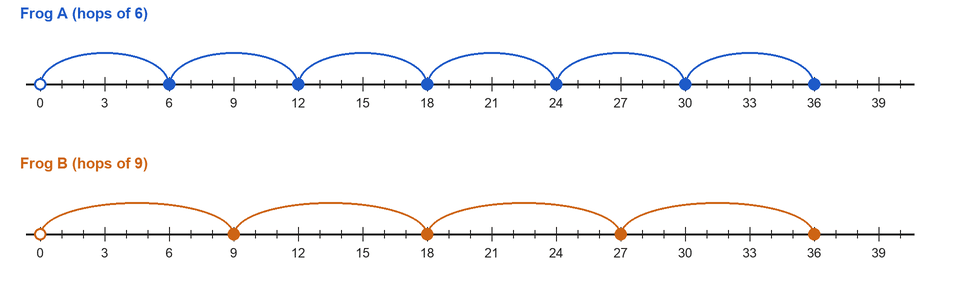
(a) Read the figure to find the numbers where both frogs land.
(b) Find the L.C.M. of 6 and 9. How is it related to the first number you found in (a)?
(c) A third frog, Frog C, starts at 0 and hops 4 at a time. On which numbers up to 40 do all three frogs land together?
- 394 marks
Question 39
Competency: Evaluation & Analysis
Case study — Meena's notebook
Meena finds the H.C.F. and the L.C.M. of four pairs of numbers. Her answers are in the table.
Pair Meena's H.C.F. Meena's L.C.M. 15 and 25 5 75 8 and 12 24 4 9 and 14 1 126 16 and 24 8 12 Remember that the H.C.F. is never greater than either number, and the L.C.M. is never less than either number.
(a) Without calculating, which of Meena's answers must be wrong? Give the reason.
(b) Find the correct H.C.F. and L.C.M. for those pairs.
(c) Use the relation between the H.C.F., the L.C.M. and the numbers to check Meena's answers for 15 and 25.
- 405 marks
Question 40
Competency: Evaluation & Analysis
Case study — Two ways to find the H.C.F.
Meera and Sam both try to find the H.C.F. of 84 and 126.
Meera writes and . She then takes every prime factor that appears in either number, as many times as it appears most often, multiplies them and writes: H.C.F. .
Sam uses the division method. He divides 126 by 84 and gets the remainder 42. Then he divides 84 by 42 and gets the remainder 0. He writes: H.C.F. .
(a) Use a property of the H.C.F. to say whose answer cannot be right.
(b) What mistake did Meera make? Find the correct H.C.F. by her method.
(c) Use Sam's H.C.F. to find the L.C.M. of 84 and 126. What do you notice about Meera's number 252?