
Opening your dashboard
Class 5 Maths Chapter 6 Rounding Off – Estimation: Competency-Based Questions (CBQ)
40 questions on Chapter 6, each worked through on its own page with the AI tutor. Class 5 Maths, ICSE 2026-27.
40 questions
1–5 marks · Mixed difficulty
- 11 mark
Question 1
Competency: Understanding
The number line shows the number of books in a school library as the point P.

Rounded off to the nearest hundred, the library has about
- 21 mark
Question 2
Competency: Analysis
A school's notice board says two things about the number of students:
Rounded off to the nearest ten, there are 1,250 students.
Rounded off to the nearest hundred, there are 1,300 students.
Which of these could be the actual number of students?
- 31 mark
Question 3
Competency: Application
Before a family road trip, the meter of the car showed 27,385 km. After the trip it showed 31,820 km. Rounding off each reading to the nearest thousand, about how far did the family travel?
- 41 mark
Question 4
Competency: Application
A school has 1,832 students. Each student must get one notebook. The notebooks are sold only in packs of 100. How many packs should the school order so that every student gets a notebook?
- 51 mark
Question 5
Competency: Analysis & Evaluation
Assertion (A): For 19 tickets at ₹ 52 each, the estimate ₹ 1,000 is very close to the actual cost.
Reason (R): Here one number was rounded up and the other was rounded down, so the two changes partly cancel each other.
- 61 mark
Question 6
Competency: Understanding
The bus for the class picnic leaves the school gate at 6:35 a.m. Tina rounds off this time to the nearest hour and reaches the gate at the rounded time. What will happen?
- 72 marks
Question 7
Competency: Application
Ravi is going to his grandmother's village. The train journey takes 5 hours 40 minutes. He then waits 1 hour 25 minutes at the bus stand. The bus ride takes 2 hours 35 minutes.
Round off each time to the nearest hour and estimate the total time of the trip. Then find the actual total time. How far apart are the two answers?
- 82 marks
Question 8
Competency: Analysis & Evaluation
Kabir has to round off 3,449 to the nearest hundred. He does it in two steps.
Step 1: 3,449 to the nearest ten is 3,450.
Step 2: 3,450 to the nearest hundred is 3,500.
So he writes 3,500 as his answer. Is Kabir's answer correct? Give a reason and write the correct answer.
- 92 marks
Question 9
Competency: Analysis
A shopkeeper rounds off each day's sales to the nearest thousand rupees. He says, "My sales on Monday and Tuesday together were about ₹ 11,000."
His actual sales on Monday were ₹ 3,612. Find the smallest and the greatest amounts (in whole rupees) that his actual sales on Tuesday could be.
- 102 marks
Question 10
Competency: Application & Evaluation
A farmer packs 4,792 mangoes equally into 8 crates. Two children estimate the number of mangoes in each crate.
Asha rounds off 4,792 to the nearest thousand and then divides by 8.
Bina rounds off 4,792 to the nearest hundred and then divides by 8.
Find both estimates. Whose estimate would you choose? Give a reason.
- 113 marks
Question 11
Competency: Understanding & Analysis
Exactly 24,638 people came to a town fair. Three posters describe the crowd.
Poster 1: "About 25,000 people came."
Poster 2: "About 24,600 people came."
Poster 3: "About 20,000 people came."
(a) To which place has the number been rounded off in each poster?
(b) How far is each rounded number from the actual number?
(c) Which poster is the closest to the actual number? Which poster would you not use, and why?
- 123 marks
Question 12
Competency: Evaluation
A library bought 2,468 books in the first term, 1,750 books in the second term and 3,512 books in the third term. Priya estimates the total by rounding off each number to the nearest thousand.
Priya's working: books
(a) Find the mistake in Priya's working.
(b) Write the correct estimate.
(c) The actual total is 7,730 books. How far from it is Priya's estimate, and how far is the correct estimate?
- 133 marks
Question 13
Competency: Creativity
You are making a shopping list of three things. Each price is a 3-digit number of rupees and is not a full hundred (so not ₹ 300 or ₹ 500). You estimate the bill by rounding off each price to the nearest hundred.
(a) Choose three prices so that the estimated bill is ₹ 1,000 but the actual bill is more than ₹ 1,000.
(b) Now choose three prices so that the estimated bill is ₹ 1,000 but the actual bill is less than ₹ 1,000.
(c) What do you notice about the way the prices were rounded in (a) and in (b)?
- 145 marks
Question 14
Competency: Analysis & Evaluation
Case study — The book fair
A book fair ran for five days. The bar graph shows the number of visitors on each day. Every number has been rounded off to the nearest hundred before drawing the bar.

(a) Read the graph. About how many visitors came on Saturday and on Sunday? About how many came on these two days together?
(b) Estimate the total number of visitors on all five days.
(c) The organisers win a prize if the actual number of visitors on Saturday and Sunday together is more than 3,300. Can they be sure of the prize from the graph alone? Use the smallest actual numbers that the two bars could stand for.
- 154 marks
Question 15
Competency: Application & Evaluation
Case study — Planning the class picnic
Class 5 is planning a picnic. The class monitor lists the costs.
Item Cost (₹) Bus hire 4,850 Lunch 6,275 Entry tickets 2,640 Snacks 985 (a) Round off each cost to the nearest thousand and estimate the total cost.
(b) Find the actual total cost. Is the estimate more or less than the actual cost, and by how much?
(c) The class has collected ₹ 14,800. Looking only at the estimate, the monitor says, "We do not have enough money." Is he right? What should he do when the money collected is so close to the estimate?
- 161 mark
Question 16
Competency: Analysis
The number line shows the number of visitors to a fort on two days. Point A is the first day and point B is the second day. (Hypothetical data.)

Each number is rounded off to the nearest thousand. Which statement is true?
- 171 mark
Question 17
Competency: Analysis
Two shops earned ₹ 5,230 and ₹ 4,870 in a day. Aman wants to estimate how much more the first shop earned than the second shop. He rounds off each amount to the nearest thousand and subtracts. His estimate is ₹ 0.
Which comment is the best?
- 181 mark
Question 18
Competency: Application
A school collected ₹ 9,980 for a trip. Each ticket costs ₹ 48. Rounding off each number to its greatest place, about how many tickets can the school buy?
- 191 mark
Question 19
Competency: Analysis & Evaluation
Assertion (A): The times 10:29 a.m. and 10:31 a.m. both round off to 10:00 a.m. when they are rounded off to the nearest hour.
Reason (R): A time with 30 minutes or more is rounded off up to the next hour, and a time with less than 30 minutes is rounded off down to the same hour.
- 201 mark
Question 20
Competency: Analysis & Evaluation
Assertion (A): The estimate 6,000 ÷ 6 = 1,000 for 5,980 ÷ 6 is more than the actual quotient.
Reason (R): 5,980 was rounded off up to 6,000, and a bigger number divided by the same divisor gives a bigger quotient.
- 211 mark
Question 21
Competency: Analysis
Riya thinks of a 3-digit number. Rounded off to the nearest ten it is 480. Rounded off to the nearest hundred it is 500. The sum of its digits is 19. What is her number?
- 221 mark
Question 22
Competency: Application
At a school canteen, one sandwich costs ₹ 24 50 p. Three friends each buy one. The canteen rounds off the price of each sandwich to the nearest rupee and then adds. How much more than the exact bill do the three friends pay?
- 231 mark
Question 23
Competency: Analysis & Evaluation
Four friends work out 487 × 62 and get the four answers below. Round off each number to its greatest place and use the estimate to choose the most sensible product.
- 241 mark
Question 24
Competency: Analysis
Meena estimates 7,640 − 2,360 by rounding off each number to the nearest thousand: 8,000 − 2,000 = 6,000. Without working out the exact difference, which statement is correct?
- 251 mark
Question 25
Competency: Analysis
Two whole numbers are each rounded off to the nearest hundred. The two rounded numbers add up to 1,000. Which of these can not be the sum of the two original numbers?
- 262 marks
Question 26
Competency: Application
A cricket match began at 3:28 p.m. and ended at 6:32 p.m.
Round off each time to the nearest hour and use the rounded times to estimate how long the match lasted. Then find the actual time and say how far the estimate is from it.
- 272 marks
Question 27
Competency: Creativity
Make up a 6-digit number that rounds off to 5,00,000 when it is rounded off to the nearest lakh, and rounds off to 4,90,000 when it is rounded off to the nearest ten thousand. Show how you chose your number and check it.
- 282 marks
Question 28
Competency: Application & Evaluation
A taxi company rounds off every fare to the nearest ₹ 10 before collecting the money. The meter shows ₹ 235 for Mohan and ₹ 234 for Neha.
(a) How much does each of them pay?
(b) Who pays more than the meter fare, and by how much? Is it fair that a difference of ₹ 1 on the meters becomes a difference of ₹ 10 in what they pay?
- 292 marks
Question 29
Competency: Analysis
Give two different numbers that stay the same when they are rounded off to the nearest hundred, but change when they are rounded off to the nearest thousand. Explain how you chose them.
- 302 marks
Question 30
Competency: Understanding & Evaluation
Shop A sells a school bag for ₹ 1,999. Shop B sells the same school bag for ₹ 2,000.
(a) Round off each price to the nearest hundred and to the nearest thousand. What do you notice?
(b) What is the real difference between the two prices? Why do many shops write a price like ₹ 1,999?
- 312 marks
Question 31
Competency: Analysis
A newspaper says, "About 5,500 books were sold at the school fair." This number is rounded off to the nearest hundred. The receipt book shows the exact number as 5,4?7, where the ? is the tens digit hidden by a drop of ink.
Which digits can the ink be hiding? Write the smallest and the greatest possible exact numbers.
- 323 marks
Question 32
Competency: Analysis
The table shows the number of people living in five towns. (Hypothetical data.)
Town Population P 3,24,860 Q 3,19,720 R 3,45,300 S 2,98,450 T 3,04,999 (a) Round off each population to the nearest ten thousand.
(b) Which towns have the same rounded population?
(c) For each such pair of towns, which town really has more people, and by how many?
- 333 marks
Question 33
Competency: Analysis & Evaluation
A shopkeeper sells 148 notebooks every day. Rohan wants to know about how many notebooks are sold in 12 days.
(a) Round off each number to its greatest place and estimate the number of notebooks.
(b) Find the exact number of notebooks. How far is the estimate from it?
(c) Show a better estimate that rounds off only 148 to the nearest ten. How close is it?
- 343 marks
Question 34
Competency: Application
A film earned ₹ 12,47,35,000 in its first week and ₹ 8,62,10,000 in its second week. (Hypothetical data.)
(a) Round off each amount to the nearest crore.
(b) Use the rounded amounts to estimate the total earnings and how much more the film earned in the first week than in the second week.
(c) Find the exact difference between the two weeks and round it off to the nearest crore. Is it the same as the estimate in (b)? Why?
- 353 marks
Question 35
Competency: Evaluation
Asha and Bina both subtract 31,980 from 78,420. Asha gets 46,440 and Bina gets 47,440.
(a) Estimate 78,420 − 31,980 by rounding off both numbers to the nearest ten thousand. Which answer is closer to this estimate? Does it help you to decide?
(b) Estimate again by rounding off to the nearest hundred. Which answer does it support?
(c) Find the exact difference and say who is right.
- 363 marks
Question 36
Competency: Application & Evaluation
A trust has ₹ 1,00,000 to share equally among 3 schools. The treasurer wants to give a round amount to each school.
(a) How much does each school get when the money is shared equally in whole rupees? How much is left?
(b) The treasurer rounds each share off to the nearest thousand. How much money does he give out in all, and how much is left?
(c) Can he round each share up to ₹ 34,000 to make it look neat? Give a reason.
- 374 marks
Question 37
Competency: Analysis & Evaluation
Case study — The sports corner
A school has ₹ 2,000 to buy two different items for its sports corner. The price list is shown. (Hypothetical data.)
Item Price (₹) Football 645 Badminton racket 748 Cricket bat 1,185 Cricket helmet 1,260 (a) Round off each price to the nearest hundred.
(b) Zoya says, "Racket and helmet give 700 + 1,300 = 2,000, which is exactly our money, so we can buy them." Find the exact cost of these two items. Is Zoya right?
(c) Find the exact cost of every pair of items. Which pairs can the school buy, and which pair uses up the most money?
- 384 marks
Question 38
Competency: Analysis & Evaluation
Case study — The electricity meter
Mr Rao's house has an electricity meter. He wrote down the reading on the 1st of each month. (Hypothetical data.)
Date Meter reading (units) 1 January 4,238 1 February 4,612 1 March 5,047 1 April 5,486 (a) Round off each reading to the nearest hundred. Use the rounded readings to estimate the units used in January, February and March.
(b) Mr Rao says, "January and February used the same units." Find the exact units used in each of the three months. Is he right?
(c) Add the three estimates from (a). Then estimate the units used from 1 January to 1 April directly, from the rounded readings of those two dates. What do you notice? Compare both with the exact total.
- 394 marks
Question 39
Competency: Application & Evaluation
Case study — Meena's bicycle
Meena saves ₹ 185 every month in her money box. She wants to buy a bicycle that costs ₹ 2,350. She wants to know in how many months she can buy it.
(a) Round off each number to the nearest hundred and use the rounded numbers to estimate the number of months.
(b) Find the smallest whole number of months in which she will have enough money.
(c) Meena says, "My estimate is 12, so 12 months is enough." How much money will she have after 12 months? Is she right?
- 405 marks
Question 40
Competency: Analysis & Application
Case study — The bottle drive
Five sections of Class 5 collected plastic bottles for recycling. The bar graph shows the number of bottles each section collected. (Hypothetical data.)
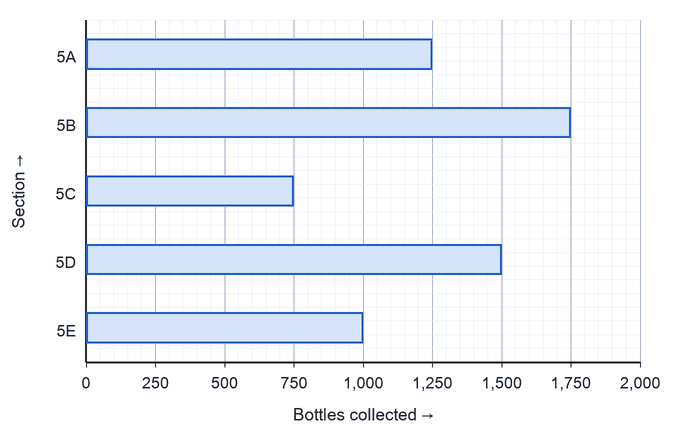
(a) Read the number of bottles collected by each section.
(b) Estimate the total number of bottles in two ways, first rounding off each number to the nearest thousand and then to the nearest hundred.
(c) The school's target is 8,000 bottles. Using the estimate to the nearest hundred, how many more bottles seem to be needed? If the sections collect exactly that many more bottles, will the school reach its target? Use the exact total to decide.