
Opening your dashboard
Class 12 Physics Chapter 8 Torque on a Current-Carrying Loop - Moving Coil Galvanometer: Competency-Based Questions (CBQ)
40 questions on Chapter 8, each worked through on its own page with the AI tutor. Class 12 Physics, ICSE 2026-27.
40 questions
1–4 marks · Mixed difficulty
- 11 mark
Question 1
Competency: Application
A light circular coil hangs from a thread so that its plane is vertical and it can turn freely about the vertical. It is joined to a small cell by thin, loose leads. Far from any magnets, it comes to rest with its axis along the magnetic north–south line, and when nudged it returns to this position. In which sense does the current flow in the coil?
- 23 marks
Question 2
Competency: Application
For a demonstration, a teacher wants to replace a bar magnet of magnetic moment by a short, compact coil of radius . The power supply can give at most . One face of the coil is marked P. (Hypothetical data.)
(a) Find the least number of turns the coil must have.
(b) Seen from face P, the current in the coil flows anticlockwise. Which face acts as the north pole? Give a reason.
(c) The coil (with the number of turns in (a) and ) is held with its axis along east–west in the Earth's horizontal field of . Find the torque on it and state how it tends to turn.
- 31 mark
Question 3
Competency: Analysis & Evaluation
Some magnetic sensors use a loop of wire twisted into a flat figure of eight: one loop of wire crosses over itself once, making two lobes of equal area that lie in the same plane. A current flows through it, and the whole loop is placed in a uniform magnetic field . Which statement about the torque on it is correct?
- 41 mark
Question 4
Competency: Analysis & Evaluation
A small current-carrying coil hangs near one pole of a strong bar magnet, with its dipole moment pointing along the magnet's field. The coil is seen to be pulled towards the magnet.
Assertion (A): A current loop placed in a non-uniform magnetic field can experience a net force.
Reason (R): The net force on a closed current loop placed in a uniform magnetic field is zero.
- 53 marks
Question 5
Competency: Analysis & Evaluation
To find the strength of a uniform field between two large magnet poles, students mount a flat coil ( turns, area , current ) on a torque sensor. They turn the coil and record the torque for different angles between the normal to the coil and the field:
( N m) 0.00 0.95 1.37 1.65 1.92 (Hypothetical data.)
(a) Show from the table that .
(b) Find the magnetic field between the poles.
(c) Predict the torque sensor reading at .
- 63 marks
Question 6
Competency: Application
The armature of a small d.c. motor is a rectangular coil of turns, , carrying . It turns about an axis through its centre, parallel to its sides, in a uniform field of perpendicular to that axis. (Hypothetical data.)
(a) Find the greatest torque on the coil.
(b) Find the torque when the plane of the coil makes an angle of with the field.
(c) A commutator reverses the current in the coil every half turn. Explain why the motor would not run continuously without it.
- 71 mark
Question 7
Competency: Analysis & Evaluation
A rectangular coil carrying a current is hung by a thread in a uniform horizontal magnetic field. Its centre does not move sideways, but the coil starts to turn.
Assertion (A): The net force on the coil is zero, yet the coil turns.
Reason (R): The forces on the two sides of the coil that cut across the field are equal and opposite but, in general, do not act along the same line.
- 81 mark
Question 8
Competency: Analysis & Evaluation
A coil mounted on a frictionless axle is held at rest in a uniform magnetic field with its plane parallel to the field, and then released. The axle lies in the plane of the coil and is perpendicular to the field.
Assertion (A): The coil is moving fastest at the instant its plane becomes perpendicular to the field.
Reason (R): The torque on the coil is greatest when its plane is perpendicular to the field.
- 91 mark
Question 9
Competency: Analysis & Evaluation
A student connects a laboratory moving coil galvanometer, through a large resistance, to a a.c. supply.
Assertion (A): The pointer shows a steady deflection that measures the r.m.s. value of the alternating current.
Reason (R): At every instant, the deflecting torque on the coil is proportional to the current in it at that instant.
- 103 marks
Question 10
Competency: Analysis & Evaluation
A student checks an old pointer-type moving coil galvanometer before using it. With no current, the pointer rests at division instead of zero. The student then passes known currents and records the readings:
Current (A) 0 10 20 30 40 50 Reading (div) 0.5 4.5 8.6 12.4 16.5 20.5 (Hypothetical data.)
(a) Show that the deflection is proportional to the current once the zero error is allowed for, and find the galvanometer constant in per division.
(b) Later the pointer reads divisions. Find the current.
(c) Which feature of the galvanometer's construction makes the deflection proportional to the current? Explain briefly.
- 111 mark
Question 11
Competency: Analysis & Evaluation
A pointer-type moving coil galvanometer suddenly stops responding: whatever current is sent to its terminals, the pointer stays at zero. On opening it, a technician finds that one of the two hair springs has snapped. Which is the best explanation?
- 124 marks
Question 12
Competency: Application
A centre-zero galvanometer is used as the null detector in a Wheatstone bridge. Its coil resistance is , its current sensitivity is divisions per , and its scale has divisions on each side of zero. At the start, the bridge is far from balance and the out-of-balance p.d. across the galvanometer terminals is . (Hypothetical data; treat this p.d. as fixed and the bridge's own resistance as negligible.)
(a) Find the current and the deflection if the galvanometer is connected directly. What would happen to it?
(b) Find the least resistance that must be put in series with the galvanometer to keep the pointer on the scale. Find the deflection with a protective resistance.
(c) Near balance the out-of-balance p.d. is only . Find the deflection with and without the resistance, and say why it is removed at this stage.
- 131 mark
Question 13
Competency: Analysis & Evaluation
A school must choose one of two galvanometers to detect very small currents. The data sheet of meter X gives its figure of merit as per division. The data sheet of meter Y gives its current sensitivity as division per . (Hypothetical data.) Which statement is correct?
- 141 mark
Question 14
Competency: Analysis & Evaluation
Two galvanometers P and Q both give divisions per mA. The coil of P has resistance and that of Q has .
Assertion (A): Of two galvanometers with the same current sensitivity, the one with the higher coil resistance has the higher voltage sensitivity, so Q is better for detecting small voltages.
Reason (R): Voltage sensitivity , where is the current sensitivity and the resistance of the galvanometer.
- 153 marks
Question 15
Competency: Application
The data sheet of a mirror (lamp-and-scale) galvanometer states: figure of merit per mm (scale at from the mirror); coil resistance . The scale reads up to on each side of zero, and the smallest shift of the light spot that can be noticed is . (Hypothetical data.)
(a) Find the current sensitivity in mm per , and the angle the coil turns per .
(b) Find the voltage sensitivity in mm per mV.
(c) Find the smallest current the instrument can detect, and the largest current it can measure on the scale.
- 161 mark
Question 16
Competency: Analysis & Evaluation
In the Bohr model of the hydrogen atom, the revolving electron is equivalent to a tiny current loop.
Assertion (A): The equivalent current of the electron in the orbit is of that in the orbit.
Reason (R): The orbital magnetic moment of the electron in the th orbit is , where is the Bohr magneton.
- 171 mark
Question 17
Competency: Application
In a "muonic hydrogen" atom, a muon takes the place of the electron. A muon has the same charge as an electron but times its mass. Treating it by the Bohr model (ignore the motion of the nucleus), the orbital magnetic moment of the muon in the lowest orbit is about ( is the Bohr magneton for the electron)
- 183 marks
Question 18
Competency: Analysis & Evaluation
A student wonders whether a strong laboratory magnet () can line up the magnetic moments of hydrogen atoms in a gas at room temperature (). Take the moment of each atom as one Bohr magneton, , and Boltzmann's constant . The work needed to turn a magnetic dipole in a uniform field from angle to angle is . (Hypothetical data.)
(a) Find the work needed to turn one atom's moment from parallel to antiparallel to the field.
(b) Compare this with the typical thermal energy of an atom at .
(c) What field would make the two energies equal? What do you conclude?
- 194 marks
Question 19
Competency: Analysis & Evaluation
An ammeter of range – is made from a galvanometer whose copper coil has resistance at and gives full-scale deflection for . The shunt is made of manganin, whose resistance hardly changes with temperature. For copper, the resistance increases by for each rise. (Hypothetical data.)
(a) Find the shunt resistance needed at .
(b) On a hot day the meter is at . What will it read when the true current is ?
(c) A better design puts a manganin resistor in series with the coil and a new shunt across the pair, as shown.
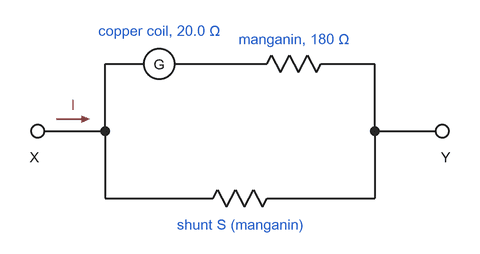
Find , and the reading at for a true current of .
- 201 mark
Question 20
Competency: Application
In a factory, the current in a heavy cable is measured with an external shunt marked ", ": when flows through the shunt, the p.d. across it is . A moving coil millivoltmeter (full scale , drawing only about at full scale) is connected across the shunt and its scale is marked –. The resistance of the shunt is about
- 211 mark
Question 21
Competency: Analysis & Evaluation
The same galvanometer is converted, with different shunts, into an ammeter of range – and then into one of range –.
Assertion (A): The – ammeter has a lower total resistance than the – ammeter.
Reason (R): A larger range needs a shunt of larger resistance, so that it carries a larger share of the current.
- 223 marks
Question 22
Competency: Application
A multimeter's voltage ranges are marked "", which means that on every range its resistance is for each volt of full-scale reading. Its galvanometer has a coil resistance of . (Hypothetical data.)
(a) Find the full-scale current of the galvanometer.
(b) Find the series resistance used for the – range.
(c) A cheaper meter is rated . Both are used on their ranges to read a p.d. of . Compare the currents they draw from the circuit, and say which is better.
- 231 mark
Question 23
Competency: Application
A laboratory voltmeter of range – has a resistance of . A student needs to measure p.d.s up to with it. To do this, the student should connect
- 241 mark
Question 24
Competency: Analysis & Evaluation
The same galvanometer is converted into a voltmeter of range – and then into one of range –.
Assertion (A): The – voltmeter has a higher total resistance than the – voltmeter.
Reason (R): The total resistance of such a voltmeter is , where is its range and the full-scale current of the galvanometer, which is the same for both.
- 254 marks
Question 25
Competency: Application
A galvanometer of resistance gives full-scale deflection for . It is to be made into a voltmeter of range – for a high-voltage power supply. The resistors available are each rated and at most across them. (Hypothetical data.)
(a) Find the series resistance needed.
(b) Find the power dissipated in it at full-scale reading.
(c) Explain why a single resistor of this kind cannot be used, and show that five resistors in series are suitable. What error in the range does this choice cause?
- 263 marks
Question 26
A square loop of side carries a current of in the sense . Its corners are at , , and , all in cm. (Hypothetical data.)
(i) Find the magnetic dipole moment of the loop as a vector.
(ii) The loop is now turned about the side (the -axis) through , so that and rise above the -plane. Find the new in component form.
(iii) A uniform field acts on the loop in the position of part (ii). Find the torque on it, and state whether this torque turns the loop back towards the -plane or further away from it.
- 274 marks
Question 27
A uniform rectangular loop of mass has and . It is hinged along the horizontal side , so that it can swing freely about , and at first it hangs vertically below the hinge. A uniform vertical magnetic field of is switched on and a current of is passed round the loop. The loop swings out of the vertical and settles at an angle to it. (Hypothetical data.)
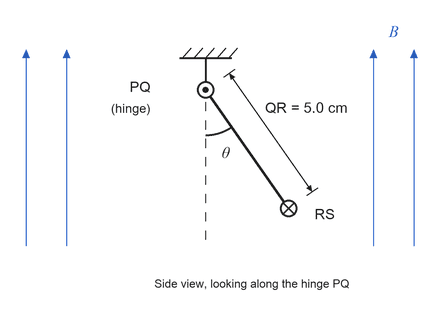
(i) Explain why only the force on the side has a moment about the hinge.
(ii) Find .
(iii) Show that the result of (ii) also follows from , where is the angle between the loop's dipole moment and the field.
(Take .)
- 283 marks
Question 28
A loop of wire is in the shape of a semicircle of radius closed by its diameter. It carries and is placed in a uniform magnetic field of that is parallel to its diameter. (Hypothetical data.)
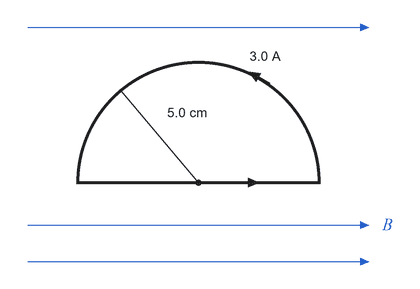
(i) Find the magnitude of the torque on the loop.
(ii) Show that the net force on the loop is zero by looking at the diameter and at the curved part separately.
(iii) About which line does the torque tend to turn the loop?
- 293 marks
Question 29
A galvanometer coil of turns and area is placed in a uniform (not radial) magnetic field of . With no current, the plane of the coil is parallel to the field. The torsional constant of the suspension is . (Hypothetical data.)
(i) Write the condition for equilibrium when the coil has turned through an angle .
(ii) Find the currents that give deflections of and , and show that the current is not proportional to the deflection.
(iii) Find the same two currents if the field were radial with the same strength.
- 303 marks
Question 30
A galvanometer coil has turns and resistance ; its current sensitivity is divisions per mA. The coil is unwound and the same frame is rewound, filling the same winding space, with wire of the same metal but half the diameter. The magnet and springs are unchanged. (Hypothetical data.)
(i) By what factors do the number of turns and the resistance of the coil change? Give reasons.
(ii) Find the new current sensitivity and the new resistance.
(iii) Find the old and new voltage sensitivities, and comment on the result.
- 314 marks
Question 31
A three-range ammeter is made from a galvanometer of resistance that gives full-scale deflection for . A chain of three resistors , , is connected across the galvanometer as shown. The common terminal is at . Using the terminal at gives a range of , the terminal at gives and the terminal at gives .
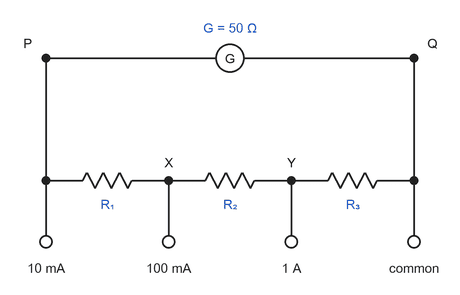
(a) For the range, which resistors form the shunt? Find .
(b) For the range, the shunt is and is in series with the galvanometer. Find .
(c) Find , and hence the values of , and .
(Hypothetical data.)
- 324 marks
Question 32
A uniform magnetic field of 3000 G is established along the positive -direction. A rectangular loop of sides 10 cm and 5 cm carries a current of 12 A. What is the torque on the loop in the different cases shown in the given figures? What is the force in each case? Which case corresponds to stable equilibrium?
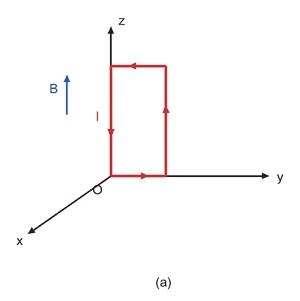
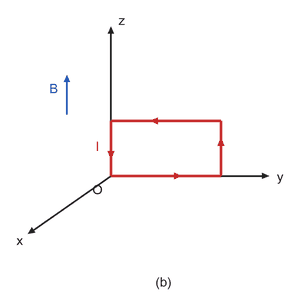
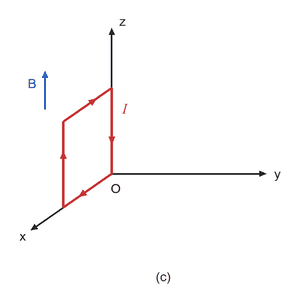
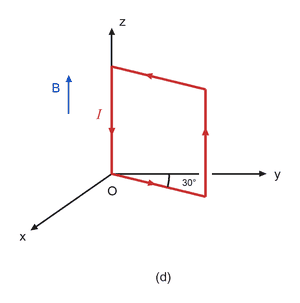
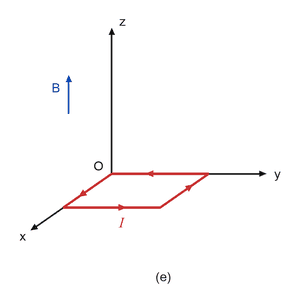
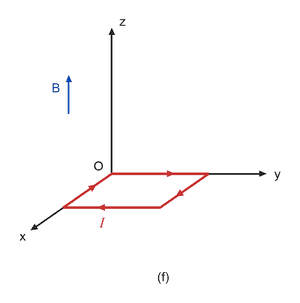
- 333 marks
Question 33
A moving coil galvanometer has 100 turns and area 300 mm. If the coil lies in a radial magnetic field of 0.4 T, find the torque exerted when a current of 10 mA flows through the coil. What is the angular of deflection of the coil if the suspension offers a torque of N m/degree?
- 343 marks
Question 34
A circular coil of 100 turns and diameter 0.2 m carrying a current of 5 A is suspended vertically in a horizontal magnetic field of 1.2 T. The magnetic field makes an angle of 30° with the normal to the plane of the coil. Find (a) the torque and (b) the force acting on the coil.
- 353 marks
Question 35
Find the torque acting on a circular loop of wire of length and carrying a current placed in a uniform magnetic field with its plane parallel to the field. If the same length of the wire is used to make a square loop, what is the torque acting on it?
- 363 marks
Question 36
If the coil of a moving coil galvanometer having 10 turns and of resistance 4.0 Ω is removed and replaced by a second coil having 100 turns of resistance 160 Ω. Calculate: (a) the factor by which the current sensitivity changes and (b) the factor by which the voltage sensitivity changes. Assume that all other features remain unaltered.
- 373 marks
Question 37
It is required to convert a galvanometer of current range 15 milliampere and voltage range 750 millivolt into (a) an ammeter of range 25 A and (b) a voltmeter of range 150 V. Calculate the values of the necessary resistance.
- 383 marks
Question 38
A moving coil galvanometer of resistance ohm gives a full scale deflection when mA current is passed through it. Giving necessary calculation explain with the help of a diagram how this galvanometer may be converted into a voltmeter of range V.
- 393 marks
Question 39
The electron in hydrogen atom moves around the proton with a speed of in a circular orbit of radius m. Calculate the
(i) equivalent current,
(ii) equivalent dipole moment and
(iii) the magnetic field at the site of the proton?
- 403 marks
Question 40
Competency: Analysis & Evaluation
For a science exhibition in Nagpur, Kabir turns a moving coil galvanometer into a simple resistance meter. He connects the galvanometer (coil resistance , full-scale deflection for , scale of equal divisions), a fresh cell of negligible internal resistance and a variable resistor in series, with the two free ends taken to a pair of probes. With the probes touching each other, he adjusts until the pointer is exactly at full scale and marks that point "". An unknown resistor is then held between the probes. (Hypothetical data.)
(a) Find the value of .
(b) With a resistor between the probes, the pointer stops at divisions. Find .
(c) Kabir plans to mark the resistance scale in equal steps, just like the current scale. Find when the pointer is at divisions and when it is at divisions, and use these results to explain why his plan is wrong.