
Competency: Application
The figure shows an automatic night light. The resistor and the light-dependent resistor (LDR) form a potential divider across the supply, and the voltage across the LDR is applied between the base and the emitter of the transistor. The LDR's resistance is about in daylight and about in darkness. The LED has across it when it glows. Take the transistor as starting to conduct when reaches , with while it conducts, , and when it is saturated. (Hypothetical data.)
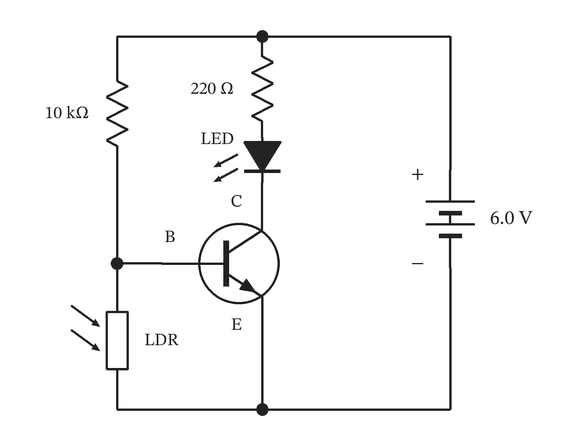
(a) Show that the LED is off in daylight.
(b) In darkness, find the base current. Show that the transistor is saturated, and find the LED current.
(c) Find the resistance of the LDR at which the transistor just starts to conduct. How should the resistor be changed so that the light comes on only when it is darker?