
Opening your dashboard
Class 12 Physics Chapter 12 Alternating Current: Competency-Based Questions (CBQ)
45 questions on Chapter 12, each worked through on its own page with the AI tutor. Class 12 Physics, ICSE 2026-27.
45 questions
1–4 marks · Mixed difficulty
- 13 marks
Question 1
Competency: Application
A kitchen oven clock has no crystal of its own. It keeps time by counting the cycles of the mains voltage, taking cycles as one second. One evening the grid is overloaded and runs at for hours. (Hypothetical data.)
(a) How many cycles does the clock count in one hour when the grid runs exactly at ?
(b) By how many seconds is the clock behind the correct time at the end of the hours?
(c) The grid operator wants such clocks to show the correct time again after the next hours. At what steady frequency must the grid run during that time?
- 21 mark
Question 2
Competency: Analysis & Evaluation
Two AC sources, each giving (r.m.s.), are joined in series. An AC voltmeter across the pair is found to read nearly zero.
Assertion (A): Two sources of (r.m.s.) each, joined in series, can give a combined r.m.s. voltage of zero.
Reason (R): The r.m.s. value of the sum of two sinusoidal voltages is always the sum of their r.m.s. values.
- 31 mark
Question 3
Competency: Analysis & Evaluation
A cheap data logger records the , mains voltage by taking exactly one reading every , starting at a random instant. Its record will show
- 43 marks
Question 4
Competency: Analysis & Evaluation
A simple battery charger passes the mains-derived current through a diode, so that only the positive half of each cycle of reaches the battery; during the negative half the current is zero. The peak current is and the frequency is . Two meters are placed in series with the battery: a moving-coil ammeter, which reads the average current, and a hot-wire ammeter, which reads the r.m.s. current. (Hypothetical data.)
(a) Find the reading of the moving-coil ammeter.
(b) Find the reading of the hot-wire ammeter.
(c) Which reading decides how much charge is stored in the battery? Find the charge delivered in one hour.
- 51 mark
Question 5
Competency: Application
In a test circuit, a resistor carries a current that is the sum of a steady current and a sinusoidal current:
ampere
A hot-wire ammeter, which responds to the heating effect, is placed in series with the resistor. Its reading is
- 61 mark
Question 6
Competency: Analysis & Evaluation
A full-wave rectifier turns the (r.m.s.) mains voltage into , so that both halves of each cycle become positive. A student connects a moving-coil voltmeter, which reads the average value, across its output. (Ignore the voltage drop in the diodes.)
Assertion (A): The voltmeter reads .
Reason (R): The r.m.s. value of a sinusoidal voltage is its peak value divided by .
- 73 marks
Question 7
Competency: Application
A two-way loudspeaker has a small tweeter for high notes and a large woofer for low notes, each with a resistance of (treat each as a pure resistance). A crossover network sends the signal to them as shown: a capacitor in series with the tweeter and an ideal inductor in series with the woofer. The designer chooses and so that at the crossover frequency of the reactance of each equals . (Hypothetical data.)
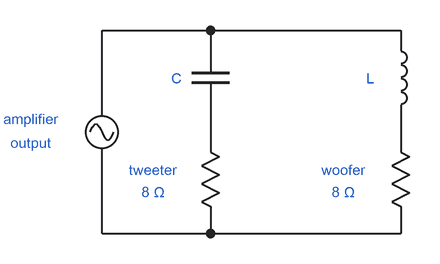
(a) Find the values of and .
(b) Find the reactances of the capacitor and of the inductor at , a bass note.
(c) For the same amplifier voltage, by what factor is the tweeter current at smaller than at ? Explain why the bass notes go mainly to the woofer.
- 81 mark
Question 8
Competency: Analysis & Evaluation
The output of a rectifier in an amplifier's power supply is a steady (DC) voltage with a small ripple on top of it, which causes a hum. The designer connects an iron-cored choke of large inductance and small resistance in series with the load. The steady current still flows almost unchanged, but the ripple current, and the hum, become much smaller.
Assertion (A): A choke of large inductance in series with a load lets the steady current through almost unchanged but greatly reduces the ripple current.
Reason (R): The reactance of an inductor, , is zero for a steady current and large at higher frequencies.
- 94 marks
Question 9
Competency: Application
A single-phase motor needs two winding currents that are apart in phase in order to start by itself. Both windings are connected across the , supply, as shown. The main winding has resistance and inductive reactance . The start winding has resistance and inductive reactance , and a capacitor is connected in series with it. (Hypothetical data.)
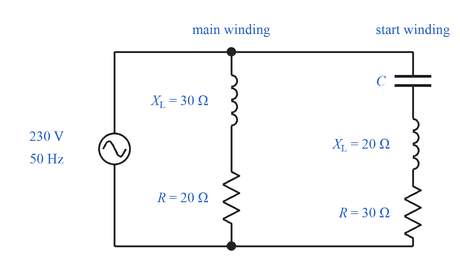
(a) Find the current in the main winding and its phase angle with respect to the supply voltage (lead or lag).
(b) By what angle, and in which sense, must the start-winding current be out of phase with the supply voltage?
(c) Find the reactance needed, and hence the capacitance .
(d) Find the current in the start winding.
- 101 mark
Question 10
Competency: Application
In a three-phase supply, each of the three live wires has a voltage of (r.m.s.) with respect to the neutral wire, and the three voltages are apart in phase. An electrician connects an AC voltmeter between two of the live wires. It reads about
- 111 mark
Question 11
Competency: Analysis & Evaluation
In a laboratory, a series circuit is connected to an AC source. Three AC voltmeters across , and read , and , but a fourth voltmeter across the source reads only .
Assertion (A): In general, the readings of AC voltmeters across , and in a series circuit do not add up to the reading across the source.
Reason (R): At every instant, the sum of the instantaneous voltages across , and equals the instantaneous voltage of the source.
- 123 marks
Question 12
Competency: Application
A cheap LED night lamp runs straight off the , mains. Instead of a bulky transformer it uses a capacitor in series with the LED unit to limit the current to (r.m.s.). Treat the LED unit as a pure resistance of . (Hypothetical data.)
(a) Find the impedance the circuit must have, and the reactance of the capacitor.
(b) Find the capacitance needed.
(c) A student suggests using a resistor in place of the capacitor. Find the resistance needed and the power it would waste, and state the power wasted in the capacitor.
- 131 mark
Question 13
Competency: Application
The treble-cut control of an amplifier is a resistor of in series with a capacitor; the output is taken across the capacitor. The output voltage falls to of the input voltage at the frequency where . This frequency is about
- 143 marks
Question 14
Competency: Analysis & Evaluation
A contactless library tag contains a flat coil of inductance and a capacitor, forming a resonant circuit tuned to the reader's frequency of . The tag's circuit has a quality factor , and it picks up enough energy only when the reader's frequency lies inside its half-power band, of total width , centred on its own resonant frequency . (Hypothetical data.)
(a) Find the capacitance of the tag's capacitor.
(b) The tag is stuck on a metal book-end. Eddy currents in the metal lower the effective inductance of its coil by . Find the new resonant frequency of the tag.
(c) Can the reader still power the tag? Support your answer with a calculation.
- 151 mark
Question 15
Competency: Analysis & Evaluation
The current drawn by machines in a factory contains, besides the part, smaller parts at whole-number multiples of (, , , …). The factory installs a capacitor bank, and the supply cable and transformer behave as an inductance of in series with it. (Hypothetical data.) Engineers warn that the bank and this inductance form a resonant circuit that can draw a dangerously large current at one of these frequencies. Which one?
- 161 mark
Question 16
Competency: Analysis & Evaluation
Two radio tuning circuits, 1 and 2, have the same coil and the same capacitor, but circuit 1 has a smaller resistance than circuit 2. Both pick up the same station, but circuit 1 separates it from neighbouring stations much better.
Assertion (A): Reducing the resistance of a series circuit makes its resonance sharper but does not change its resonant frequency.
Reason (R): The resonant frequency does not contain , while the quality factor increases as decreases.
- 174 marks
Question 17
Competency: Application
A water-pump motor connected to the , supply draws at a power factor of (current lagging). To reduce the current in the supply line, an electrician connects a capacitor in parallel with the motor. The motor's own current and power are not changed by this. (Hypothetical data.)
(a) Find the average power taken by the motor.
(b) The motor current can be split into a part in phase with the voltage and a part lagging it by . Find each part.
(c) The capacitor's current leads the voltage by . Find the capacitance that makes the overall power factor exactly .
(d) Find the current in the supply line after the capacitor is connected.
- 181 mark
Question 18
Competency: Application
The label on a compact fluorescent lamp reads: , , , . (Voltage and current are r.m.s. values.) The power factor of the lamp is about
- 193 marks
Question 19
Competency: Application
In a pulse circuit, a capacitor charged to is connected at across a coil of inductance whose resistance is very small. (Hypothetical data.)
(a) At what time is the capacitor first completely discharged?
(b) Find the largest current in the coil.
(c) Because of the small resistance, the peak voltage across the capacitor has fallen to after a few oscillations. What fraction of the original energy has been turned into heat by then?
- 201 mark
Question 20
Competency: Analysis & Evaluation
A teacher compares the oscillations of an circuit with those of a block on a spring: the charge plays the part of the displacement , and the current plays the part of the velocity.
Assertion (A): In this comparison, the capacitance plays the role of the mass of the block.
Reason (R): An inductor opposes any change in the current through it, just as mass opposes any change in velocity.
- 213 marks
Question 21
Competency: Application
The current in a power-station busbar is too large to pass through an ammeter, so it is measured with a current transformer: the busbar passes once through an iron ring, acting as a primary of turn, and turns wound on the ring form the secondary, which is connected to an ammeter of resistance and range –. Treat the transformer as ideal. (Hypothetical data.)
(a) What does the ammeter read when the busbar carries ?
(b) What is the largest busbar current this arrangement can measure?
(c) For a busbar current of , find the power used in the ammeter and the voltage across the -turn primary.
- 221 mark
Question 22
Competency: Analysis & Evaluation
A transformer steps the mains down to for a garden lamp. On opening it, a student finds that one winding is made of much thicker wire than the other. Which winding is thicker, and why?
- 231 mark
Question 23
Competency: Analysis & Evaluation
An old-style mains adapter containing an iron-cored transformer is left plugged in with nothing connected to its output. An energy meter shows that it takes far less power than when its load is connected, although a small current still flows in its primary.
Assertion (A): A transformer with its secondary left open draws a small current but takes very little power from the mains.
Reason (R): The emf induced in the secondary of a transformer is proportional to the number of turns in the secondary.
- 244 marks
Question 24
Competency: Analysis & Evaluation
A bicycle dynamo is a small AC generator. Its r.m.s. emf is proportional to the frequency of its output: volt (with in hertz). Its winding has an inductance of and negligible resistance. It lights a headlamp rated , ; treat the lamp as a fixed resistance. (Hypothetical data.)
(a) Using the expression for the peak emf of a coil rotating in a magnetic field, explain why is proportional to .
(b) Find the lamp current at (slow riding) and at (fast riding).
(c) Show that, however fast the cyclist rides, the lamp current can never exceed its rated value.
- 251 mark
Question 25
Competency: Analysis & Evaluation
A student turns the coil of a model AC generator slowly by hand and watches a sensitive centre-zero meter connected to it.
Assertion (A): The emf of the generator is greatest at the instant the plane of the coil is parallel to the magnetic field.
Reason (R): At that instant the magnetic flux through the coil is greatest.
- 264 marks
Question 26
A resistor of , an ideal inductor of and a capacitor of are connected in series across a (r.m.s.), supply. (Hypothetical data.)
(i) Find the impedance of the circuit and the r.m.s. current.
(ii) Find the r.m.s. voltages across the resistor, the inductor and the capacitor.
(iii) The voltage across the capacitor is more than the supply voltage. Explain how this is possible, and verify that the three voltages combine to give .
(iv) Does the current lead or lag the supply voltage, and by how much?
- 274 marks
Question 27
A resistor and an ideal inductor are connected in series across a source of emf .
(i) Apply Kirchhoff's loop rule to write the differential equation for the current .
(ii) Show by substitution that is a solution, and obtain and in terms of , , and .
(iii) For , and , find and . (Hypothetical data.)
- 284 marks
Question 28
A lamp (pure resistance) and a coil are joined in series to a , supply, as shown. The ammeter reads , voltmeter (across the lamp) reads and (across the coil) reads . The coil has resistance and inductance .
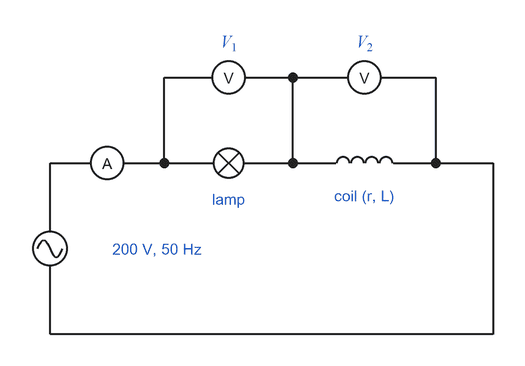
(a) Explain why is not equal to .
(b) Find the resistance of the lamp, and the resistance and inductance of the coil.
(c) Find the power factor of the whole circuit and the power taken from the supply.
(Hypothetical data.)
- 293 marks
Question 29
At a place the Earth's magnetic field has a horizontal component (towards geographic north) of and a vertical component of . A coil of turns and area is spun at about an axis through its centre in its own plane. Find the peak emf when the axis of rotation is
(a) vertical;
(b) horizontal, along the north–south line;
(c) horizontal, along the east–west line.
(Hypothetical data.)
- 303 marks
Question 30
A pure inductance of H is connected across a V, Hz source find (a) the reactance, (b) current and (c) peak value of current.
- 313 marks
Question 31
A capacitor of capacitance and a coil of resistance and inductance H are connected in series with a V– Hz source. Calculate the rms value of the current in the circuit.
- 323 marks
Question 32
A variable frequency V alternating voltage source is connected across a series combination of H, and . Calculate (a) the angular frequency of the source which drives the circuit in resonance, (b) the impedance of the circuit and (c) amplitude of the current at resonance.
- 333 marks
Question 33
A bulb of resistor , connected to an inductor of inductance , is in series with an AC source marked V, Hz. If the phase angle between the voltage and current is radian, calculate the value of .
- 343 marks
Question 34
A V variable frequency AC source is connected to a series combination of H, and . Calculate (a) angular frequency of the source to get maximum current in the circuit, (b) the current amplitude at resonance and (c) the power dissipation in the circuit.
- 354 marks
Question 35
A capacitor is connected to a Hz, V supply. (i) Write down the equation for the instantaneous voltage and current. (ii) Find the maximum energy stored in the capacitor.
- 363 marks
Question 36
A capacitor, H inductor and a resistor are connected in series with V, Hz source. Calculate the (i) impedance, (ii) current and (iii) power dissipated in the circuit.
- 374 marks
Question 37
A choke coil is needed to operate an arc lamp at V (r.m.s.) and Hz. The arc lamp has an effective resistance of when running at A (r.m.s.). Calculate the inductance of the choke coil. If the same arc lamp is to be operated on V (DC), what additional resistance is required? Compare the power losses in both the cases.
- 383 marks
Question 38
A H inductor and a resistor are connected in series to a V, Hz AC source. Calculate the current in the circuit and the phase angle between the current and the source voltage.
- 394 marks
Question 39
Show that in an series circuit, the source frequencies and at which the current amplitude falls to of the current at resonance are separated by an interval equal to .
- 404 marks
Question 40
An circuit has mH, and connected in series to a source of volt. Calculate the current amplitude and the average power dissipated per cycle at a frequency that is lower than the resonant frequency.
- 414 marks
Question 41
Two impedances and when connected separately across a V, Hz supply consumed W and W at power factors of lagging and leading respectively. If these impedances are now connected in series across the same supply, find (i) the total power absorbed and the overall power factor and (ii) the value of the impedance to be added in series so as to raise the overall power factor to unity.
- 423 marks
Question 42
A generator produces a current of r.m.s value A at V. The voltage is stepped up to V by an ideal transformer and transmitted a long distance through a power line of total resistance . Find the percent of power lost due to the stepping up of the voltage.
- 433 marks
Question 43
A current of A flows in a coil when it is connected to a V DC source. When the same coil is connected to an AC source ( V, Hz), a current of A flows in the coil. Calculate the coefficient of self-inductance of the coil.
- 443 marks
Question 44
A capacitor, H inductor and a resistor are connected in series to an AC source whose emf is given by where is in volt and is in second. Calculate
(i) the impedance of the circuit
(ii) the peak value of current in the circuit
- 453 marks
Question 45
An alternating emf of frequency Hz is applied to a circuit with a resistor of , an inductor of mH and a capacitor of connected in series.
(i) What is the angle by which the current leads or lags the applied emf?
(ii) Represent the voltage and the current in a vector diagram showing the phase angle.