
Opening your dashboard
Class 12 Maths Chapter 6 Adjoint and Inverse of a Matrix: Competency-Based Questions (CBQ)
40 questions on Chapter 6, each worked through on its own page with the AI tutor. Class 12 Maths, ICSE 2026-27.
40 questions
1–10 marks · Mixed difficulty
- 14 marks
Question 1
Competency: Application
A school canteen sells three lunch combos made from samosas, sandwiches and glasses of juice. (Hypothetical data.)
- Combo P: 2 samosas, 1 sandwich and 1 juice for Rs 90
- Combo Q: 1 samosa, 2 sandwiches and 1 juice for Rs 110
- Combo R: 1 samosa, 1 sandwich and 2 juices for Rs 100
Let one samosa, one sandwich and one juice cost Rs , Rs and Rs , and assume each combo costs the same as its items bought separately.
(a) Write the information as a matrix equation and find .
(b) Find .
(c) Find the price of each item, and the bill for a class order of 3 samosas, 2 sandwiches and 2 juices.
- 24 marks
Question 2
Competency: Application
Three sponsors fund a school's annual prizes. Each Academics prize carries Rs , each Sports prize Rs and each Arts prize Rs . Every year Sponsor 1 pays for 2 Academics, 1 Sports and 1 Arts prize; Sponsor 2 pays for 1 Academics and 3 Sports prizes; Sponsor 3 pays for 1 Sports and 2 Arts prizes. (Hypothetical data.)
In 2025 the three sponsors paid Rs 3,250, Rs 2,500 and Rs 2,000. In 2026 they paid Rs 3,700, Rs 3,200 and Rs 2,300. The prize values were revised in 2026, but the number of prizes each sponsor funds did not change.
(a) Write the coefficient matrix and find and .
(b) Using , find the value of each prize in 2025.
(c) Using the same , find the value of each prize in 2026, and state which prize had the largest percentage increase.
- 34 marks
Question 3
Competency: Application
A hostel dietician mixes three foods , and for a breakfast bowl. The table gives the nutrients (in grams) in one unit of each food. (Hypothetical data.)
Nutrient Protein 4 2 1 Carbohydrate 2 5 3 Fat 1 1 4 The bowl must contain exactly 15 g of protein, 22 g of carbohydrate and 9 g of fat. Let , , be the units of , , used.
(a) Write the conditions as a matrix equation .
(b) Find and explain why the dietician gets exactly one mixture.
(c) Using the matrix method, find the number of units of each food.
- 44 marks
Question 4
Competency: Application
A school's coding club sends secret words. Each letter is replaced by its position in the alphabet (, , …, ), the numbers are taken in pairs as columns , and each pair is multiplied by the key matrix
The club receives the coded numbers . (Hypothetical data.)
(a) Show that is invertible.
(b) Find .
(c) Decode the word received.
- 54 marks
Question 5
Competency: Application
A teachers' welfare fund invests Rs 1,00,000 in three schemes paying simple interest of 6%, 8% and 9% per annum. The total interest for one year is Rs 7,700. The amount in the 8% scheme is Rs 20,000 less than the amounts in the other two schemes put together. (Hypothetical data.)
Let the amounts in the 6%, 8% and 9% schemes be Rs thousand, Rs thousand and Rs thousand.
(a) Write the three conditions as equations and in the form .
(b) Find and .
(c) Find the amount invested in each scheme.
- 64 marks
Question 6
Competency: Application
In a computer-graphics lab, a colour filter changes the colour code of a pixel into , where
To undo the filter, the students must find using elementary row operations only. (Hypothetical data.)
(a) Starting from , apply and , and write the resulting equation.
(b) Continue with row operations to find .
(c) After filtering, a pixel has code . Find its original code.
- 73 marks
Question 7
Competency: Analysis & Evaluation
A teacher's answer card shows a matrix and its adjoint, but two entries of the adjoint, marked and , have been smudged:
(a) Using only the first row of and the first column of , find .
(b) Find and by identifying which cofactors they are.
(c) Write .
- 83 marks
Question 8
Competency: Application
In a mobile game, a sprite at position is first moved by the matrix and then by , so it ends at . After both moves the sprite is at . (Hypothetical data.)
(a) Find without multiplying the matrices, and say why the move can be undone.
(b) Find as a product of and .
(c) Find the starting position .
- 93 marks
Question 9
Competency: Analysis & Evaluation
The eco-club treasurer recorded three purchases of badges, caps and T-shirts, each item at a fixed price of Rs , Rs and Rs . (Hypothetical data.)
- Purchase 1: 2 badges, 1 cap, 1 T-shirt for Rs 500
- Purchase 2: 1 badge, 2 caps, 3 T-shirts for Rs 900
- Purchase 3: 3 badges, 3 caps, 4 T-shirts for Rs 1,500
(a) Write the records as and find .
(b) Find and decide whether the records are consistent.
(c) The treasurer suspects one total in Purchase 3 was mistyped. What total would make the records consistent, and could the three prices then be found uniquely?
- 103 marks
Question 10
Competency: Application
Meera's calculator app can add and multiply matrices but has no inverse key. She needs the inverse of
(a) Show that .
(b) Use this result to express in terms of and .
(c) Find and check it with the adjoint method.
- 111 mark
Question 11
Competency: Analysis & Evaluation
A student checks a shortcut for the adjoint of a matrix on .
Assertion (A): .
Reason (R): For a matrix, the adjoint is obtained by interchanging the two diagonal entries and changing the signs of the other two entries.
- 121 mark
Question 12
Competency: Analysis & Evaluation
A matrix used in a survey model has . (Hypothetical data.)
Assertion (A): .
Reason (R): For a square matrix of order , .
- 131 mark
Question 13
Competency: Analysis & Evaluation
A message is scrambled first by an invertible matrix and then by an invertible matrix of the same order, so the scrambled message is . Two students discuss how inverses of products behave.
Assertion (A): For all invertible matrices and of the same order, .
Reason (R): For invertible matrices and of the same order, .
- 141 mark
Question 14
Competency: Analysis & Evaluation
A light panel has a 'toggle' matrix : applying it twice brings every setting back to the start, so .
Assertion (A): If is a square matrix with , then is invertible and .
Reason (R): If is a square matrix with , then .
- 151 mark
Question 15
Competency: Analysis & Evaluation
Kabir tries to find the inverse of by elementary row operations on . After , the left side becomes .
Assertion (A): Kabir cannot reach the identity matrix on the left, so the inverse of cannot be found by row operations.
Reason (R): , so is singular and has no inverse.
- 161 mark
Question 16
Competency: Analysis & Evaluation
To find the inverse of by row operations, Riya writes and starts with because the first entry is 0.
Assertion (A): The interchange must be applied both to on the left side and to the prefactor on the right side.
Reason (R): Interchanging two rows of a determinant changes its sign.
- 171 mark
Question 17
Competency: Analysis & Evaluation
A shopkeeper's two records of the same items give the equations and . (Hypothetical data.)
Assertion (A): The system has no solution.
Reason (R): If , then the system has no solution.
- 181 mark
Question 18
Competency: Analysis & Evaluation
A quiz card asks for every set of numbers , , that satisfies all three equations , and .
Assertion (A): The only solution of this system is .
Reason (R): is a solution of every homogeneous system .
- 191 mark
Question 19
Competency: Application
For the school play, adult tickets cost Rs 80 and student tickets Rs 50. In all 300 tickets were sold for Rs 21,000. With adult and student tickets, the organiser solves by the matrix method. (Hypothetical data.)
How many tickets of each kind were sold?
- 201 mark
Question 20
Competency: Application
A spy club codes letter pairs with the key (coded pair original pair). Which matrix must the receiver multiply the coded pairs by to recover the message?
- 211 mark
Question 21
Competency: Analysis & Evaluation
A settings matrix of a machine has . (Hypothetical data.) When the machine runs at double speed its matrix becomes . What is ?
- 221 mark
Question 22
Competency: Analysis & Evaluation
While finding for a matrix by elementary operations, Arjun starts from and lists his steps:
- Step 1: , applied to on the left and to on the right
- Step 2: , applied to both sides in the same way
- Step 3: , applied to on the left and to the prefactor on the right
- Step 4: , applied to both sides in the same way
Which step is not allowed?
- 231 mark
Question 23
Competency: Application
A coding club tests key matrices of the form . A key is useless if it has no inverse. For which values of is the key useless?
- 241 mark
Question 24
Competency: Analysis & Evaluation
A shop's price matrix (in rupees) is invertible, and its inverse is already known. The billing software now stores prices in paise, so it uses . Which is ?
- 251 mark
Question 25
Competency: Application
To find the inverse of , Sana writes , applies and then , getting on the left. Which matrix is now on the right in front of ?
- 263 marks
Question 26
Match correctly statements given in column I with those given in column II.
Column I
1. For what value of , the matrix has no inverse?
2. If and , then ________.
3. If is a non-singular matrix such that , then find .
4. Find the matrix for which .
5. If , then ________.
Column II
(a)
(b)
(c)
(d)
(e)
- 274 marks
Question 27
Gautam buys 5 pens, 3 bags and 1 instrument box and pays a sum of ₹ 160. From the same shop, Vikram buys 2 pens, 1 bag and 3 instrument boxes and pays a sum of ₹ 190. Also, Ankur buys 1 pen, 2 bags and 4 instrument boxes and pays a sum of ₹ 250.
(i) Convert the given situation into a matrix equation of the form .
(ii) Find .
(iii) Find .
- 286 marks
Question 28
A furniture factory uses three types of wood namely, teakwood, rosewood and satinwood for manufacturing three types of furniture that are table, chair and cot. The wood requirements (in tonnes) for each type of furniture are given below:
Table Chair Cot Teakwood 2 3 4 Rosewood 1 1 2 Satinwood 3 2 1 It is found that 29 tonnes of teakwood, 13 tonnes of rosewood and 16 tonnes of satinwood are available to make all three types of furniture.
Using the above information, answer the following questions:
(i) Express the data given in the table above in the form of a set of simultaneous equations.
(ii) Express the set of equations in (i) in the form .
(iii) Find .
(iv) Find the number of table(s), chair(s) and cot(s) produced.
- 299 marks
Question 29
Abdul threw a basketball in the direction of the basketball hoop which traversed a parabolic path in a vertical plane. (In the picture, the ball leaves Abdul's hands and rises along the parabola towards the hoop; the hoop stands at a horizontal distance of 70 feet from Abdul, with the top of its rim 10 feet above the floor.)
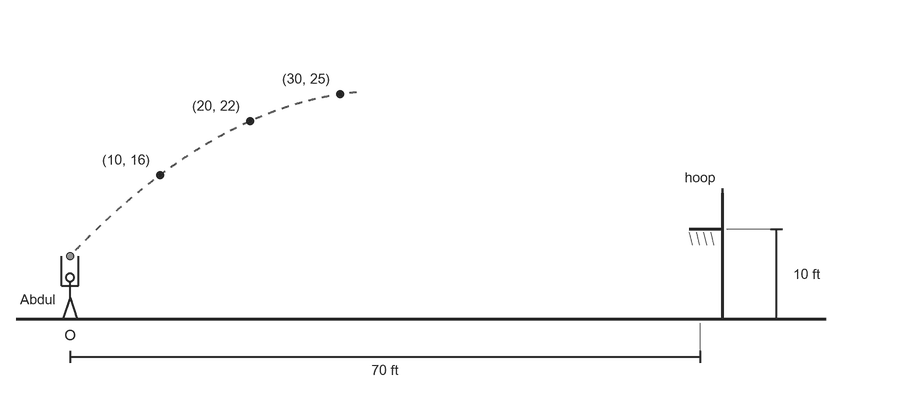
The equation of the path traversed by the ball is with respect to a -coordinate system in the vertical plane. The ball traversed through the points , and . The basketball hoop is at a horizontal distance of 70 feet from Abdul. The height of the basketball hoop is 10 feet from the floor to the top edge of the rim.
(i) Express the given information in the form of a set of simultaneous equation.
(ii) Write the above system of equations in the form .
(iii) Find .
(iv) Find .
(v) Find .
(vi) Write the value of .
(vii) Find the equation of the path traversed by the ball.
(viii) Did the ball successfully go through the hoop? Justify your answer.
- 306 marks
Question 30
The following tables give information about the number of boys and girls in three schools , and in the years 2023 and 2024.
School A Class 11 Class 12 Boys 70 65 Girls 68 72 School B Class 11 Class 12 Boys 45 50 Girls 40 60 School C Class 11 Class 12 Boys 80 74 Girls 75 82 The matrices below show the data given in the tables above in matrix form.
, ,
Based on the given information, answer the following questions:
(i) Find .
(A) (B) (C) (D)
(ii) Find .
(A) (B) (C) (D)
(iii) Find .
(A) (B) (C) (D)
(iv) Find .
(A) (B) (C) (D)
(v) Find .
(A) (B) (C) (D)
(vi) Find .
(A) (B) (C) (D)
- 3110 marks
Question 31
Two Schools P and Q want to award their selected students on the values of discipline, politeness and punctuality. The School P wants to award ₹ each, ₹ each and ₹ each for the three respective values to its 3, 2 and 1 students with a total amount of ₹ 1000. School Q wants to spend ₹ 1500 to award its 4, 1 and 3 students on the respective values (by giving the same award money for the three values as before). If the total amount of awards for one prize on each value is ₹ 600, using matrices, find the award money for each value.
Based on the above information, answer the following questions:
Part A
(i) Write the system of equations related to the above problem.
(ii) Which of the following matrices represents equation for the problem? (Type: )
(A) (B)
(C) (D)
(iii)
(A) (B) (C) (D)
(iv)
(A) (B) (C) (D)
(v) Which statement is true for matrix ?
(A) has an inverse because . (B) has an inverse because . (C) is not defined because . (D) has an inverse because .
Part B
(i)
(A) (B) (C) (D)
Recall that , where is a cofactor of .
(ii) Which of the following is true for the matrix in this problem?
(A) (B) (C) (D)
where is the identity matrix of order . Verify your answer.
(iii) Which matrix is the inverse of the coefficient matrix in the problem?
(A) (B) (C) (D)
(iv) The system of equations of the given problem
(A) is inconsistent (B) has infinitely many solutions (C) is consistent (D) None of these
(v) The award money for each value is
(A) ₹ 200, ₹ 100, ₹ 300 (B) ₹ 300, ₹ 200, ₹ 100 (C) ₹ 100, ₹ 200, ₹ 300 (D) ₹ 100, ₹ 300, ₹ 100
- 321 mark
Question 32
Competency: Analysis
A stationery shop sells a notebook at Rs and a pen at Rs . Customer 1 buys 3 notebooks and 2 pens, and Customer 2 buys 4 notebooks and 3 pens. Their bills are Rs 150 and Rs 205. (Hypothetical data.)
The clerk writes the prices as the row matrix , puts each customer's basket in one column of , and writes the bills as the row matrix , so that .
Which expression gives the price matrix ?
- 331 mark
Question 33
Competency: Analysis & Evaluation
A school orders stationery for its three wings every term. Its order matrix (one row for each wing, one column for each item) is a matrix with . Two suppliers send rate matrices and of order (one row for each item, one column for each cost head), and the school finds that the cost matrices and are exactly equal. (Hypothetical data.)
Assertion (A): , that is, the two suppliers have quoted exactly the same rates.
Reason (R): If is a non-singular matrix and , then pre-multiplying both sides by gives .
- 341 mark
Question 34
Competency: Analysis & Evaluation
A photo-editing app stretches a photo. Each point of the photo moves to , where , so widths are doubled and heights become five times as large. The "undo" button must apply .
Assertion (A): .
Reason (R): Every diagonal matrix is invertible, and its inverse is obtained by taking the reciprocal of each diagonal entry.
- 351 mark
Question 35
Competency: Analysis & Evaluation
A dhaba sells three thalis. Each thali is made of 5 portions of rotis, dal and sabzi, as shown in the table, and its price is the sum of the prices of its portions. (Hypothetical data.)
Thali Rotis Dal (bowls) Sabzi (bowls) Thali 1 3 1 1 Thali 2 1 2 2 Thali 3 1 1 3 So the portion prices satisfy , where is the matrix of the table, with , and lists the thali prices. Next month the owner raises the price of every thali by Rs 10, with the same portions. If each thali price is still the sum of its new portion prices, what happens to the portion prices?
- 362 marks
Question 36
Competency: Creativity & Evaluation
A warehouse robot moves on a floor marked with a grid of points that have integer co-ordinates. A move command is a matrix with integer entries that sends the point to . The "undo" command uses , and it must also send every grid point to a grid point, so must have integer entries.
(a) Design a command matrix , with all four entries non-zero integers, whose inverse has integer entries. Find .
(b) Using , explain why your design works, and why the matrix cannot be used.
- 372 marks
Question 37
Competency: Analysis & Evaluation
A florist sells roses, lilies and orchids at Rs , Rs and Rs per stem. (Hypothetical data.)
- Bouquet 1: 1 rose, 2 lilies and 2 orchids for Rs 180
- Bouquet 2: 2 roses, 1 lily and 1 orchid for Rs 120
- Bouquet 3: 1 rose, 1 lily and 3 orchids for Rs 200
Aman writes this as . He computes correctly as and announces Rs , Rs and Rs as the prices.
(a) Find .
(b) Explain Aman's mistake, and find the correct price of each flower.
- 383 marks
Question 38
Competency: Application
Two singers record a duet in a small studio, each with a microphone. Because they stand close together, each microphone picks up 80% of its own singer's sound level and 20% of the other singer's. In a simple model, if the singers' true levels are and (in arbitrary units), the recorded levels are
where and . (Hypothetical data.)
(a) Find using elementary row operations only.
(b) Hence write .
(c) The recorded levels are and . Find the true levels of the two singers.
- 393 marks
Question 39
Competency: Analysis & Evaluation
Around a triangular block in a town, three one-way roads run from junction P to Q, from Q to R and from R to P. They carry , and vehicles per hour. Other roads bring vehicles into each junction and take vehicles away, as shown in the table. At each junction, the number of vehicles going in equals the number coming out. (Hypothetical data.)
Junction Vehicles entering from other roads (per hour) Vehicles leaving by other roads (per hour) P 300 200 Q 150 250 R 200 200 (a) Write the three junction balances as , and show that and .
(b) Show that the junction counts alone cannot fix , and , by finding every solution in terms of .
(c) A camera on road RP records 180 vehicles per hour. Find and .
- 405 marks
Question 40
Competency: Application & Analysis
A district's economy is studied with two sectors, Agriculture (Ag) and Manufacturing (Mf). Each sector uses part of its own output and part of the other sector's output as input. For example, farms buy tools and fertiliser, and mills buy cotton and sugarcane. The table gives the input, in rupees, needed from each sector to produce Rs 1 of output. (Hypothetical data.)
Input from Per Rs 1 of Ag output Per Rs 1 of Mf output Ag 0.2 0.4 Mf 0.3 0.1 Let be the matrix of this table, the total outputs of Ag and Mf, and the outside demand, both in Rs crore. In this input–output model the outputs must satisfy , that is, .
(a) Write and show that it is non-singular.
(b) Find .
(c) The outside demand is Rs 60 crore for Ag and Rs 30 crore for Mf. Find the total output of each sector. If the demand for Ag then rises by Rs 12 crore, find the new outputs, and decide whether a manufacturing capacity of Rs 75 crore is enough.