
Opening your dashboard
Class 12 Maths Chapter 21 Three-Dimensional Geometry - 2: Straight Line in Space: Competency-Based Questions (CBQ)
40 questions on Chapter 21, each worked through on its own page with the AI tutor. Class 12 Maths, ICSE 2026-27.
40 questions
1–5 marks · Mixed difficulty
- 13 marks
Question 1
Competency: Application
A new railway line in hilly country is laid on a uniform gradient between two stations. Station is taken as the origin, the -axis points east, the -axis north and the -axis vertically up (in metres). Station is at . Treat the centre line of the track as a straight line. (Hypothetical data.)
(a) Find the Cartesian equations of the centre line in their simplest form.
(b) A signal post is to stand on the centre line at the point where . Find the coordinates of this point.
(c) A surveyor's peg is fixed at . Does it lie on the centre line? If not, how far above or below the line is it at the same and ?
- 21 mark
Question 2
Competency: Application
A delivery drone takes off from a rooftop pad and flies in a straight line to a balcony drop point . Coordinates are in metres, with the -axis vertically up and the ground as . (Hypothetical data.)
A ground marshal wants to stand directly below the drone at the moment its height is 30 m. The marshal should stand at
- 31 mark
Question 3
Competency: Analysis & Evaluation
The program of a CNC drilling machine moves the drill bit along the straight path
with coordinates in centimetres. (Hypothetical data.)
Assertion (A): The direction cosines of the drill's path are (or their negatives).
Reason (R): Whatever the form of the equations, the direction ratios of a line are the numbers in the denominators, here .
- 43 marks
Question 4
Competency: Application
In a warehouse, an inclined conveyor belt carries parcels in a straight line from the loading point to the upper delivery point . Coordinates are in metres with the -axis vertically up. (Hypothetical data.)
(a) Write a vector equation of the belt's line and state the values of the parameter that give the belt itself (from to ).
(b) A barcode scanner is to be fixed over the belt at the point where the belt is 2.5 m high. Find this point and its distance from measured along the belt.
(c) A second, identical belt is to be installed parallel to the first, with its loading point at . Write a vector equation of the new belt's line and find its upper end.
- 51 mark
Question 5
Competency: Application
A radio mast stands on level ground along the -axis. A straight guy wire runs from the point on the mast to a ground anchor , in metres. (Hypothetical data.)
Which of these is a vector equation of the line of the guy wire?
- 61 mark
Question 6
Competency: Analysis & Evaluation
Two engineers write the equation of the same overhead gantry-crane rail in a factory (in metres). Engineer 1 writes and Engineer 2 writes . (Hypothetical data.)
Assertion (A): Both equations describe the same rail.
Reason (R): The direction vectors and are parallel.
- 74 marks
Question 7
Competency: Application
An inclined mine shaft runs in a straight line from its entrance at the surface down to the bottom station , in metres (-axis vertically up). A refuge chamber is at . Engineers will cut the shortest possible straight gallery from to the shaft. (Hypothetical data.)

(a) Find the Cartesian equations of the shaft.
(b) Find the point where the gallery meets the shaft.
(c) Find the length of the gallery, and show that lies between and . How far along the shaft from is ?
- 81 mark
Question 8
Competency: Application
In a stadium, a spectator's eye is at and the centre spot of the pitch is at , in metres. A camera hangs at . The broadcaster wants to know how close the camera comes to the spectator's line of sight . (Hypothetical data.)
The perpendicular distance of the camera from the line is
- 93 marks
Question 9
Competency: Application
A delivery drone leaves its hub , flies straight to the waypoint , turns, and flies straight to the customer's rooftop pad . Coordinates are in metres with the -axis vertically up from the ground. (Hypothetical data.)
(a) Write vector equations of the lines of the two legs and .
(b) Find the angle between the two legs.
(c) A tree stands vertically at the ground point , and its top is 26 m high. Will the drone clear the tree on the second leg? Give a reason.
- 101 mark
Question 10
Competency: Analysis & Evaluation
Two aircraft fly level along straight tracks at different heights. Track 1 has direction and track 2 has direction , where points east and north. (Hypothetical data.)
Assertion (A): The angle between the two flight tracks is .
Reason (R): The angle between two lines with direction vectors and is given by .
- 111 mark
Question 11
Competency: Application
Two straight stay cables of a cable-stayed bridge leave the top of a pylon at , on opposite sides, and are anchored to the deck. In metres, their lines are
(Hypothetical data.) The angle between the two cables is
- 124 marks
Question 12
Competency: Application
In a school atrium, a staircase handrail runs straight from to and a ramp handrail runs straight from to , in metres (-axis vertically up). (Hypothetical data.)
(a) Find the angle between the two handrails.
(b) A support rod with direction ratios is to be perpendicular to the staircase handrail. Find .
(c) A bracket bar through the top of the staircase handrail, , must be perpendicular to both handrails. Find its Cartesian equations.
- 131 mark
Question 13
Competency: Analysis & Evaluation
Two straight struts of a solar-panel stand lie along the lines
(Hypothetical data.)
Assertion (A): The two struts are perpendicular to each other.
Reason (R): Lines with direction ratios and are perpendicular if and only if .
- 143 marks
Question 14
Competency: Application
A road tunnel is bored through a hill by two crews starting at the two portals, with a planned bend where the drives meet. The west portal is the origin and the east portal is , in metres (-axis up). The west crew bores along and the east crew along . (Hypothetical data.)
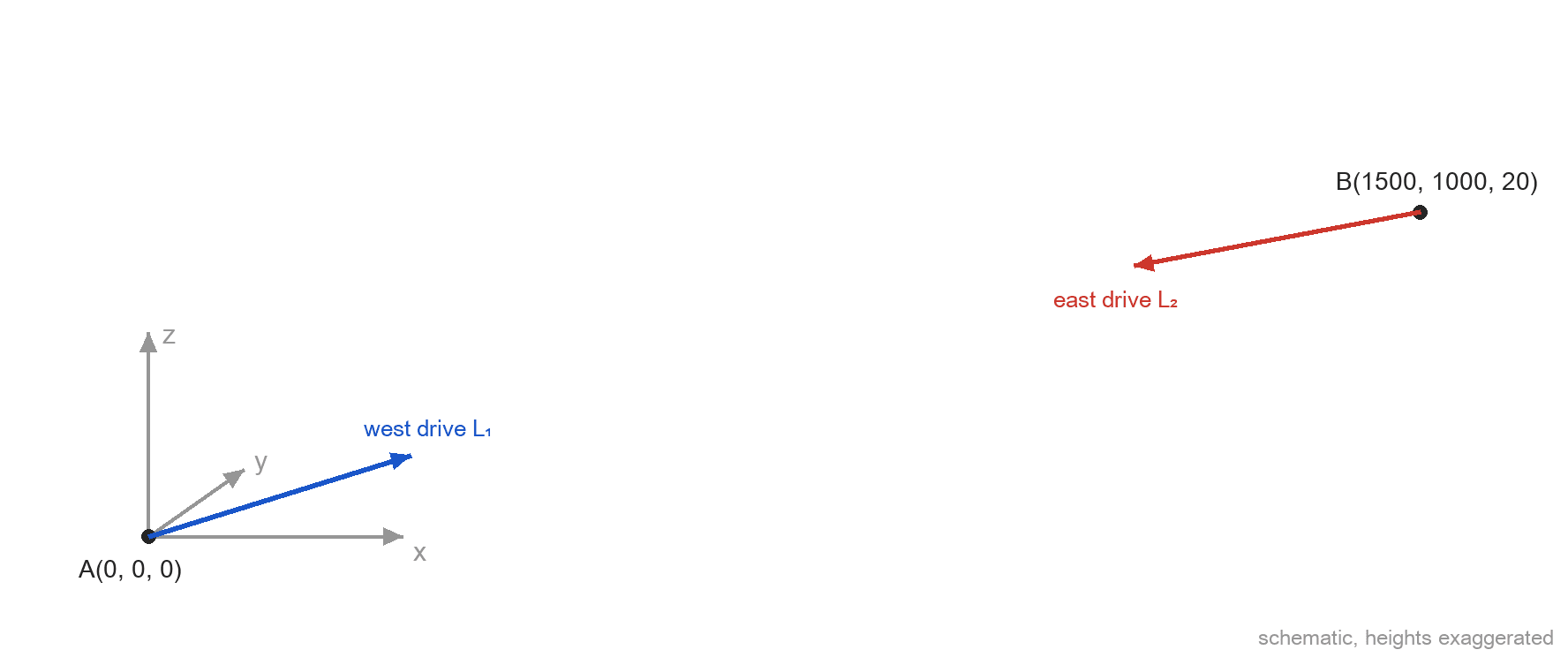
(a) Show that the two drives meet.
(b) Find the point where they meet.
(c) Find the length bored by each crew, to the nearest metre, and the total length of the tunnel.
- 151 mark
Question 15
Competency: Application
Two surveyors at and sight the summit of a hill. Their straight lines of sight are
in metres, and the summit is the point where they meet. (Hypothetical data.)
The coordinates of the summit are
- 161 mark
Question 16
Competency: Analysis & Evaluation
The centre line of a road on level ground is and the centre line of a sloping flyover deck is , in metres with vertically up. On a ground map the two centre lines cross at . (Hypothetical data.)
Assertion (A): The road and the flyover centre lines intersect, because their ground plans cross at .
Reason (R): Two non-parallel lines in space intersect if and only if the shortest distance between them is zero.
- 173 marks
Question 17
Competency: Analysis & Evaluation
In a tunnel, two blast holes are drilled into the rock face to form a V-shaped cut. The holes start at and and are drilled along the directions and respectively, in metres. Each hole is drilled to a length of 2.6 m. (Hypothetical data.)
(a) Using the condition for coplanar lines, show that the lines of the two holes are coplanar.
(b) Find the point where the lines of the holes meet, and its distance from each starting point.
(c) Do the two drilled holes actually meet? Find the distance between the ends of the holes.
- 181 mark
Question 18
Competency: Analysis & Evaluation
Two straight members of a roof truss lie along the lines
in metres. (Hypothetical data.)
Assertion (A): The two members meet at the point .
Reason (R): The direction ratios and are not proportional, so the lines are not parallel.
- 194 marks
Question 19
Competency: Analysis & Evaluation
An air-traffic planner models two flight paths as straight lines, in kilometres, with the -axis vertically up. A climbing aircraft follows and a cruising aircraft follows . A planning rule requires any two flight paths in this sector to be at least 2 km apart. (Hypothetical data.)
(a) Show that the two paths are neither parallel nor intersecting.
(b) Find the shortest distance between the paths.
(c) Find the points of the two paths that are closest to each other, and state whether the planning rule is met.
- 201 mark
Question 20
Competency: Analysis & Evaluation
In an airport baggage hall, two straight baggage conveyors cross at different levels. Their centre lines are and , in metres. (Hypothetical data.)
Assertion (A): No point of the first centre line is closer than 4 m to any point of the second centre line.
Reason (R): The shortest distance between two skew lines is the least of all the distances between a point of one line and a point of the other.
- 214 marks
Question 21
Competency: Analysis & Evaluation
A high-voltage line runs between the tops of two pylons at and . A new telecom cable is to run between the tops of two poles at and . All coordinates are in metres with the -axis vertically up, and each cable is treated as a taut straight segment. The safety rule requires at least 10 m between the two cables. (Hypothetical data.)
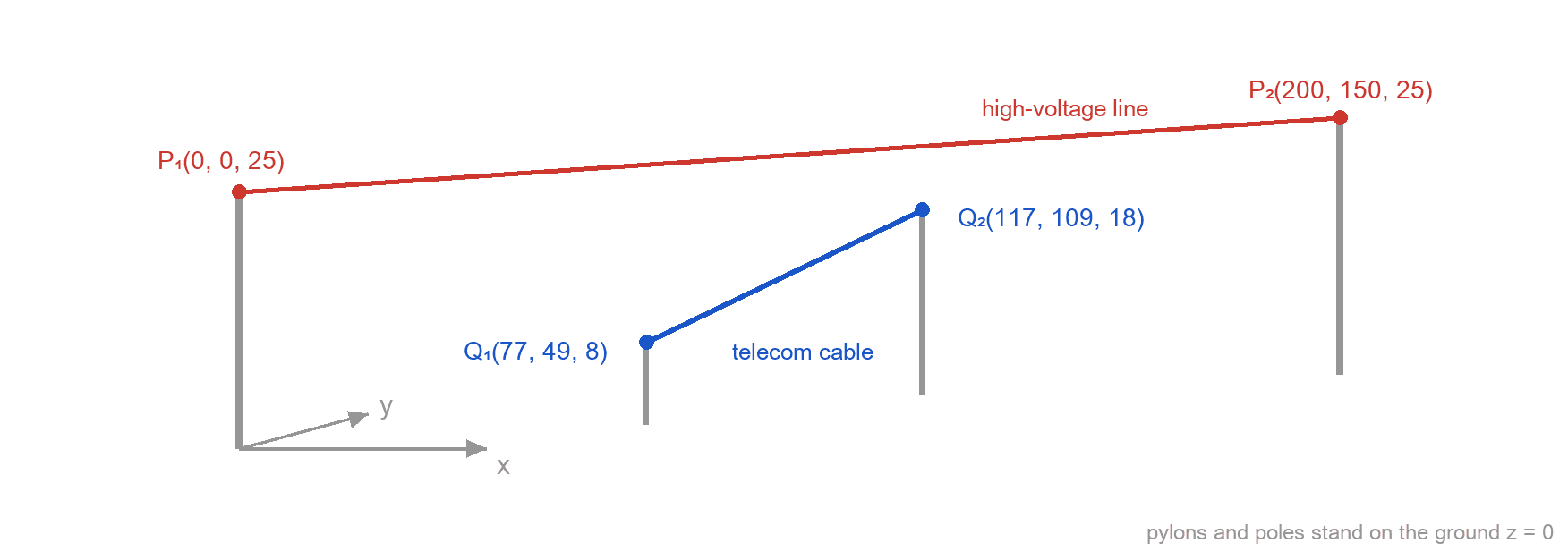
(a) Write vector equations of the lines and .
(b) Find the shortest distance between these two lines.
(c) Find the points of the two lines nearest to each other. Show that they lie within the two spans, and decide whether the safety rule is met.
- 221 mark
Question 22
Competency: Application
For a ground investigation, two straight inclined boreholes are drilled from rigs at and on level ground, along the directions and respectively ( vertically up, lengths in metres). The engineers must know how close the lines of the two boreholes come. (Hypothetical data.)
The shortest distance between the lines of the boreholes is
- 231 mark
Question 23
Competency: Analysis & Evaluation
The centre lines of the two guideway beams of a twin-track monorail run along and , in metres. (Hypothetical data.)
Assertion (A): The distance between the two beam centre lines is 5 m.
Reason (R): The distance between any two lines and is .
- 243 marks
Question 24
Competency: Application
A straight road on level ground has centre line . A metro viaduct runs beside it with centre line , in metres with vertically up. A metro station platform is centred at the point of the viaduct. (Hypothetical data.)
(a) Show that the two centre lines are parallel and distinct.
(b) Find the distance between the two centre lines.
(c) A straight service cable is to join to the road centre line by the shortest route. Find the point where it meets the road centre line, and explain why the cable is longer than the 12 m height of the viaduct.
- 251 mark
Question 25
Competency: Application
The handrail of an inclined travelator (moving walkway) between two floors of an airport lies along the line
in metres. (Hypothetical data.) The maintenance software needs the line in vector form. Which equation is correct?
- 261 mark
Question 26
Competency: Application
In a park, a lamp post stands with its foot at the origin and its bulb at . A straight vertical marker pole stands with its foot at and its top at . The ground is the plane , the -axis points vertically up, and all lengths are in metres. (Hypothetical data.)
Light travels in straight lines, so at night the tip of the pole's shadow is the point where the line through the bulb and the top meets the ground. The tip of the shadow is at
- 271 mark
Question 27
Competency: Analysis
A funicular railway climbs a hillside on a straight track from the lower station to the upper station . The -axis points east, the -axis north and the -axis vertically up, with lengths in metres. (Hypothetical data.)
The angle that the track makes with the horizontal is
- 281 mark
Question 28
Competency: Application
A paraglider pilot launches from a hilltop. The origin is the point of the landing field directly below the launch point, the -axis points vertically up, and lengths are in metres. While the glider flies straight at a steady speed, the pilot's position seconds after launch is . The landing field is the plane . (Hypothetical data.)
When the pilot is 100 m above the field, the horizontal distance of the pilot from the origin is
- 291 mark
Question 29
Competency: Evaluation
A school is adding a straight access ramp that starts at a floor point taken as the origin. The building rule it follows says that a ramp may rise at most 1 m for every 12 m of horizontal run (a slope of at most ). The -axis points vertically up and lengths are in metres. (Hypothetical data.)
Four proposed centre lines for the ramp all pass through the origin and climb in the direction given in each option. Which one meets the rule?
- 301 mark
Question 30
Competency: Analysis & Evaluation
In a warehouse, the straight ceiling rail of an overhead hoist runs along , and a straight strip of safety tape on the floor, marking a forklift aisle, runs along . Lengths are in metres, points vertically up and the floor is the plane . (Hypothetical data.)
Assertion (A): The hoist rail is perpendicular to the tape line, even though the two lines never meet.
Reason (R): Two lines in space can be perpendicular only if they intersect.
- 311 mark
Question 31
Competency: Analysis & Evaluation
In a car factory, a robot turns a metal bracket through a half-turn () about the straight axis , with lengths in centimetres. A half-turn about a line moves every point to its image in that line. A corner of the bracket starts at . (Hypothetical data.)
Assertion (A): After the half-turn, the corner is at .
Reason (R): For a point not on a line , a point is the image of in if and only if the mid-point of lies on and is perpendicular to .
- 322 marks
Question 32
Competency: Creativity
In a shopping-mall atrium, a sloping steel beam lies along the line , in metres with the -axis vertically up. A straight decorative light cable is to start from an anchor on a wall. The designer wants the line of the cable neither to meet the line of the beam nor to run parallel to it. (Hypothetical data.)
Propose a direction for the cable, and show that the line of the cable and the line of the beam are skew. Also describe which directions the designer must avoid.
- 332 marks
Question 33
Competency: Application
On a theatre lighting truss, two spotlights at the point send straight beams along the directions and . Lengths are in metres and points vertically up. A third spotlight at must send its beam along the line that bisects the angle between the first two beams. (Hypothetical data.)
Find a vector equation of the line of the third beam, and check that it makes equal angles with the two beams.
- 342 marks
Question 34
Competency: Analysis & Evaluation
A diving boat holds a straight, taut guide rope that runs down from the point on the water surface along the direction . Lengths are in metres and points vertically up. A diver goes 6 m down the rope from . Riya writes the rope as and says: "Moving 6 m along the rope means , so the diver is at , which is 12 m below the surface." (Hypothetical data.)
Find the error in Riya's reasoning, and find the diver's true position and depth.
- 352 marks
Question 35
Competency: Understanding
The design file for a billboard frame gives the line of a straight steel brace as , in metres, with the ground as the plane and the -axis vertically up. A technician says the equation is meaningless because it divides by zero. (Hypothetical data.)
(a) Explain what the equation means, and write the line in vector form.
(b) Find the point of the brace that is 9 m above the ground.
- 363 marks
Question 36
Competency: Analysis
A tracking station has its antenna at the origin on the ground. A high-altitude research balloon drifts at a constant height of 10 km with constant velocity, and its position minutes after it is first logged is , in kilometres. The antenna can track the balloon only while the balloon is within 51 km of it. (Hypothetical data.)
Find the times at which the balloon enters and leaves the tracking range, and for how long the station can track it.
- 373 marks
Question 37
Competency: Analysis & Evaluation
A straight inclined conveyor in a cement plant rests on four trestles. A surveyor records the top centres of the trestles as shown below, in metres, with the -axis vertically up. The four points should lie on one straight line, but one trestle was built wrongly. (Hypothetical data.)
Trestle Top centre Find which trestle is out of line, write the Cartesian equations of the line through the other three tops, and find the perpendicular distance of the faulty top from this line.
- 383 marks
Question 38
Competency: Analysis
In a chemical plant, a steam pipe runs along the line and a cold-water pipe runs along , in metres with vertically up. Treat both pipes as long straight lines. A safety rule says their centre lines must be at least 0.6 m apart. The engineers can move the cold-water pipe only straight up or straight down. (Hypothetical data.)
Find the present shortest distance between the pipes. Then find the least distance through which the cold-water pipe must be moved up, and the least distance through which it must be moved down, to meet the rule. Which move is smaller?
- 395 marks
Question 39
Competency: Analysis & Evaluation
In a car-body workshop, two robot arms move their tool tips in straight lines at steady speeds. Taking a corner of the work cell as the origin, with lengths in centimetres and time in seconds, the positions of the two tips are
for . The safety software stops both arms if the tips ever come within 5 cm of each other. (Hypothetical data.)
(a) Show that the straight paths of the two tips intersect, and find the point where they cross.
(b) Find the time at which each tip passes . Do the tips collide at ?
(c) Find the distance between the tips at time , and the least distance between them during the motion. Will the safety software stop the arms?
- 404 marks
Question 40
Competency: Analysis
A park is building a climbing frame for children from straight steel bars. The designer's table gives the end points of four bars, in metres, with the ground as the plane and the -axis vertically up. (Hypothetical data.)
Bar From To (a) Which two bars are parallel? Which pairs of bars are perpendicular?
(b) Find the angle between the bars and .
(c) Show that the bars and cross each other, and find the point where they must be clamped together.