
Opening your dashboard
Class 12 Maths Chapter 20 Three-Dimensional Geometry - 1: Basic Concepts: Competency-Based Questions (CBQ)
40 questions on Chapter 20, each worked through on its own page with the AI tutor. Class 12 Maths, ICSE 2026-27.
40 questions
1–5 marks · Mixed difficulty
- 13 marks
Question 1
Competency: Application
An air-traffic radar is at the origin . The -axis points east, the -axis north and the -axis vertically upward; 1 unit = 1 km. At one instant two aircraft are at and . (Hypothetical data.)
(a) Which aircraft is flying higher, and by how much? Write the coordinates of the point on the ground directly below .
(b) Find the straight-line distances of and from the radar. Which aircraft is nearer to the radar?
(c) The controller wants any two aircraft to be at least 10 km apart. Is this condition met by and ?
- 21 mark
Question 2
Competency: Analysis & Evaluation
In a room, take one corner of the floor as the origin, the floor as the -plane and the -axis vertically upward (in metres). The whole wall that lies in the -plane is a plane mirror. A laser at is aimed at the mirror so that the reflected beam reaches a sensor at . The path from to the mirror and on to has the same length as the straight segment from to the image of in the mirror. (Hypothetical data.)
The total length of the beam's path from to is
- 33 marks
Question 3
Competency: Application
The mast of a tower crane stands on the -axis with its foot at the origin (ground = -plane, in metres). The horizontal jib is fixed at the top of the mast, 40 m above the ground. The jib has been turned so that it makes an angle with the positive -axis, where and the jib points into the region where . The trolley on the jib is 30 m from the mast. The hook hangs vertically below on a cable 29.5 m long. A truck bed is at . (Hypothetical data.)

(a) Find the coordinates of the trolley .
(b) Find the coordinates of the hook and its height above the ground.
(c) The load on the hook is to be moved in a straight line from to . Find the length of this path.
- 41 mark
Question 4
Competency: Analysis & Evaluation
A cable-suspended camera hangs over a rectangular stadium from four cables. The tops of the four support towers are at , , and , and the camera is at , all in metres. (Hypothetical data.)
Assertion (A): The four cables , , and all have the same length, m.
Reason (R): Every point on the vertical line through the centre of a rectangle is at the same distance from all four vertices of the rectangle.
- 51 mark
Question 5
Competency: Application
A straight zip-line cable runs from the start platform to the landing point , in metres. A brake-warning marker is fixed on the cable three-quarters of the way from to . (Hypothetical data.)
The coordinates of are
- 63 marks
Question 6
Competency: Application
A ropeway runs from a lower station (the origin) to an upper station . Take the -axis east, the -axis north and the -axis vertically upward, with 1 unit = 1 km. Treat the rope as a straight line. Seen from above, the rope runs on a bearing of (that is, east of north), and it rises at to the horizontal. The rope is 1.2 km long. (Hypothetical data.)
(a) Show that the direction cosines of are .
(b) Find the angles that the rope makes with the vertical and with the east direction.
(c) Find the coordinates of , and how much higher is than (in metres).
- 71 mark
Question 7
Competency: Analysis & Evaluation
An uplighter stands in a corner of a room. The two floor edges through are along and , and the vertical edge is along . Its beam is aimed into the room so that it makes equal acute angles with , and .
Assertion (A): The beam makes an angle of with the vertical edge .
Reason (R): A line equally inclined to the three coordinate axes has direction cosines .
- 81 mark
Question 8
Competency: Application
A geologist drills a straight borehole from a point on level ground towards an ore deposit at . The -axis points east, the -axis north and the -axis vertically upward; units are metres. (Hypothetical data.)
The angle between the borehole and the vertically downward direction is
- 91 mark
Question 9
Competency: Analysis & Evaluation
On a straight funicular railway, the car going up moves in the direction with direction cosines (axes: east, north, vertically up). The car coming down moves along the same straight track. (Hypothetical data.)
Assertion (A): The direction cosines of the motion of the car coming down are .
Reason (R): If a directed line makes angles with the positive axes, the oppositely directed line makes angles , , with them.
- 103 marks
Question 10
Competency: Application
A room is 6 m long, 4 m wide and 3 m high. Take one floor corner as the origin, the 6 m edge along the -axis, the 4 m edge along the -axis and the vertical edge along the -axis. A lamp at hangs above a table from two wires fixed to ceiling hooks at and . (Hypothetical data.)
(a) Find the length and the direction cosines of the wire (directed from to ).
(b) Find the length and the direction cosines of the wire (directed from to ).
(c) Which wire makes the smaller angle with the vertical? Which wire is perpendicular to the 6 m edge of the room?
- 111 mark
Question 11
Competency: Analysis & Evaluation
At an observatory, the -axis points east, the -axis north and the -axis vertically upward. A telescope tube points in the direction with direction cosines . (Hypothetical data.)
Of the six directions east, west, north, south, up and down, the tube points closest to
- 123 marks
Question 12
Competency: Application
A vertical antenna mast stands with its foot at the origin on level ground (the -plane); its top is , in metres. Two straight guy cables run from to ground anchors at and . (Hypothetical data.)
(a) Find the direction cosines of the cables and (directed from ).
(b) Find the angle that each cable makes with the mast .
(c) Find the angle between the two cables at the top of the mast.
- 131 mark
Question 13
Competency: Application
Two cameras film a marker on a studio floor to measure its position in 3-D. The marker is at and the cameras are at and , in metres. (Hypothetical data.)
The angle between the two lines of sight at the marker is
- 144 marks
Question 14
Competency: Application
A solar panel is tilted at to the ground and faces south. Take the -axis east, the -axis north and the -axis vertically upward. The line perpendicular to the panel (its normal), drawn away from its front face, has direction ratios . The power produced is proportional to , where is the angle between this normal and the direction towards the sun. Towards the sun, the direction ratios are at noon and at 9 a.m. (Hypothetical data.)
(a) Find the direction cosines of the normal, and show that at noon the sun's rays fall along the normal.
(b) Find at 9 a.m.
(c) Taking , express the power at 9 a.m. as a percentage of the power at noon.
- 151 mark
Question 15
Competency: Analysis & Evaluation
In a model of a gable roof, two straight rafters run from the ridge point down to the eaves at and , in metres. (Hypothetical data.)
Assertion (A): The angle between the two rafters at the ridge is .
Reason (R): The acute angle between two lines with direction ratios and is given by .
- 161 mark
Question 16
Competency: Analysis & Evaluation
A designer builds a frame with two struts along directions with direction ratios and . A mirror-image frame is made by reflecting it in the -plane, which changes the sign of every -value; its struts have direction ratios and .
Assertion (A): The angle between the struts is in both frames.
Reason (R): Changing the sign of any one direction ratio of just one of two lines never changes the angle between the lines.
- 173 marks
Question 17
Competency: Application
A tent has a rectangular base on level ground, with , , and , in metres. Four straight poles run from the corners to the top . (Hypothetical data.)
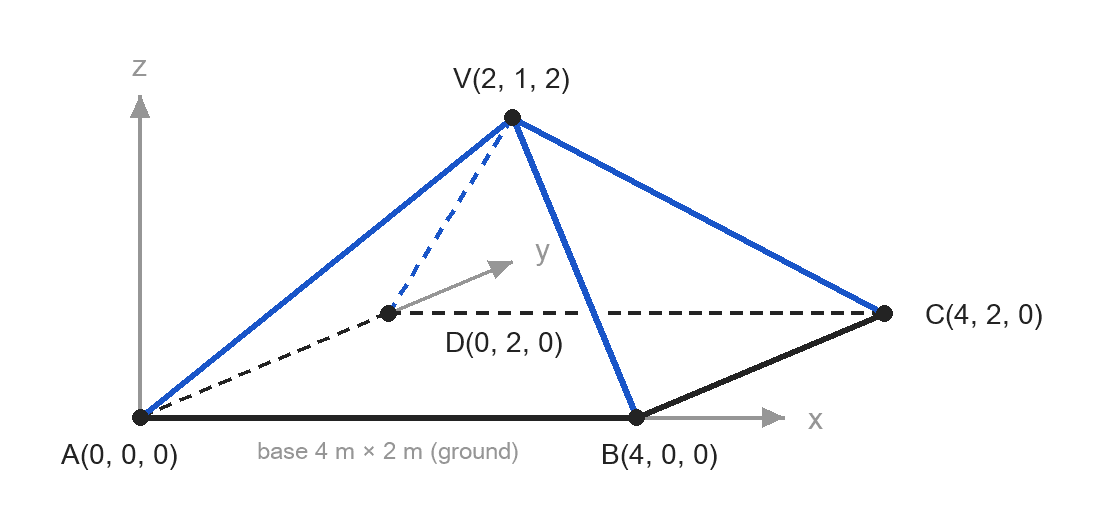
(a) Show that all four poles have the same length.
(b) Find the angle between the poles to the ends of a long side, and the angle between the poles to the ends of a short side.
(c) Find the angle between the poles to opposite corners.
- 181 mark
Question 18
Competency: Analysis & Evaluation
Two straight steel braces in a frame have direction ratios and . (Hypothetical data.)
Assertion (A): The two braces are perpendicular to each other.
Reason (R): For both sets of direction ratios, .
- 194 marks
Question 19
Competency: Application
Take the -axis east, the -axis north and the -axis vertically upward. A straight stretch of river flows in the horizontal direction with direction ratios . A straight bridge deck is to be built horizontal and perpendicular to the river. (Hypothetical data.)
(a) Find the direction cosines of the bridge deck (give both possible senses).
(b) Show that a vertical pier is perpendicular to both the river and the bridge deck.
(c) An approach ramp at one end of the bridge has direction ratios , where . Show that the ramp is perpendicular to the river for every value of , and find if the ramp rises 1 m for every 12 m of horizontal distance.
- 201 mark
Question 20
Competency: Analysis & Evaluation
In a building, a vertical pillar meets the ceiling. Two straight beams under the ceiling are both perpendicular to the pillar.
Assertion (A): The two beams must be parallel to each other.
Reason (R): In space, two lines that are both perpendicular to the same line need not be parallel to each other.
- 211 mark
Question 21
Competency: Analysis & Evaluation
A straight power cable runs from to , and a second straight cable runs from to , in metres. (Hypothetical data.)
Assertion (A): The cables and are parallel.
Reason (R): One cable is entirely at a height of 30 m and the other entirely at a height of 25 m, so the two cables never meet.
- 221 mark
Question 22
Competency: Analysis & Evaluation
A robot arm has its shoulder joint at the origin and its elbow at (units: decimetres). For a particular task the elbow must be a right angle, that is, the forearm must be perpendicular to the upper arm , where is the wrist. (Hypothetical data.)
Which of these wrist positions satisfies this condition?
- 233 marks
Question 23
Competency: Application
In a laser periscope, a beam travels in straight lines from to a mirror at , up to a second mirror at , and then out towards , in centimetres. (Hypothetical data.)
(a) Show that the beam turns through a right angle at , and again at .
(b) Show that the outgoing part is parallel to the incoming part .
(c) Find the total length of the beam's path from to .
- 243 marks
Question 24
Competency: Application
At an open-air concert, two loudspeakers are mounted on towers at and , in metres, with the ground as the -plane. A listener's ears are at . Take the speed of sound as 340 m/s. (Hypothetical data.)
(a) Find the distance from to the listener.
(b) Find the distance from to the listener.
(c) Both speakers play the same sound. By how many seconds should the sound from be delayed so that both sounds reach this listener together? (Give the answer to three decimal places.)
- 251 mark
Question 25
Competency: Application
Two vertical flagpoles stand on level ground (the -plane), in metres. The top of the first pole is , and at a certain moment the tip of its shadow is at . The top of the second pole is . The sun's rays are parallel, so the ray through to the tip of the second shadow is parallel to . (Hypothetical data.)
The tip of the second pole's shadow is at
- 261 mark
Question 26
Competency: Analysis
A delivery drone is at the point . Take the -axis east, the -axis north and the -axis vertically upward, with lengths in metres. The drone flies in a straight line in the direction with direction ratios , and it keeps moving forward in this direction (it never turns back). Four checkpoints are given in the options. (Hypothetical data.)
Through which checkpoint will the drone pass?
- 271 mark
Question 27
Competency: Evaluation
Four survey drones each report the angles that their straight flight paths make with the positive -axis (east), the positive -axis (north) and the positive -axis (vertically upward). Exactly one of the four reports must be faulty. (Hypothetical data.)
Which report must be faulty?
- 281 mark
Question 28
Competency: Understanding & Application
In a classroom, take one corner of the floor as the origin , the floor as the -plane and the vertical edge through as the -axis, with lengths in metres. The front wall of the room is the -plane. To fix a whiteboard, a laser level projects a straight horizontal red line across the front wall at a height of m above the floor. (Hypothetical data.)
The equations of the laser line are
- 291 mark
Question 29
Competency: Analysis
At a hill station, four straight hiking trails start from the same base camp. Take the -axis east, the -axis north and the -axis vertically upward. The table gives the direction ratios of each trail, taken in the uphill sense. (Hypothetical data.)
Trail Direction ratios Which trail climbs most steeply, in the sense that it makes the smallest angle with the vertically upward direction?
- 301 mark
Question 30
Competency: Analysis & Evaluation
A straight steel beam is fixed horizontally under the ceiling of a hall. Take the -axis east, the -axis north and the -axis vertically upward, and let be the direction cosines of the beam.
Assertion (A): .
Reason (R): Every horizontal line has direction ratios proportional to .
- 311 mark
Question 31
Competency: Analysis & Evaluation
A camera drone flies in a straight line in the direction with direction ratios . It then turns and flies in the direction with direction ratios . The axes are east, north and vertically upward. (Hypothetical data.)
Assertion (A): Because the second direction has a negative direction ratio, the angle between the two flight directions is obtuse.
Reason (R): Two lines with direction ratios and are perpendicular if and only if .
- 322 marks
Question 32
Competency: Application
The aerial ladder of a fire engine turns about a pivot on the truck, m above the road. Take the road as the -plane, the -axis east, the -axis north and the -axis vertically upward, in metres. The ladder is set along the direction with direction ratios . A person is waiting at a window sill m above the road. (Hypothetical data.)
How far must the ladder be extended from the pivot for its tip to reach the height of the sill? Find the co-ordinates of the tip when it does.
- 332 marks
Question 33
Competency: Analysis
A straight bridge girder rests on three bearings. The bearings at the two ends are at and , in metres, with the -axis east, the -axis north and the -axis vertically upward. The middle bearing is m east of , so its -co-ordinate is . For the girder to rest on all three bearings, the points , and must lie on one straight line. (Hypothetical data.)
Find the - and -co-ordinates of the middle bearing .
- 342 marks
Question 34
Competency: Application & Analysis
In an office, take one floor corner as the origin, the floor as the -plane and the -axis vertically upward, in metres. A ceiling sprinkler nozzle is at . When it works, it wets every point that is within m of the nozzle. (Hypothetical data.)
(a) Find the centre and the radius of the circular patch of floor that gets wet.
(b) A box of files lies on a desk top at . Will the box get wet?
- 352 marks
Question 35
Competency: Creativity & Analysis
A delivery drone hovers at above a courtyard, in metres, with the -axis east, the -axis north, the -axis vertically upward and the courtyard floor as the -plane. It must reach a drop point in two straight legs. The first leg is horizontal, so the drone stays m above the floor, and it ends at a turning point . The second leg goes from straight to . The pilot wants the two legs to be at right angles to each other. (Hypothetical data.)
Suggest one possible turning point (other than itself), and show that your two legs are perpendicular.
- 363 marks
Question 36
Competency: Analysis
From the top of a lighthouse, m above the sea, a laser rangefinder measures two buoys and floating on the sea. Take as the origin, the -axis east, the -axis north and the -axis vertically upward, in metres. The readings are given below. (Hypothetical data.)
Buoy Range from Direction cosines of the line of sight from m m (a) Find the co-ordinates of and , and check that both buoys are on the sea surface.
(b) Find the cosine of the angle between the two lines of sight.
(c) Find the distance between the buoys in two ways: from the co-ordinates, and by the cosine formula .
- 373 marks
Question 37
Competency: Evaluation
Two crews dig a straight tunnel through a hill from both ends at once. The portals are at and , in metres, with the -axis east, the -axis north and the -axis vertically upward. The crew at sets its boring machine along the direction with direction ratios . The crew at sets its machine along the direction with direction ratios . The plan allows each crew's direction to differ from the line of the tunnel by less than . (Hypothetical data.)
(a) Show that the crew at is boring exactly along .
(b) Show that the crew at is not boring exactly along .
(c) The sine of the angle between lines with direction ratios and is given by the formula below.
Use it to find for the crew at , and decide whether this crew is within the allowance. Take .
- 383 marks
Question 38
Competency: Analysis & Evaluation
A straight stay cable of a cable-stayed bridge runs from the top of the pylon, , to an anchor on the deck, , in metres. The still river surface is the -plane and the -axis is vertically upward. The water acts as a plane mirror, so the image of a point is the point . Let and be the images of and . (Hypothetical data.)
(a) Find the direction cosines of the cable and of its image , each directed from the image of the pylon top towards the image of the anchor.
(b) Find the cosine of the angle between the cable and its image.
(c) The cable makes an acute angle with the horizontal, so that equals the cosine of the acute angle between the cable and the vertical. Show that .
- 395 marks
Question 39
Competency: Application & Evaluation
A village water main is laid as a straight pipe from a pumping station to a storage tank on a hillside. Two farm tanks, and , are to be joined to the main by straight branch pipes, and each branch should be as short as possible to save cost. Take the -axis east, the -axis north and the -axis vertically upward, in metres. The positions are given below. (Hypothetical data.)
Point (pumping station) (storage tank) (farm tank 1) (farm tank 2) Co-ordinates (a) Show that are direction ratios of the main , and find the foot of the perpendicular from to the line . Check that lies on the pipe, between and .
(b) The branch from is laid along . Find its length, and its cost at ₹1,200 per metre.
(c) A planner says: "The perpendicular distance of from the line is m, so the branch from needs only m of pipe." Show that the foot of the perpendicular from to the line lies beyond . Hence find the length of the shortest branch from to the main, and comment on the planner's claim.
- 404 marks
Question 40
Competency: Analysis & Evaluation
A technician is installing a dish antenna. Take the -axis east, the -axis north and the -axis vertically upward. The satellite is in the southern part of the sky, in the direction with direction ratios from the dish. During installation the dish is tried in three settings, and the direction in which it points in each setting is given below. The pointing error of a setting is the angle between the direction in which the dish points and the direction of the satellite. (Hypothetical data.)
Setting Direction ratios (a) Find the direction cosines of the satellite direction and of each setting.
(b) Find the cosine of the pointing error for each setting, and decide which setting is the best.
(c) The technician turns the dish from straight to and says: "The dish has turned through the difference of the two pointing errors." Find the angle through which the dish turned, and comment on the claim.