
Opening your dashboard
Class 12 Maths Chapter 2 Functions: Competency-Based Questions (CBQ)
40 questions on Chapter 2, each worked through on its own page with the AI tutor. Class 12 Maths, ICSE 2026-27.
40 questions
1–5 marks · Mixed difficulty
- 11 mark
Question 1
Competency: Application
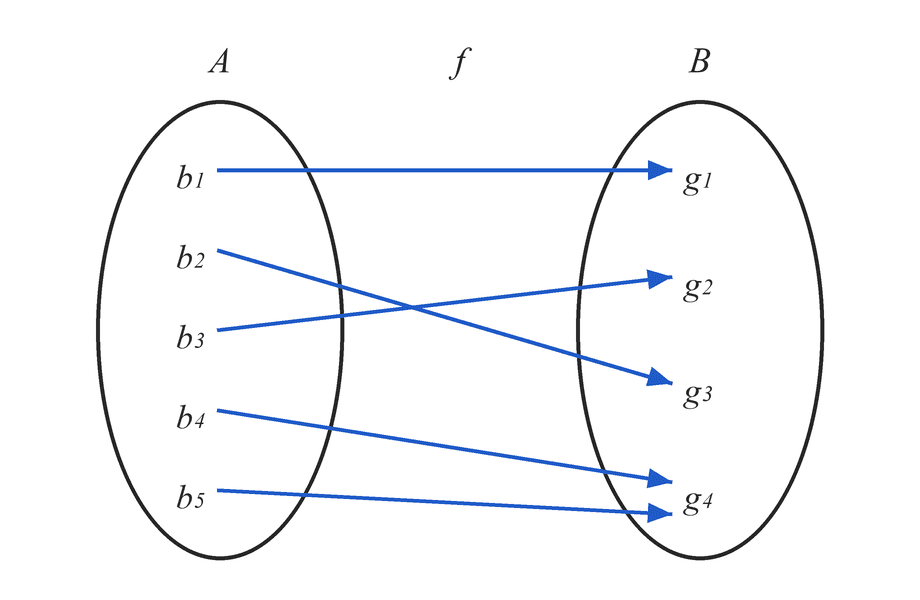
A school's office is setting up its records software, which can store a rule only if the rule is a function from the first set to the second. Which of these rules can be stored?
- 23 marks
Question 2
Competency: Application
A mall's car park charges Rs 30 for the first hour or part of an hour, and Rs 20 for each further hour or part of an hour, but never more than Rs 150 for a visit. A car may stay for at most 12 hours. Let be the fee in rupees for a stay of hours, . (Hypothetical data.)
(a) Find and .
(b) Find the range of .
(c) The fee is a function of the time parked. Explain why the time parked is not a function of the fee.
- 31 mark
Question 3
Competency: Application
A packaging unit cuts a square of side cm from each corner of a square sheet of side 24 cm and folds up the flaps to make an open box. The volume of the box is cm³.
For to describe a box that can actually be made, its domain should be
- 41 mark
Question 4
Competency: Analysis & Evaluation
On Sports Day, the teacher prepares a register that pairs each student of the set of participants with an event from the set of events.
Assertion (A): If one student is entered for two events, then the rule 'student event entered' from to is not a function.
Reason (R): A function from a set to a set assigns to each element of exactly one element of .
- 54 marks
Question 5
Competency: Application
Eighty students with admission numbers 1001 to 1080 write a test in a hall with 40 seats numbered 1 to 40. The seat of the student with admission number is
(Hypothetical data.)
(a) Find the seat of the student with admission number 1077.
(b) Show that is not one-one on . What does this mean for the hall?
(c) The morning session has the students with admission numbers 1001 to 1040. Prove that is one-one on this set, so that no two of these students get the same seat.
- 61 mark
Question 6
Competency: Analysis & Evaluation
A class teacher writes the names of her 40 students in alphabetical order (two students with the same name are ordered by admission number) and gives roll numbers 1 to 40 in that order. Let give each student of the class his or her roll number.
Assertion (A): is one-one.
Reason (R): A function is one-one if every element of is the image of some element of .
- 71 mark
Question 7
Competency: Analysis & Evaluation
A class has 40 students. Let be the function from the set of these students to the set of the 12 months of the year that gives each student the month of his or her birth.
Assertion (A): is one-one.
Reason (R): If and are finite sets with , then no function from to is one-one.
- 83 marks
Question 8
Competency: Application
A school corridor has 120 lockers numbered 1 to 120. The 40 students of a class, with roll numbers 1 to 40, are given lockers by the rule , where is the roll number. Let and . (Hypothetical data.)
(a) Find the locker of the student with roll number 25.
(b) Which student gets locker 100? Is locker 101 given to any student?
(c) Is onto? Find how many lockers are left empty.
- 91 mark
Question 9
Competency: Analysis & Evaluation
An imaginary hotel has one room for every natural number (rooms 1, 2, 3, …), and every room is occupied. To make space for a new guest, the manager moves the guest in room to room , for every . This move is the function , .
Assertion (A): is not onto, so after the move room 1 is empty.
Reason (R): is one-one.
- 101 mark
Question 10
Competency: Application
Six new students are placed in the school's four houses as follows: Aman Red, Bela Blue, Chirag Red, Diya Green, Eshan Green, Farah Red. This gives a function from the set of the six students to . (Hypothetical data.)
The coordinator wants to be onto by moving just one student. Which move achieves this?
- 114 marks
Question 11
Competency: Application
A school auditorium has 10 rows A, B, …, J (row numbers ) with 20 seats in each row (). The booking system gives the seat in row , seat the code
Let be the set of all 200 seats and . (Hypothetical data.)
(a) Find the code of seat 7 in row D.
(b) Prove that is a bijection.
(c) A ticket shows code 158. Which seat is it?
- 121 mark
Question 12
Competency: Analysis & Evaluation
A school's planner rolls each club's monthly duty forward by one month every year. Number the months 1 (January) to 12 (December) and let . The roll-forward is , where for and .
Assertion (A): is a bijection.
Reason (R): Every function from a finite set to itself is a bijection.
- 131 mark
Question 13
Competency: Application
Six monitors (numbered 1 to 6) share six duties (numbered 1 to 6). Each week the teacher uses a rule to give monitor a duty, and she wants every duty done by exactly one monitor. Which rule, from to , is a bijection?
- 143 marks
Question 14
Competency: Application
During a festival sale a shop gives 10% off the marked price, and a customer also has a coupon worth Rs 100 off. The cashier can apply them in either order. For an item priced Rs (), let (coupon) and (sale). (Hypothetical data.)
(a) Find the amount paid for an item priced Rs 1500 if the coupon is applied first and then the sale discount.
(b) Write and , and say what each one means.
(c) Which order is better for the customer, and by how much? Does the answer depend on the price?
- 153 marks
Question 15
Competency: Application
A weather station's sensor reports temperatures in kelvin (K). The software converts kelvin to degrees Celsius by , and degrees Celsius to degrees Fahrenheit by .
(a) A reading is 300 K. Find the temperature in °F.
(b) Find a single formula for , the Fahrenheit temperature for a reading of kelvin.
(c) A student computes instead. Find it, and explain why it does not convert any temperature correctly.
- 161 mark
Question 16
Competency: Analysis & Evaluation
Each student of a school is given a locker by a one-one function from the set of students to the set of lockers. Each locker has a key whose tag carries a code given by a one-one function from the set of lockers to the set of codes.
Assertion (A): No two students hold keys with the same code, that is, is one-one.
Reason (R): The composition of two one-one functions is one-one.
- 171 mark
Question 17
Competency: Application
A cab app charges a fare of rupees for a ride of km. On a highway the cab moves at a steady 30 km/h, so in minutes it covers km. (Hypothetical data.)
The fare as a function of the time (in minutes) of a highway ride, , is
- 184 marks
Question 18
Competency: Application
In a school cipher club, the letters A, B, …, Z are numbered 0, 1, …, 25. Let . A letter with number is encoded as the letter with number
(a) Encode the word MATH.
(b) Explain why is invertible, and find a rule for .
(c) Decode the received word VWLU.
- 193 marks
Question 19
Competency: Application
A mobile plan costs Rs 199 a month plus Rs 25 for each extra GB of data, and extra data is sold in whole GB only. The bill for extra GB is , . Let be the set of possible bills. (Hypothetical data.)
(a) Find the bill for 6 extra GB.
(b) Show that is invertible, find , and say what it tells the customer.
(c) A customer claims his bill is Rs 330. Use to show that this bill is impossible, and say why would not be invertible as a function from to .
- 201 mark
Question 20
Competency: Analysis & Evaluation
For a debate, 30 students are seated in a hall with 35 chairs, one student to a chair. Let be the function from the set of students to the set of chairs that gives each student his or her chair.
Assertion (A): has an inverse function from the set of chairs to the set of students.
Reason (R): A function is invertible if and only if it is one-one and onto.
- 211 mark
Question 21
Competency: Application
An airport kiosk charges a fixed fee of Rs 300 and converts the rest at Rs 85 per US dollar. For Rs handed over (), a traveller gets dollars. (Hypothetical data.)
Using , how many rupees must a traveller hand over to get exactly 200 dollars?
- 224 marks
Question 22
Competency: Application
The cipher club numbers the letters A, B, …, Z as 0, 1, …, 25 and tries a 'mirror' code on : the letter with number becomes the letter with number (so A Z, B Y, and so on).
(a) Encode the word CODE.
(b) Show that for every , and hence that . What does this mean for the person decoding?
(c) The club also uses shift codes remainder when is divided by 26, for . For which value of is its own inverse?
- 234 marks
Question 23
Competency: Application
A number lock app hides a number in two steps: first , then . So the stored code is , with .
(a) Find the stored code for .
(b) Using , find the rule that recovers from a code , and recover the number whose code is 63.
(c) A student undoes the steps in the order 'undo , then undo ', that is, uses . What does he get for the code 63? Why is it wrong?
- 241 mark
Question 24
Competency: Analysis & Evaluation
In a number game, one player says a real number and the partner must reply . Let , .
Assertion (A): , so if the partner's reply is said back to him, he must reply with the first player's number.
Reason (R): is a bijection.
- 251 mark
Question 25
Competency: Application
A puzzle club wants a number code in which the same rule both encodes and decodes, so that applying it to a coded number gives back the original. Which rule has this property?
- 264 marks
Question 26
Let and . Show that , , is a bijection.
- 274 marks
Question 27
Show that the function defined by is a bijection, and find .
- 284 marks
Question 28
Let be . Find , and find all for which .
- 293 marks
Question 29
Let be defined as . Find , and .
- 303 marks
Question 30
If is defined by , write .
- 313 marks
Question 31
Let be the set of complex numbers. Prove that the mapping given by , , is neither one-one nor onto.
- 323 marks
Question 32
Let be defined by . Let be given as . Then find the sum of all the values of for which .
- 334 marks
Question 33
In an inter-school quiz competition, a school sent two teams of students. One team consisted of 5 boys, say and , and the second team consisted of 4 girls, say and .
Based on the above information, answer the following questions:
(i) The mapping is
(A) One-one but not onto. (B) Only onto but not one-one. (C) One-one and onto both. (D) Neither one-one nor onto.
(ii) The number of functions from to is
(A) (B) (C) (D)
(iii) The number of functions from to is
(A) (B) (C) (D)
(iv) The number of one-one functions from to is
(A) (B) (C) (D)
- 345 marks
Question 34
In a residential school, the principal nominated three boys (Rahul, Piyush, Samir) and two girls (Shweta, Arushi) as prefects for the school.
Based on the above information, answer the following questions:
(i) How many relations can possibly be formed from sets and ?
(A) (B) (C) (D)
(ii) How many of these relations are functions?
(A) (B) (C) (D)
(iii) Let be defined by , then is
(A) Surjective (B) Injective (C) Neither surjective nor injective (D) Surjective and injective
(iv) How many injective functions are possible from to ?
(A) (B) (C) (D)
(v) How many bijective functions are there from to ?
(A) (B) (C) (D)
- 354 marks
Question 35
Mr. Sinha had a terrace garden in the huge balcony of his office building wherein he developed flower beds in parallel rows. Suppose equation of one of the rows is .
Based on the above information, answer the following questions:
(i) The function defined by is
(A) Bijective (B) Surjective but not injective (C) Injective but not surjective (D) Neither surjective nor injective
(ii) The range of defined by is
(A) (B) (C) (D)
(iii) The inverse of the function is
(A) (B) (C) (D)
(iv) If and , then is equal to . True or False?
- 361 mark
Question 36
Competency: Analysis
A railway station's timetable uses 24-hour time, but the clock on the platform has a 12-hour face. The hour of the timetable, , is shown on the clock face as an hour in . For example, is shown as 3, and both and are shown as 12. Let be this rule.
Which statement about is correct?
- 371 mark
Question 37
Competency: Analysis & Evaluation
On a mobile phone keypad, each of the 26 letters is printed on exactly one digit key: 2 (A B C), 3 (D E F), 4 (G H I), 5 (J K L), 6 (M N O), 7 (P Q R S), 8 (T U V) and 9 (W X Y Z). Let be the set of the 26 letters, let , and let give each letter the key it is printed on.
Assertion (A): has no inverse function from to , so a digit typed on its own cannot tell us which letter was meant.
Reason (R): is many-one; for example, and are both 2.
- 382 marks
Question 38
Competency: Creativity
A teacher marks a class quiz out of 20, in whole marks, so the set of possible scores is . She wants a rule that turns each score into one grade from , with a higher score never getting a lower grade.
(a) Design such a rule, written as score bands, so that is onto .
(b) Explain why no rule from to can be one-one.
- 393 marks
Question 39
Competency: Evaluation
An electricity board charges Rs 4 per unit for the first 100 units used in a month and Rs 6 per unit for every unit above 100. (Hypothetical data.) In this model, take the units used as any real number , so the bill in rupees is
Kabir wants to find the units used from a bill . He simplifies the second line to and writes for every bill .
(a) Show that is a bijection.
(b) Find the correct , and use a bill of Rs 300 to decide whether Kabir's formula is right.
- 405 marks
Question 40
Competency: Analysis
A courier company in a city sorts its parcels in two stages. First, each delivery zone sends its parcels to one sorting hub; this is a function from the set of zones to the set of hubs . Then each hub loads everything it receives onto one delivery van; this is a function from to the set of vans . So the van that finally carries a zone's parcels is given by . (Hypothetical data.)
Zone Hub N E N S W Hub N E S W Van (a) Write as a table, giving the van for each zone.
(b) Is one-one? Is it onto? Which of the two stages, or , makes it fail to be one-one? Give reasons.
(c) The company opens a new hub C with its own new van , so , and moves zone to hub C. All other entries stay the same. Show that the new composite is a bijection, and find .