
Opening your dashboard
Class 12 Maths Chapter 19 Vector or Cross Product: Competency-Based Questions (CBQ)
40 questions on Chapter 19, each worked through on its own page with the AI tutor. Class 12 Maths, ICSE 2026-27.
40 questions
1–5 marks · Mixed difficulty
- 11 mark
Question 1
Competency: Application
A 3-D printer reads a model as a list of flat triangular facets. For a facet listed as , the slicing software takes the facet's normal as , and the list is correct only if this normal points out of the solid.
One facet lies on the flat top face of a printed block. Its corners are , and (in cm), and the block lies below this face, so "out of the solid" is the direction of . (Hypothetical data.)
In which order must the corners be listed?
- 21 mark
Question 2
Competency: Analysis & Evaluation
A surveying program stores the direction of a straight canal. For two displacement vectors and of a boat, it finds that .
Assertion (A): The program may conclude that .
Reason (R): If with , then is parallel to (or is the zero vector).
- 33 marks
Question 3
Competency: Application
A technician is setting up a dish antenna. The dish points along , but the strongest signal arrives along . Let be the angle between and . (Hypothetical data.)
(a) Use the vector product to find .
(b) Explain why alone does not fix , and find to the nearest tenth of a degree.
(c) The motor turns the dish about an axis perpendicular to both and . Find a unit vector along this axis.
- 41 mark
Question 4
Competency: Analysis & Evaluation
A laptop's hinge is at the origin. The base runs from the hinge to its front edge along and the open screen runs from the hinge to its top edge along (in cm). (Hypothetical data.)
Assertion (A): The angle between the base and the screen is .
Reason (R): The angle between two vectors is fixed by the value of alone.
- 51 mark
Question 5
Competency: Application
A virtual-reality headset uses right-handed axes. It tracks the unit vector in which the user looks (forward) and the unit vector pointing out of the top of the user's head (up). In the starting position , , and the user's right is .
During a game, and . (Hypothetical data.) Using the starting position to choose the order of the vector product, the unit vector pointing to the user's right is
- 61 mark
Question 6
Competency: Analysis & Evaluation
A sculptor welds three steel rods to one point. Two rods lie along non-zero, non-parallel vectors and , and the third lies along .
Assertion (A): The three rods can never all lie in one flat plane.
Reason (R): When and are non-zero and not parallel, is a non-zero vector perpendicular to both and .
- 74 marks
Question 7
Competency: Application
A surveyor marks the corners of a plot of farmland on a hillside as , , and , in metres, with the -axis vertical. To find the area of the plot , the surveyor splits it along the diagonal . (Hypothetical data.)
(a) Find the area of .
(b) Find the area of and hence the area of the plot, correct to one decimal place.
(c) The method in (a) and (b) is valid only if the four corners lie in one plane. Using the vector products found above, show that they do.
- 81 mark
Question 8
Competency: Application
A small sailing yacht's triangular mainsail has its lower front corner (tack) at , its top corner (head) at on the mast, and its lower back corner (clew) at , in metres. (Hypothetical data.)
The area of the sail is
- 93 marks
Question 9
Competency: Application
The roof of a botanical garden's glass dome is made of identical triangular glass facets. One facet has corners , and , in metres. (Hypothetical data.)

(a) Find the area of one facet.
(b) The glass cutter needs the angle of the facet at corner . Use the vector product to find , then find to the nearest hundredth of a degree.
(c) Toughened glass costs Rs 2400 per m². Find the cost of the glass for 20 such facets.
- 101 mark
Question 10
Competency: Analysis & Evaluation
Two surveyors find the area of the same triangular field . One works from corner , the other from corner .
Assertion (A): , so both surveyors get the same area.
Reason (R): The vector is perpendicular to the plane of the triangle.
- 111 mark
Question 11
Competency: Application
A car-park canopy is covered with 10 identical solar panels, each in the shape of a parallelogram. Two adjacent edges of each panel are and , in metres. At midday each square metre of panel gives 200 W. (Hypothetical data.)
The total power from the canopy at midday is
- 123 marks
Question 12
Competency: Application
A park has a triangular flower bed . The gardener can only measure lengths with a tape: m, m and m. Let and . (Hypothetical data.)
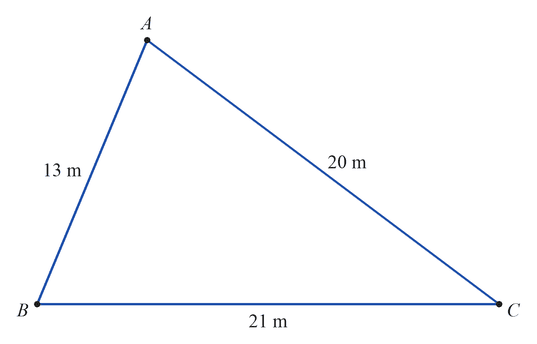
(a) Using , find .
(b) Using the identity , find .
(c) Find the area of the bed and the cost of laying grass turf on it at Rs 250 per m².
- 131 mark
Question 13
Competency: Application
A school garden on a gentle slope has corners , , and , in metres, taken in this order round the plot. Turf is sold in rolls that each cover 1.5 m², and only whole rolls can be bought. (Hypothetical data.)
The least number of rolls needed to cover the plot is
- 141 mark
Question 14
Competency: Analysis & Evaluation
A town planner enlarges the plan of a triangular park so that every length on the plan is doubled. On the old plan two sides of the park from one corner are and ; on the new plan they are and .
Assertion (A): The area of the park on the new plan is 4 times its area on the old plan.
Reason (R): .
- 153 marks
Question 15
Competency: Application
A ridge tent has a rectangular floor with corners , , and , and a ridge pole from to , in metres. The two sloping sides and and the two triangular ends and are made of canvas; the floor is a separate sheet. (Hypothetical data.)

(a) Using the vector product, find the area of the sloping side .
(b) Find the area of the triangular end .
(c) The tailor adds 10% extra canvas for seams. How much canvas is needed in all?
- 163 marks
Question 16
Competency: Application
A door turns about a vertical hinge line, which is the -axis; the lower hinge is at the origin. A person pushes the handle , whose position vector is m, with a force N. Only the component of the moment along the hinge line turns the door; the hinges resist the other components. (Hypothetical data.)
(a) Find the moment of the push about .
(b) Find the turning effect of the push about the hinge line.
(c) Keeping the size of the push the same, in which direction should the person push to get the largest turning effect, and what is that largest value?
- 171 mark
Question 17
Competency: Analysis & Evaluation
A cyclist's pedal crank joins the axle to the pedal. At one moment the crank points straight down from the axle, and the cyclist presses straight down on the pedal.
Assertion (A): At this moment the push produces no turning effect on the crank about the axle.
Reason (R): The moment of a force is when and are parallel.
- 184 marks
Question 18
Competency: Application
A video-game engine shades each triangle of a 3-D model by its brightness , where is the unit normal of the triangle and is the unit vector from the surface towards the light. A brightness of 0 means the face is dark. One triangle has corners , and . (Hypothetical data.)

(a) Find .
(b) Find the unit normal .
(c) Find the brightness of the triangle when the light is along , and when it is along .
- 191 mark
Question 19
Competency: Application
A flat triangular air vent has corners , and , in metres. Wind blows through it with a steady velocity m/s. The volume of air passing through a flat opening per second is , where is the vector area of the vent. (Hypothetical data.)
The volume of air passing through the vent per second, correct to two decimal places, is
- 203 marks
Question 20
Competency: Application
Two flat sloping glass walls of a glasshouse meet along a straight edge. Wall 1 contains the directions and ; wall 2 contains the directions and . (Hypothetical data.)
(a) Find a vector normal to wall 1 and a vector normal to wall 2.
(b) The edge lies in both walls, so it is perpendicular to both normals. Find a unit vector along the edge.
(c) Find the acute angle between the two walls.
- 211 mark
Question 21
Competency: Application
Kepler's second law says that the line from the Sun to a comet sweeps out area at a constant rate, equal to , where is the comet's position vector from the Sun and its velocity. At one instant a comet has (in AU) and (in AU per year). (Hypothetical data.)
The area swept per year by the line from the Sun to the comet is
- 221 mark
Question 22
Competency: Analysis & Evaluation
A security laser beam in a museum hall passes through the point in the direction . A statue stands at , in metres. (Hypothetical data.)
Assertion (A): The distance of the statue from the beam is m.
Reason (R): , where is the angle between and .
- 233 marks
Question 23
Competency: Analysis & Evaluation
A tablet app has a triangular button with corners , and on the screen (the -plane, in cm). To decide whether a tap at a point is on the button, the app finds the -components of
The tap is inside the button exactly when all three have the same sign. (Hypothetical data.)
(a) Find the three vector products for a tap at .
(b) Decide whether the tap at is on the button, and explain why the test works.
(c) Decide whether a tap at is on the button.
- 241 mark
Question 24
Competency: Application
A flat wheelchair ramp is a rectangle with three of its corners at , and , in metres, where the floor is the -plane and points vertically up. The angle between the ramp and the floor equals the angle between their normals. (Hypothetical data.)
The cosine of the angle between the ramp and the floor is
- 251 mark
Question 25
Competency: Analysis & Evaluation
A coastal radar station at the origin tracks a ship that moves in a straight line with constant velocity . At time the ship is at , with , where and are fixed and not parallel.
Assertion (A): The line sweeps out equal areas in equal intervals of time.
Reason (R): For each , is perpendicular to both and .
- 264 marks
Question 26
In a triangle , let , and , and let be the lengths of the sides . Using vector products, prove the sine rule
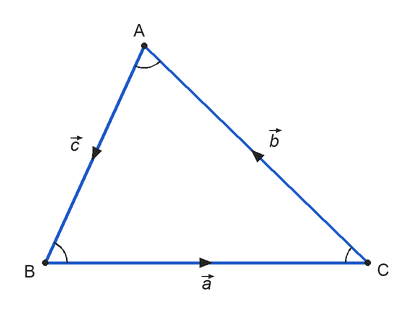
- 274 marks
Question 27
Let and .
(i) Write as the sum of a vector parallel to and a vector perpendicular to .
(ii) Verify that .
(iii) Explain this result using the parallelogram with adjacent sides and .
- 284 marks
Question 28
is a plane quadrilateral and , , , are the midpoints of , , , respectively. Using vectors, prove that is a parallelogram whose area is half the area of .
You may use the result: area of a quadrilateral .
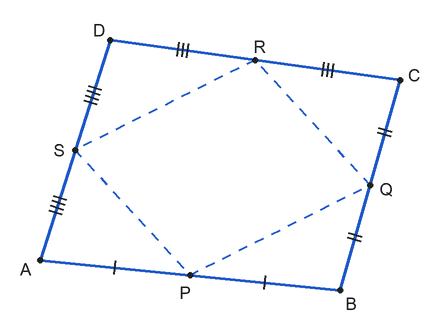
- 294 marks
Question 29
A force acts through the point .
(i) Find the moment of about the point and its magnitude.
(ii) is another point. Show that lies on the line of action of , and verify that taking in place of gives the same moment about .
(iii) Show that the moment is perpendicular to .
- 304 marks
Question 30
Let and . Find the unit vectors that lie in the plane of and and are perpendicular to .
- 313 marks
Question 31
Match correctly statements given in column I with those given in column II.
Column I Column II 1. If and , then unit vector along the vector ______ (a) 2. If the vectors and are such that , and is a unit vector, then the angle between and is ______ (b) 3. The projection of the vector on the vector , where , and is ______ (c) 2 units 4. If , and are three vectors, then a vector perpendicular to both the vectors and is ______ (d) 5. If the sides and of a parallelogram are represented as vectors and , then find the unit vector along diagonal . (e) - 324 marks
Question 32
Drone delivery navigation: A logistics company uses drones to deliver packages. A drone starts from a warehouse at point and moves toward a delivery point . On its way, it faces a wind force represented by a vector , which affects its path.
Based on the above information, answer the following questions:
(i) What is the displacement vector from to ?
(A) (B) (C) (D)
(ii) What is the magnitude of the displacement vector?
(A) (B) (C) (D)
(iii) What is the angle between the wind force vector and the displacement vector ?
(A) (B) (C) (D)
(iv) What is the projection of the wind vector on the direction of motion ()?
(A) units (B) units (C) units (D) units
- 334 marks
Question 33
Military strike on an airbase: A missile is launched from a military base at point with a velocity vector . The target airbase is at point . Military intelligence wants to verify if the missile is correctly heading toward the target.
Based on the above information, answer the following questions:
(i) What is the position vector from the launch site to the target?
(A) (B) (C) (D)
(ii) Is the missile heading directly toward the target airbase?
(A) Yes, because the vectors and are perpendicular.
(B) Yes, because the vectors and are parallel.
(C) No, because the vectors have different magnitudes.
(D) No, because the dot product of the vectors is zero.
(iii) What is the magnitude of the missile's velocity vector?
(A) 12 (B) 10 (C) (D)
(iv) How long (in seconds) will the missile take to reach the target if it maintains constant velocity?
(A) 2 sec (B) 1 sec (C) 3 sec (D) 4 sec
- 344 marks
Question 34
An instructor at the astronomical centre shows three among the brightest stars in a particular constellation. Assume that telescope is located and the three stars have their locations at points , and having position vectors , and , respectively.

Based on the above information, answer the following questions:
(i) How far is the star from star ?
(ii) Find a unit vector in the direction of .
(iii) Find the measure of .
(iv) What is the projection of vector on vector ?
- 354 marks
Question 35
The flight path of two airplanes in a flight simulator game are shown below. The coordinates of the airports and are given.

Airplane 1 flies directly from to . Airplane 2 has a layover at and then flies to . The path of Airplane 2 from to can be represented by the vector .
(Note: Assume that the flight path is straight and fuel is consumed uniformly throughout the flight.)
(i) Find the vector that represents the flight path of Airplane 1. Show your steps.
(ii) Write the vector representing the path of Airplane 2 from to . Show your steps.
(iii) What is the angle between the flight paths of Airplane 1 and Airplane 2 just after take-off? Show your work.
(iv) Consider that Airplane 1 started the flight with a full fuel tank. Find the position vector of the point where a third of the fuel runs out if the entire fuel is required for the flight. Show your work.
- 364 marks
Question 36
The Bermuda triangle, which is also known as Devil's triangle, is in the western part of the North Atlantic ocean, where about 50 ships and 20 aircraft are reported to have disappeared.
Consider the vertices of Bermuda triangle as , and .
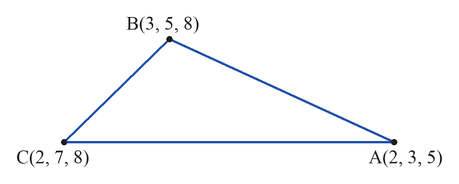
On the basis of the above information, answer the following questions:
(i) Find .
(ii) Find .
(iii) Find the value of .
(iv) Find the area of .
- 375 marks
Question 37
A building is to be constructed in the form of a triangular pyramid, as shown in the figure.

Let its angular points be , , and and be the point of intersection of the medians of .
Based on the above information, answer the following questions:
(i) The coordinates of point are
(A) (B) (C) (D)
(ii) The length of vector is
(A) units (B) units (C) units (D) units
(iii) Area of (in sq. units) is
(A) (B) (C) (D)
(iv) The sum of lengths of and is
(A) 5 units (B) 9.32 units (C) 10 units (D) 11 units
(v) The length of the perpendicular from the vertex on the opposite face is
(A) units (B) units (C) units (D) units
- 381 mark
Question 38
Competency: Analysis
A delivery robot in a warehouse moves on the floor in straight lines through the waypoints , , , and , in that order. The floor is the -plane (in metres) and points vertically up. (Hypothetical data.)
At each of the waypoints , and , the robot's controller finds the -component of , where is the direction in which the robot arrives at the waypoint and is the direction in which it leaves.
At which waypoint(s) does the robot turn to its right?
- 393 marks
Question 39
Competency: Creativity
A furniture maker is replacing an old rectangular glass tabletop, 120 cm by 48 cm, with a slanted top in the shape of a parallelogram. The customer wants the new top to have exactly the same area as the old one. Take along the front edge and across the table, away from the front, with lengths in cm. (Hypothetical data.)
The front edge of the new top is and its side edge is with . So that the legs fit, the side edge must be at least 50 cm and at most 70 cm long.
Design a suitable side edge: find the value that must have, give one suitable vector , and use the vector product to show that your design meets both conditions.
- 405 marks
Question 40
Competency: Analysis & Evaluation
A surveyor maps a community garden plot on level ground. She sets up her instrument at a peg at the corner of the road, which lies outside the plot, and records the position vector of each corner from , with pointing east, pointing north and pointing vertically up, in metres. The corners are listed anticlockwise round the plot as seen from above. (Hypothetical data.)

Corner Position vector from (m) Her mapping software finds the area of the plot by the rule
(a) Find the -component of each of the five vector products in the rule.
(b) Hence find the area of the plot.
(c) A classmate instead adds the areas of the five triangles , , , and , each found as of the magnitude of the vector product, and gets m². Explain why her method is wrong for this plot, saying which triangles must be subtracted and why, and show that her total exceeds the true area by twice the combined area of those triangles.