
Opening your dashboard
Class 12 Maths Chapter 18 Scalar or Dot Product: Competency-Based Questions (CBQ)
40 questions on Chapter 18, each worked through on its own page with the AI tutor. Class 12 Maths, ICSE 2026-27.
40 questions
1–5 marks · Mixed difficulty
- 14 marks
Question 1
Competency: Application
A machine part hangs from a steel ring. Two cables attached to the ring run up to two overhead hooks, so the ring is pulled by the cable forces and . Their magnitudes are kN and kN, and the angle between the two cables is . The resultant of the two pulls holds up the weight of the part. (Hypothetical data.)

(a) Find .
(b) Using the scalar product, find the magnitude of the resultant , and hence the weight of the part.
(c) Find the angle that the resultant makes with the cable force .
- 21 mark
Question 2
Competency: Application
Two friends drag a heavy box across a floor with two ropes tied to the same hook. One pulls with a force of magnitude 50 N and the other with 30 N. The combined effect of the two pulls (their resultant) has magnitude 70 N. (Hypothetical data.)
What is the angle between the two ropes?
- 31 mark
Question 3
Competency: Analysis & Evaluation
Two ropes tied to a hook pull on it with forces and , in newtons. (Hypothetical data.)
Assertion (A): , so the resultant pull on the hook is N.
Reason (R): for any two vectors.
- 41 mark
Question 4
Competency: Analysis & Evaluation
In a video-game physics engine, a ball has velocity and a wall has normal vector . The program finds . (Hypothetical data.)
Assertion (A): Since , either the ball is at rest () or the normal is the zero vector.
Reason (R): For every vector , , so holds only when .
- 51 mark
Question 5
Competency: Analysis & Evaluation
A wall clock has a minute hand 5 cm long and an hour hand 3 cm long. At exactly 4 o'clock, let and be the vectors from the centre of the dial to the tips of the minute hand and the hour hand. (Hypothetical data.)
Assertion (A): At 4 o'clock the tips of the two hands are 7 cm apart.
Reason (R): Whenever the angle between two vectors and is obtuse, .
- 64 marks
Question 6
Competency: Application
The figure shows a roof truss in a vertical plane. Take as the origin, horizontal and vertically upwards, with distances in metres. The tie beam runs from to , the rafter runs from to the ridge , and a second rafter joins to . is the midpoint of , a vertical king post joins to , and is the midpoint of . A strut joins to . (Hypothetical data.)
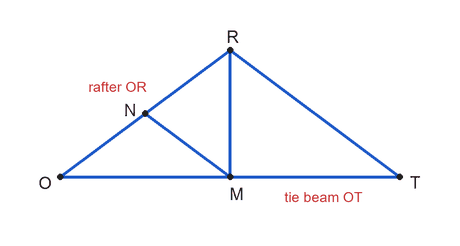
(a) Find the angle between the rafter and the tie beam (the pitch of the roof).
(b) Show that the strut is not perpendicular to the rafter, and find the acute angle between them.
(c) The engineer wants a strut from that meets the rafter at right angles, at a point . Find the coordinates of and the length of this strut .
- 73 marks
Question 7
Competency: Application
A futsal goal is 3 m wide. On a coach's plan, the goal posts are at and on the goal line, distances in metres. A player may shoot from spot , straight in front of the goal, or from spot , nearer the goal but to one side. The shooting angle at a spot is the angle between the lines from the ball to the two posts. (Hypothetical data.)

(a) Find the shooting angle at .
(b) Find the shooting angle at .
(c) From which spot does the goal look wider, and by about how many degrees?
- 83 marks
Question 8
Competency: Application
A music app records how many hours each listener spent last week on three kinds of music: (classical, film songs, pop). Listener is stored as the vector , listener as and listener as . The app measures how alike two listeners' tastes are by the cosine similarity, the cosine of the angle between their vectors. (Hypothetical data.)
(a) Find the cosine similarity of and .
(b) Find the cosine similarity of and .
(c) Whose taste is closer to 's? Explain why, for this app, the cosine similarity of two listeners can never be negative.
- 91 mark
Question 9
Competency: Application
A vertical telecom mast is 12 m tall, with its foot at the origin and its top at . Two guy wires run from to ground anchors at and , distances in metres. (Hypothetical data.)
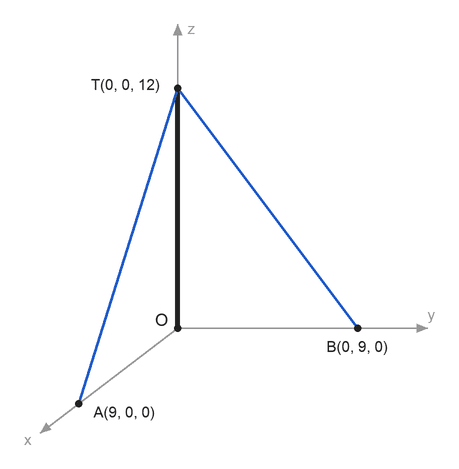
What is the angle between the two guy wires at the top of the mast?
- 101 mark
Question 10
Competency: Application
A long-jump runway points along the horizontal unit vector , where and are horizontal and points vertically upwards. At take-off, an athlete's velocity is m/s. (Hypothetical data.)
The take-off angle is the angle between and the runway direction . What is it?
- 111 mark
Question 11
Competency: Analysis & Evaluation
A carpenter has built a gate frame in the shape of a parallelogram, with and . To check the corners, the carpenter measures the two diagonals and and finds them equal in length.
Assertion (A): The frame is a rectangle.
Reason (R): For any two vectors, .
- 121 mark
Question 12
Competency: Analysis & Evaluation
A delivery drone flies three straight legs, with displacement vectors , and (all non-zero). Its flight log shows and .
Assertion (A): The angle between the first leg and the third leg must also be less than .
Reason (R): The angle between two non-zero vectors is less than if and only if their dot product is positive.
- 131 mark
Question 13
Competency: Analysis & Evaluation
In a steel space frame, two struts meet at a joint. Their direction vectors are and , in metres. (Hypothetical data.)
Assertion (A): The two struts meet at right angles.
Reason (R): The two struts have the same length.
- 144 marks
Question 14
Competency: Application
A small training aircraft is landing on a runway. Take pointing east and pointing north. The aircraft rolls along the runway in the direction of the unit vector . The wind velocity is , in knots. The aircraft's maximum safe crosswind (the wind component across the runway) is 15 knots. (Hypothetical data.)
(a) Find the scalar component of along , and say whether it is a headwind or a tailwind.
(b) Find the crosswind, the vector component of perpendicular to the runway.
(c) Find the magnitude of the crosswind and decide whether the landing is within the aircraft's limit.
- 154 marks
Question 15
Competency: Application
A ray-tracing program draws light bouncing off a flat mirror. The mirror's unit normal (pointing towards the side the light comes from) is . A light ray arrives travelling in the direction . On reflection, the part of along the mirror's surface is kept and the part along is reversed. (Hypothetical data.)
(a) Find the scalar component and explain what its sign tells you.
(b) Write as the sum of a vector along and a vector parallel to the mirror.
(c) Find the direction of the reflected ray, and verify that and that the ray leaves at the same angle to the normal as it arrived.
- 163 marks
Question 16
Competency: Application
In a 3D game, a camera sits at the origin. It uses its own axes along the unit vectors
and it looks along . The camera coordinates of a point with position vector are . (Hypothetical data.)
(a) Show that , , are mutually perpendicular.
(b) Find the camera coordinates of a tree at , and check that they give the same distance from the camera.
(c) An object is at . Is it in front of the camera or behind it?
- 171 mark
Question 17
Competency: Application
A straight hiking trail leaves a camp heading north-east. A hiker leaves the camp and, cutting across open ground, ends up at a point whose displacement from the camp is km, where points east and points north. (Hypothetical data.)
How far has the hiker progressed in the direction of the trail?
- 181 mark
Question 18
Competency: Application
A slanting support pole of a large marquee tent stands with its foot at the origin and its top at , where m, with and horizontal and vertically upwards. At a moment when the Sun is directly overhead, its rays travel straight down. (Hypothetical data.)
How long is the shadow of the pole on the level ground?
- 193 marks
Question 19
Competency: Application
A rooftop solar panel faces south. Take east, north and vertically upwards. The unit normal to the panel is . The unit vector pointing from the panel towards the Sun is at 9 a.m. and at noon. The panel gives 300 W when sunlight falls along its normal; assume its output is watts, where is the angle between and the direction of the Sun. (Hypothetical data.)
(a) Find the angle between the panel's normal and the direction of the Sun at 9 a.m.
(b) Find the output of the panel at 9 a.m.
(c) Find the output at noon, correct to one decimal place.
- 203 marks
Question 20
Competency: Application
A computer-graphics program shades each flat face of an object using the rule
where is the face's outward unit normal and is the unit vector from the object towards the lamp; 255 is the brightest possible value and 0 is black. Three faces have normals , and . (Hypothetical data.)
(a) Find the brightness of face 1.
(b) Find the brightness of face 2 and say which of faces 1 and 2 looks brighter.
(c) Show that face 3 is drawn black, and explain this in terms of the angle between and .
- 213 marks
Question 21
Competency: Application
A shopper pushes a loaded trolley along a level supermarket aisle. Take along the aisle and vertically upwards. The push on the handle is N (forward and slightly downward), and the trolley moves with constant velocity m/s. The rate at which a force does work (its power) is . (Hypothetical data.)
(a) Find the angle that the push makes with the floor.
(b) Find the power delivered by the push.
(c) Find the work done by the push in 20 seconds, and explain why the downward part of the push does no work.
- 221 mark
Question 22
Competency: Application
A security camera is mounted at the origin with its axis along . It detects an object only if the angle between and the object's position vector is at most . Distances are in metres. (Hypothetical data.)
Which of these objects does the camera detect?
- 231 mark
Question 23
Competency: Application
In a physics laboratory, a small flat coil of area m (70 cm) is placed between the poles of an electromagnet, where the magnetic field is uniform and equal to tesla. The unit normal to the plane of the coil is . The magnetic flux through the coil is , where the area vector is . (Hypothetical data.)
What is the magnetic flux through the coil?
- 241 mark
Question 24
Competency: Analysis & Evaluation
Two warehouse robots, one after the other, push a wheeled crate through the same displacement m. The first pushes with the constant force N and the second with N. (Hypothetical data.)
Assertion (A): The two robots do equal work on the crate, even though .
Reason (R): , so the difference of the two forces is perpendicular to the displacement and does no work.
- 251 mark
Question 25
Competency: Analysis & Evaluation
Rain falls steadily with velocity . A flat, tiltable rain collector has opening area and area vector (magnitude , along the normal to the opening). The volume of rain entering per second is proportional to , and the tilt changes only the direction of .
Assertion (A): The collector gathers rain fastest when its opening faces straight into the rain, that is when is parallel to .
Reason (R): For two vectors of fixed lengths, the scalar product is greatest when the vectors are perpendicular.
- 264 marks
Question 26
Find all vectors in the -plane such that and the scalar projection of on is .
- 274 marks
Question 27
Using vectors, prove that the altitudes of a triangle are concurrent.
- 281 mark
Question 28
Competency: Application
In a methane molecule (), the carbon atom sits at the centre of a regular tetrahedron and the four hydrogen atoms sit at its corners. A chemistry model places the carbon atom at the origin and the hydrogen atoms at , , and , in suitable units. These are four alternate corners of a cube centred at .
What is the bond angle ?
- 291 mark
Question 29
Competency: Analysis & Evaluation
A robotic arm on an assembly line pushes a part with a constant force of magnitude 12 N, while the part moves through a straight displacement of length 0.5 m. The arm's computer log records the work done in this move as 7.2 J. (Hypothetical data.)
Assertion (A): The logged value of the work must be wrong.
Reason (R): For any two vectors and , .
- 301 mark
Question 30
Competency: Analysis & Evaluation
A food-delivery app works out how far a rider has moved along a straight road. On its map, points east and points north, with distances in km. The rider's displacement from the restaurant is . An old version of the app stores the direction of the road as , while a new version stores it as . (Hypothetical data.)
Assertion (A): Both versions of the app find the same vector projection of on the direction of the road.
Reason (R): For every non-zero real number , the scalar projection of on is equal to the scalar projection of on .
- 311 mark
Question 31
Competency: Analysis
The figure shows a plan of a small park drawn on a square grid. Four straight paths run from a fountain to the benches , , and . Take as one square to the right (east) and as one square up (north); each square stands for 5 m. All four paths look as if they meet at right angles. (Hypothetical data.)

Which two paths actually meet at a right angle at the fountain?
- 321 mark
Question 32
Competency: Application & Analysis
A child pulls a toy cart along a level floor by a string. Take along the floor in the direction of motion and vertically upwards, with forces in newtons and distances in metres. On the first trip the pull is , and the cart moves through . On the second trip the child holds the string more steeply, so the pull acts along , and the cart again moves through . (Hypothetical data.)
What size of pull on the second trip does the same work as the first pull?
- 332 marks
Question 33
Competency: Analysis & Evaluation
While revising for a test, Kabir writes: "The scalar product is associative, so and are always the same vector." He decides to test his claim with , and .
(a) Work out and for these vectors.
(b) Is Kabir's claim correct? Explain what kind of quantity each side is.
- 342 marks
Question 34
Competency: Analysis & Evaluation
A test rig checks whether the net force on a hovering drone is zero. Each load cell on the rig reads the scalar component of along its own axis. An intern fits only two load cells, with axes along and , sees that both read zero, and concludes that the net force must be zero. (Hypothetical data.)
(a) Show that the intern's conclusion is not safe by finding a non-zero force that both load cells would read as zero.
(b) A third load cell is added, with its axis along . Show that if all three cells read zero, then .
- 352 marks
Question 35
Competency: Application & Evaluation
A traffic-police speed gun measures only the component of a vehicle's velocity along the line of sight from the vehicle to the gun. On a straight highway, take along the road in the direction of travel and across the road. A car moves with velocity m/s. The gun has been set up well away from the road edge, so at the moment of the reading the unit vector from the car towards the gun is . The speed limit is 80 km/h. (Hypothetical data.)
(a) Find the speed shown by the gun, in km/h.
(b) Is the car over the speed limit, and does the gun catch it? Explain why a speed gun used like this can never show more than the true speed.
- 363 marks
Question 36
Competency: Application
Take the Earth as a sphere with centre and radius km (its mean radius is about 6371 km). A flight planner stores the position of each airport as a unit vector from . Airport has and airport has . An aircraft flies the shortest route over the surface, an arc of a great circle, whose length is , where is in radians. (Hypothetical data.)
(a) Find in degrees, correct to one decimal place.
(b) Find the flight distance along the surface, to the nearest km.
(c) Using , find the straight-line distance through the Earth, to the nearest km, and say how much longer the flight route is.
- 373 marks
Question 37
Competency: Creativity
A designer is building a tilted cube-shaped frame in a computer design program. The three edges that meet at the corner must be mutually perpendicular and each 9 units long, and every edge vector must have whole-number components. One edge is already fixed as . (Hypothetical data.)
(a) Check that , and design a second edge vector that meets the conditions.
(b) Design the third edge vector .
(c) Verify with scalar products that your three edges meet at right angles.
- 383 marks
Question 38
Competency: Application & Analysis
A mobile-network company wants to put up a tower at the same distance from three villages , and . On the planning map, with as the origin and distances in km, the position vectors of the villages are , and . Let be the position vector of . (Hypothetical data.)
(a) Show that is equally far from two points with position vectors and exactly when .
(b) Use this condition twice to find the position vector of the tower.
(c) Find the distance of the tower from each village.
- 395 marks
Question 39
Competency: Application & Analysis
A family buys 25 kg of rice, 8 kg of dal and 5 litres of cooking oil every month, so its quantity vector is . The table gives the prices at three nearby shops. Each shop's prices form a price vector; for example, shop A has . The monthly bill in rupees at a shop is the scalar product of its price vector with . (Hypothetical data.)
Item Shop A Shop B Shop C Rice (₹ per kg) 52 48 46 Dal (₹ per kg) 120 130 115 Cooking oil (₹ per litre) 160 150 172 (a) Find the monthly bill at each shop. At which shop should the family buy?
(b) The three prices at shop C add up to the largest total of the three shops, yet shop C gives the smallest bill. Explain why, using .
(c) Next month the family will buy 2 kg more dal at shop C, keep the oil the same and buy less rice, so that the bill does not change. Find how much less rice they buy. How would the same change in quantities affect the bill at shop A?
- 404 marks
Question 40
Competency: Application & Analysis
On a pool (billiards) table, take and along two sides of the table, with velocities in m/s. The cue ball, sliding without spin, moves with velocity and strikes a stationary object ball of the same mass. At the moment of impact, the line from the centre of the cue ball to the centre of the object ball is along . For such a smooth, perfectly elastic collision, the object ball moves off with the vector projection of on , and the cue ball keeps the rest of , which is the component of perpendicular to . (Hypothetical data.)
(a) Find the velocity and the speed of the object ball just after the impact.
(b) Find the velocity of the cue ball just after the impact, and show that the two balls move off at right angles to each other.
(c) Show that the sum of the squares of the two speeds after the impact equals the square of the cue ball's speed before it, and explain this using the scalar product.