
Opening your dashboard
Class 12 Biology Chapter 9 Theory of Evolution and Evolution of Man: Competency-Based Questions (CBQ)
40 questions on Chapter 9, each worked through on its own page with the AI tutor. Class 12 Biology, ICSE 2026-27.
40 questions
1–5 marks · Mixed difficulty
- 13 marks
Question 1
After a school trip to a bird sanctuary in Tamil Nadu, a Class 12 student, Student X, explains why herons have long legs.
Student X says: "The ancestors of herons kept stretching their legs to keep their bodies out of the water. The slightly longer legs each bird gained in this way were passed on to its young, so over many generations the legs became long."
(a) Name the theory of evolution that Student X is using.
(b) Point out the part of X's explanation that shows each of the two assumptions of this theory.
(c) A bird-ringing team records that a heron which had waded in deep water all its life produced young whose legs were no longer than those of other heron chicks. (Hypothetical observation.) Which assumption of the theory does this observation go against, and what general conclusion about such characters does it support?
- 21 mark
Question 2
Assertion (A): According to Lamarck, snakes became long-bodied and legless because their ancestors stretched their bodies while crawling through thick vegetation, generation after generation.
Reason (R): Lamarck held that parts of the body that are not used become smaller and gradually disappear, and that changes acquired during a lifetime pass to the next generation.
- 31 mark
Question 3
On a field trip to a wetland, students note four observations about a (hypothetical) frog population:
1. Each female lays a few thousand eggs every season.
2. The number of adult frogs in the wetland stays about the same from year to year.
3. The frogs differ from one another in leg length and in how far they can jump.
4. Many tadpoles and young frogs die, eaten by predators or short of food.
Which two observations together lead to Darwin's deduction of survival of the fittest (natural selection)?
- 41 mark
Question 4
Assertion (A): According to Darwin, new species arise from old species when small changes accumulate over a number of years.
Reason (R): Darwin held that species are unchangeable and that different species originated independently of one another.
- 54 marks
Question 5
A district hospital in a malaria-endemic part of central India follows the children born in a set of villages up to the age of 10. The children are grouped by their genotype for the haemoglobin gene, where A is the normal allele and S is the sickle-cell allele. (Hypothetical data.)
Genotype AA AS SS Children followed 500 300 20 Children alive at age 10 425 291 4 (a) Calculate the percentage of children of each genotype alive at age 10.
(b) Which genotype is favoured here? Give the reason why survival is lower in each of the other two genotypes.
(c) Both parents of a newborn in these villages are AS. What is the probability that the child has the genotype that survived best in the table? Show the cross.
- 63 marks
Question 6
An agricultural research station in Maharashtra sprays a cotton field every year with the same dose of one insecticide to control a (hypothetical) leaf-eating caterpillar. The table shows the percentage of caterpillars killed by the spray. (Hypothetical data.)
Year 1 3 5 7 Caterpillars killed (%) 98 90 60 25 (a) What percentage of caterpillars survived the spray in Year 1 and in Year 7? What does the survival in Year 1 tell you about the caterpillar population before the insecticide was first used?
(b) Explain the trend in the table in terms of natural selection.
(c) A farmer says, "The insecticide has made the caterpillars resistant to it." Which theory of evolution does this way of thinking follow? Rewrite the statement correctly.
- 73 marks
Question 7
A pigeon fancier in Lucknow wants a new breed that has the fan-shaped tail of a fantail and the reversed neck feathers of a jacobin.
Stage 1: The fancier mates a fantail with an unrelated jacobin and raises their hybrid young.
Stage 2: Over the next generations the fancier picks only the birds that show both features and mates closely related birds among them, generation after generation.
(a) Name the type of breeding used in Stage 1 and in Stage 2.
(b) Why are closely related birds mated in Stage 2 instead of bringing in new unrelated birds?
(c) From which common ancestor have the fantail and the jacobin been produced? State one way in which this process differs from natural selection in the time it takes.
- 81 mark
Question 8
Assertion (A): Hybrids produced by outbreeding are usually weaker than their parents.
Reason (R): Outbreeding involves the mating of two unrelated individuals.
- 93 marks
Question 9
A botany student raises 2,000 evening primrose (Oenothera lamarckiana) plants from the seeds of one parent plant. Three of the plants are markedly different from all the rest, appear without any in-between forms, and their seeds give plants just like themselves. (Hypothetical data.)
(a) How would Hugo de Vries have explained these three plants? How does this kind of variation differ from the variations Darwin described?
(b) Give one reason why de Vries' conclusions drawn from this plant were criticised.
(c) How does the modern synthetic theory fit such inheritable changes into evolution?
- 101 mark
Question 10
Assertion (A): Neo-Darwinism regards reproductive isolation as an essential factor in the formation of new species.
Reason (R): Neo-Darwinism defines evolution as the change in the frequency of an allele within a population as a result of environmental changes and natural selection.
- 111 mark
Question 11
Two forms of a (hypothetical) pond snail differ in shell form, which is inherited. Over its life a form-P snail lives about 3 years and leaves on average 20 young that reach adulthood; a form-Q snail lives about 2 years and leaves on average 35 young that reach adulthood. (Hypothetical data.)
According to the modern synthetic theory (Neo-Darwinism), which form will become more common in the pond?
- 121 mark
Question 12
A hospital genetics laboratory examines the chromosomes of a patient. The report says that the cells contain the normal number of 46 chromosomes, but a segment has broken off one chromosome and become attached to a different, non-homologous chromosome. This genetic variation is
- 134 marks
Question 13
A large population of a (hypothetical) wild balsam plant grows in a valley in Himachal Pradesh and is in Hardy–Weinberg equilibrium for flower colour. Pink (R) is dominant over white (r). A survey of 40,000 plants finds 100 white-flowered plants. (Hypothetical data.)
(a) Find the frequencies of alleles r () and R ().
(b) A gardener pulls out every white-flowered plant before it sets seed. What percentage of all the r alleles in the population escape removal? Show your working.
(c) Use your answer to (b) to explain why white flowers keep appearing in the population for many generations even though the gardener removes them every year.
- 141 mark
Question 14
Assertion (A): A survey of a very large, randomly mating (hypothetical) beetle population, in which there was no mutation, no migration and no selection on body colour, found the same frequency of the allele for red colour in 1995 and in 2025.
Reason (R): According to the Hardy–Weinberg principle, the frequency of an allele in a population remains constant from generation to generation as long as the other factors remain constant.
- 151 mark
Question 15
Assertion (A): The Hardy–Weinberg principle is concerned with the phenotypes of individual organisms in a population.
Reason (R): The Hardy–Weinberg principle describes the composition of the entire gene pool of a population.
- 161 mark
Question 16
A survey of a large, randomly mating (hypothetical) population in Hardy–Weinberg equilibrium finds that homozygous dominant (AA) and homozygous recessive (aa) individuals are equally common. What fraction of the population is heterozygous (Aa)?
- 173 marks
Question 17
A small island in the Bay of Bengal has about 2,000 lizards of a (hypothetical) species. Body colour is controlled by one gene with three alleles, C1, C2 and C3, at frequencies 0.6, 0.3 and 0.1. A severe cyclone kills lizards at random, whatever their colour, and only 10 survive: 6 are C1C1 and 4 are C1C2. (Hypothetical data.)
(a) Calculate the allele frequencies among the survivors. Which allele has been lost?
(b) Name this effect and explain why it is due to chance and not to natural selection.
(c) Name two factors from the chapter that could bring allele C3 back into the island population.
- 181 mark
Question 18
The records of a city hospital show that newborn babies of intermediate birth weight have the highest survival, while babies of very low and very high birth weight have lower survival. If this pattern of selection acted over many generations, what would happen to birth weight in the population?
- 193 marks
Question 19
Long ago, a few individuals of one (hypothetical) ground-living, insect-eating lizard species reached a chain of new volcanic islands where no other lizards lived. Today the islands have four lizard species, all descended from it. (Hypothetical data.)
Species Habitat Main feature W Tree trunks Long toes for climbing X Loose soil Short limbs, burrows Y Rock crevices Flattened body Z Open ground Long hind legs for running (a) Name the evolutionary process shown and the kind of evolution it represents.
(b) Describe, in order, how one ancestral species gave rise to these four species.
(c) Predict how many new lizard forms would have arisen if every habitat on the islands had already been occupied by other lizards when the ancestors arrived. Give a reason.
- 201 mark
Question 20
Assertion (A): Adaptive radiation is also called divergent evolution.
Reason (R): In adaptive radiation, different groups of organisms living in similar habitats on different continents develop similar characters and come to resemble one another.
- 213 marks
Question 21
A zoo keeps records of crosses that have been made in captivity between animals that do not normally interbreed in nature:
Cross Offspring Male donkey × female horse Mule — sterile Mallard duck × pintail duck Hybrids — fertile Bull frog × leopard frog Hybrids die before reaching maturity (a) The horse and the donkey can produce a mule. Why are they still placed in two different species?
(b) A visitor argues: "Mallards and pintails give fertile hybrids, so they must be one species." Is the visitor right? Explain using the interbreeding definition of a species.
(c) Could genes pass from the bull frog to the leopard frog population through the hybrids in the third cross? Give a reason.
- 221 mark
Question 22
Two (hypothetical) populations of field crickets live in the same grassland. One population mates in early spring and the other in late summer, so the two never interbreed. Over time they have become distinct species while still living side by side. This is an example of
- 234 marks
Question 23
Class 12 students lay out a time line of human evolution on the school's 100 m athletics track. The finish line stands for today, and every 1 m of track stands for 40,000 years. The start line is the marker for the earliest Australopithecus (about 4 million years ago).
(a) How far from the finish line should they place the markers for the earliest Homo habilis (about 2.4 million years ago) and the earliest Homo erectus (about 1.9 million years ago)?
(b) Where do the markers go for Cro-Magnon man (early modern humans in Europe, from about 40,000 years ago) and for the change in way of life that began about 10,000 years ago? What percentage of the track lies between the Cro-Magnon marker and the finish line, and what does this show?
(c) Name the change in way of life that the last marker stands for.
- 241 mark
Question 24
Assertion (A): Ramapithecus is no longer regarded as a direct ancestor of humans.
Reason (R): Fossils of Ramapithecus, mainly jaws and teeth, have been found in the Siwalik Hills of India.
- 251 mark
Question 25
In the primate section of a zoo in Mysuru, a guide shows visitors a lemur, a monkey and a chimpanzee. The guide says that these animals share with humans certain features that set the order Primates apart from most other mammals. Which set of features is the guide describing?
- 265 marks
Question 26
Read the source given and answer the questions that follow.
On the Galapagos Islands, Darwin observed several species of finches with unique beak shapes. These finches closely resembled another finch species, a large ground finch, on the mainland of South America. Evolution in Darwin's finches is a powerful evidence for natural selection. Artificial selection is a process by which man chooses the trait it wants to perpetuate. It involves selective breeding of organisms with desired qualities over many generations and is much faster than natural selection. Artificial selection can be practised by two main types of breeding: inbreeding and outbreeding. Inbreeding involves mating of two closely related individuals and is carried out to perpetuate a particular trait. For example, pedigree dogs are often inbred to enhance specific qualities. Outbreeding involves the mating of two unrelated individuals and results in the progeny called hybrid which is tougher than the parents. Artificial selection over many generations improves the quality of the stock. Artificial selection may also give rise to new breeds or varieties which differ from the original population.
1. Pedigreed dogs are result of the following technique.
(a) inbreeding (b) outbreeding (c) natural selection (d) both (a) and (c)
2. In Darwin's finch, where was the ancestral finch found
(a) Galapagos Islands (b) South America (c) North America (d) Pacific Islands
3. A hybrid is formed as a result of mating of
(a) unrelated individuals (b) inbreeding (c) individuals with same traits (d) both (a) and (c)
4. What is not true of artificial selection?
(a) may give rise to new breeds (b) desired quality can be obtained in one generation (c) over many generations improves the quality of stock (d) much faster than natural selection
5. Darwin's finches is an example of
(a) convergent evolution (b) artificial selection (c) natural selection (d) survival of the fittest
- 275 marks
Question 27
Read the source given and answer the questions that follow.
Genetic drift is a mechanism of evolution in which allele frequencies of a population change over generations due to chance. Its effect is strongest in small populations. It usually results in the loss of some alleles altogether. It has major effects when a population is sharply reduced in size by a natural disaster (bottleneck effect) or when a small group splits off from the main population to form a colony (founder effect). The bottleneck effect happens when natural disasters like earthquakes, floods, fires and epidemics kill most individuals and leave behind a small, random group of survivors. It may lead to the loss of some alleles and the allele frequencies in new group are very different from the original population. The founder effect occurs when a few individuals move away from the parental population to establish a new colony. The founding individuals of the new colony do not represent the genetic diversity of the parental population as some alleles may be missing altogether.
1. The bottleneck effect in a population will be very pronounced in the following case.
(a) severe fire (b) mutations in a population (c) random mixing of individuals (d) death of some individuals
2. When the allelic frequencies of a population change over generation due to chance events, it is called
(a) gene migration (b) disruptive selection (c) artificial selection (d) genetic drift
3. When a few individuals move away from a parental population to form a new colony, it leads to
(a) Bottleneck effect (b) Natural selection (c) Founder's effect (d) Artificial selection
4. Which of the following statements is true for the Founder's effect?
(a) result of an earthquake (b) immigration of some individuals (c) some alleles may not be present at all (d) random mix of all alleles
5. The new population in a bottleneck effect represents
(a) population with loss of some alleles (b) large population with stable allelic frequencies (c) random population with equal number of two alleles (d) genetic diversity
- 285 marks
Question 28
Read the source given and answer the questions that follow.
Change in the population of peppered moth in England is an example of natural selection. Before the industrial revolution, the tree trunks were light coloured and covered by lichens. Light-coloured peppered moth, Biston betularia typica had the advantage as they camouflaged well with tree trunks. They escaped predation by birds. The population of light grey moths was about 95%. On the contrary black-coloured moths Biston betularia carbonaria were visible on light-coloured tree trunks and were easy prey for the birds. Hence their population was only about 5%. During industrial revolution, as coal was used in the industries, the tree trunks turned black with soot. As a result, the population of black moth increased as they camouflaged with black tree trunks and could be spotted by the predators. Simultaneously the population of light-coloured moth dwindled as they could be easily spotted and became an easy prey. Then as the industrial revolution progressed, coal was replaced by oil and electricity. It reduced the formation of black soot and the tree trunks became lighter again. It resulted in the increase in the population of light-coloured moths again.
1. Which type of peppered moth were more prevalent before the industrial revolution?
(a) Biston carbonaria betularia (b) Biston typica betularia (c) Biston betularia carbonaria (d) Biston betularia typica
2. Which of the following changes occurred during industrial revolution?
(a) Number of black-peppered moth diminished (b) Number of predatory birds increased (c) Number of white-peppered moth diminished (d) Tree trunks turned greyish white
3. An important change that occurred as the industrial revolution progressed and coal was replaced by oil.
(a) tree trunks were covered by soot (b) predators for peppered moth increased (c) dark-peppered moth camouflaged with tree trunks (d) increase in number of light-peppered moth
4. What type of evolutionary phenomenon, does the change in population of peppered moth represent?
(a) artificial selection (b) genetic drift (c) natural selection (d) mutation
5. What happened to the population of black and light grey peppered moths when industries started using oil as a fuel?
(a) 95% black and 5% grey moth (b) 5% black and 95% grey moth (c) 50% black and 50% grey moth (d) 65% black and 45% grey moth
- 295 marks
Question 29
(a) Name the scientist who conducted simulation experiment as shown in the figure.
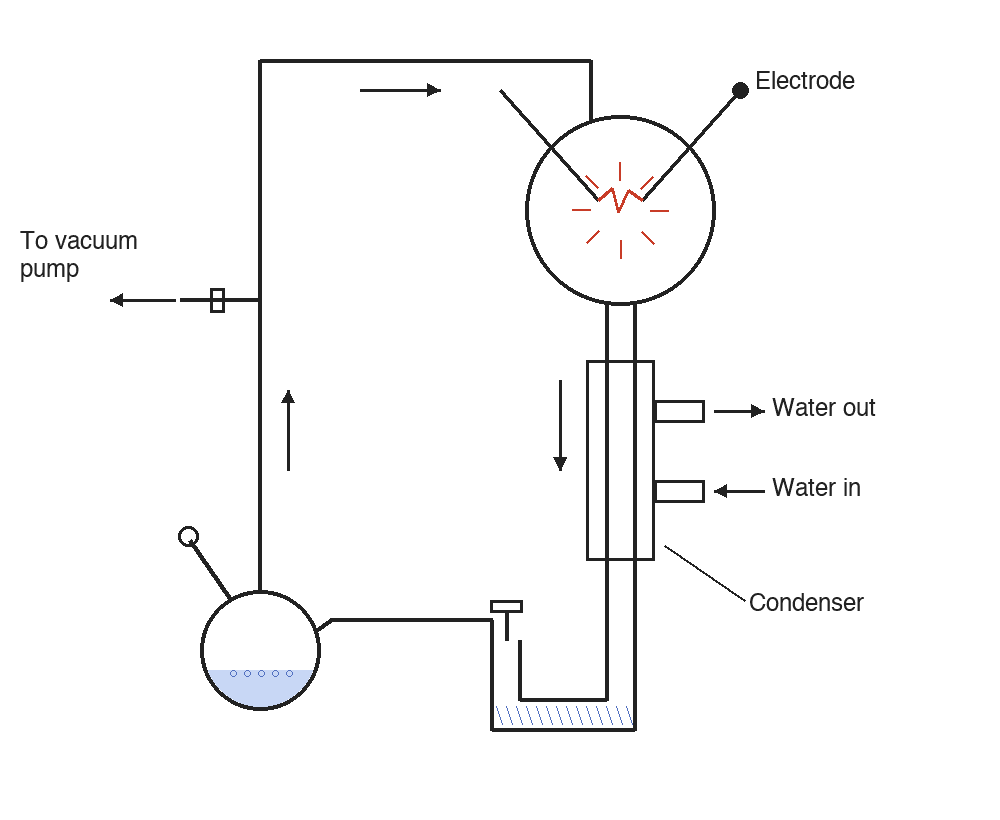
(b) Name the mixture of inorganic substances used in spark discharge.
(c) What was the purpose of the experiment?
(d) How was lightning simulated in this experiment?
(e) Name the compounds synthesised in this experiment.
- 303 marks
Question 30
What do the following changes represent in the given graph?
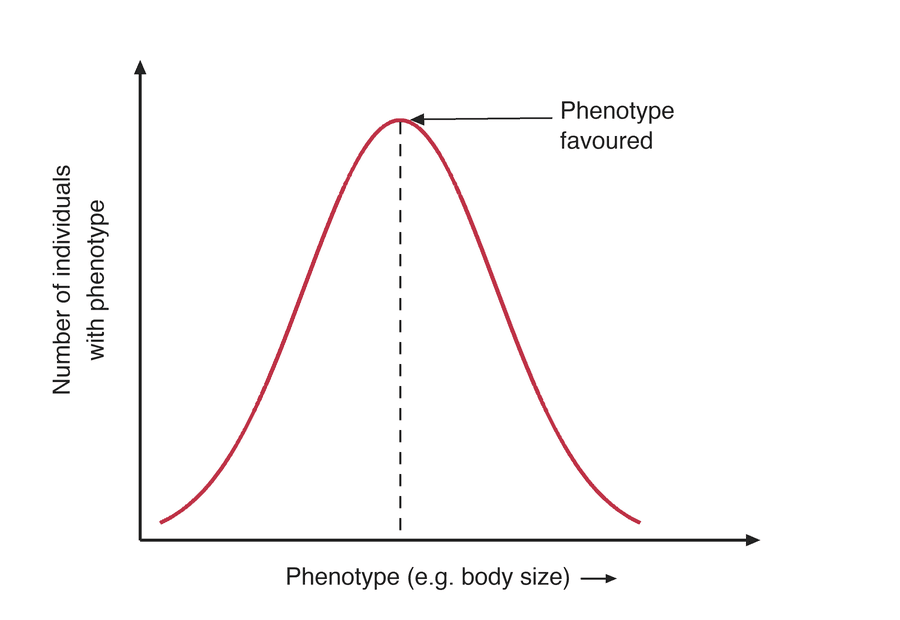
(i) If operation of natural selection makes peak higher and narrower.
(ii) If peak shifts to right direction.
(iii) If two peaks are formed instead.
- 313 marks
Question 31
Explain antibiotic resistance observed in bacteria in light of Darwinian selection theory.
- 323 marks
Question 32
Explain the evolution of long neck of giraffe according to Charles Darwin.
- 333 marks
Question 33
Explain industrial melanism.
- 341 mark
Question 34
A farmer near Jalgaon in Maharashtra grows a seedless banana variety. Every plant in the plantation was raised from a sucker (a shoot that grows from the underground stem of an older plant), and the plants never set seed. One plant starts bearing bunches with clearly shorter and thicker fruits. Suckers taken from this plant and planted in a different field also bear the short, thick fruits, year after year. (Hypothetical data.)
Which source of variation best explains this new feature?
- 351 mark
Question 35
Assertion (A): A study of how mammals, after the extinction of the dinosaurs, diversified into many new groups such as bats, whales and primates is a study of macroevolution.
Reason (R): Macroevolution is the study of the progressive changes in gene frequencies within a population over many generations.
- 361 mark
Question 36
A small village reservoir holds about 900 fish of a (hypothetical) carp species. For a gene that controls the scale pattern, the frequency of allele s in these fish is 0.10. The state fisheries department releases 100 hatchery-reared fish of the same species into the reservoir; in the hatchery stock the frequency of allele s is 0.60. The released fish survive and breed freely with the resident fish, and there is no mutation, selection or drift. (Hypothetical data.)
What is the frequency of allele s in the gene pool of the reservoir after the release?
- 372 marks
Question 37
A science website carries the headline: "DNA proves it — humans evolved from chimpanzees." The article below the headline reports that human and chimpanzee DNA, proteins and the banding patterns of their chromosomes are very similar.
Evaluate the headline. Give two reasons for your judgement, and rewrite the headline so that it states the evidence correctly.
- 382 marks
Question 38
An old museum collection in Shillong lists two "species" of a (hypothetical) hill bird: a bright blue bird and a brown, streaked bird of the same size. Every blue specimen in the collection is a male and every brown specimen is a female. A field team then watches these birds in the forests of Meghalaya for three breeding seasons. Blue birds always pair with brown birds, build nests with them and raise chicks. Ringed chicks from these nests grow up into both blue males and brown females, and these grown young pair and raise young of their own. (Hypothetical data.)
(a) Which way of defining a species led the museum to list two species? Why did it give a wrong result here?
(b) Which definition of a species does the field evidence use, and what does the evidence show?
- 393 marks
Question 39
In a school herb garden, some tulsi (holy basil) plants of the same variety and the same age have grown tall, while others have stayed short. Tulsi can be grown from stem cuttings, and a plant raised from a cutting has the same genes as the plant it was cut from. A student wants to find out whether the difference in height is an environmental variation or a genetic variation.
(a) Plan an experiment with stem cuttings that would answer the student's question. State the conditions you would keep the same.
(b) State the result you would expect if the difference in height is (i) environmental, (ii) genetic.
(c) Which of these two kinds of variation could play a part in the evolution of tulsi? Give a reason.
- 404 marks
Question 40
A genetics laboratory in Pune keeps fruit flies in culture bottles. A gene in these flies has two alleles, A and a, and earlier tests showed that the allele makes no difference to how well flies survive or breed in the laboratory. A student sets up eight small populations (S1–S8), each kept at 10 flies by choosing 10 parents at random in every generation, and two large populations (L1, L2) of 500 flies each. In every population the frequency of allele a was 0.50 at the start. All the bottles are kept under the same conditions. The table shows the frequency of allele a after 20 generations. (Hypothetical data.)
Population S1 S2 S3 S4 S5 S6 S7 S8 L1 L2 Number of flies 10 10 10 10 10 10 10 10 500 500 Frequency of allele a after 20 generations 0 0.80 0.20 1.00 0 0.65 0.35 1.00 0.48 0.53 (a) In how many small populations has allele a been lost, and in how many has it become the only allele of this gene? Calculate the mean frequency of allele a in the eight small populations.
(b) Explain why the small populations ended with such different frequencies, while both large populations stayed close to 0.50.
(c) The student concludes: "Allele a must be harmful, because natural selection removed it from populations S1 and S5." Evaluate this conclusion using the data.