
Opening your dashboard
Class 12 Biology Chapter 8 Evolution - Origin of Life: Competency-Based Questions (CBQ)
40 questions on Chapter 8, each worked through on its own page with the AI tutor. Class 12 Biology, ICSE 2026-27.
40 questions
1–5 marks · Mixed difficulty
- 14 marks
Question 1
A science centre in Bengaluru shows the history of the universe on a giant 24-hour clock. The universe begins at midnight (0:00), and the present moment is the next midnight (24:00). According to the Big Bang theory, the universe originated about 13.8 billion (13,800 million) years ago, so the whole 13,800 million years are squeezed into 24 hours.
(a) The earth was formed about 4,540 million years ago. At what time on the clock does this happen?
(b) The oldest widely accepted fossils of simple one-celled organisms (layered microbial mats called stromatolites) are about 3,500 million years old. At what time on the clock is this, and how many million years after the earth's formation?
(c) A visitor asks why life did not appear as soon as the earth was formed. Give two reasons, from the conditions on the early earth, why life had to wait.
- 21 mark
Question 2
Assertion (A): Methane and ammonia were present in the primitive atmosphere, although the main gases given out by volcanoes were hydrogen, nitrogen, water vapour and carbon dioxide.
Reason (R): Methane and ammonia were formed by the interaction of the volcanic gases in the atmosphere.
- 31 mark
Question 3
A school quiz card lists five events that, according to the Big Bang theory, led to the origin of the earth:
P: As the universe expanded and its temperature came down, galaxies such as the Milky Way formed.
Q: The universe began in the Big Bang, about 13.8 billion years ago, from an extremely hot, dense state that has been expanding ever since.
R: A spherical cloud of gases and cosmic dust collapsed under its own gravity into a rotating flattened disc.
S: Smaller clouds condensed by gravity to form the planets.
T: The earth's matter condensed into a solid lithosphere and a gaseous atmosphere.
Which order, from earliest to latest, is correct?
- 43 marks
Question 4
A college microbiology club repeats Pasteur's swan-necked flask experiment. Three flasks of the same nutrient broth are boiled for several minutes, their necks are bent into an S shape, and they are left to cool. (Hypothetical data.)
Flask What was done on day 10 Result after 3 months 1 Nothing; the neck stays intact and the flask upright Broth clear; no organisms 2 The bent neck is broken off Broth turns cloudy with microorganisms within a few days 3 Neck intact, but the flask is tilted so the broth runs into the bend and back Broth turns cloudy with microorganisms within a few days (a) The neck of flask 1 is open to the air. Explain why its broth still stays free of organisms.
(b) Explain why the broth in flask 3 turns cloudy even though its neck was never broken.
(c) A classmate argues that boiling had spoiled the broth so that it could no longer support life. Use flasks 2 and 3 to answer this classmate, and state the conclusion the three flasks together support.
- 51 mark
Question 5
Assertion (A): Aristotle believed that life could arise spontaneously from non-living material such as soil or mud.
Reason (R): Aristotle supported his belief with an experiment in which a dirty shirt and wheat grains kept in a dark cupboard produced mice.
- 61 mark
Question 6
During a debate on the origin of life, one team defends the theory of special creation, which holds that all species were created at once, as they are now, and have not changed since. Which finding from the study of fossils most directly contradicts this claim?
- 74 marks
Question 7
A museum timeline gives these ages (in million years before the present) for some events in the history of life on earth. The events are listed in random order.
Event Began (million years ago, approximate) P: Eukaryotes 1,600 Q: Oxygen-producing cyanobacteria 2,700–3,000 R: Abiotic chemical evolution and anaerobic life 4,200 S: Simple land plants 470 T: First mammals 220 (a) Arrange the events from the earliest to the latest.
(b) Using the table, how many million years separate the start of R from the start of Q?
(c) The appearance of Q is described as "the end of abiosynthesis". Explain why.
- 83 marks
Question 8
A college biochemistry class tests one part of Sidney Fox's work. (Hypothetical data.)
Tray Treatment of the same amino acid solution Result after 7 days A Kept dissolved in cold water at room temperature No polypeptide chains B Spread on a hot, dry rock-like plate until the water evaporates, then washed off with water Short polypeptide chains present (a) Explain why polypeptide chains formed in tray B but not in tray A.
(b) Where on the primitive earth could conditions like those of tray B have existed?
(c) Name the aggregates Fox obtained from such polymers, and state where this step fits in the possible sequence from simple gases to the first cell.
- 91 mark
Question 9
Assertion (A): Aerobic respiration could arise only after photoautotrophs had evolved.
Reason (R): Photosynthesis released oxygen as a by-product and changed the atmosphere from reducing to oxidising.
- 103 marks
Question 10
A college biology club in Pune builds a working model of Miller and Urey's apparatus: a gas chamber fitted with electrodes, a flask of water heated from below, a water-cooled condenser, and a liquid trap at the bottom of the circuit. Before the week-long run, they discuss what would go wrong if some parts failed.
(a) Suppose the heater under the water flask fails. What two jobs of the boiling water would be lost?
(b) Suppose the water supply to the condenser stops. Why would few products collect in the trap?
(c) Name the natural condition of the primitive earth that each of these imitates: the electric sparks, the boiling water, and the condenser.
- 111 mark
Question 11
Assertion (A): The Miller–Urey experiment showed that organic molecules can be synthesised abiotically in an oxidising atmosphere.
Reason (R): Free oxygen destroys most of the intermediate products formed during abiotic synthesis.
- 121 mark
Question 12
(Hypothetical data.) A space probe studies two moons. Both have liquid water and frequent lightning storms.
Moon P: methane, ammonia, hydrogen and water vapour; no free oxygen.
Moon Q: nitrogen, oxygen, carbon dioxide and water vapour.
Going by the conclusions of the Miller–Urey experiment, on which moon could amino acids most likely form without living cells?
- 133 marks
Question 13
A student makes cards for a class display on Lederberg's three stages of the biochemical origin of life:
P: Free atoms in the atmosphere combine to form water and ammonia.
Q: Simple sugars, purines and amino acids, formed in the atmosphere, reach the oceans with rainwater.
R: Protein droplets and nucleic acids of the oceanic broth form colloidal aggregates that can grow and divide by budding.
S: Some organisms develop chlorophyll and begin photosynthesis.
T: Cyanobacteria change into other forms of algae; fungi and protozoa appear.
(a) Sort the five cards under the stages chemogeny, biogeny and cognogeny.
(b) What names did Haldane and Oparin give to the cell-like aggregates of card R?
(c) Card T belongs to a stage in which a major change in cell type also took place. State that change.
- 141 mark
Question 14
Assertion (A): According to the modern concept of abiogenesis, the first living forms arose suddenly from non-living matter in a single step.
Reason (R): The modern concept of abiogenesis is based on the same principle as the Oparin–Haldane theory and the Miller–Urey experiment.
- 151 mark
Question 15
Assertion (A): Evolution is described as a slow, continuous and irreversible process of change.
Reason (R): All organisms obtain energy and matter from their environment and carry out metabolic processes.
- 161 mark
Question 16
A bacterium in a pond, a cell in a neem leaf and a cell in the human liver each carefully regulate the water and salts inside them and resist change, even when their surroundings change. Among the features that all organisms share, this is
- 174 marks
Question 17
A biotechnology student compares a 140-amino-acid stretch of the same blood protein in humans and four other animals. The table gives the number of positions at which each animal's protein differs from the human protein. (Hypothetical data.)
Animal Chimpanzee Gorilla Horse Fish Differences from human (out of 140) 1 2 16 30 (a) Arrange the four animals from the most to the least closely related to humans, and state the principle you used.
(b) Calculate the percentage of positions at which the horse protein, and the fish protein, are the same as the human protein.
(c) Even the fish protein is largely the same as the human one. Explain how this supports common ancestry, giving two other molecular features that all organisms share.
- 183 marks
Question 18
On a visit to the zoology museum of a veterinary college in Chennai, a class sees three specimens:
Specimen 1: a python skeleton with a small, rudimentary pelvic girdle.
Specimen 2: the gut of a herbivorous mammal with a large caecum at the junction of the small and large intestine.
Specimen 3: a human gut with a vermiform appendix at the same position.
(a) To which structures of four-footed vertebrates is the python's pelvic girdle homologous, and what does it suggest about the python's ancestry?
(b) What role does the caecum play in the herbivorous mammal?
(c) Why did this region become less important in humans, and what kind of organ is the human appendix?
- 193 marks
Question 19
(Hypothetical data.) Geologists studying an undisturbed quarry face in Kutch, Gujarat, find two layers of sedimentary rock:
Layer Position Fossils found X Lower Impressions of sea fish and marine shells Y Upper Leaves of land plants and bones of a land reptile (a) Which layer was formed first? Give a reason.
(b) What change in the area over time do these layers suggest, and which use of fossils does this illustrate?
(c) The reptile's bones from layer Y are fitted together into a nearly complete skeleton. Name two things about the extinct animal that palaeontologists can work out from it.
- 201 mark
Question 20
Assertion (A): Archaeopteryx is regarded as a connecting link between reptiles and birds.
Reason (R): The bones of Archaeopteryx were less dense than those of modern birds, and its breast bone (keel) was better developed than theirs.
- 211 mark
Question 21
In the Government Botanical Garden at Ooty, a student sees a Ruscus plant. Its flat, green, leaf-like structures are really modified stems, and they do the same job as the leaves of a mango tree. The leaf-like stems of Ruscus and the leaves of mango are
- 221 mark
Question 22
A botanist notes that tulip trees, sassafras and witch hazels grow naturally only in two widely separated regions: eastern North America and eastern Asia. Which explanation is supported by biogeographical evidence?
- 231 mark
Question 23
A student writes in a test: "A human embryo first becomes an adult fish, then an adult amphibian, and so on, before it becomes human." Which statement gives the accepted form of the recapitulation theory?
- 244 marks
Question 24
A natural history museum counts the fossil species of three plant groups in its collection of rocks from three eras. (Hypothetical data.)
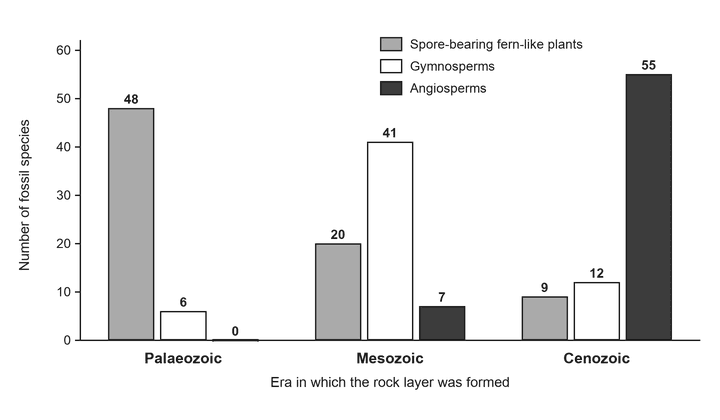
Plant group Palaeozoic Mesozoic Cenozoic Spore-bearing fern-like plants 48 20 9 Gymnosperms 6 41 12 Angiosperms 0 7 55 (a) For each era, name the plant group with the most fossil species. What names does the geological time scale give to the Mesozoic and Cenozoic eras on the basis of plant life?
(b) Why are there no angiosperm fossils from the Palaeozoic rocks, but a few from the Mesozoic?
(c) A visitor says the chart proves that flowering plants evolved step by step from gymnosperms. Give two points about the fossil record of plants that weaken this claim.
- 251 mark
Question 25
Assertion (A): Many of the major subdivisions of the vascular plants can be traced back to the Carboniferous period of the Palaeozoic era.
Reason (R): The Carboniferous period falls in the part of the Palaeozoic era known as the Age of amphibians.
- 265 marks
Question 26
Read the source given and answer the questions that follow.
Princeton University researchers B. Rosemary Grant and Peter Grant have been studying the evolution of Darwin's finches, for the last four decades, on the Galápagos Islands which are situated on the west coast of South American mainland.
They have found that a new species of Darwin's finches developed in as little as two generations. This provides direct genetic evidence in which the new species arise.
Their research has shown that the droughts on the island can drive evolutionary changes in the finches. Drought diminished the supplies of easily cracked nuts but permitted the survival of plants that produce larger, tougher nuts. Drought thus favoured birds with strong, wide beaks that can break these tougher seeds. This led to producing populations of birds with these traits. The Grants have estimated that if droughts occur about once every 10 years on the islands, a new species of finch would arise in only about 200 years.
1. According to the research study by Grants, appearance of new species points towards
(a) disuse of organs (b) natural selection (c) mutation selection (d) artificial selection
2. The Grants study found that the drought on Galapagos Islands led to
(a) depletion of easily cracked nuts (b) depletion of large strong nuts (c) finches migrating from main land (d) reduced population on finches
3. During droughts in the island, survival of following types of plants was observed
(a) grasses with thin leaves (b) plants with small nuts (c) plants with tough nuts (d) plants with small leaves
4. New species of Darwin's finches as observed by the research group were
(a) large and strong (b) similar to main land (c) had narrow, small beaks (d) had strong, wide beaks
5. The study by Grants points towards the following evolutionary change
(a) droughts can occur on islands (b) new species due to evolutionary changes (c) scarcity of food on island (d) migration of finches to main land
- 275 marks
Question 27
(a) Name the scientist who conducted simulation experiment as shown in the figure.
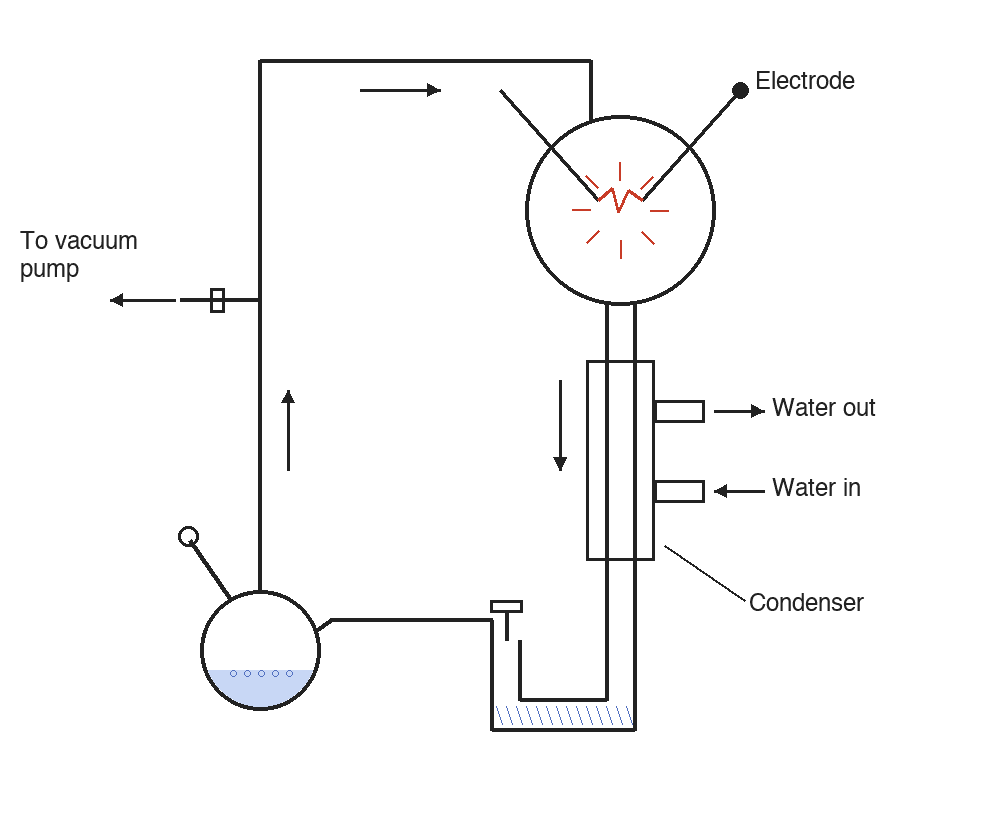
(b) Name the mixture of inorganic substances used in spark discharge.
(c) What was the purpose of the experiment?
(d) How was lightning simulated in this experiment?
(e) Name the compounds synthesised in this experiment.
- 285 marks
Question 28
Give scientific reasons for the following statements.
(i) Process of growth & divisions were not precise and regulated in coacervates.
(ii) Oparin and Haldane theory of origin of life is the most accepted one at present.
(iii) First evolved organisms were heterotrophs and anaerobes.
(iv) Abiogenesis is not possible at present.
(v) Ozone sheath was formed in the stratosphere after the origin of life on earth.
- 293 marks
Question 29
(i) Write two differences between homologous organs and analogous organs.
(ii) Give one example of homologous organs and one example of analogous organs found in plants.
- 305 marks
Question 30
(i) Describe the Oparin Haldane Theory of origin of life.
(ii) The tadpole larva of amphibians resembles fishes. How does this observation support evolution?
- 311 mark
Question 31
A team of geologists in a quarry finds a thin layer of volcanic ash lying just below a fossil-bearing layer of sedimentary rock. They think the ash is about 300 million years old and want to check its age by radioactive dating. The table gives the half-lives of four radioactive isotopes.
Isotope Half-life Carbon-14 5,730 years Potassium-40 1,250 million years Tritium (hydrogen-3) 12.3 years Iodine-131 8 days Which isotope is suitable for dating this ash layer, and why?
- 321 mark
Question 32
Redi kept meat in open flasks and in sealed flasks. Little white worms (maggots) appeared only on the meat in the open flasks. Supporters of spontaneous generation objected: “By sealing the flasks you also shut out fresh air, and the meat needs fresh air to give rise to life.”
Which further set-up would best answer this objection?
- 331 mark
Question 33
Assertion (A): The Cenozoic era is called the Age of mammals, even though the first mammals appeared earlier, in the Mesozoic era.
Reason (R): In the geological time scale, an era is named after the group of organisms that was dominant during it, not after the group that first appeared in it.
- 341 mark
Question 34
In 1969 a meteorite fell near the town of Murchison in Australia. Scientists found in it more than 70 kinds of amino acids, including many kinds that living organisms on earth do not use. Their tests showed that these amino acids had formed in space and were not contamination picked up on earth. No cells or spores were found.
Which conclusion does this finding justify?
- 352 marks
Question 35
The audio guide at a science museum in Kolkata plays four statements about how life began:
P: “Every kind of living thing was made in its present form at one time, and none has changed since.”
Q: “Hundreds of small frogs appear from the dry, cracked mud of a pond after the first monsoon shower, so the wet mud must turn into frogs.”
R: “Life on earth began from spores of simple organisms that travelled through space on meteorites.”
S: “Simple gases, given energy by lightning and ultraviolet rays, slowly formed the molecules that later made up the first cells.”
(a) Name the theory of the origin of life that each statement belongs to.
(b) Using the theory of biogenesis, explain where the frogs in statement Q really come from.
- 362 marks
Question 36
Meera notices green and black mould growing on a slice of bread left in her kitchen. Her younger brother says the mould is made by the bread itself as it goes stale. Meera knows that mould grows from tiny spores carried in the air.
Design a simple experiment that Meera could do at home to show that the mould comes from spores in the air (biogenesis) and not from the bread itself. State the expected result.
- 373 marks
Question 37
A teacher describes four kinds of early microorganisms, W, X, Y and Z, according to the Oparin–Haldane picture of early life. She does not name them.
Kind Source of its organic compounds Source of its energy Chlorophyll Oxygen W Takes them ready-made from the surroundings Fermentation of the organic compounds Absent Neither uses nor releases it X Makes them from carbon dioxide Chemical reactions of inorganic compounds Absent Neither uses nor releases it Y Makes them from carbon dioxide and water Sunlight Present Releases it Z Takes them ready-made from the surroundings Breaking down food with oxygen Absent Uses it (a) Name the mode of nutrition of each kind, using the terms of the Oparin–Haldane picture.
(b) Arrange the four kinds in the order in which they are thought to have appeared on earth.
(c) Give one reason why W is placed first and one reason why Z is placed last.
- 383 marks
Question 38
A poster in a school corridor says: “Most of the earth’s history has been the time of fish, reptiles and mammals.” A student checks it against these rounded current values from the geological time scale.
Event Began (million years ago) Formation of the earth 4,540 Palaeozoic era 539 Mesozoic era 252 Cenozoic era 66 (a) Calculate the length of each of the three eras.
(b) What percentage of the earth’s history do the three eras together make up? Give your answer to one decimal place.
(c) Is the poster right? Give a reason, and state what kind of life the fossil record shows for most of the rest of the earth’s history.
- 392 marks
Question 39
During a class discussion, Arjun says: “Evolution always makes organs bigger and more numerous. Over time, every lineage only gains parts and never loses them.”
Evaluate Arjun’s claim, using two examples from the evolution of animals.
- 405 marks
Question 40
A research group repeats the Miller–Urey experiment with methane, ammonia, hydrogen and water vapour, and sparks running all the time. Every day they take a small sample of the water and measure four substances. Hydrogen cyanide (HCN) and aldehydes are known to react with ammonia in water to form amino acids. (Hypothetical data.)
Day 0 1 2 3 5 7 Ammonia 100 82 66 55 42 34 Hydrogen cyanide 0 9 12 10 6 3 Aldehydes 0 7 9 8 5 3 Amino acids 0 2 5 8 12 14 (All amounts are relative amounts in the same arbitrary units.)
(a) Which substance in the table was used up steadily, and which kept increasing? What percentage of the starting ammonia had been used up by day 7?
(b) Hydrogen cyanide and aldehydes rose to a peak and then fell, while amino acids kept rising. What does this pattern suggest about how the amino acids were formed?
(c) In a second run, the sparks are switched off at the end of day 2, but the heating and cooling continue. Predict, with a reason, how the amount of amino acids would change after day 2.