
Opening your dashboard
Class 12 Biology Chapter 6 Chromosomes, Sex-Linked Inheritance and Human Genetic Disorders: Competency-Based Questions (CBQ)
40 questions on Chapter 6, each worked through on its own page with the AI tutor. Class 12 Biology, ICSE 2026-27.
40 questions
1–5 marks · Mixed difficulty
- 13 marks
Question 1
A student studying meiosis on a microscope slide sketches one cell of a plant just before meiosis. She marks three genes on its two pairs of homologous chromosomes, as shown. (Hypothetical example.)
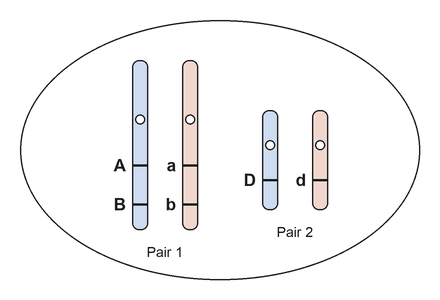
Assume that no crossing over takes place in this cell's line of descent unless a part asks about it.
(a) List all the kinds of gametes this plant can form, with the percentage of each.
(b) For which two pairs of genes does Mendel's law of independent assortment hold, and for which pair does it fail? Explain using the behaviour of chromosomes in meiosis.
(c) A few gametes of the type A b D are also found. Name the event that produced them, and state between which structures and in which stage it occurs.
- 24 marks
Question 2
A plant breeder at an agricultural university in Ludhiana works with two genes of a crop plant: P (purple flower) is dominant over p (white flower), and L (long fruit) is dominant over l (round fruit). She test-crosses a plant of genotype PpLl with a ppll plant. Her results are given below. (Hypothetical data.)
Offspring Number Purple, long 46 Purple, round 456 White, long 448 White, round 50 Total 1000 (a) She had expected purple-long and white-round to be the commonest classes. Explain why they are not, and give the arrangement of the alleles on the two homologous chromosomes of the PpLl plant.
(b) Calculate the recombination frequency between the two genes, and state their distance on a linkage map.
(c) She needs many purple-long plants. Another PpLl plant has P and L on one chromosome and p and l on its homologue. About how many purple-long plants would its test cross give out of 1000? Show how you got the number.
- 31 mark
Question 3
In a plant, genes A and B lie on the same chromosome. One plant has A and B on one chromosome and a and b on its homologue. Because of crossing over, it forms gametes in these proportions: AB 40%, ab 40%, Ab 10%, aB 10%. (Hypothetical data.)
The plant is self-pollinated. What percentage of the offspring will be aabb?
- 41 mark
Question 4
Assertion (A): The 12.6% recombinants in Bateson and Punnett's test cross for flower colour and pollen shape show that these two genes are incompletely linked.
Reason (R): Incompletely linked genes lie very close together on the same chromosome.
- 53 marks
Question 5
Students in a college genetics laboratory in Bengaluru are given this extract from the linkage map of one Drosophila chromosome. Each gene's position is in map units from one end.
Gene Net veins Black body Purple eyes Cinnabar eyes Vestigial wings Brown eyes Map position 0.0 48.5 54.5 57.5 67.0 104.5 (a) Which two genes in the extract are the most tightly linked? What percentage of recombinant offspring would a test cross for this pair be expected to give?
(b) One student predicts that a test cross for net veins and brown eyes will give 104.5% recombinants. Explain his mistake and state what the test cross would actually show.
(c) Map makers never look at the genes themselves. On what is the map based?
- 61 mark
Question 6
Assertion (A): A linkage map shows the actual physical distance between two genes on a chromosome in micrometres.
Reason (R): On a linkage map, a crossing-over frequency of 1% is taken as a distance of 1 unit.
- 73 marks
Question 7
During a zoology field project, students study chromosome slides of three animals, P, Q and R. Their observations are given below.
Animal Body cell of female Body cell of male Eggs Sperms P 24 chromosomes 23 chromosomes all have 12 half have 12, half have 11 Q 46 chromosomes 46 chromosomes all alike, 23 each 23 each, of two kinds that differ in one chromosome R 78 chromosomes 78 chromosomes 39 each, of two kinds that differ in one chromosome all alike, 39 each (a) Which animal shows female heterogamety? Write the sex chromosomes of its male and its female.
(b) Why does the male of P have one chromosome fewer than the female? Name this type of sex determination and give the sex chromosomes of the male's two kinds of sperm.
(c) In which of the animals does the father decide the sex of the offspring? Give a reason.
- 81 mark
Question 8
Assertion (A): The sex of a human child is fixed at the time of fertilisation.
Reason (R): A woman produces two kinds of eggs: some carry an X chromosome and the others carry a Y chromosome.
- 94 marks
Question 9
A school in Pune holds a vision-screening camp. Each student reads special colour charts. (Hypothetical data.)
Group tested Number tested Colour blind Boys 500 30 Girls 500 2 (a) Colour blindness is due to a recessive allele on the X chromosome. Explain why so many more boys than girls are colour blind.
(b) What must be true of the father, and of the mother, of each colour-blind girl?
(c) One colour-blind girl, Riya, has a younger brother with normal vision. What is the genotype of her mother? Give the reason. What is the chance that the couple's next son will be colour blind?
- 101 mark
Question 10
Assertion (A): All the sons of a colour-blind woman are colour blind, whatever the vision of her husband.
Reason (R): She carries the recessive allele on both her X chromosomes, and a son receives his only X chromosome from his mother.
- 111 mark
Question 11
A genetic counsellor in Jaipur is studying a trait that appears in several members of a family. Which one observation, on its own, shows that the trait cannot be X-linked recessive?
- 124 marks
Question 12
A research laboratory compares the start of the mRNA of a normal gene with that of three mutant forms, X, Y and Z. (Hypothetical sequences.)
Form mRNA, read in codons from the start Normal AUG – GAA – UAC – CGU – GGA Mutant X AUG – GUA – UAC – CGU – GGA Mutant Y AUG – GAA – UAA – CGU – GGA Mutant Z AUG – AAU – ACC – GUG – GA… Codons used: AUG = methionine, GAA = glutamic acid, GUA = valine, UAC = tyrosine, CGU = arginine, GGA = glycine, UAA = stop.
(a) Name the kind of change in each of X, Y and Z.
(b) Which mutant will make the shortest polypeptide? Give a reason.
(c) Name a human disease, described in this chapter, caused by the same kind of change as X, and one caused by the same kind of change as Z.
- 131 mark
Question 13
Suresh works as an X-ray technician in a hospital. After an accidental exposure to X-rays, a mutation arises in some of the cells of the skin of his hand. Will his future children inherit this mutation?
- 141 mark
Question 14
Assertion (A): Sickle cell anaemia is caused by a gene (point) mutation.
Reason (R): Mutations occur randomly and may arise spontaneously or be induced by mutagens.
- 154 marks
Question 15
A large government maternity hospital in Hyderabad reviews ten years of birth records. (Hypothetical data.)
Age of mother (years) Births Babies with Down syndrome 20–24 20,000 14 25–29 30,000 24 30–34 16,000 24 35–39 5,000 25 40–44 1,000 20 (a) Work out the number of babies with Down syndrome per 10,000 births for mothers aged 20–24 and for mothers aged 40–44. How many times greater is the second figure?
(b) A nurse says the risk is the same for mothers aged 25–29 and 35–39, because both groups had about the same number of affected babies. Is she right? Explain.
(c) Explain how an error in the mother's egg leads to Down syndrome. Give the chromosome number of the egg and of the baby's body cells.
- 164 marks
Question 16
In a genetics class at a medical college in Kolkata, the teacher explains that the two X chromosomes of a woman can sometimes fail to separate during egg formation (non-disjunction). Such a woman's husband forms normal sperms.
(a) Name the two kinds of abnormal eggs that this error can produce, with their chromosome numbers.
(b) Each abnormal egg may be fertilised by an X-bearing or a Y-bearing sperm. Write the sex chromosomes of all four zygotes and state what each zygote develops into.
(c) Explain why a YO zygote can never be formed when non-disjunction occurs only in the father and the mother's eggs are normal.
- 171 mark
Question 17
A colour-blind woman and a man with normal vision have a son with Klinefelter's syndrome (44 + XXY). The son has normal colour vision. Assuming no new mutation, where did the non-disjunction of sex chromosomes take place?
- 181 mark
Question 18
Meera, aged 22, learns that her father, aged 48, has just been found to have Huntington's chorea. He is heterozygous for the gene, and her mother has no history of the disorder. What is the chance that Meera carries the gene, and why does her good health at present not settle the question?
- 191 mark
Question 19
Assertion (A): Individuals with Turner's syndrome are usually sterile.
Reason (R): Individuals with Turner's syndrome are of short stature and have a webbed neck.
- 203 marks
Question 20
A research team at a medical college in Lucknow studies 200 pairs of identical twins and 200 pairs of fraternal twins of the same sex. For each feature it records the percentage of pairs in which both twins are alike. (Hypothetical data.)
Feature Identical twins: pairs alike (%) Fraternal twins: pairs alike (%) ABO blood group 100 60 Feature K 52 49 Feature L 85 40 (a) Why are the identical twins alike in blood group in every pair, while the fraternal twins are not?
(b) Which feature, K or L, depends mainly on the environment? Give a reason from the data.
(c) Feature L is strongly inherited, yet identical twins are alike for it in only 85% of pairs. What does this tell you?
- 211 mark
Question 21
Assertion (A): A routine karyotype of a patient can show that he has sickle cell anaemia.
Reason (R): Karyotyping can detect changes in the number of chromosomes and gross changes in their structure.
- 221 mark
Question 22
A geneticist in Delhi wants to work out how a rare inherited trait is passed on. Each family she meets has only two or three children, too few to show a clear ratio, so she records the trait in thousands of people of a large population. Which approach is she using, and which problem does it overcome?
- 234 marks
Question 23
A genetic counsellor in Chennai records this family history of polydactyly (extra fingers or toes). (Hypothetical family.)
A polydactylous man (I-1) married a normal woman (I-2). They had four children: a polydactylous son (II-1), a polydactylous daughter (II-2), a normal son (II-3) and a normal daughter (II-4). II-2 married a normal man (II-5); they have a polydactylous daughter (III-1) and a normal son (III-2). II-3 married a normal woman (II-6); their three children, a son (III-3), a daughter (III-4) and a son (III-5), are all normal.
(a) Draw the pedigree chart using standard symbols.
(b) Give two features of the chart that point to a dominant trait, and one feature that shows the gene is not on the X chromosome.
(c) II-2 and II-5 are expecting another child. What is the chance that this child is polydactylous? Show the cross.
- 241 mark
Question 24
The pedigree shows a family with an autosomal recessive disorder.
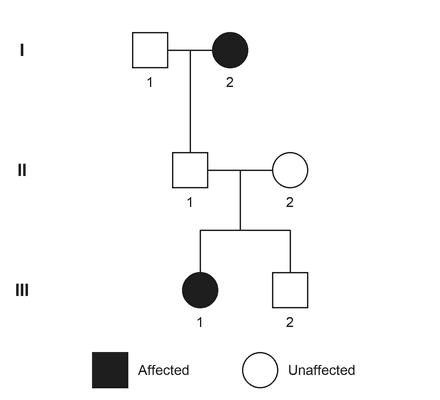
Which individuals are certainly heterozygous?
- 251 mark
Question 25
Assertion (A): If two parents who both show a trait have a child who does not show it, the trait cannot be recessive.
Reason (R): Parents who both show a recessive trait are homozygous recessive, so they can pass on only the recessive allele.
- 265 marks
Question 26
Read the source given and answer the questions that follow.
Sickle cell anaemia is an inherited red blood cell disorders that affects haemoglobin, which carries oxygen in the body. It results due to a mutation in which amino acid glutamate at position 6 is replaced by valine in the beta-chain of haemoglobin. Normally the red blood cells are biconcave disc-shaped and flexible to move through the blood vessels. But in sickle cell disease, they become crescent or 'sickle' shaped and cannot bend and carry enough oxygen leading to anaemia. A portion of β-chain of haemoglobin of a normal human is as follows
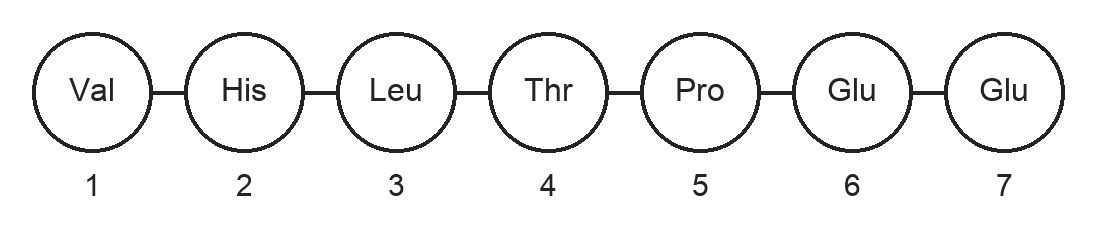
The normal codon for the sixth amino acid is GAG. In some individuals, due to mutation X, the sixth codon GAG mutates to GUG.
1. GUG is the code for
(a) Valine (b) Glutamic acid (c) Proline (d) Leucine
2. Which of the following statements is correct for mutation X?
(a) causes no change in the shape of red blood cells (b) in β-chain of haemoglobin, proline is changed to valine (c) red blood cells cannot carry enough oxygen in body (d) shape of red blood cells becomes biconvex disc-like
3. Due to the mutation, shape of RBCs becomes
(a) biconcave disc-like (b) elongated (c) circular (d) crescent-shape
4. The disease sickle cell anaemia is due to
(a) valine is replaced by glutamic acid at first position (b) glutamic acid is replaced by valine at first position (c) valine is replaced by glutamic acid at sixth position (d) glutamic acid is replaced by valine at sixth position
5. The normal code for glutamic acid is
(a) GAA (b) GUG (c) GAG (d) GAU
- 275 marks
Question 27
Read the source given and answer the questions that follow.
Haemophilia is a sex-linked or X-linked disease which is also known as bleeder's disease as the patient continues to bleed even from a minor cut due to the absence of anti-haemophilic globulin or factor VIII and plasma thromboplastin factor IX essential for blood clotting. As a result of continuous bleeding the patient may die of blood loss. Colour blindness is another type of sex-linked disease in which the person is not able to distinguish red, green or both the colours from other colours. Vision is not affected and the person can lead a normal life. Sex-linked diseases, as given above are recessively inherited disorders present on the X chromosomes. The males express the trait more often as they have only one X chromosome and Y chromosome carries no allele. A heterozygous female is normal but carrier of the trait. She has one X chromosome with normal gene and the other with defective gene. She can pass on the trait to both male and female offsprings through the defective X chromosome.
1. A haemophilic person lacks the following in blood.
(a) plasma globulins (b) plasma thromboplastin factor IX (c) albumins (d) WBC
2. Which of the following statements is incorrect regarding haemophilia?
(a) It is an X-linked dominant disease (b) It involves absence of clotting factors (c) It is a sex-linked recessive disease (d) Person keeps bleeding even from a minor cut
3. If a normal man marries a female whose father was colour blind, which of the following statements is true for their offsprings?
(a) All sons will be colour blind (b) All daughters will be colour blind (c) 50% chance for sons to be colour blind and 50% chance for daughters to be carrier (d) All sons will be normal but all daughters will be carriers
4. A colour blind man marries a normal female. What are the chances that their son is colour blind?
(a) 25% (b) 50% (c) 75% (d) 0%
5. A female can be haemophilic, only if she has
(a) haemophilic mother and normal father (b) carrier mother and haemophilic father (c) a carrier mother and normal father (d) both (a) and (b)
- 285 marks
Question 28
Read the source given and answer the questions that follow.
Thalassaemia is an autosomal recessive genetic disorder caused by the defect in the synthesis of globin chains of haemoglobin. Haemoglobin has four chains two alpha and two beta. Depending on which globin chains are affected, it can be alpha thalassaemia or beta thalassaemia. Beta thalassaemia is due to a mutation in the HBB gene on chromosome 11. Beta thalassaemia exists in two states, as a carrier (beta thalassaemia minor) or affected (beta thalassaemia major). Beta thalassaemia minor is a condition when one of the two beta globin copies is faulty. Individual is healthy but a carrier. Beta thalassaemia major is a condition when both copies of the beta globin chain are affected and there is no production of beta globin chain. Such individuals have severe anaemia and need frequent blood transfusions. If a faulty globin is represented by 'r' and normal working copy as 'R', a person could be normal (RR), a carrier (Rr) or affected (rr).
1. Beta thalassaemia disorder is inherited from parents to children in the following way.
(a) mainly to the male child (b) mainly to the female child (c) only from carrier to thalassaemia major (d) equally to a male or a female child
2. If both parents are genetic carriers, the chances of their child being a thalassaemia major is
(a) 25% (b) 50% (c) 75% (d) 100%
3. A female who is beta thalassaemia minor has
(a) one copy of defective gene on chromosome X (b) two copies of defective gene on chromosome X (c) one copy of defective gene on an autosome (d) two copies of defective gene on an autosome
4. Study the chart given below and choose the correct answer
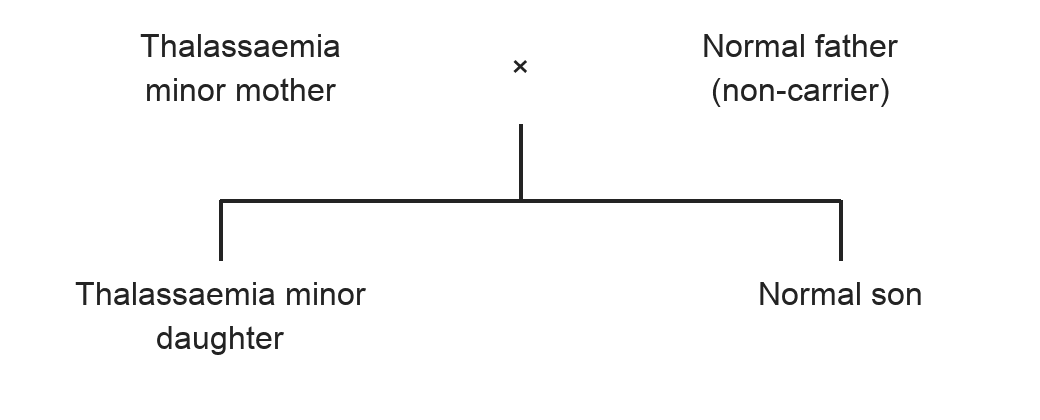
(a) The genotype of mother is 'rr' and father is 'RR' (b) Thalassaemia is inherited from mother to daughters and not to sons (c) There is a 50% possibility for a child to be thalassaemia minor (d) There is a 25% possibility for a child to be thalassaemia minor
5. Beta thalassaemia major child has
(a) severe anaemia due to one faulty copy of beta-globin chain (b) needs blood transfusion as no beta globin is produced (c) anaemia due to one faulty and one normal copy of beta-globin chain (d) none of the above
- 293 marks
Question 29
How is sex determined in human beings?
- 303 marks
Question 30
A man who is a PTC taster has a non-taster wife. They have a taster son and two non-taster daughters. Give the genotypes of the parents. Is this a sex-linked character? Explain.
- 313 marks
Question 31
Duchenne's muscular dystrophy is sex-linked and usually affects only males. People with the disease become progressively weaker early in life.
(a) What is the probability that a woman whose brother has Duchenne's muscular dystrophy will have an affected child?
(b) If the mother's brother had Duchenne's disease, what is the probability that the person will receive the gene?
- 323 marks
Question 32
Explain the process of sex-determination in grasshopper.
- 333 marks
Question 33
What is the genotype of Turner's Syndrome? Mention any one symptom of this syndrome.
- 341 mark
Question 34
A poultry farm near Namakkal wants to separate day-old chicks into males and females without handling each chick. In the fowl, a cock has the sex chromosomes ZZ and a hen has ZW. The gene for barred (striped) feathers lies on the Z chromosome and has no partner on the W chromosome. Its allele B (barred) is dominant over b (non-barred), and a day-old barred chick shows a pale spot on its head that a non-barred chick lacks.
Which cross of parent birds gives chicks in which every chick with the head spot is a male and every chick without it is a female?
- 351 mark
Question 35
Assertion (A): A male honeybee (drone) has no father, yet it has a grandfather on its mother's side.
Reason (R): A drone develops from an unfertilised egg, while its mother, the queen, developed from a fertilised egg.
- 361 mark
Question 36
A cytogenetics laboratory compares the band patterns of two different (non-homologous) chromosomes in a healthy parent and in that parent's child. The letters stand for bands, read from one end, and the dot marks the centromere. (Hypothetical data.)
Chromosome Parent Child Chromosome 1 A B C D • E F G H A B C D • E F Q R Chromosome 2 M N O • P Q R M N O • P G H Which change in chromosome structure best explains the child's chromosomes?
- 372 marks
Question 37
A rice breeder at a research station in Cuttack wants to select plants carrying R, a dominant gene for resistance to bacterial blight, without infecting every seedling. Testing for the disease takes weeks, but two marker genes on the same chromosome can be checked in a few days. The linkage map of this region is given below. (Hypothetical data.)
Gene Marker M1 Resistance gene R Marker M2 Map position (map units) A plant carrying the M1, R and M2 alleles of the resistant parent on one chromosome, and the susceptible parent's alleles of all three genes on its homologue, is test-crossed with a susceptible plant, and the breeder keeps only offspring that show the resistant parent's allele of one marker.
(a) Which marker, M1 or M2, should the breeder use? Give a reason.
(b) Out of test-cross offspring kept because they carry the chosen marker allele, about how many would be expected to lack the gene R?
- 382 marks
Question 38
In a college laboratory stock of Drosophila that has bred true for red, round eyes for years, a student finds one male with narrow eyes. Breeding shows that narrow eyes are due to a recessive allele. (Hypothetical mutant.)
Plan two generations of crosses, starting with this male, to find out whether the narrow-eye gene lies on the X chromosome or on an autosome. State the result you would expect in each case.
- 393 marks
Question 39
A genetic counsellor at a hospital in Bhopal receives three referrals in one week.
- Referral 1: A newborn baby has a flat face and weak muscle tone, and the doctor suspects Down syndrome.
- Referral 2: A rare form of early hearing loss has appeared in several members of one family over four generations, and the family wants to know whether it is passed on as a dominant or a recessive trait.
- Referral 3: A medical team wants to find out how much of the variation in adult body weight in a town is due to genes and how much to diet and lifestyle.
The three methods available are karyotyping, pedigree analysis and twin studies.
(a) Choose the most suitable method for each referral and give one reason for each choice.
(b) A trainee suggests that karyotyping all members of the family in Referral 2 would answer the family's question. Is the trainee right? Explain.
- 405 marks
Question 40
Plant breeders often expose seeds to gamma rays to create new mutations, because a useful new variety, such as one with shorter stems or earlier ripening, may arise among the mutants. In a trial at an agricultural university, batches of dry rice seeds were exposed to different doses of gamma rays and sown. The dose is measured in gray (Gy), the unit of absorbed radiation dose. Each plant that survived to flower was self-pollinated, and the seeds of each plant were raised next season as one family. The breeders counted the families in which a new visible mutant, such as a dwarf or a pale-leaved seedling, appeared. (Hypothetical data.)
Dose (Gy) Seeds that grew into flowering plants (%) Families showing a new mutant (%) none seen (a) Why did the breeders include a batch of seeds given Gy? State why the mutants are counted in the families and not in the treated plants themselves.
(b) For each dose from to Gy, work out how many mutant families are expected from a batch of seeds. Which dose gives the most?
(c) A trainee proposes using Gy next season, "because the percentage of mutant families rises with the dose". Evaluate this proposal using the data.