
Opening your dashboard
Class 12 Biology Chapter 3 Human Reproduction: Competency-Based Questions (CBQ)
40 questions on Chapter 3, each worked through on its own page with the AI tutor. Class 12 Biology, ICSE 2026-27.
40 questions
1–5 marks · Mixed difficulty
- 13 marks
Question 1
At a children's clinic in Lucknow, a doctor examines three one-year-old boys (hypothetical case). In boy X both testes are in the scrotum. In boy Y one testis is in the scrotum and the other is still inside the abdominal cavity. In boy Z neither testis has come down into the scrotum.
(a) Through which opening do the testes normally pass into the scrotum, and what encloses the blood vessels, nerves and ducts they pull down with them?
(b) Explain why boy Z will not be able to produce sperms as an adult if his testes stay in the abdomen.
(c) Can boy Y produce sperms as an adult if his second testis never descends? Give a reason.
- 21 mark
Question 2
A man's semen is examined in a hospital laboratory in Chennai (hypothetical case). Both his vasa deferentia are completely blocked just where they leave the epididymis; the rest of his duct system and all his glands are normal. What will his semen be like?
- 31 mark
Question 3
Assertion (A): Sperms released from the seminiferous tubules are stored in the epididymis for some time before they pass into the vas deferens.
Reason (R): The sperms released from the seminiferous tubules are immature; they get concentrated and mature in the epididymis.
- 41 mark
Question 4
A 35-year-old woman has both her ovaries removed in an operation, but her uterus, fallopian tubes and pituitary gland are left normal (hypothetical case). Which change is expected?
- 51 mark
Question 5
Assertion (A): The endometrium of the uterus breaks down and is built up again in every menstrual cycle.
Reason (R): The myometrium is a thick middle layer of smooth muscle that contracts strongly during the delivery of a baby.
- 63 marks
Question 6
A research laboratory in Hyderabad measured the volume of germ cells before and after the growth phase of gametogenesis. (Hypothetical data.)
Organ Cell before growth Volume (µm³) Cell after growth Volume (µm³) Testis Spermatogonium 900 Primary spermatocyte 1800 Ovary Oogonium 900 Primary oocyte 5400 (a) Calculate how many times the cell volume increases during the growth phase in each organ.
(b) Do these results agree with the difference expected between spermatogenesis and oogenesis? Explain.
(c) What is the growth phase a preparation for, and what is the chromosome number of the cells formed by it?
- 71 mark
Question 7
A semen sample tested at a fertility clinic in Pune shows sperms with normal heads and normal tails, but they swim only very weakly. A stain shows that the spiral structures in their middle pieces are abnormal (hypothetical case). Which explanation fits best?
- 81 mark
Question 8
Assertion (A): Each spermatid formed in the seminiferous tubules contains 46 chromosomes.
Reason (R): Spermatids are formed from secondary spermatocytes by the second meiotic division.
- 93 marks
Question 9
Students in a histology class in Kochi compare slides of two ovaries (hypothetical case).
Structure seen Ovary P (girl aged 6 years) Ovary Q (woman aged 25, day 20 of her cycle) Primary follicles many fewer Secondary follicles none a few Graafian follicle none none Corpus luteum none one, developing (a) Why are there no secondary or Graafian follicles in ovary P?
(b) State two features by which the students can tell a secondary follicle in ovary Q from a primary follicle.
(c) What does the developing corpus luteum in ovary Q tell about this cycle, and which hormone is it releasing?
- 101 mark
Question 10
Blood tests on a woman over one cycle show that her FSH level is normal but her LH level stays very low throughout (hypothetical case). Which outcome is expected in her ovary during this cycle?
- 111 mark
Question 11
Assertion (A): A mature Graafian follicle protrudes from the surface of the ovary.
Reason (R): A mature Graafian follicle is only about 1 mm in diameter.
- 123 marks
Question 12
A gynaecology unit in Bhopal recorded the blood hormone levels of a woman with a regular 28-day cycle in which the ovum was not fertilised. (Hypothetical data; values in arbitrary units.)
Day of cycle 3 7 11 13 14 16 21 27 Oestrogen 4 9 26 20 15 10 18 5 LH 5 6 8 20 60 12 6 4 Progesterone 1 1 1 1 2 5 15 2 (a) Use the LH values to find the day of ovulation. How many days before ovulation does oestrogen reach its maximum?
(b) What does the sharp rise in LH bring about in the ovary?
(c) Which structure is releasing the progesterone recorded on day 21, and what is its effect on the endometrium?
- 131 mark
Question 13
Assertion (A): Menstruation begins when the blood levels of oestrogen and progesterone are very high.
Reason (R): Menstruation follows the degeneration of the corpus luteum when the released ovum is not fertilised.
- 143 marks
Question 14
A technician in a hospital embryology laboratory in Delhi photographs a human egg collected just after ovulation, at a magnification of ×400. On the print the egg (without its outer layer of cells) measures 60 mm across. (Hypothetical data.) The egg's nucleus is seen held at the metaphase of the second meiotic division. Outside the egg there is a clear zone, and outside that, radiating rows of follicle cells.
(a) Calculate the actual diameter of the egg in mm.
(b) Is this cell correctly called an ovum? Give a reason.
(c) If this egg is fertilised, which of its two coverings will disappear, and which may stay intact until the morula stage?
- 153 marks
Question 15
In a research study (hypothetical experiment), human sperms were divided into three batches and placed with human eggs that still had their coverings of follicle cells.
Batch Treatment of the sperms Result 1 Hyaluronidase blocked Sperms stayed outside the layer of follicle cells 2 Acrosin (zona lysin) blocked Sperms passed the follicle cells but stopped at the next layer 3 Fertilin proteins on the sperm surface covered Sperms did not attach to the egg as they normally do (a) Explain the result of batch 1.
(b) Name the layer at which the sperms of batch 2 stopped, and explain why they could not cross it.
(c) What does the result of batch 3 show about the role of fertilin?
- 161 mark
Question 16
A woman's ovaries and uterus are normal, but scarring has completely closed the isthmus of both her fallopian tubes (hypothetical case). Which statement about her is correct?
- 171 mark
Question 17
Assertion (A): A sperm that has just been deposited in the vagina is not yet able to fertilise the ovum.
Reason (R): A sperm must first undergo capacitation, a set of changes in the membrane covering its acrosome, in order to fertilise the ovum.
- 183 marks
Question 18
An embryologist follows the cleavage of a human zygote, taking the zygote's volume as 1 unit. The zona pellucida is intact, so the total volume of the embryo stays almost the same. (Hypothetical data.)
Number of blastomeres 1 2 4 8 16 32 Total volume of embryo (units) 1 1 1 1 1 1 (a) Calculate the average volume of one blastomere at the 8-cell and at the 32-cell stage.
(b) Each blastomere keeps a full set of chromosomes. Explain what happens to the ratio of DNA to cytoplasm as cleavage goes on.
(c) State one way in which these cleavage divisions differ from ordinary mitotic divisions, as the data show.
- 191 mark
Question 19
Assertion (A): The cleavage of the human zygote is holoblastic.
Reason (R): The human egg contains a large amount of yolk.
- 203 marks
Question 20
Just after a baby was born at a hospital in Kolkata, blood samples were taken from two vessels of the umbilical cord and tested. (Hypothetical data; arbitrary units.)
Sample Oxygen Carbon dioxide Urea Vessel J 18 52 30 Vessel K 75 40 12 (a) Which vessel carries blood from the foetus to the placenta? Give one reason from the data.
(b) Urea is lower in the blood returning to the foetus. Where has the urea gone, and by what process?
(c) Name the foetal part and the maternal part of the placenta between which this exchange takes place.
- 211 mark
Question 21
Assertion (A): The placenta is described as a temporary organ.
Reason (R): The placenta acts as an endocrine gland, secreting hormones such as hCG, oestrogen and progesterone.
- 221 mark
Question 22
A medical-college museum in Patna labels two specimens of human development: one taken 5 weeks after fertilisation and one taken 12 weeks after fertilisation (hypothetical case). Which labels are correct?
- 233 marks
Question 23
A labour room in Jaipur recorded the following during the early hours of a woman's labour. (Hypothetical data; arbitrary units.)
Time from start of labour (hours) 0 2 4 6 Oxytocin level in blood 1 2 4 8 Strength of uterine contractions 10 20 40 80 (a) By what factor do the oxytocin level and the strength of contractions change every 2 hours?
(b) Explain why the two values keep rising together instead of levelling off.
(c) During this period the cervix widens and the amniotic fluid flows out. Name this stage of labour and state what makes the fluid come out.
- 241 mark
Question 24
A nurse in a district hospital in Nashik notes that a baby was born at 10:00 a.m. and that the placenta and the remains of the umbilical cord came out at 10:08 a.m. (hypothetical case). What does this record show?
- 253 marks
Question 25
A nutrition project in a maternity ward in Guwahati analysed two samples of fluid from the same mother's mammary glands. (Hypothetical data; grams per 100 mL.)
Sample Day after delivery Fat Sugar Protein Antibodies M 1 2.0 5.0 6.0 high N 6 4.0 7.0 1.5 low (a) Which sample is colostrum? Give two reasons from the data.
(b) How many times more protein does colostrum have than the other sample here?
(c) Explain how the antibodies in colostrum help the newborn, and why this immunity is called passive.
- 265 marks
Question 26
Read the source given and answer the questions that follow.
The ovarian or the menstrual cycle in human beings involves a number of cyclic changes that occur in the ovary and uterus under the influence of FSH and LH from anterior pituitary. The cycle occurs with a periodicity of about 28 days with ovulation occurring around the 14th day. If ovum is not fertilised, the corpus luteum formed after ovulation, degenerates. Consequently by the 28th day, the lining of the uterus—the endometrium breaks down and the cycle begins again. Refer to the figure given below with various phases of the menstrual cycle and answer the questions that follow.
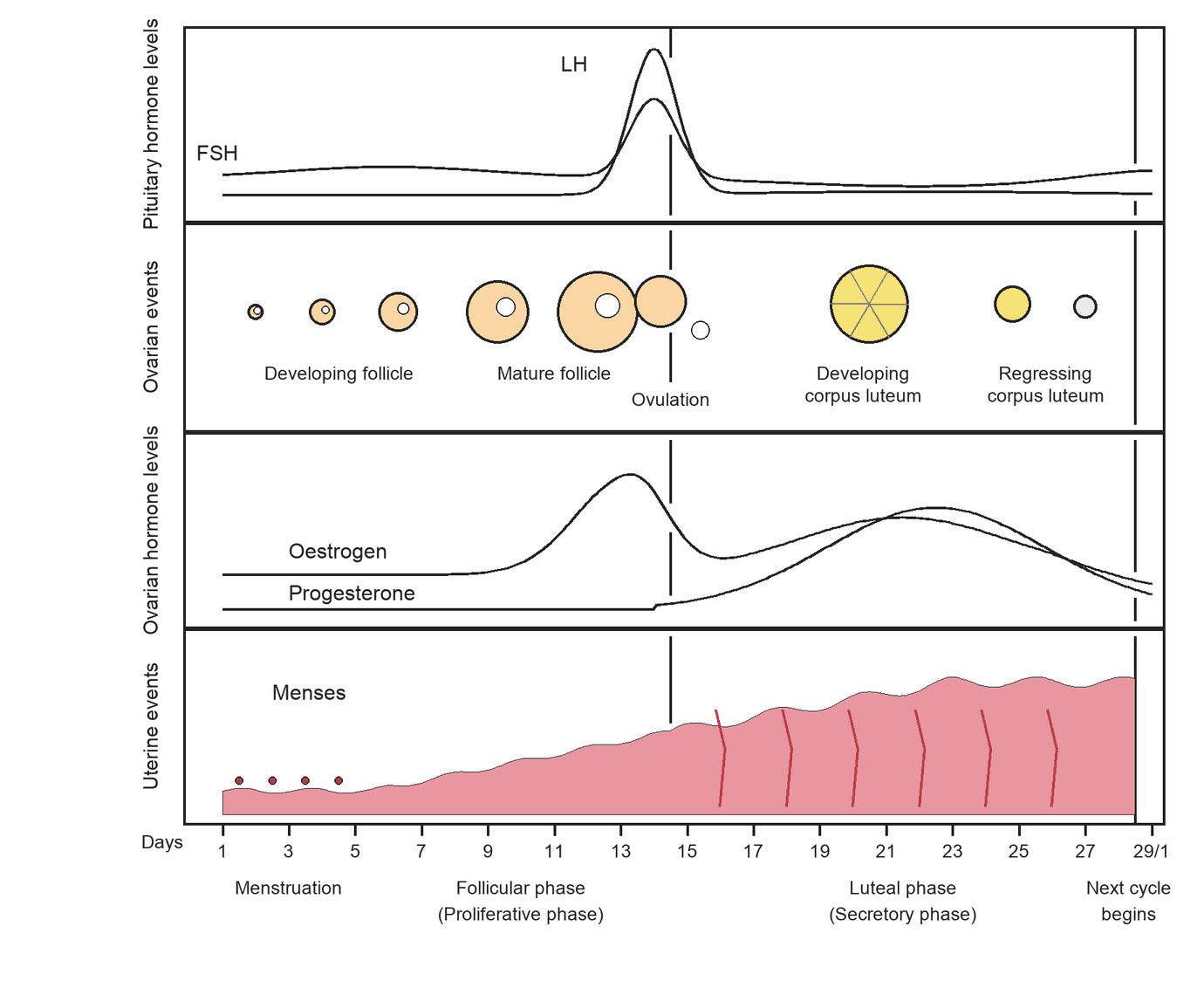
1. Which days of the menstrual cycle mark the proliferative phase?
(a) 1–5 (b) 15–23 (c) 6–14 (d) 13–17
2. Identify the hormones that are at peak level during ovulatory phase
(a) progesterone (b) FSH (c) LH (d) both FSH and LH
3. Which of the following occurs during secretory phase?
(a) follicles mature (b) endometrium breaks (c) corpus luteum develops (d) oestrogen level keeps increasing
4. The breakdown of endometrium occurs during the following phase
(a) proliferative (b) luteal (c) follicular (d) menstrual
5. Increase in the thickness of uterine lining is directly related to increase in the following hormone
(a) progesterone (b) FSH (c) LH (d) Oestrogen
- 275 marks
Question 27
Read the source given and answer the questions that follow.
After implantation, a special tissue called placenta, develops between the embryo and the uterine wall of the mother. Placenta consists of foetal part, the chorion as well as the maternal tissue—the decidua basalis. The placenta helps in the exchange of the nutrients and gases between the mother and the foetus. It is also involved in the removal of wastes produced by the growing foetus. Placenta is connected to the foetus via umbilical cord. Placenta also produces a number of proteins and different hormones like human chorionic gonadotropin (hCG), human placental lactogen (hpl), oestrogen and progesterone. Because hCG comes from the embryonic chorion and not the mother, this hormone is tested for in all pregnancy tests. In the later stages of pregnancy, placenta also secretes a hormone called relaxin which facilitates childbirth by dilating the cervix at the time of parturition.
1. Placenta consists of the following tissues.
(a) only foetal tissue (b) chorion (c) decidua basalis (d) both (b) and (c)
2. Which of the following hormone is tested in pregnancy tests to confirm pregnancy?
(a) oestrogen (b) hCG (c) progesterone (d) hpl
3. Which of the following is not a function of placenta?
(a) remove wastes from maternal blood (b) supply nutrients from mother to foetus (c) supply oxygen to foetus (d) remove wastes from foetus to maternal blood
4. The hormone hCG is produced from the
(a) ovary (b) uterine lining of mother (c) chorion of embryo (d) pituitary gland
5. The function of relaxin is to
(a) maintain pregnancy (b) stop ovulation (c) dilate cervix (d) maintain placenta
- 283 marks
Question 28
What is menstrual cycle? Which hormones regulate menstrual cycle?
- 293 marks
Question 29
Suppose the acrosome of mammalian spermatozoa does not function normally, how would it affect fertilisation? Give reasons.
- 303 marks
Question 30
Explain why there is no menstrual cycle before puberty, after menopause and during pregnancy.
- 313 marks
Question 31
The events of the menstrual cycle are represented below. Answer the questions following the diagram
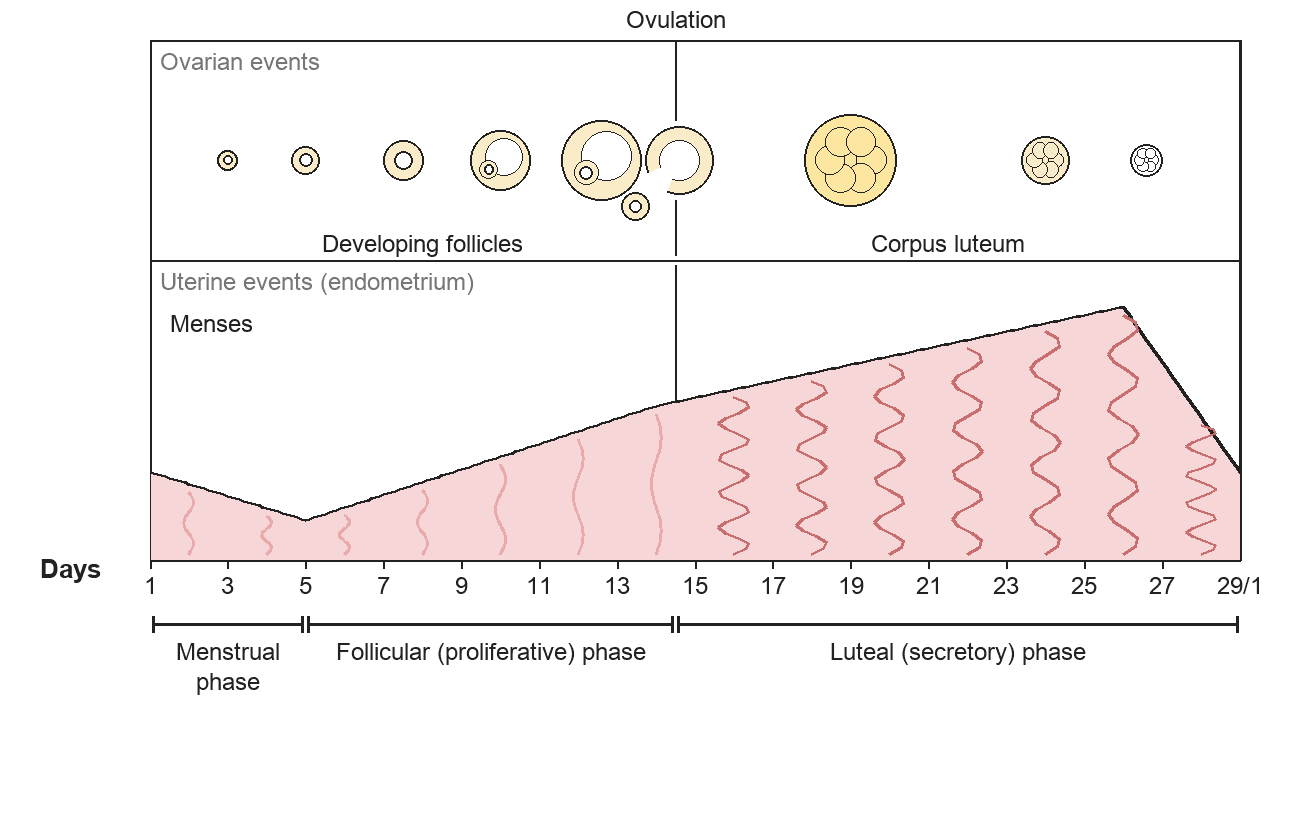
(a) State the levels of FSH, LH and progesterone simply by mentioning high or low around 13th, 14th day and 21st to 23rd day.
(b) In which of the above mentioned phases does the egg travel to the fallopian tube?
- 323 marks
Question 32
(a) In which part of human female reproductive system do the following events take place?
(i) Release of 1st polar body
(ii) Release of 2nd polar body
(iii) Fertilisation
(iv) Implantation
(b) From where do the signals for parturition originate and what does maternal pituitary release for simulating uterine contraction for childbirth?
- 333 marks
Question 33
Explain the process of spermatogenesis in humans.
OR
Give an account of hormonal control of oogenesis.
- 343 marks
Question 34
Draw a labelled diagram of L.S. of human testis.
OR
Draw a labelled diagram of the mature embryo sac of angiosperms.
- 355 marks
Question 35
Describe the physico-chemical events that take place during fertilisation in humans.
- 365 marks
Question 36
Given below is the diagram depicting the menstrual cycle in human beings. Study it carefully and answer the questions that follow.
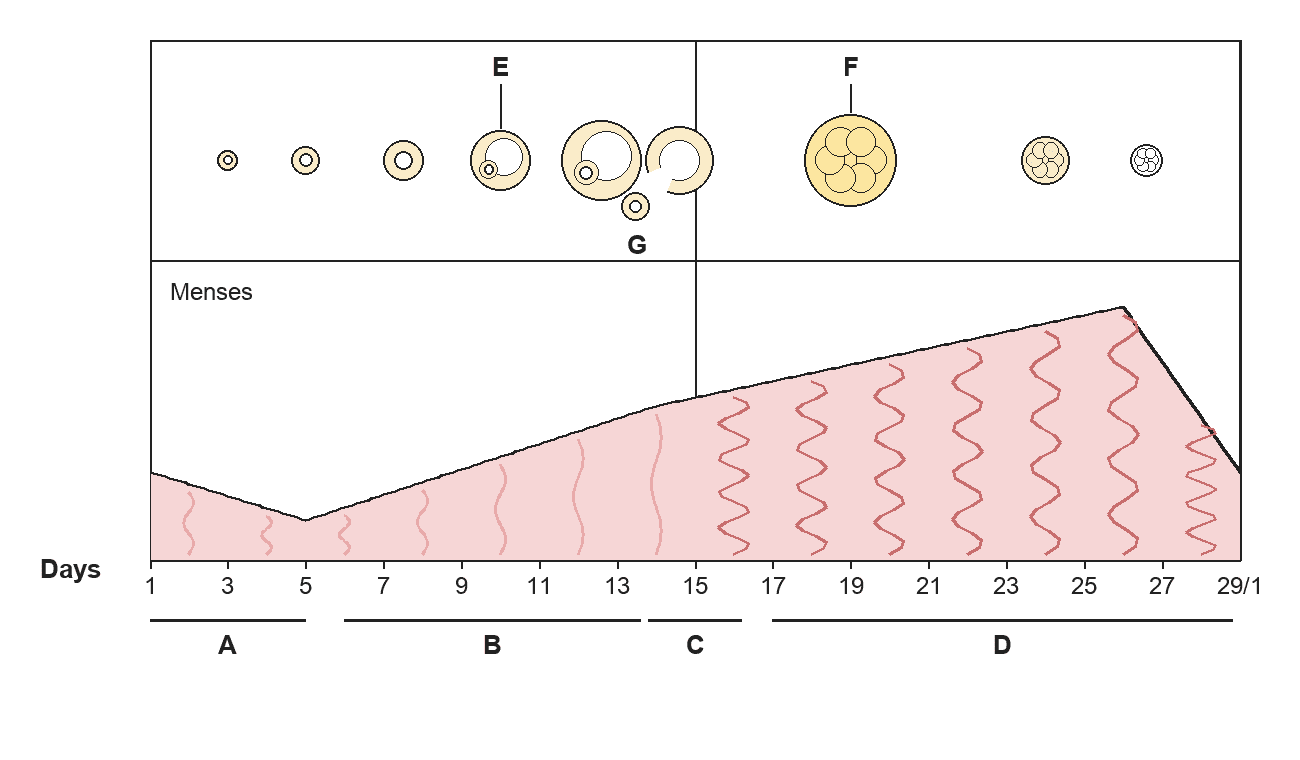
(i) Which phases are indicated by 'C' and 'D'?
(ii) Name the structure labelled 'F'? What is its role?
(iii) Explain the changes in the level of progesterone during phases 'C' and 'D'.
(iv) Which hormone present in the urine confirms pregnancy in human beings?
(v) Identify the structure labelled 'E'. Name the hormone released by it.
- 371 mark
Question 37
Three pregnant women, P, Q and R, at a district hospital in Ranchi each took a medicine for one week only (hypothetical case). It was later found that this medicine disturbs the formation of limbs and digits, but it has no effect on limbs that have already formed. Woman P took it in the 6th week after fertilisation, woman Q in the 16th week and woman R in the 32nd week. Which outcome is expected?
- 381 mark
Question 38
After a surgery called hysterectomy, a 42-year-old woman in Nagpur no longer has a uterus. The surgeon did not touch her ovaries, and her blood tests still show a rise of FSH early in each cycle and a mid-cycle surge of LH (hypothetical case).
Assertion (A): This woman has no more menstrual bleeding after the surgery, although her ovaries are normal.
Reason (R): Her ovaries continue to develop follicles and release an ovum in each cycle after the surgery.
- 393 marks
Question 39
A 17-year-old boy is examined at a hospital in Bengaluru (hypothetical case). Tests show that his anterior pituitary releases almost no LH (ICSH) and almost no FSH, although the tissue of his testes is normal. His testes are small and produce no sperms, and his prostate gland and seminal vesicles have also not developed.
(a) Neither LH nor FSH acts directly on the prostate gland or the seminal vesicles. Explain why these glands have still not developed.
(b) The doctor compares two treatments.
- Plan 1: injections of testosterone alone.
- Plan 2: injections of hormones that act like LH and like FSH.
Evaluate each plan for (i) the development of his secondary sex organs and (ii) the start of sperm production. Which plan suits him if he wants to father children later?
- 405 marks
Question 40
Read the passage and study the table, then answer the questions that follow.
In early pregnancy the corpus luteum in the ovary keeps secreting progesterone, the hormone that maintains the endometrium. The chorion of the embryo secretes human chorionic gonadotropin (hCG), which keeps the corpus luteum active. As the placenta grows, it begins to secrete progesterone itself. A research team at a medical college in Pune measured these hormones in a group of healthy pregnant women and estimated how much of the progesterone came from each source. (Hypothetical data; values in arbitrary units. Weeks are counted from the first day of the last menstrual period.)
Week of pregnancy hCG Progesterone from corpus luteum Progesterone from placenta (a) In which week is the hCG level highest? From which week onwards does the placenta supply more progesterone than the corpus luteum?
(b) Calculate the total progesterone level in week 6 and in week 16, and the percentage of it that came from the corpus luteum in each of these weeks.
(c) Two women in this group need an emergency operation in which the ovary carrying the corpus luteum is removed: woman X in week 6 and woman Y in week 16. Use your answers to (b) to predict which pregnancy is at greater risk, explain why, and suggest what the doctors could do for her.