
Opening your dashboard
Class 12 Biology Chapter 19 Biodiversity and Conservation: Competency-Based Questions (CBQ)
40 questions on Chapter 19, each worked through on its own page with the AI tutor. Class 12 Biology, ICSE 2026-27.
40 questions
1–5 marks · Mixed difficulty
- 14 marks
Question 1
A school eco-club walks a straight line through a national park in central India, from a sal forest (F), across a grassy meadow (M), to a marsh at the edge of a lake (W). In each habitat they list the plant species they find; each letter stands for one species. (Hypothetical data.)
Habitat Plant species recorded Sal forest (F) a, b, c, d, e, f, g, h Meadow (M) g, h, i, j, k, l Marsh (W) l, m, n, o, p (a) What is the alpha diversity (species richness) of each habitat, and which habitat has the highest?
(b) Take the number of species found in only one of two habitats as a simple measure of the beta diversity between them. Work it out for F and M, for M and W, and for F and W. Which pair shows the highest beta diversity, and why would you expect this pair to differ most?
(c) The club's teacher says the gamma diversity of this landscape is 16 species, not 8 + 6 + 5 = 19. Explain why.
- 21 mark
Question 2
Assertion (A): Two ponds each hold three species in equal numbers. A pond with one species each of fish, frog and snail is considered more diverse than a pond with three species of fish.
Reason (R): Species taxonomic diversity means the presence of taxonomically unrelated species, and such species add more to diversity.
- 34 marks
Question 3
The numbers of species recorded in India in some groups of animals, as listed in an older national survey (late 1990s), are given below.
Group Species recorded Arthropoda 68,389 Other invertebrates 8,329 Mollusca 5,070 Protozoa 2,577 Pisces (fishes) 2,546 Aves (birds) 1,232 Reptilia 456 Mammalia 390 Amphibia 209 Protochordata 119 (a) What percentage of all the species in this table are arthropods? (Give one decimal place.)
(b) Find the total number of vertebrate species (fishes, amphibians, reptiles, birds and mammals). About how many times this number are the arthropod species?
(c) A student concludes: "These lists are nearly complete, so few new animal species are left to be found in India." Give two reasons from the chapter why this conclusion is wrong.
- 41 mark
Question 4
A microbiologist at a university in Pune spreads a pinch of forest soil on a nutrient medium. Molecular tests show thousands of kinds of bacteria in the soil, but only a few dozen grow as colonies. This observation best explains why
- 54 marks
Question 5
A team of zoologists counts butterfly species at four sites on one mountain slope in Sikkim, in the Eastern Himalaya. Each site is searched for the same number of days. (Hypothetical data.)
Site Altitude (m) Butterfly species recorded 1 600 240 2 1,500 172 3 2,400 98 4 3,300 41 (a) By what percentage does the number of species fall from site 1 to site 4? (Give one decimal place.)
(b) Between which two neighbouring sites is the fall in species per 100 m rise in altitude the greatest? Show your working.
(c) Give two reasons from the chapter for the trend shown by the data.
- 61 mark
Question 6
Assertion (A): When the species richness of a group of organisms in a region is plotted against area on logarithmic scales, the points lie close to a straight line.
Reason (R): For such a region, the slope (Z) of this straight line is usually about 1.15.
- 74 marks
Question 7
At an agricultural research station in Haryana, three grassland plots of equal size were sown with different numbers of native grass and herb species. In the third year, an equal quantity of seeds of a fast-spreading alien weed was scattered over each plot. Two years later, a year of severe drought struck. (Hypothetical data.)
Plot Native species sown Cover of the alien weed after two years (%) Fall in total plant biomass in the drought year (%) P 2 46 52 Q 8 21 28 R 16 7 11 (a) Which plot resisted both the alien weed and the drought best? What relation between species diversity and these two results do the data show?
(b) Name the two features of a stable community that this experiment tests, matching each to one column of data.
(c) Name the third feature of a stable community that this experiment does not test, and say what the station should record to test it.
- 81 mark
Question 8
Assertion (A): The loss of a few species from an ecosystem may not, at first, affect how well the ecosystem functions.
Reason (R): In Paul Ehrlich's analogy, the airplane stands for a single species and its rivets stand for the genes of that species.
- 94 marks
Question 9
The numbers of critically endangered species listed in the IUCN Red List in three successive years are given below.
Group 2020 2021 2022 Plants 4,337 4,976 5,232 Molluscs 682 717 717 Insects 347 408 412 Fishes 666 739 800 Amphibians 650 673 681 Reptiles 324 433 433 Birds 223 225 231 Mammals 221 229 232 Others 312 322 327 Total 7,762 8,722 9,065 (a) Which two groups show no change between 2021 and 2022?
(b) Calculate the percentage increase in the total number of critically endangered species from 2020 to 2022, and the percentage of the 2022 total that is made up of plants. (Give one decimal place.)
(c) What does the category 'critically endangered' tell a conservation officer about these species?
- 101 mark
Question 10
Assertion (A): Mass extinctions are common events that happen every few thousand years.
Reason (R): Mass extinction is the extinction of a large number of species at certain periods of earth's history due to catastrophes or sudden changes in the environment.
- 111 mark
Question 11
A state forest department has money to protect only a few of its many threatened species this year. It checks the IUCN Red List and chooses first the species that face the highest risk of extinction in the wild. Which use of the Red List is the department making?
- 123 marks
Question 12
A natural history museum compares the records of bird species of a large tropical region over the last 500 years. (Hypothetical data.)
Where the species lived Species known Species that became extinct Islands of the region 120 42 Mainland of the region 900 27 (a) Calculate the percentage of species that became extinct on the islands and on the mainland.
(b) Which observation recorded by the World Conservation Monitoring Centre do these data agree with?
(c) From the chapter's list of characteristics that make a species vulnerable to extinction, name the one whose examples include many island species, and explain why it makes a species vulnerable.
- 134 marks
Question 13
Satellite maps of a district on the Deccan plateau give the area under each kind of land use in 2000 and in 2020. (Hypothetical data.)
Land use Area in 2000 (km²) Area in 2020 (km²) Natural forest 1,200 760 Grassland 300 90 Wetland 60 12 Cropland 1,500 1,980 Towns, roads and industry 140 358 (a) Which natural habitat lost the largest share of its own area? Show the percentage lost for each of the three natural habitats.
(b) From the chapter's list of human activities that destroy habitats, name the activity most likely to have reduced (i) the grassland and (ii) the wetland.
(c) An officer says, "The grassland has only turned into crop fields; the land is still green, so wildlife has lost nothing." Explain why the officer is wrong.
- 141 mark
Question 14
Assertion (A): Fish-eating ducks and falcons die in areas where the water is polluted with pesticides.
Reason (R): Pesticides added to water make their way into fishes, and then into the birds that eat these fishes.
- 151 mark
Question 15
After heavy rain, fertiliser from the fields around a village pond is washed into it. Within days the amount of nutrients in the pond rises sharply and most of its fish and other animal species die. Tests find no pesticide, no lead and no newly introduced species. The loss of species is best explained by
- 164 marks
Question 16
The pygmy hog (Porcula salvania, formerly Sus salvanius) is a highly threatened wild pig that now survives in the wild only in Assam. A breeding centre in Assam caught 12 pygmy hogs from the last small patch of tall grassland where they survived and bred them in captivity. The numbers in the centre at the end of each year were recorded. (Hypothetical data.)
Year 0 (start) 1 2 3 4 Number of hogs 12 20 34 56 90 At the end of year 4, the forest department declared a large grassland a protected area, stopped its burning and grazing, and released 30 of the hogs into it.
(a) Name the conservation strategy used at the breeding centre, and give the reason it was chosen for this species.
(b) By what factor did the number of hogs in the centre increase in four years?
(c) Give two reasons why protecting the grassland on site was essential before the release.
- 171 mark
Question 17
The last 40 plants of a critically endangered orchid grow on a single cliff. Within a year the cliff will be under water when a new dam fills its reservoir. Which step should the forest department take first to save the species?
- 181 mark
Question 18
Assertion (A): Biodiversity hotspots are identified as priority areas for in situ conservation.
Reason (R): Approximately 20% of the human population lives in the biodiversity hotspots of the world.
- 194 marks
Question 19
Details of six biosphere reserves of India are given below.
Biosphere reserve Year Type Area (km²) Nilgiri 1986 Western Ghats 5,520 Nanda Devi 1988 Himalayas 5,860 Nokrek 1988 East Himalayas 820 Gulf of Mannar 1989 Coasts 10,500 Sunderbans 1989 Gangetic Delta 9,630 Agasthyamalai 2001 Western Ghats 3,500 (a) What is the total area of the two Western Ghats reserves, and what percentage is it of the total area of all six reserves? (Give one decimal place.)
(b) The Nilgiri reserve includes the Silent Valley. Silent Valley is one of the three main centres of biodiversity of a hotspot. Name the hotspot and the other two centres.
(c) The Gulf of Mannar and the Sunderbans are not inland forests. Give two features of biosphere reserves, from the chapter, that allow such areas to be biosphere reserves.
- 201 mark
Question 20
A state wants to protect a large natural biome where several tribal villages have lived for centuries, keeping their traditional farming and herding. It plans to keep the most undisturbed part free of all human activity and to allow research around it. Which kind of protected area suits this plan?
- 214 marks
Question 21
A state of India kept these records in its state Red Data Book and forest survey. (Hypothetical data.)
Year Threatened species in the state Natural forest (km²) 1994 90 9,000 2002 120 8,400 2010 138 8,150 (a) Name the international meeting held in 2002 and state what the countries pledged there.
(b) For each period, 1994–2002 and 2002–2010, calculate the average yearly rise in the number of threatened species and the average yearly loss of natural forest.
(c) The state's biodiversity was still being lost after 2002. Did it keep to the 2002 pledge? Give the reason from your answer to (b).
- 221 mark
Question 22
Under a forest rule, villagers may collect the fruits of a wild medicinal tree only in alternate years and only up to a quota that lets the trees regenerate fully. Which key objective of the Convention on Biodiversity does this rule directly put into practice?
- 231 mark
Question 23
Assertion (A): The Convention on Biodiversity came into force within two years of the Earth Summit held at Rio de Janeiro.
Reason (R): Fair and equitable sharing of the benefits arising out of the use of genetic resources is one key objective of the Convention.
- 241 mark
Question 24
A widely quoted estimate (published in 2014) is that over 64% of the world's wetlands disappeared during the twentieth century. A district had 50 natural wetlands at the start of that century. If it lost its wetlands at the same rate as the world did over that century, how many of them would be left at its end?
- 251 mark
Question 25
Assertion (A): India manages its biodiversity only through in situ systems such as national parks and sanctuaries.
Reason (R): India's national bureaux for plant, animal and fish genetic resources conserve germplasm outside its natural habitat, for example plant germplasm in seed gene banks and field gene banks.
- 263 marks
Question 26
Conservationists compare four forest regions (hypothetical data).
Region Total species Endemic species Natural habitat already lost P 4000 1200 70% Q 5000 150 75% R 3000 1000 10% S 1500 100 20% (i) Which region would most likely be marked as a biodiversity hotspot? Give the reason.
(ii) Region Q has the most species. Why is it not the best choice?
(iii) Region R has many endemic species. Why is it not the first priority?
- 275 marks
Question 27
Read the sources given and answer any four from the questions given below.
The new species called exotic or alien species, when deliberately introduced into a geographical region pose competition for food, space and predation for the existing species. The new or exotic species may cause disappearance of the native species (already present in the natural environment).
Lake Victoria, a shallow freshwater lake in South Africa had an extremely diverse collection of over 300 species of small cichlid fishes till 1954. These small fish occupied different niches, some fed on arthropods, some on plants, some were fish-eaters while others fed on fish eggs and larvae. As a large commercial predatory fish, the Nile perch that grows up to 4 feet was introduced in this lake, it spread quickly, eating away the cichlid fish. By 1986, Nile perch constituted 80% of the total fish and the endemic cichlid species were virtually gone. Nile perch threatened the entire ecosystem of the lake.
Similarly introduction of water hyacinth Eichhornia, a floating water weed, from South America, when introduced into lakes, spread quickly, and soon covered the entire lake. It blocked the sunlight and led to reduced oxygen level in water, hence threatening the survival of number of aquatic species in the several tropical countries including India.
1. Which of the following was an alien species in Lake Victoria?
(a) cichlid fish (b) Eichhornia (c) Nile perch (d) arthropods
2. The ecosystem of Lake Victoria was disturbed because
(a) Eichhornia occupied the whole lake (b) competition between cichlid fish and Nile perch (c) predation by cichlid fish (d) predation by Nile perch
3. Which of the following is not true for water hyacinth?
(a) it created havoc in the aquatic system where it was introduced (b) it spreads fast and covers the whole lake quickly (c) it is a floating water weed (d) it was introduced in South America in 1986
4. Native species means
(a) new or alien species introduced (b) species already present in the environment (c) predatory species of that region (d) species having different niches
5. The following change took place in Lake Victoria by 1986
(a) Nile perch population grew to 50% (b) cichlid population fell to 20% (c) water weed spread through the entire lake (d) oxygen content of the lake became very low
- 285 marks
Question 28
Read the sources given and answer any four from the questions given below.
In situ conservation strategies mean conservation of biodiversity on site. They emphasise on the protection of total ecosystems. These include protected areas like hot spots, national parks, wildlife sanctuaries and biosphere reserves. Ex situ conservation strategies means, the threatened animals and plants are taken out from their natural habitat and placed in special areas like botanical gardens, zoo and aquaria where they can be protected and given special care. The concept of hotspots was developed by Norman Myers in 1988 to identify priority areas for in situ conservation. Hotspots are the richest zones of biodiversity. They contain the most threatened reservoirs of plant and animal life on earth. They have notable concentration of endemic species, i.e., species occupying narrow restricted area and confined to that region only.
A particular area or region is designated hotspot on the basis of number of endemic species and the degree of threat to species, which is measured in terms of habitat loss.
India has three main hotspots and these extend into the neighbouring countries also. These are Western Ghats, Indo-Burma region and eastern Himalayas.
1. Which of the following are examples of in situ conservation strategies?
(a) national parks and zoo (b) biosphere reserves and hotspots (c) botanical gardens and aquaria (d) wildlife sanctuaries and zoo
2. Which of the following statements is true for hot spots?
(a) richest biodiversity regions (b) contain most threatened plants and animals (c) present near the equator in hot regions (d) both (a) and (b)
3. Endemic species of plants and animals are the ones which are
(a) endangered (b) most threatened (c) present in narrow restricted area (d) almost extinct
4. The following are the main 'hotspots' in India.
(a) Western Ghats and Eastern Ghats (b) Eastern Himalayas and Kutch area (c) Eastern Himalayas and Indo-Burma region (d) Indo-Burma region and Eastern Ghats
5. A region is designated as a hot spot if
(a) it has high number of endemic species (b) it has number of plants and animals (c) it has a hot climate (d) it is close to a water reservoir
- 295 marks
Question 29
Read the sources given and answer any four from the questions given below.
IUCN Red List is a publication of International Union for Conservation of Nature and Natural resources (IUCN). It is a catalogue of taxa that are facing the risk of extinction. It gives information on threatened species of plants and animals. It imparts information about the urgency and scale of conservation needed for some main categories known as Red List Categories of species.
Extinct species are the ones which are already lost from wild as well as from cultivation. The last individual has died. Extinct in the wild species need utmost attention as there may be some individuals present in cultivation.
Critically endangered species are likely to become extinct in wild in immediate future. Their number is very small and need immediate attention. The vulnerable species are likely to get endangered in future. Their numbers may be less or still abundant. There are some rare species with very small populations. They are thinly scattered all over the world but are not endangered species.
1. Which of the following categories needs utmost attention for conservation?
(a) extinct (b) vulnerable (c) endangered (d) rare
2. What is IUCN Red list?
(a) a list of threatened species of plants (b) a list of threatened species of animals (c) both (a) and (b) (d) a list of countries where threatened species need conservation
3. Rare species the ones which are
(a) endangered (b) present in small number (c) vulnerable (d) both (a) and (b)
4. Vulnerable species are the ones which are
(a) facing extinction (b) almost extinct (c) present in only specific places in the world (d) need less attention than endangered
5. The individuals of the following species are already lost from wild as well as from cultivation
(a) extinct (b) endangered (c) vulnerable (d) critically endangered
- 303 marks
Question 30
Give three hypotheses for explaining why tropics show greatest levels of species richness.
- 313 marks
Question 31
What do you mean by evil quartet? How can it be prevented? Name them.
- 323 marks
Question 32
Define the following:
(i) Hotspots
(ii) Ramsar sites
(iii) Red data book
- 333 marks
Question 33
Explain the Rivet Popper Hypothesis.
- 343 marks
Question 34
Discuss any three major causes of loss of biodiversity.
- 351 mark
Question 35
A wildlife survey team records these features of four animal species living in the forests of an Indian state. (Hypothetical data.)
Species Adult body mass Main food Population and breeding Where it lives P about 0.05 kg seeds and grain very large; several litters a year forests and farmland across the state Q about 150 kg deer and wild pigs about 40 adults; one litter in 2 to 3 years forests of several districts R about 0.02 kg insects large; breeds every year forests across the state S about 1 kg water plants and snails large; breeds every year spends each winter at the same three lakes, reached along a fixed route On the basis of the characteristics that make a species particularly vulnerable to extinction, which species is most at risk?
- 361 mark
Question 36
Assertion (A): In the Khasi and Jaintia hills of Meghalaya, sacred forests still hold many rare and endemic plants that are no longer found in the degraded land around them.
Reason (R): Sacred forests are national parks, so the law bans all forestry, grazing and cultivation in them.
- 372 marks
Question 37
In a hill forest of north-east India, ecologists find that the large, hard-seeded fruits of a tall canopy tree, Tree X, are swallowed whole and carried away from the parent tree only by hornbills. The small fruits of the forest's fig trees are eaten and their seeds spread by more than 20 kinds of birds, bats and monkeys. Hunting in the area could wipe out either the hornbills or one of the fig-eating bird species. (Hypothetical case.)
(a) Using Paul Ehrlich's rivet popper analogy, which of these two losses is like losing a rivet from the wing of the aeroplane? Give a reason.
(b) Predict how the loss of the hornbills would change this forest over the next few decades.
- 382 marks
Question 38
Kamala, who lives in a tribal village in the Eastern Ghats, grows tulsi and about fifteen medicinal herbs, first brought from the nearby forest, in her home garden. Every year she also sows seed of four old local rice varieties that her family has saved for generations, although most farmers around her now grow a single high-yielding variety. A team from a national seed gene bank visits her to collect samples. (Hypothetical case.)
(a) Name the conservation strategy that Kamala's home garden represents, and state whether the chapter groups it with in situ or ex situ strategies.
(b) Give one reason why plant breeders value the seed of her old rice varieties.
- 393 marks
Question 39
A state's biodiversity board has so far recorded 4,400 species of flowering plants and 11,000 species of animals in the state. (Hypothetical data.) By Robert May's global estimate, only about 22% of all the species on earth have been described so far.
(a) Assuming that the same 22% applies to this state, estimate the total number of flowering plant species and of animal species in the state, and the number of each still to be discovered.
(b) A board member says, "By the same rule, about 78% of the bird species of our state must still be undiscovered." Evaluate this claim.
- 405 marks
Question 40
A state plans a new biosphere reserve of 2,400 km² in a hill forest where several tribal villages have farmed and herded for centuries. The plan divides the reserve into three zones, X, Y and Z, shown in the figure (not to scale). The forest department lists four uses to be fitted into the zones: (1) the villages with their fields and grazing land, (2) a guided trail where small groups of students study plants and birds on a few days each year, (3) the last undisturbed stand of a rare endemic tree and the breeding grounds of a threatened deer, and (4) a tree nursery and forest-produce market run jointly by the department and the villagers. (Hypothetical data.)
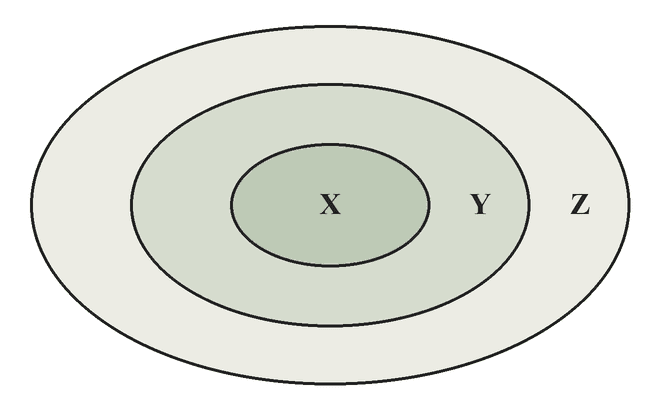
Zone X Y Z Area (km²) 600 800 1,000 (a) Name zones X, Y and Z, and state how much human activity is allowed in each.
(b) In which zone should each of the four uses be placed?
(c) Calculate the percentage of the reserve in each zone. A company then asks for 150 km² of zone X to build a holiday resort. What percentage of zone X would this take? Evaluate the request and suggest a better plan for the resort.