
Opening your dashboard
Class 12 Biology Chapter 13 Plant Breeding to Enhance Food Production: Competency-Based Questions (CBQ)
40 questions on Chapter 13, each worked through on its own page with the AI tutor. Class 12 Biology, ICSE 2026-27.
40 questions
1–5 marks · Mixed difficulty
- 11 mark
Question 1
Farmers in a rain-fed district say that the weather, the soil moisture and the temperature in their fields change a great deal from one year to the next, and in bad years whole crops fail. A breeding institute plans a new pulse variety for them. Which breeding objective deals with their problem most directly?
- 21 mark
Question 2
Assertion (A): The Green Revolution in India depended only on the new high-yielding varieties; fertilisers and irrigation played no part in it.
Reason (R): When the high-yielding Mexican wheat varieties were introduced in India, higher doses of fertilisers, irrigation and pesticides were also given to these crops.
- 31 mark
Question 3
A hill state brings in cuttings of a fruit variety that was never grown there before. Four events from the programme are listed below. Which event is an example of acclimatisation?
- 44 marks
Question 4
A new pure line of wheat, line W, was tested in farmers' fields in three agroclimatic zones for three years. Its grain yield was compared with that of the best existing variety of each zone (the check). (Hypothetical data.)
Zone Year 1 (W / check), t/ha Year 2 (W / check), t/ha Year 3 (W / check), t/ha North-western plains 5.2 / 4.6 5.0 / 4.5 5.4 / 4.7 Central plateau 4.1 / 4.3 3.9 / 4.2 4.2 / 4.4 Eastern plains 4.8 / 4.2 4.0 / 4.3 4.6 / 4.4 (a) Find the mean yield of line W and of the check over the three years in the north-western plains.
(b) Line W had already done well in the institute's research fields. Why was it still tested in farmers' fields, in each zone, for at least three years?
(c) For which zone should the breeder propose line W as a new variety? Give a reason from the data, and state what happens to the proposal before the variety reaches farmers.
- 51 mark
Question 5
For hundreds of years, farmers in a village saved seed only from the plants of their millet crop that gave the heaviest heads, and sowed that seed the next year. Over time their millet came to look very different from its wild relatives. Which process changed the crop?
- 61 mark
Question 6
A horticulture institute must keep the germplasm of 300 mango varieties. Its field orchard of grown trees needs a large area and is costly to run every year. Which plan lets it keep a large number of these genotypes in a small area at a fraction of the cost?
- 71 mark
Question 7
Assertion (A): A seed agency that supplies stem pieces of an improved sugarcane variety to farmers is supplying 'seed' of that variety.
Reason (R): In plant breeding, the term 'seed' means any plant part that is used to grow a crop.
- 83 marks
Question 8
A breeder crossed a high-yielding wheat line that gets rust with a line that does not. The F₁ plants were selfed, and 400 F₂ plants were raised in a field where rust spores were sprayed on the plants and the air was kept moist. At the end of the season, 98 plants showed rust and 302 plants stayed healthy. (Hypothetical data.)
(a) Why were the F₂ plants grown under conditions in which they could easily get rust?
(b) What did the breeder do with the 302 healthy plants next, before any of them could be tested as a new variety?
(c) Give two advantages a farmer would get from a rust-resistant variety compared with controlling rust by chemical sprays.
- 91 mark
Question 9
A wheat variety bred for rust resistance stayed healthy in a district for many years. Then, although the farmers kept sowing its pure seed, rust began to appear on it in the same district. What is the most likely explanation?
- 101 mark
Question 10
Assertion (A): Wheat varieties with solid stems suffer less damage from the stem sawfly.
Reason (R): Hairy leaves give cotton plants resistance to jassids.
- 113 marks
Question 11
A school in Odisha serves rice in its mid-day meal. A nutrition officer compares ordinary rice with an iron-fortified rice variety, which contains 5 times as much iron as normally consumed rice. (Hypothetical data: ordinary rice has 0.8 mg iron in 100 g; each child eats 150 g of rice a day; a child of this age needs about 12 mg of iron a day.)
(a) How much iron does a child get each day from 150 g of each kind of rice?
(b) What percentage of the child's daily iron need does each kind of rice supply?
(c) Many of these children eat enough rice to feel full but still lack iron. Explain why such a lack is called "hidden hunger" and why it is so common.
- 124 marks
Question 12
The figure shows all the chromosomes in one body cell of three plants, P, Q and R. Solid chromosomes belong to one genome; banded chromosomes belong to a different genome.
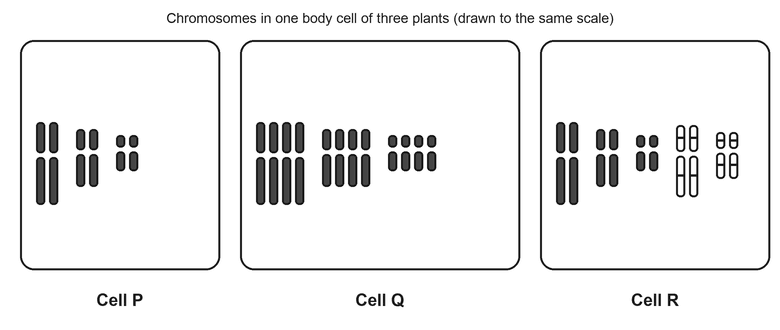
(a) How many genomes (complete chromosome sets) are present in each of the cells P, Q and R?
(b) Name the type of ploidy shown by plant Q and by plant R.
(c) Plants Q and R both have four genomes, but a breeder would obtain them in different ways. Outline how each could be produced from diploid plants.
- 133 marks
Question 13
A seed company in Telangana compares two inbred lines of maize with the F₁ hybrid made by crossing them. (Hypothetical data.)
Character Inbred line A Inbred line B F₁ (A × B) Grain yield (t/ha) 3.2 2.8 4.0 Days to maturity 115 112 104 Plants with leaf blight (%) 30 34 8 (a) By what percentage is the yield of the F₁ higher than that of the better parent?
(b) The effects of hybrid vigour are expressed in different ways. Name the kind of effect shown by the F₁'s higher yield, and the kind shown by its earlier maturity and lower leaf blight.
(c) A sugarcane breeder who obtains a superior hybrid does not need to cross its parents again every year, as the maize company must. Why?
- 141 mark
Question 14
Assertion (A): Many polyploid crop species tolerate harsh climatic conditions better and have a high economic value.
Reason (R): Polyploids arise only when breeders treat plants with colchicine; they do not occur in nature.
- 153 marks
Question 15
A dairy cooperative in Gujarat releases large amounts of whey as an effluent. It sets up a fermenter to grow yeast on the whey as single cell protein (SCP). In the fermenter the yeast biomass doubles every 4 hours. (Hypothetical data.)
(a) If the fermenter is started with 50 kg of yeast, what mass of yeast biomass will be present after 24 hours, assuming it keeps doubling at the same rate?
(b) Before the yeast can be used as human food, it has to be processed. What must the processing remove?
(c) The cooperative claims that its SCP unit "reduces the pressure on agriculture". Explain this claim.
- 161 mark
Question 16
Assertion (A): Single cell protein is valued in the human diet because it is rich in fats.
Reason (R): Single cell protein is rich in quality protein and poor in fats.
- 173 marks
Question 17
A tissue culture laboratory in Kerala raises banana plants from 4 shoot-tip explants of one high-yielding plant. On the multiplication medium, every shoot gives 5 shoots in each 4-week cycle, and all the shoots are cultured again. (Hypothetical data.)
(a) How many shoots will the laboratory have at the end of three cycles?
(b) Name the kind of plant hormone the multiplication medium must contain, and explain how it makes one explant give several shoots.
(c) The shoots are now 2–3 cm long but have no roots. What must be done with them next?
- 184 marks
Question 18
A callus culture was kept in the same vessel at about 24 °C with some light, and three measurements were taken every two weeks. (Hypothetical data.)
Week Dry mass of callus (g) Sucrose left in medium (g/L) Volume of medium (mL) 0 0.5 30 50 2 1.4 21 46 4 2.6 11 41 6 3.1 4 37 (a) Explain the change in each column of the table.
(b) Between which two readings did the dry mass rise the least? Suggest a reason from the table.
(c) What would happen to the cells if the culture were left in this vessel, and what should the technician do to keep the culture growing?
- 191 mark
Question 19
A nursery wants thousands of plants of one rare hybrid rose, all exactly like the mother plant, with as little genetic variation among them as possible. Which tissue culture plan suits this best?
- 201 mark
Question 20
Assertion (A): Shoot meristem cultures are useful for conserving the germplasm of crops.
Reason (R): Keeping genotypes in culture vessels needs a relatively small area and costs a fraction of growing large living collections in the field.
- 214 marks
Question 21
Protoplasts were isolated from rice cells and from carrot cells, mixed, and put into three dishes. In each dish 200 protoplasts were later checked for fusion. (Hypothetical data.)
Dish Treatment Fused protoplasts (out of 200) 1 none 1 2 solution of polyethylene glycol (PEG) 24 3 very brief high-voltage electric current 20 (a) Work out the percentage of fused protoplasts in each dish. What do the results show?
(b) Why were the cell walls removed before the cells were mixed, and how was this done?
(c) Describe the events in a fused rice–carrot protoplast that lead to a hybrid plant.
- 221 mark
Question 22
Assertion (A): Pomato, the somatic hybrid of tomato and potato, was obtained by fusing their protoplasts because the two plants cannot be crossed in the usual sexual way.
Reason (R): It is easy to introduce foreign DNA into protoplasts because their cell walls have been removed.
- 233 marks
Question 23
A cotton farmer in Vidarbha kept this record of two seasons. (Hypothetical data.)
Season 1 Season 2 Cotton grown ordinary variety Bt cotton In the soil — Trichoderma added Chemical sprays used 10 3 Bolls damaged by bollworms 40% 6% (a) Bollworm damage fell in season 2 even though the farmer sprayed fewer chemicals. Explain why.
(b) What was Trichoderma expected to do in the soil?
(c) The farmer still sprayed chemicals three times in season 2. Does this mean the farmer was not following Integrated Pest Management (IPM)? Explain.
- 241 mark
Question 24
(Hypothetical example.) A team released a predatory insect into paddy fields to control a leaf-eating pest. The predator eats only the pest's caterpillars, and the team knew this. But the release was made when the pest was present only as eggs and pupae, so most of the predators died or left. Which aspect of the ecosystem did the team fail to study?
- 251 mark
Question 25
Assertion (A): Leaf-eating pests and beetles stay away from plants that are sprayed with neem extract.
Reason (R): Azadirachtin from neem is a strong poison that kills the natural predators living on the pests.
- 265 marks
Question 26
Read the sources given and answer any four from the questions given below.
Golden rice is a genetically modified variety of rice (Oryza sativa) produced through genetic engineering. It is rich in beta carotene, a precursor of vitamin A. Golden rice is meant to overcome vitamin A deficiency, deficiency of which causes blindness in children in the developing world.
It differs from the parental strains as it contains three beta-carotene genes. Two are isolated from daffodil plant and the third gene from a bacterium. This combination of genes allows the rice plant to synthesise beta-carotene by modifying certain metabolic pathways.
Fortified with beta-carotene, this genetically modified rice crop has good yield and is more tolerant to abiotic stresses.
1. Golden rice, a variety of rice has enhanced nutritional value due to the presence of
(a) Vitamin A (b) beta-carotene (c) bacterium (d) daffodil genes
2. The genetically modified variety of rice is produced by introducing
(a) two genes of daffodil plant (b) one gene of a bacterium (c) both (a) and (b) (d) a bacterium with desired gene
3. The genetically modified variety of rice stores its nutrients in its
(a) roots (b) stem (c) leaves (d) seeds
4. Golden rice is called a genetically modified crop because it
(a) gives good yield (b) rich in carbohydrates and proteins (c) has a gene from bacterium (d) more tolerant to abiotic stress
5. Golden rice can help to overcome the deficiency of following in children.
(a) carbohydrates (b) vitamin A (c) vitamin B (d) minerals
- 275 marks
Question 27
Read the sources given and answer any four from the questions given below.
Single cell protein (SCP) refers to the edible protein extracted from the microbial biomass, rich in high-quality protein. These microbes can be grown using inexpensive substrates like agricultural waste, industrial effluents, sawdust and corn cobs, thus reducing the environmental pollution too. Various microorganisms used for the production of SCP are bacteria like Cellulomonas, Alcaligenes, algae like Spirulina, Chlorella and fungi like yeast (Saccharomyces), Agaricus, Fusarium. In addition to proteins, SCP contains other nutrients such as lipids and vitamins.
Most of the organisms used in obtaining SCP are single-celled microorganisms but the term SCP may be misleading as some multicellular microorganisms are also used. Commercial production of SCP is mostly based on yeasts and some fungi like Fusarium graminearum.
Use of SCP: SCP production may have potential for feeding the ever-increasing world population. Massive quantities of SCP can be produced in a single day.
1. Which of following organisms cannot be used as SCP?
(a) algae (b) fungi (c) bacteria (d) mosses
2. SCP can be grown on the following substrates
(a) industrial effluents (b) agricultural wastes (c) both (a) and (b) (d) petri dishes
3. SCP can be obtained from the following algae
(a) Fusarium (b) Spirulina (c) Saccharomyces (d) Agaricus
4. SCP are a source of
(a) only proteins (b) proteins and vitamins (c) lipids and vitamins (d) both (a) and (c)
5. Commercial production of SCP is mostly based on fungi like
(a) Fusarium (b) Chlorella (c) mushrooms (d) Cellulomonas
- 283 marks
Question 28
Following are the steps and aims in the breeding of a new genetic variety of a crop
Step Aim 1. a. __________ Collection of pre-existing genetic variability 2. Pure line creation to evaluate and selection as a parents 3. b. __________ to combine the desired character of different plants 4. Screening the superior combinant c. __________ 5. Release and commercialisation of new cultivars d. __________ - 293 marks
Question 29
Describe the tissue culture technique in plants.
- 301 mark
Question 30
Farmers in a high-altitude district of Himachal Pradesh need a cabbage variety that can stand early frosts, and the state wants its seed in farmers' hands within about three seasons. A cabbage variety bred for frost tolerance is already grown in a region abroad that has a similar cold climate. (Hypothetical case.) Which plan suits the state best?
- 311 mark
Question 31
Assertion (A): In the 1960s, Indian scientists crossed the introduced high-yielding dwarf Mexican wheat varieties with traditional Indian wheat varieties, instead of relying only on the Mexican varieties.
Reason (R): The high-yielding dwarf varieties obtained from these crosses were better suited to the climate and soil conditions of India.
- 321 mark
Question 32
A women's cooperative in a coastal village of Tamil Nadu has sunny, shallow ponds of alkaline water, to which mineral salts can be added. There is no factory nearby, so no starch, sugar or whey effluent is available. The cooperative wants to grow single cell protein (SCP) in these ponds. (Hypothetical case.) Which microorganism suits them best?
- 331 mark
Question 33
Protoplasts were isolated from tobacco leaf cells with cellulase and pectinase dissolved in a mannitol solution. A student moved some of the protoplasts into distilled water by mistake. Within minutes they swelled and burst, while those left in the mannitol solution stayed round and intact. (Hypothetical case.) Which explanation fits these observations?
- 341 mark
Question 34
Assertion (A): The autotriploid varieties of tea grown in India are multiplied vegetatively, by cuttings, rather than by seed.
Reason (R): An autopolyploid has more than two copies of the same genome.
- 352 marks
Question 35
Khesari dal (Lathyrus sativus) is grown on poor soils in parts of Chhattisgarh and is eaten daily by many poor families there. Its seeds contain a neurotoxin. A breeding station compares two new lines. (Hypothetical data.)
Line Grain yield (t/ha) Neurotoxin in seed (%) P 1.6 0.45 Q 1.4 0.08 (a) By what percentage is the yield of line Q lower than that of line P, and how many times more neurotoxin does line P contain than line Q? (1 mark)
(b) Which line should the station recommend to these families? Justify your choice using the idea of nutritional quality. (1 mark)
- 362 marks
Question 36
In a village school in Rajasthan, most children eat maize roti at nearly every meal and few vegetables. A health check shows that many of them lack vitamin A and iron, and that the protein in their meals is of poor quality. The school has a kitchen garden and a small field. (Hypothetical case.)
Plan what the school should grow, choosing one improved or biofortified crop for each of the three problems: vitamin A, iron and protein quality. For each choice, say how it helps. (2 marks)
- 372 marks
Question 37
On a farm in Haryana, the same chemical herbicide was sprayed every season at the recommended dose to control one weed of the wheat field. The table shows the percentage of plants of that weed that survived the spray each year. (Hypothetical data.)
Year 1 2 3 4 5 Weed plants surviving the spray (%) 2 5 14 33 62 (a) How many times as high was the survival in year 5 as in year 1? Explain why the herbicide became less effective each year. (1 mark)
(b) Give two advantages a bioherbicide would have over this chemical herbicide. (1 mark)
- 383 marks
Question 38
A breeder crosses two tomato varieties. The female parent has green seedling stems, and the male parent has purple seedling stems. Purple stem is dominant, and the male parent is the only purple-stemmed tomato in the area. So a seedling with a purple stem must come from a cross-pollinated seed. Flowers of the female parent were emasculated and dusted with the male parent's pollen. One lot was bagged before and after pollination; the other lot was left unbagged. (Hypothetical data.)
Lot Seeds sown Seedlings with purple stems Bagged 90 88 Unbagged 60 33 (a) Calculate the percentage of hybrid seedlings in each lot.
(b) Where did the green-stemmed seedlings of the unbagged lot most likely come from?
(c) Even the bagged lot gave two green-stemmed seedlings. Suggest how this happened, and how the breeder can avoid it.
- 393 marks
Question 39
Pod borer caterpillars attack chickpea in Madhya Pradesh. An extension team divided a farmer's field into three equal plots: one was left unsprayed, one was sprayed with a broad-spectrum chemical insecticide, and one with a nucleopolyhedrovirus (NPV) that attacks the pod borer. Three weeks later the team recorded this. (Hypothetical data.)
Plot Pods damaged (%) Spiders per m² Unsprayed 32 12 Chemical insecticide 8 2 NPV 11 11 (a) By what percentage did each spray reduce pod damage compared with the unsprayed plot?
(b) Why did the spiders survive in the NPV plot but not in the chemical plot?
(c) Which treatment should the team advise for the next season? Justify your answer using the data and the idea of Integrated Pest Management (IPM).
- 404 marks
Question 40
Read the case and answer the questions that follow.
In the early 1960s India often had to import food grain, as its population grew year after year. From the mid-1960s, high-yielding dwarf varieties of wheat, and later of rice, were introduced and bred further in India. Farmers grew them with more fertiliser, irrigation and pest control, and harvests rose sharply. This change is called the Green Revolution. The table gives India's population at three censuses and the food grain produced in the farm year ending that year (figures rounded).
Year Population (million) Food grain production (million tonnes) 1951 361 51 1971 548 108 2011 1211 244 (a) Calculate the food grain produced per person, in kg per year, in 1951 and in 2011.
(b) Between 1951 and 2011, by how many times did the population rise, and by how many times did food grain production rise? What does this comparison show?
(c) Name two developments described in this chapter that made this rise possible, and give one reason why plant breeding must continue even now.