
Opening your dashboard
Class 11 Maths Chapter 9 Permutations and Combinations: Competency-Based Questions (CBQ)
40 questions on Chapter 9, each worked through on its own page with the AI tutor. Class 11 Maths, ICSE 2026-27.
40 questions
1–5 marks · Mixed difficulty
- 13 marks
Question 1
Competency: Application
A burger app lets a customer build a burger in four choices, one after another:
- a bun: one of kinds;
- a patty: one of kinds;
- cheese: with cheese or without cheese;
- a sauce: one of sauces, or no sauce at all.
Two burgers are different if they differ in at least one of these choices. (Hypothetical data.)
(a) How many different burgers can be built?
(b) Riya does not want cheese but does want a sauce. How many burgers can she build?
(c) The owner wants to advertise “more than different burgers” by adding new kinds of patty only. What is the least number of new patty kinds needed?
- 21 mark
Question 2
Competency: Application
In messenger RNA, the genetic code is read in codons. A codon is an ordered string of three bases, and each base is one of A, U, G and C. A base may appear more than once in a codon, so AAG and GAA are two different codons.
In how many of the possible codons does at least one base appear more than once?
- 31 mark
Question 3
Competency: Analysis & Evaluation
A school canteen plans a soup for each of Monday, Tuesday and Wednesday, choosing from soups. The same soup may be served on more than one of these days. (Hypothetical data.)
Assertion (A): The canteen can plan the soups for the three days in ways.
Reason (R): Because a soup may be repeated, the number of plans is .
- 44 marks
Question 4
Competency: Application
A phone is unlocked with a -digit PIN. Each digit is one of to , digits may repeat, and a PIN may begin with .
(a) How many PINs are possible?
(b) How many PINs have four different digits?
(c) On a greasy screen, a thief sees smudges on exactly four keys, , , and . Assuming every digit of the PIN leaves a smudge and no other key is smudged, how many PINs are still possible?
(d) On another phone the smudges are on exactly three keys, , and . How many -digit PINs are possible now?
- 53 marks
Question 5
Competency: Application
A radio presenter has a list of different songs. In one show she plays of them, one after another, and no song is played twice. A running order is the list of the songs in the order they are played.
(a) How many running orders are possible?
(b) Two particular songs, X and Y, must both be played, with X played at some point before Y. How many running orders are possible?
(c) Of the songs, are upbeat and are slow (the other are neither). The show must open with an upbeat song and close with a slow song, with no other condition. How many running orders are possible?
- 61 mark
Question 6
Competency: Application
A medley relay has four legs swum in a fixed order: backstroke, breaststroke, butterfly, freestyle. A coach has swimmers, each able to swim every stroke. She picks of them and gives each picked swimmer one leg; nobody swims two legs. (Hypothetical data.)
In how many ways can she set the team?
- 71 mark
Question 7
Competency: Analysis & Evaluation
The six letters of the word PLANET are all different. A puzzle app shows them in every possible order, one order per screen.
Assertion (A): The app needs screens.
Reason (R): Exactly of these orders begin with a vowel.
- 81 mark
Question 8
Competency: Analysis & Evaluation
A delivery company plans a van’s route by checking every possible order in which the van can visit its stops (the van starts from the depot and need not return). Its computer checks orders every second, and the plan must be ready within one hour. (Hypothetical data.)
What is the greatest number of stops for which every order can be checked within one hour?
- 93 marks
Question 9
Competency: Application
A string of festival lights hangs in a straight row. It must use red, green, yellow and blue light. Lights of the same colour look exactly alike, so two strings differ only if the colour pattern differs. (Hypothetical data.)
(a) How many different colour patterns are possible?
(b) In how many patterns are both end lights red?
(c) In how many patterns does the blue light come somewhere to the left of both yellow lights?
- 101 mark
Question 10
Competency: Analysis & Evaluation
A word game asks how many different arrangements can be made from all the letters of the word ASSESS.
Assertion (A): Since the letter S appears times, the number of arrangements is .
Reason (R): If of objects are alike and the rest are all different, the number of arrangements of all objects is .
- 111 mark
Question 11
Competency: Application
A ship sends signals by hoisting flags one above another on a mast. It has identical red flags, identical blue flags and white flag. Every signal uses all flags, and by the ship’s rule the white flag may be neither at the top nor at the bottom. (Hypothetical data.)
How many different signals are possible?
- 123 marks
Question 12
Competency: Analysis & Evaluation
A round table has identical chairs, equally spaced. Seatings that differ only by turning the whole table (a rotation) count as the same seating; empty chairs are left empty.
(a) In how many ways can people sit at the table?
(b) On another evening only guests, A, B, C, D and E, come, so chairs stay empty. In how many ways can the guests sit?
(c) The host asks the guests to sit in neighbouring chairs, so that the empty chairs are also next to one another. In how many ways can they sit now?
- 131 mark
Question 13
Competency: Analysis & Evaluation
Five friends can sit either on a bench (in a row) or around a small round table. At the table, seatings that differ only by a rotation count as the same.
Assertion (A): The number of seatings at the round table is one-fifth of the number of seatings on the bench.
Reason (R): Each round-table seating can be “cut open” at any one of its places to give different bench seatings, and every bench seating is obtained in this way from exactly one round-table seating.
- 141 mark
Question 14
Competency: Analysis & Evaluation
A florist strings different flowers into a closed garland. A garland can be turned round and can also be turned over.
Assertion (A): The number of different garlands is .
Reason (R): different objects can be arranged round a circle in ways when the clockwise and anticlockwise orders are counted as different.
- 151 mark
Question 15
Competency: Analysis & Evaluation
A round cake is cut into equal slices. A baker puts a cherry on of the slices and a nut on each of the other slices. Two designs count as the same if one can be turned (rotated) on the plate to look exactly like the other. Cherries all look alike, and so do nuts.
How many different designs are possible?
- 164 marks
Question 16
Competency: Application
In a lottery game, a player marks different numbers from to on a ticket. The order of marking does not matter. Later, different winning numbers are drawn from to . (Hypothetical game.)
(a) How many different tickets can be marked?
(b) How many tickets match exactly of the winning numbers?
(c) How many tickets match at least of the winning numbers?
(d) How many tickets match none of the winning numbers?
- 171 mark
Question 17
Competency: Application
A box holds bulbs, of which are faulty. An inspector picks bulbs from the box to test (the order of picking does not matter). (Hypothetical data.)
In how many of the possible selections is at least one faulty bulb picked?
- 181 mark
Question 18
Competency: Analysis & Evaluation
In a small office network, each of computers is joined to every other computer by its own cable, and no two computers share a cable.
Assertion (A): The network needs cables.
Reason (R): The number of cables is , because each cable joins two computers.
- 194 marks
Question 19
Competency: Application
A school tournament has teams. They are drawn into two pools of teams. In each pool, every team plays every other team in that pool exactly once. The top teams of each pool reach the semi-finals ( matches), and the winners play the final ( match).
(a) How many pool matches are played altogether?
(b) How many matches does the whole tournament have?
(c) If instead all teams played every other team exactly once in a single league, how many more matches would be needed than in this format?
(d) The two pools are not named or numbered. In how many ways can the teams be split into the two pools?
- 201 mark
Question 20
Competency: Analysis & Evaluation
A teacher must choose of the students in her class for a museum trip; the other stay back for a rehearsal.
Assertion (A): The number of ways of choosing the students for the trip is .
Reason (R): .
- 213 marks
Question 21
Competency: Application
For a school cultural evening, chairs stand in a row on the stage. The organiser chooses of the singers and of the dancers, and seats the chosen performers on the chairs.
(a) In how many ways can the performers be chosen and seated?
(b) In how many of these ways do the two dancers not sit side by side?
(c) In how many of these ways do the two dancers sit on the two end chairs?
- 223 marks
Question 22
Competency: Analysis & Evaluation
A standard pack has cards: ranks (A, 2, 3, …, 10, J, Q, K) in each of suits. In a card game, a hand is any cards from the pack; the order of the cards does not matter.
(a) A full house is three cards of one rank and two cards of another rank (for example, three 7s and two Ks). How many hands are full houses?
(b) A two pair hand has two cards of one rank, two cards of a second rank, and a fifth card of a third rank. How many hands are two pair?
(c) How many hands have all five cards from the same suit?
- 231 mark
Question 23
Competency: Analysis & Evaluation
From a squad of players, a coach can either appoint a captain and a vice-captain (two different players), or simply pick players to go out for the coin toss.
Assertion (A): There are twice as many ways to appoint a captain and a vice-captain as to pick the players for the coin toss.
Reason (R): For any and with , .
- 241 mark
Question 24
Competency: Application
A website asks for a -character password made of exactly capital letters (A to Z, different from each other) and digits ( to , all different). The letters and digits may be in any positions, for example 4K7Q1 or QK417.
How many such passwords are possible?
- 253 marks
Question 25
Competency: Analysis & Evaluation
An examination paper has three sections: Section A with questions, Section B with questions and Section C with questions. A candidate must answer exactly questions, with at least from Section A, at least from Section B and at least from Section C.
(a) In how many ways can a candidate choose the questions?
(b) In how many of these choices is the first question of Section A included?
(c) Kabir counts the choices like this: “Choose from A, from B and from C, then any of the remaining questions. That gives .” Explain why his answer is too large.
- 261 mark
Question 26
Competency: Analysis
A railway line has stations. For every journey from one station to a different station on the line, a separate kind of printed ticket is needed, and a ticket from station P to station Q is a different kind from a ticket from Q to P. The railway now opens new stations on the same line. (Hypothetical data.)
How many new kinds of ticket must the railway now print?
- 271 mark
Question 27
Competency: Analysis
In a school cricket match, a batter faces all balls of an over. On each ball she scores , or runs; no other score is possible on a ball, and there are no extras. She scores exactly runs in the over. (Hypothetical data.)
A ball-by-ball record lists her score on ball , ball , …, ball in order. How many different ball-by-ball records are possible?
- 281 mark
Question 28
Competency: Analysis & Evaluation
Eight friends meet at a café. Their table is square, with chairs on each side, so it has chairs. Two seatings count as the same if one can be obtained from the other by turning the whole table, with its chairs and the people on them, through a quarter turn, a half turn or a three-quarter turn. These are the only turns after which the square table stands exactly where it stood before. (Hypothetical data.)
Assertion (A): The eight friends can be seated in different ways.
Reason (R): When rotations count as the same, different people can be seated round a circular table with chairs in ways.
- 291 mark
Question 29
Competency: Analysis
A farmer has planted mango trees in rows of , so that the trees form a square grid, as shown in the figure (top view). To mark out paths, a surveyor stretches a straight rope through every pair of trees. Ropes that lie along the same straight line count as one line.
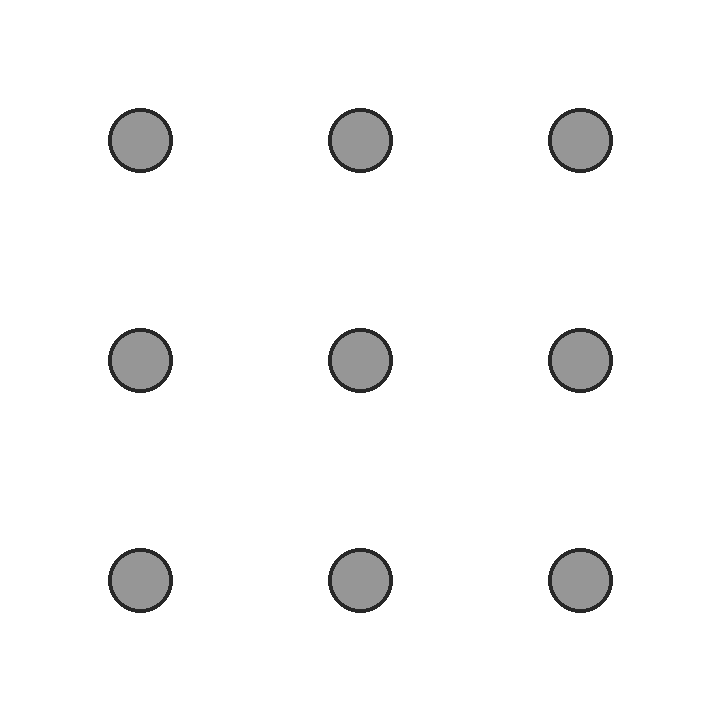
How many different straight lines does the surveyor mark?
- 301 mark
Question 30
Competency: Analysis & Evaluation
A balloon seller has red balloons, all exactly alike, and blue balloons, all exactly alike. A child may take one or more of these balloons. Two choices are different only if they differ in the number of red balloons or in the number of blue balloons.
Assertion (A): The child can make different choices.
Reason (R): If there are alike objects of one kind and alike objects of another kind, the number of selections that contain at least one object is .
- 311 mark
Question 31
Competency: Analysis
In a maths-club treasure hunt, a box is locked with a -digit code. The clue card says:
- the code uses only the digits , and no digit is used twice;
- the code does not begin with ;
- the code, read as a -digit number, is divisible by .
How many codes fit the clue card?
- 322 marks
Question 32
Competency: Analysis
A scout troop designs a torch code for night signalling. Each symbol is sent as a sequence of flashes, and each flash is either short (S) or long (L). For example, S, SL and LLS are three different codes. Different symbols must get different codes. (Hypothetical data.)
(a) How many different codes use from to flashes?
(b) The troop wants a different code for each of the letters and the digits. Find the smallest number such that codes of to flashes are enough.
- 332 marks
Question 33
Competency: Evaluation
In a colony, the houses are numbered from to . A sign painter is paid extra for every house number that contains the digit at least once. Arjun counts these numbers as follows.
“Numbers with in the hundreds place: . Numbers with in the tens place: . Numbers with in the units place: . So the total is .”
(a) Explain the mistake in Arjun's method.
(b) Find the correct number of house numbers that contain at least one .
- 342 marks
Question 34
Competency: Application
A tourism department plans a bus circuit through heritage towns. The bus visits each town exactly once and then returns to the town it started from. (Hypothetical data.)
(a) On a map, a circuit is drawn as a closed loop through the towns, with no starting town and no direction of travel marked. How many different loops can be drawn?
(b) The bus always starts and ends at Agra, one of the towns, and the order of visits matters, so a loop driven clockwise and the same loop driven anticlockwise are different trips. How many different trips are possible?
- 352 marks
Question 35
Competency: Application
A tiffin service offers different curries, including paneer and chole. A customer chooses any different curries for a meal box; the order of choosing does not matter. To keep each box balanced, the kitchen does not allow paneer and chole in the same box. (Hypothetical data.)
(a) How many different meal boxes can a customer choose?
(b) How many of these boxes contain paneer?
- 363 marks
Question 36
Competency: Analysis
For a test, students of Class 11 and students of Class 12 sit at the single desks of a small exam hall, arranged in rows of as shown in the figure. To stop copying, the invigilator wants no two students of the same class to be neighbours, where neighbours means side by side in the same row, or one directly behind the other.

(a) In how many ways can the students be seated if there is no rule?
(b) In how many ways can they be seated following the invigilator's rule?
(c) What fraction of all seatings follows the rule?
- 373 marks
Question 37
Competency: Creativity
A cycling club has members. Each member is to get a cloth badge that no other member has. The badges are made from coloured ribbons. (Hypothetical data.)
(a) In the first plan, each badge carries ribbons of different colours tied together in a bunch, so only the set of colours matters, not their order. What is the least number of ribbon colours the club must stock?
(b) The shop can supply at most colours. Design a different badge rule that gives every member a different badge using at most colours. Describe your rule and show by counting that it gives at least badges.
- 383 marks
Question 38
Competency: Analysis
A family of (Papa, Mummy, Dadi, Dadu and three children) travels in a -seater car. The seats are the driver's seat, the front passenger seat, seats in the middle row and seats in the back row. Only Papa and Mummy hold driving licences. (Hypothetical data.)
(a) In how many ways can the family sit, with a licensed driver in the driver's seat?
(b) For safety, children should not ride in the front passenger seat, so no child may sit there. In how many ways can the family sit now, still with a licensed driver?
(c) The back row is hard to climb into, so, in addition to the rule in (b), Dadi and Dadu must not sit in the back row. In how many ways can the family sit now?
- 395 marks
Question 39
Competency: Analysis & Evaluation
A school offers its Class 11 students the electives shown in the table. Every student studies English and also chooses different electives. All electives are different subjects. (Hypothetical data.)
Group Number of electives offered Languages Sciences Commerce Arts The school is comparing three rules for choosing the electives.
(a) Rule P: exactly one elective from each group. How many different choices does Rule P allow?
(b) Rule Q: any of the electives, as long as at least one of them is a language. How many different choices does Rule Q allow?
(c) Rule R: at least one language and at least two sciences. The principal says, “Rule R allows exactly twice as many choices as Rule P.” Check whether the principal is right.
- 404 marks
Question 40
Competency: Application
In a 3-tier AC coach of an Indian train, one bay has berths: on each of the two main sides there is a lower, a middle and an upper berth ( berths), and along the corridor there is a side lower and a side upper berth. So the bay has lower berths in all: the two main lower berths and the side lower berth.
A family of (Dadi, Papa, Mummy and Riya) books berths in this bay. The railway may give them any of the berths, one berth to each person, and it matters who sleeps on which berth. (Hypothetical data.)
(a) In how many ways can the family members be given berths?
(b) Dadi cannot climb, so she must get a lower berth. In how many ways can the berths be given now?
(c) Mummy and Riya want the two side berths (in either order), and Dadi must still get a lower berth. In how many ways can the berths be given now?