
Opening your dashboard
Class 11 Maths Chapter 7 Quadratic Equations: Competency-Based Questions (CBQ)
40 questions on Chapter 7, each worked through on its own page with the AI tutor. Class 11 Maths, ICSE 2026-27.
40 questions
1–5 marks · Mixed difficulty
- 14 marks
Question 1
Competency: Application
A school lawn is a rectangle m long and m wide. Two straight paved paths, each of the same width metres, cross the lawn: one runs the full length (parallel to the m sides) and the other runs the full width (parallel to the m sides). The gardener wants exactly m of grass to remain. (Hypothetical data.)
(a) Show that the grass area is square metres, and hence that satisfies .
(b) Solve the equation and decide the width of each path, giving a reason for rejecting any value.
(c) Paving costs ₹ per square metre. Find the cost of paving the two paths.
- 24 marks
Question 2
Competency: Application
A road-safety booklet models the stopping distance metres of a car on a wet road travelling at km/h by
The term is the distance covered while the driver reacts, and is the braking distance. (Hypothetical model.)
(a) Find the stopping distance at km/h.
(b) A driver suddenly sees a fallen tree m ahead. Find the greatest speed at which the car can still stop in time.
(c) Near a school the car must be able to stop within m. Find the greatest safe speed, and explain why the other root of your equation is ignored.
- 31 mark
Question 3
Competency: Application
A tin-smith has a rectangular sheet cm by cm. She cuts an equal square of side cm from each of the four corners and folds up the flaps to make an open box. The base of the box must have an area of cm. (Hypothetical data.)
The side of each square cut out is
- 41 mark
Question 4
Competency: Analysis & Evaluation
A picture framer wants a rectangular frame m wide with this property: when a m by m square is cut off one end, the rectangle that is left has the same shape as the whole frame (the same ratio of longer side to shorter side). Let the length of the frame be m, with .
Assertion (A): The length of the frame is m.
Reason (R): The length satisfies , which leads to , and the positive root of this equation is .
- 54 marks
Question 5
Competency: Application
A ferry travels at km/h in still water. On a river whose current flows at a steady km/h, it goes km upstream and then km back downstream. The round trip, not counting stops, takes hours. (Hypothetical data.)
(a) Form an equation in and reduce it to a quadratic equation. Hence find the speed of the current.
(b) How long does the ferry take for each direction?
(c) In the rainy season the current becomes stronger. Find the greatest current speed for which the round trip still takes at most hours.
- 61 mark
Question 6
Competency: Application
To estimate the depth metres of a dry well, Kabir drops a stone from rest at the top and hears it hit the bottom s later. The stone falls for seconds and covers metres; take m/s. The sound then travels up at m/s.
Putting turns the timing equation into a quadratic in .
The depth of the well is about
- 71 mark
Question 7
Competency: Analysis & Evaluation
Sheila solves
by multiplying both sides by , which gives the quadratic equation .
Assertion (A): The given equation has exactly one solution.
Reason (R): Every root of the quadratic equation obtained after multiplying both sides by is a solution of the given equation.
- 84 marks
Question 8
Competency: Analysis & Evaluation
A school science club launches a water rocket from a platform. Its height metres above the ground seconds after launch is modelled by
(Hypothetical model.)
(a) A balloon is tied at a height of m. Using the discriminant, decide whether the rocket can reach the balloon.
(b) Using the discriminant of the equation , find the greatest height that the rocket reaches.
(c) At what time does it reach that greatest height?
- 91 mark
Question 9
Competency: Application
A bus pulls away from a stop from rest. In the first seconds it covers metres. At the same instant a passenger m behind the stop starts running after it at a steady m/s, so after seconds the runner has covered metres. The runner catches the bus if for some . (Hypothetical data.)
The least running speed with which the passenger can catch the bus is
- 101 mark
Question 10
Competency: Analysis & Evaluation
On a park plan (units: metres), a circular pond has its centre at the origin and radius , so its edge is the set of points with .
A straight jogging track is to follow the line .
The track avoids the pond completely (it does not even touch the edge) exactly when the equation obtained by substituting the line into the circle has no real root.
The track avoids the pond exactly when
- 111 mark
Question 11
Competency: Analysis & Evaluation
Riya is designing an algebra puzzle in which the expression must be the square of a linear expression in (with real coefficients).
Assertion (A): is the square of a linear expression only when .
Reason (R): For , the expression is the square of a linear expression with real coefficients exactly when .
- 124 marks
Question 12
Competency: Application
A planning app stores a rectangular vegetable plot by a quadratic equation: the length and the breadth of the plot, in metres, are the two roots of
(Hypothetical data.) Answer without solving the equation.
(a) Find the perimeter and the area of the plot.
(b) A straight drip pipe is laid along a diagonal of the plot. Find its length.
(c) The plot is to be enlarged by making each side m longer. Form the quadratic equation whose roots are the new length and breadth, and find by how much the area increases.
- 134 marks
Question 13
Competency: Application
In a physics laboratory an object and a screen are fixed cm apart, and a convex lens of focal length cm is moved along the line between them. A sharp image appears on the screen when the distance cm from the object to the lens satisfies
(all distances positive).
(a) Show that satisfies .
(b) The two lens positions that give a sharp image are and , a distance apart. Using the sum and product of the roots, show that
(c) In an experiment cm and the two sharp-image positions are cm apart. Find and the two positions of the lens.
(d) Explain why no sharp image can be found unless the screen is at least from the object.
- 141 mark
Question 14
Competency: Analysis & Evaluation
A small theatre estimates its profit per show, in rupees, when the ticket price is ₹ as
(Hypothetical model.) The two prices at which are called the break-even prices.
Assertion (A): The ticket price that gives the greatest profit is ₹, the average of the two break-even prices.
Reason (R): If and are the roots of , then , and the graph of is symmetric about the line .
- 151 mark
Question 15
Competency: Application
Two friends run laps of a circular track. Their lap times, in minutes, are the roots and of
They start together from the same point and run in opposite directions. They pass each other every minutes, where in time the fractions of a lap they cover add up to one whole lap:
(Hypothetical data.) Without solving the equation, equals
- 164 marks
Question 16
Competency: Analysis & Evaluation
A machine shakes strongly (resonates) at the speeds that are the roots of
where is in thousands of revolutions per minute and is a positive number that an engineer can adjust by changing a balancing mass. For testing, both resonant speeds must be real and lie strictly inside the band . Let . (Hypothetical data.)
(a) For which values of are the resonant speeds real?
(b) Using the discriminant, the axis of symmetry and the signs of and , find all values of for which both resonant speeds lie inside the band.
(c) Find the resonant speeds when and when , and comment on each.
- 171 mark
Question 17
Competency: Application
A hydraulic door closer is modelled by the equation
where is a real constant set by an adjustment screw. The door swings shut smoothly, without swinging past the frame, when both roots are real and negative. (Hypothetical model.)
The values of that give a smooth close are exactly
- 181 mark
Question 18
Competency: Analysis & Evaluation
A quality engineer sets two tolerance limits, which are the roots of .
Writing , she notes that .
Assertion (A): Both roots of are greater than .
Reason (R): For any quadratic with real roots, the single condition guarantees that both roots are greater than .
- 191 mark
Question 19
Competency: Analysis & Evaluation
Signal P on a street turns green at the times (in minutes after 8:00) that are the roots of , and signal Q turns green at the times that are the roots of .
Assertion (A): The two equations have exactly one common root, , so both signals turn green together exactly once, at 8:03.
Reason (R): Both equations have a positive discriminant.
- 204 marks
Question 20
Competency: Application
A canal bridge has a parabolic arch. Its feet and are on the water level, m apart, and its highest point is m above the water, directly above the midpoint of . Take as the origin, the -axis along the water and the -axis through (units: metres). (Hypothetical data.)
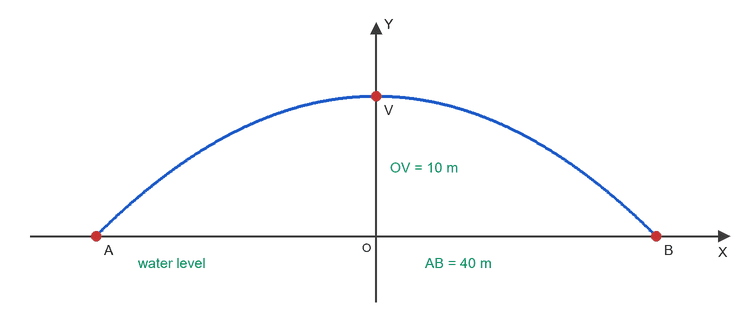
(a) Show that the arch is .
(b) A barge m wide, whose flat cabin roof is m above the water, passes through the middle of the arch. Does it pass under, and with how much clearance at its corners?
(c) Find the greatest width of a barge with an m high flat roof that can pass through the middle.
- 214 marks
Question 21
Competency: Application
A furniture workshop makes and sells chairs a week. Its weekly revenue is rupees and its weekly cost is rupees. (Hypothetical data.)
(a) Write the weekly profit as a quadratic function of .
(b) How many chairs a week give the greatest profit, and what is that profit?
(c) For how many chairs a week (whole numbers) does the workshop make no loss (profit )?
- 221 mark
Question 22
Competency: Application
A ball is thrown from a hand m above the ground. When it has moved metres horizontally, its height is
metres. (Hypothetical model.) The ball is higher than m exactly when
- 233 marks
Question 23
Competency: Application
A farmer has m of fencing to make a rectangular enclosure , divided into two pens by one fence parallel to , as shown. All of the fencing is used: the three fences , , are each m long and the two sides and are each m long. (Hypothetical data.)
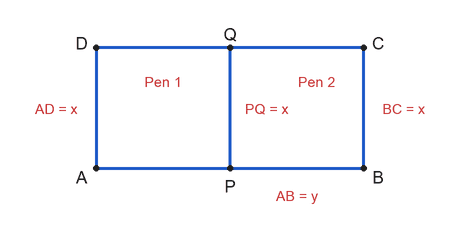
(a) Show that the total area is square metres.
(b) Find the dimensions that give the greatest total area, and that area.
(c) For which values of is the total area at least m?
- 241 mark
Question 24
Competency: Analysis & Evaluation
The main cable of a small suspension footbridge hangs between two towers m apart. With the left tower at , its height above the deck (in metres) is
Assertion (A): The cable is lowest at the middle of the span, where it is m above the deck.
Reason (R): The graph of meets the -axis at the point .
- 251 mark
Question 25
Competency: Analysis & Evaluation
A factory finds that when it makes thousand bottles a day, the average cost per bottle, in hundreds of rupees, is
(Hypothetical model.)
Assertion (A): By choosing a suitable production level , the factory can bring the average cost down to ₹ per bottle (that is, ).
Reason (R): The least value of is (₹ per bottle), reached when .
- 264 marks
Question 26
Find all real values of for which the equation has four distinct real roots.
- 274 marks
Question 27
The three equations
have a common positive root. Find the values of and , the common root, and the other root of each equation.
- 284 marks
Question 28
Let , where is a real number.
(i) Find the values of for which the number lies between the roots of .
(ii) Find the values of for which exactly one root of lies strictly between and .
- 294 marks
Question 29
Find all real values of for which both roots of the equation
are greater than .
- 301 mark
Question 30
Competency: Analysis
In a district inter-school football league, every team plays every other team exactly once. With teams, the number of matches is
The organisers are told four different totals for this season by four different people. (Hypothetical data.) Which total can actually occur for a whole number of teams?
- 311 mark
Question 31
Competency: Application
Meena puts ₹20,000 in a bank deposit that pays compound interest at per annum, compounded yearly. After years the deposit is worth ₹23,328. (Hypothetical data.)
The amount after years on a principal is
Writing turns this into a quadratic equation in . The annual rate of interest is
- 321 mark
Question 32
Competency: Analysis & Evaluation
The power of a lens, in dioptres (D), is the reciprocal of its focal length in metres, so . In a school optics kit, the focal lengths (in metres) of two convex lenses are the roots of
Assertion (A): The powers of the two lenses, in dioptres, are the roots of .
Reason (R): If and are the roots of , where and , then and are the roots of .
- 331 mark
Question 33
Competency: Analysis & Evaluation
A delivery drone flying level at a steady speed of m/s draws an electrical power of
watts, for . (Hypothetical model.)
Assertion (A): The drone draws the least power when it flies at m/s, and this least power is W.
Reason (R): The equation has no real roots.
- 341 mark
Question 34
Competency: Analysis
A surveyor measures the height cm of the ground above a level reference string at points metres along a straight trench. The heights fit a quadratic function of exactly. (Hypothetical data.)
(m) (cm) Without finding the formula, which statement about the points where the ground meets the string is correct?
- 352 marks
Question 35
Competency: Application
A group of students hires a tempo traveller for a day trip for ₹4,800, to be shared equally. Just before the trip, students drop out, so each of the others has to pay ₹100 more. (Hypothetical data.)
Taking as the number of students in the original group, form an equation, reduce it to a quadratic equation, and find how many students went on the trip.
- 362 marks
Question 36
Competency: Creativity
Ms Rao is setting a quiz. She wants a quadratic equation , with integers and , whose roots are real, distinct, both positive and irrational, and add up to .
Frame one such equation, find its roots, and show that it meets every condition.
- 373 marks
Question 37
Competency: Application & Evaluation
In a chemistry experiment, mol of ethanoic acid is mixed with mol of ethanol, and the mixture is left to reach equilibrium:
If mol of the ester has formed at equilibrium, then satisfies
where is the equilibrium constant for this reaction at room temperature.
(i) Reduce this equation to a quadratic equation in .
(ii) Solve it, giving the roots correct to decimal places.
(iii) Decide which root gives the amount of ester formed, and find the percentage of the acid that is turned into ester.
- 383 marks
Question 38
Competency: Analysis
During a festival sale, a shop gives two successive discounts of and on the marked price of a television. The two rates add up to , but together they reduce the price by only . (Hypothetical data.)
(i) Show that .
(ii) Form a quadratic equation whose roots are and , and find the two discounts.
(iii) A customer says she would pay less if the larger discount were given first. Is she right? Give a reason.
- 395 marks
Question 39
Competency: Analysis & Evaluation
A science club builds a torch from a battery pack of four V cells. The pack has an e.m.f. of V and an internal resistance of . When it drives a current of amperes through a bulb, the power delivered to the bulb, in watts, is
The cells give out watts in all, and watts of this is wasted as heat inside the pack. (Hypothetical data.)
(a) The club wants the bulb to receive W. Form a quadratic equation in and find the two possible currents.
(b) For each current, find the power wasted inside the pack and the resistance of the bulb, using . Which bulb should the club choose for a torch whose cells last longer? Give a reason.
(c) Using the discriminant of , find the greatest power the pack can deliver to any bulb, and the current at which this happens.
- 405 marks
Question 40
Competency: Analysis & Evaluation
A school weather club in a city in north India records the air temperature (in °C) on a hot day in May, hours after midnight:
(hours) (°C) (Hypothetical data.) The club models the readings by a quadratic function .
(a) Use the pattern of the readings to find the highest point of the model, and show that the model is .
(b) The school stops outdoor games whenever the temperature is °C or more. Using the model, find the times between which games must stop, to the nearest minute.
(c) A member uses the model to predict the temperature at a.m. Find the predicted value, and judge whether the model can be trusted at that time.