
Opening your dashboard
Class 11 Maths Chapter 6 Complex Numbers: Competency-Based Questions (CBQ)
40 questions on Chapter 6, each worked through on its own page with the AI tutor. Class 11 Maths, ICSE 2026-27.
40 questions
1–5 marks · Mixed difficulty
- 14 marks
Question 1
Competency: Application
A survey drone maps a field by flying a square spiral at a fixed height. Seen from above, take the take-off point as the origin of the Argand plane, with east along the positive real axis and north along the positive imaginary axis (lengths in metres). The drone's direction of travel is written as a complex number of modulus : east is , and each turn to the left multiplies the direction by .
The drone starts at facing east and flies runs of m, m, m, , so the -th run is metres long, turning left after every run. (Hypothetical data.)
(a) In which compass direction does the drone face after left turns?
(b) Explain why the -th run is the complex number , and show that after runs the drone is at the point .
(c) Show that any four consecutive runs, numbered to (), together move the drone by . Hence find how far the drone is from after runs.
- 21 mark
Question 2
Competency: Application
A small stepper motor has four coils set at right angles. Writing directions as complex numbers, the field of a coil points along one of . In a test sequence, at step the controller switches on the three neighbouring coils whose fields are , and , each of the same strength. The resultant field is their sum. (Hypothetical data.)
At step , the resultant field is
- 31 mark
Question 3
Competency: Analysis & Evaluation
A signal-processing stage multiplies its input by . An engineer passes a real signal through identical stages ( a positive integer) and claims the output is again real.
Assertion (A): is a real number for every positive integer .
Reason (R): , and hence .
- 44 marks
Question 4
Competency: Application
A farm map is drawn on an Argand plane with the farmhouse at the origin , east along the positive real axis and north along the positive imaginary axis. One unit on each axis is m. The well is at and the cattle shed is at . (Hypothetical data.)

(a) How far is the well from the farmhouse, in metres?
(b) A straight pipe is laid from the well to the shed. A tap is fitted on the pipe so that . Find the complex number for and describe where the tap is with respect to the farmhouse.
(c) Find the length of the pipe in metres and check that and are in the ratio .
- 51 mark
Question 5
Competency: Application
An artist builds a hanging mobile: a light flat frame carries three equal weights. Drawn on an Argand plane (unit: dm), the weights hang at , and . The frame hangs level when its string is tied at the centre of mass of the three equal weights. (Hypothetical data.)
At which point should the string be tied?
- 61 mark
Question 6
Competency: Analysis & Evaluation
A surveyor marks three pegs for a straight fence. On her Argand-plane plan the pegs are at , and .
Assertion (A): The points , and are collinear.
Reason (R): Three points , , of the Argand plane are collinear only if one of them is the midpoint of the other two.
- 74 marks
Question 7
Competency: Analysis & Evaluation
An old puzzle map reads: “From the stone walk straight to the oak, turn to the right and walk the same distance again; put a peg there. Go back to the stone, walk straight to the pine, turn to the left and walk the same distance; put a second peg there. The treasure is halfway between the two pegs.”
On an Argand plane (unit: m) the oak is at and the pine at . The stone is at . Recall that multiplying a complex number by turns it through anticlockwise, and multiplying by turns it through clockwise. (Hypothetical data.)
(a) Explain why the first peg is at and the second at .
(b) If the stone is at , find , and the treasure point .
(c) The stone has since been carried away. Show that the treasure can still be found, because does not depend on .
- 84 marks
Question 8
Competency: Application
In AC circuit theory a component's opposition to current is its impedance (in ohms), written as a complex number: a resistor of ohms has , an inductor of reactance ohms has , and a capacitor of reactance ohms has . (Engineers write for ; we use .) Impedances in series add, and two impedances and in parallel combine to .
Branch 1 is a resistor in series with an inductor of reactance . Branch 2 is a resistor in series with a capacitor of reactance . (Hypothetical data.)
(a) Write and , and find the total impedance when the two branches are joined in series.
(b) Find the combined impedance when the two branches are joined in parallel, and explain why the combination behaves like a pure resistor.
(c) A supply whose voltage phasor is volts is connected across branch 1 alone. Using the rule , where is the voltage phasor, find the current phasor in the form and its size .
- 91 mark
Question 9
Competency: Application
A fractal-art program colours a pixel by repeating the rule , where is a fixed number for each pixel. For this pixel is .
The program starts with , then works out , , , in turn.
The value of is
- 101 mark
Question 10
Competency: Analysis & Evaluation
While checking a control-system design, an engineer meets the equation , whose coefficients are all real.
Assertion (A): The number is a root of .
Reason (R): If a polynomial equation with real coefficients has a non-real root, then the conjugate of that root is also a root.
- 114 marks
Question 11
Competency: Application
A telecom company has three mobile towers. On an Argand-plane map (unit: km) they stand at , , .
A control room is to be built at the point that is the same distance from all three towers. (Hypothetical data.)
(a) Write the condition as a linear equation in and .
(b) Write the condition as a linear equation in and .
(c) Solve the two equations to locate the control room, and find its distance from each tower.
- 121 mark
Question 12
Competency: Application
A home sensor hub is fixed at the point on an Argand-plane floor plan (unit: m). Because of thick walls it reaches devices only up to m away, including devices at exactly m. Four smart plugs are at the points below. (Hypothetical data.)
Which plug is out of range of the hub?
- 134 marks
Question 13
Competency: Analysis & Evaluation
A carpenter wants right-angled set squares whose three sides are all whole numbers of centimetres. A friend shows her a trick with complex numbers: take whole numbers , square , and use and as the two shorter sides and as the longest side.
(a) Carry out the trick for , and check that the three numbers really form a right-angled triangle.
(b) Using the property , prove that the trick always works, that is, .
(c) The carpenter needs a set square with longest side cm. Find whole numbers that give it, and the other two sides.
- 141 mark
Question 14
Competency: Analysis & Evaluation
Two harbour tugs pull a ship. Writing forces as complex numbers (in kN, east real, north imaginary), the pulls are and . The resultant force is . (Hypothetical data.)
Assertion (A): The resultant force has magnitude kN, the same as .
Reason (R): For any two complex numbers and , .
- 154 marks
Question 15
Competency: Application
A Ferris wheel of radius m turns anticlockwise (as seen in the figure) at a steady per minute. Its centre is m above the ground point . Take as the origin of an Argand plane in the plane of the wheel, with the real axis along the ground and the imaginary axis vertically up, so .
At time a cabin is level with the centre, on the right, at . (Hypothetical data.)

(a) Explain why the cabin's position after minutes is
(b) Find the cabin's position after minutes in the form , and its height above the ground correct to two decimal places.
(c) For how many minutes in each full turn is the cabin more than m above the ground?
- 161 mark
Question 16
Competency: Application
A ship leaves port and sails km on a bearing of , then km on a bearing of . (A bearing is measured clockwise from north.) Using the Argand plane with east along the positive real axis and north along the positive imaginary axis, a bearing of is the direction of argument . (Hypothetical data.)
Where is the ship now, measured from the port?
- 174 marks
Question 17
Competency: Analysis & Evaluation
In an AC laboratory, two signal generators are joined in series. Their voltages are represented by the phasors (complex numbers, in volts)
The modulus of a phasor is the peak voltage and its argument is the phase angle. The total voltage is . (Hypothetical data.)
(a) Write and in polar form, giving each modulus and principal argument.
(b) Find , and show that and .
(c) The total voltage drives a current through a component of impedance ohms, and the current is given by . Find the current phasor in polar form and in the form .
- 181 mark
Question 18
Competency: Analysis & Evaluation
A camera crew films a product on a turntable. A marker on the table is at the point of an Argand plane whose origin is the centre of the table. The table is turned anticlockwise through an angle .
Assertion (A): The marker's new position is .
Reason (R): , and when two complex numbers are multiplied their moduli multiply and their arguments add.
- 194 marks
Question 19
Competency: Application
A graphics program has a “spiral” move that sends every point of a picture to , where is a fixed complex number; it turns the picture about the origin and enlarges it. A designer finds that applying twice sends every point to . (Hypothetical data.)
(a) Explain why , and find both possible values of .
(b) The designer knows that a single move turns the picture anticlockwise through an acute angle. Which value of is it?
(c) Using this , find where one application of sends the point , and check your answer by applying a second time.
- 201 mark
Question 20
Competency: Application
A maths club puzzle card says: “I am a complex number with a positive imaginary part. When you square me, you get .”
Which number is on the card?
- 211 mark
Question 21
Competency: Analysis & Evaluation
A frequency-doubling circuit squares the phasor of its input. A student wants an input phasor that gives the output , and writes the following.
Assertion (A): The square roots of are .
Reason (R): .
- 224 marks
Question 22
Competency: Application
A wind turbine has three blades, each m long, set apart. In the plane of the blades, take the hub as the origin of an Argand plane (unit: m). At one instant the tip of the first blade is at , on the positive real axis, and the other tips and follow anticlockwise. Let be a complex cube root of unity. (Hypothetical data.)

(a) Explain why the tips are at , and , and write and in the form .
(b) Show that . What does this tell an engineer about the balance of the rotor?
(c) Show that each tip satisfies .
(d) Find the distance between the tips and .
- 231 mark
Question 23
Competency: Application
A balanced three-phase supply has phase voltages of V, apart. With , the phase phasors are
The voltage between lines and (the line voltage) has size .
What is the line voltage?
- 241 mark
Question 24
Competency: Analysis & Evaluation
A designer places the corners of a triangular logo at , and on the unit circle, where is a non-real cube root of unity. She notes two facts.
Assertion (A): and are the roots of the equation .
Reason (R): and are complex conjugates of each other.
- 251 mark
Question 25
Competency: Analysis & Evaluation
A triangular display sign turns through at every tick of its motor. If the position of a corner is at the start, then after ticks it is , where is a non-real cube root of unity. A technician predicts where the corner will be after ticks.
Assertion (A): .
Reason (R): , so depends only on the remainder when is divided by .
- 263 marks
Question 26
Competency: Analysis
In his book of 1572 the Italian mathematician Rafael Bombelli studied the cubic equation . A formula published in 1545, now called Cardano's formula, gives a root of the equation as
where the two cube roots are chosen so that their product is .
(a) Show that for Bombelli's equation the formula gives .
(b) Show that and .
(c) Hence find the value of given by the formula, check that it is a root of , and explain why this example helped mathematicians to accept numbers such as .
- 271 mark
Question 27
Competency: Analysis
A round display has four LEDs, placed at the points , , and of an Argand plane drawn on its face. A test program runs for steps , and at step it lights the LED at the point . (Hypothetical data.)
Over a long run, which LEDs are ever lit?
- 283 marks
Question 28
Competency: Application & Analysis
A surveyor draws a triangular plot of land on an Argand plane. One corner is at the origin , and one unit on each axis is m. The other two corners are at and . (Hypothetical data.) For a triangle with corners , and , she uses the rule
(a) Show that .
(b) Find and hence the area of the plot in square metres.
(c) A neighbour suggests moving the corner to , where is real; this moves along the line through parallel to . Show that the area of triangle is the same for every real , and find when .
- 291 mark
Question 29
Competency: Application & Analysis
A photo-editing app has a "turn and zoom" tool. Positions on the screen are complex numbers, with the origin at the centre of the screen, and the tool multiplies the position of every point of a picture by the same complex number . After the tool is used once, the corner of a sticker appears at . (Hypothetical data.)
Where does the corner of the same sticker appear?
- 302 marks
Question 30
Competency: Analysis
Inside a computer chip a multiplication takes longer than an addition. To find , where , , and are real, a signal-processing chip uses only three real multiplications:
It then gives the real part of the product as and the imaginary part as .
(a) Show that the chip's real and imaginary parts are correct.
(b) Use the chip's method to find , and check your answer by multiplying directly.
- 311 mark
Question 31
Competency: Application
In a video game the player's position is a complex number , with the centre of the arena at the origin. A "spin" power-up multiplies by a fixed complex number . The designer wants the spin to turn the player about the centre without moving the player nearer to the centre or farther from it.
Which of these numbers can she use as ?
- 322 marks
Question 32
Competency: Evaluation
In a maths-club challenge, Rhea claims: “I can find two non-real complex numbers that are not conjugates of each other, whose sum is real and whose product is also real.”
Decide whether Rhea's claim can be true, and justify your answer with a proof.
- 335 marks
Question 33
Competency: Analysis & Evaluation
Two identical lighthouses stand on a straight coast. On an Argand plane (unit: km) the coast is the real axis, lighthouse is at and lighthouse is at , and the sea is the region where . Take the brightness of a lamp seen from a distance to be proportional to . (Hypothetical data; haze and the shape of the beams are ignored.)
A boat at the point sees lamp at least four times as bright as lamp .
(a) Explain why this happens exactly when .
(b) Writing , show that the boundary is a circle, and find its centre and radius.
(c) A boat sails parallel to the coast along the line . Between which points of its path does it see lamp at least four times as bright as lamp ? Find the length of this stretch, correct to two decimal places.
- 341 mark
Question 34
Competency: Application
A two-link robot arm lies flat on a table, as shown in the figure. Take the shoulder joint as the origin of an Argand plane, with the real axis along the edge of the table (unit: dm). The first link is dm long and makes an angle of with the real axis. The second link is dm long and points in the direction of the positive imaginary axis. The position of the tip is the sum of the two link vectors. (Hypothetical data.)
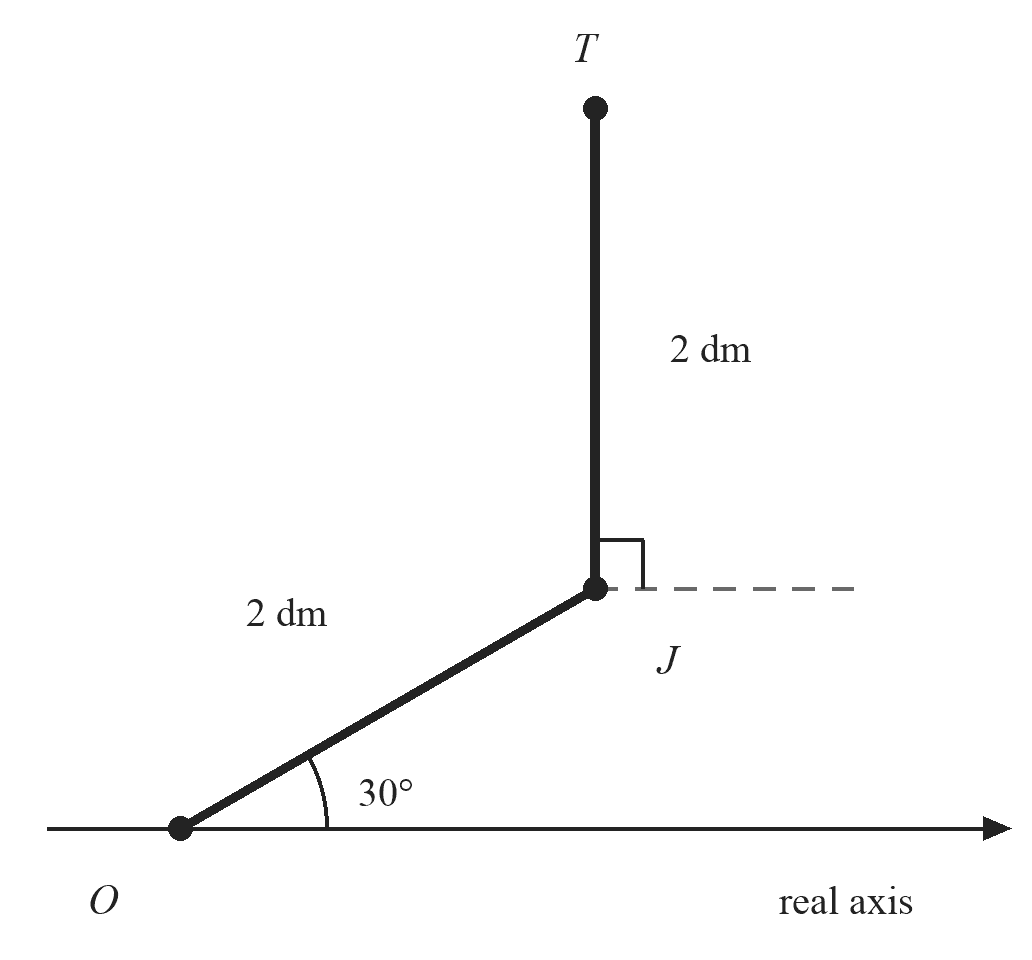
How far is the tip from , and what angle does make with the real axis?
- 351 mark
Question 35
Competency: Analysis & Evaluation
A navigation app stores each direction as a complex number and records its principal argument , which always lies in . To double the turning angle of the direction , the app squares .
Assertion (A): For , .
Reason (R): For non-zero complex numbers and , for some integer .
- 363 marks
Question 36
Competency: Creativity
A town planner is designing a circular park with six fountains at the corners of a regular hexagon. On her Argand-plane plan (unit: m) the centre of the park is the origin, and the first fountain is at , due north. She wants one complex number such that multiplying the position of any fountain by gives the position of the next fountain. She may number the fountains in either direction. (Hypothetical data.)
(a) Choose a suitable , and give its modulus, its argument and its form .
(b) Using your , write the positions of all six fountains in the form .
(c) Design a ring of six benches, one at the midpoint of each side of the hexagon. Find one complex number such that the bench between and the next fountain is at , and find the position of the first bench.
- 375 marks
Question 37
Competency: Application & Analysis
A laser projector draws a triangle on a wall during a light show. Positions on the wall are complex numbers, with the centre of the show as the origin (unit: cm). Every second, the software multiplies the position of each point of the triangle by
At the start () the corners are at the positions in the table. (Hypothetical data.)
Corner Position at (a) Write in polar form, and describe what one multiplication by does to the triangle.
(b) Find the positions of and at s, and of at s, in the form . Show that the side at s is half as long as at .
(c) The software restarts the show as soon as corner is less than mm from the centre. At what time does the restart happen, and where is at that moment? Give in polar form and in the form .
- 381 mark
Question 38
Competency: Analysis & Evaluation
A graphing app has a tool that lists the square roots of any complex number. For the input it lists two outputs.
Assertion (A): The square roots of are and .
Reason (R): Every non-zero complex number has exactly two square roots, and each of them is the negative of the other.
- 392 marks
Question 39
Competency: Evaluation
Arjun finds the square roots of in his notebook as follows.
He lets , where and are real, and writes three equations.
Adding the first and third equations, he gets , so is or . Subtracting them, he gets , so is or . He writes the answer as .
(a) Find the mistake in Arjun's working.
(b) Write the correct square roots, and check one of them by squaring.
- 402 marks
Question 40
Competency: Application & Analysis
A solar farm places its panels at the points of a triangular grid. On an Argand plane (unit: m) the panel positions are , where and are integers and is a complex cube root of unity. A cleaning robot at the origin moves in a straight line to the panel at . (Hypothetical data.)
(a) Using , and , show that for real and .
(b) Find the distance , and check it by writing in the form .