
Opening your dashboard
Class 11 Maths Chapter 5 Compound and Multiple Angles: Competency-Based Questions (CBQ)
40 questions on Chapter 5, each worked through on its own page with the AI tutor. Class 11 Maths, ICSE 2026-27.
40 questions
1–5 marks · Mixed difficulty
- 14 marks
Question 1
Competency: Application
A robot arm in a factory has two straight links. The upper link is cm long and is hinged at the shoulder ; it makes an angle with the horizontal, where . The forearm is cm long; it is turned anticlockwise through a further angle beyond the line of , where . Both and are acute. Take as the origin, the -axis horizontal and the -axis vertically upward, with lengths in cm. (Hypothetical data.)
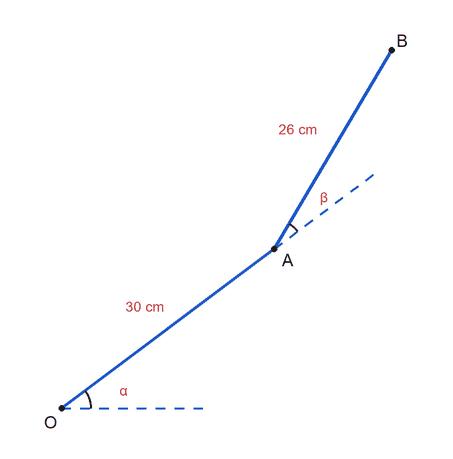
(a) The forearm makes the angle with the horizontal. Without using tables, find and .
(b) Find the coordinates of the tip .
(c) For the next task the controller keeps where it is but turns the forearm the other way, so that now makes the angle with the horizontal. Find the new height of above the shoulder .
- 21 mark
Question 2
Competency: Application
On a summer day the sun's angle of elevation at noon in a north Indian town is . A vertical flagpole on level ground is m tall. (Hypothetical data.)
Without using tables, what is the exact length of the flagpole's shadow at noon?
- 31 mark
Question 3
Competency: Analysis & Evaluation
Two satellites move on the same circular orbit of radius around the centre of the Earth. In a plane through , their positions are and .
Assertion (A): , so the distance between the two satellites depends only on the angle between them, not on where they are on the orbit.
Reason (R): for all angles and .
- 44 marks
Question 4
Competency: Application
A music teacher strikes two tuning forks together, one of frequency Hz and one of frequency Hz. Students hear a steady note that grows loud and soft again and again; these swells are called beats. Taking equal amplitudes, the combined sound at the ear is modelled by
where is the time in seconds. (Hypothetical data.)
(a) Write as a product of a sine and a cosine. Hence state the frequency of the note that is heard.
(b) The loudness depends on the slowly changing factor. Find the times in the first second, , when the sound dies away completely, and hence the number of beats heard per second.
(c) For two forks of frequencies and Hz with , show that the number of beats per second is .
- 51 mark
Question 5
Competency: Analysis & Evaluation
Two loudspeakers play the same tone. At a listener's seat the two sound waves are and , so the second wave is ahead of the first. (Hypothetical data.)
What is the amplitude of the combined wave at the seat?
- 64 marks
Question 6
Competency: Application
A footballer kicks a ball from the ground at a speed of m/s at an angle above the horizontal. Ignoring air resistance and taking m/s², the ball lands at a horizontal distance (its range)
(Hypothetical data.)
(a) Find the range when and when .
(b) Show that the angles and always give the same range.
(c) A team-mate stands m away. Using , find the two possible values of for which the ball lands at the team-mate's feet.
- 71 mark
Question 7
Competency: Understanding
Light that is already polarised passes through a polarising filter whose axis makes an angle with the light's direction of polarisation, . By Malus's law the light that gets through has intensity , where is the intensity when .
Assertion (A): When , the intensity that gets through is .
Reason (R): As increases from to , the intensity that gets through decreases.
- 84 marks
Question 8
Competency: Application
A stepladder has two legs, each m long, hinged together at the top. When it stands open on a level floor, the angle between the two legs at the hinge is , where . The two legs and the floor form an isosceles triangle. (Hypothetical data.)
(a) Without using tables, find and , explaining the sign you choose.
(b) Find the height of the hinge above the floor (correct to two decimal places) and the distance between the feet of the ladder.
(c) On another day the safety bar is set so that the feet are m apart. Find for this new opening.
- 91 mark
Question 9
Competency: Application
A security camera is fixed at ground level at a point , m from the foot of a vertical tower that is m tall. Let . The camera is aimed along the line that bisects , and this line meets the tower at . (Hypothetical data.)
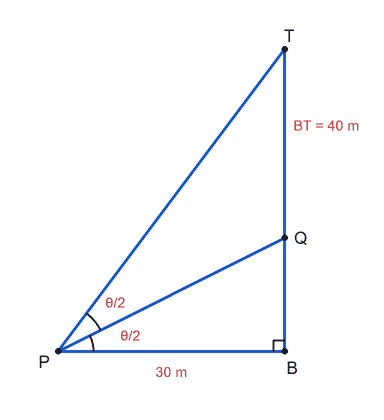
How high above the ground is the point ?
- 104 marks
Question 10
Competency: Application
A park has a bandstand whose floor is a regular decagon (ten equal sides). Its ten corners lie on a circle of radius m with centre . (Hypothetical data.) You may use .
(a) Show that each side of the floor is metres long.
(b) Find the exact length of one side, and the length of railing needed to go once round the edge, correct to two decimal places.
(c) Find the exact distance from to the middle of a side, and its value correct to two decimal places.
(d) Find the area of the floor, correct to two decimal places.
- 111 mark
Question 11
Competency: Understanding
A floor tile is a regular pentagon, so each of its interior angles is . A designer needs the cosine of this angle to work out where the tile edges meet.
Assertion (A): .
Reason (R): for every angle , and .
- 124 marks
Question 12
Competency: Analysis & Evaluation
Two workers tip a tall cabinet forward to slide a trolley under it. The side view of the cabinet is the rectangle , with depth m and height m. The cabinet turns about its front bottom edge , and the bottom edge makes an angle with the floor. Let be the angle that the diagonal makes with . (Hypothetical data.)

(a) Find the length of , and and .
(b) The diagonal makes the angle with the floor. When , find the height of the corner above the floor.
(c) The cabinet is uniform, so its centre of mass is the midpoint of . It will topple forward once this point passes directly above , that is, once reaches . Find at that moment, and decide whether the cabinet is still safe when .
- 131 mark
Question 13
Competency: Analysis & Evaluation
A carpenter glues two wooden wedges side by side so that they share a vertex and one face. The first wedge has angle with ; the second has angle with . Both angles are acute, and the two wedges together make the angle .
Assertion (A): The two wedges together make exactly a right angle, .
Reason (R): for all acute angles and .
- 143 marks
Question 14
Competency: Application
A medium-wave (AM) radio station broadcasts on a carrier of frequency kHz. When it sends a steady test tone of kHz, the part of the signal that carries the tone has the form
with kHz and kHz, in milliseconds (so the frequencies are in cycles per millisecond: and ). (Hypothetical data.)
(a) Write as a sum of two cosines.
(b) Hence state the two frequencies actually present in , and the width of the band of frequencies they occupy.
(c) In India, neighbouring medium-wave stations are kHz apart, so each station must keep its signal within a band kHz wide centred on its carrier. What is the highest tone frequency that fits?
- 151 mark
Question 15
Competency: Analysis & Evaluation
In an a.c. circuit the voltage is and the current is , where and is the angle by which the current lags behind the voltage. The power supplied at each instant is . For an ideal coil, .
Assertion (A): For an ideal coil, the average value of over one full cycle of the voltage is zero.
Reason (R): For every value of , the power goes through its pattern twice in each cycle of the voltage.
- 163 marks
Question 16
Competency: Application
A rain gutter is made by bending a metal strip cm wide along its centre line, so its cross-section is a V with two sides and , each cm long. Each side makes an angle with the vertical through the fold . When the gutter is full, the water surface is the line . (Hypothetical data.)

(a) Show that the area of the cross-section of water in a full gutter is cm².
(b) Find this area when .
(c) Find the greatest possible area, and the angle between the two sides of the gutter that gives it.
- 171 mark
Question 17
Competency: Application
In a gearbox, gear turns three times as fast as gear . Each gear has a mark that starts on the same horizontal line, so when the mark on has turned through an angle , the mark on has turned through . At one instant . (Hypothetical data.)
At that instant, what is the cosine of the angle turned by the mark on ?
- 181 mark
Question 18
Competency: Analysis & Evaluation
A student writes a spreadsheet routine that takes the angle turned by a dial, , and returns using only , by the rule
Assertion (A): The routine returns the correct value of for every with .
Reason (R): for every angle .
- 194 marks
Question 19
Competency: Application
A STOP road sign is a regular octagon. The distance between two opposite sides (across the flats) is cm, so the distance from the centre to the middle of each side is cm. Each side subtends an angle of at . (Hypothetical data.)
(a) Using the half-angle formula , find in surd form.
(b) Find the exact length of one side of the sign and its value correct to two decimal places.
(c) Find in surd form, and hence the distance between two opposite corners of the sign (across the corners), correct to two decimal places.
- 201 mark
Question 20
Competency: Application
A sloping roof has a pitch of : each rafter makes an angle of with the horizontal. A rafter is m long from the wall plate to the ridge. (Hypothetical data.)
Without using tables, how far does the rafter rise vertically, in exact form?
- 213 marks
Question 21
Competency: Analysis & Evaluation
An office chair stands on a base with five equal legs, each reaching cm from the centre, spaced evenly round the centre at intervals. Seen from above, take the centre as the origin with one leg along the positive -axis, so the leg tips are at angles , , , and . (Hypothetical data.) You may use and .
(a) Write the -coordinates of the five leg tips in terms of and only.
(b) Show that the -coordinates of the five tips add up to zero.
(c) Find the exact length of the base measured along the -axis, from the tip furthest forward to the tips furthest back, and its value correct to two decimal places.
- 221 mark
Question 22
Competency: Application
In a physics laboratory a laser beam strikes a small plane mirror at right angles and is reflected straight back to a point on a screen m away; the screen is parallel to the mirror. The mirror is then turned through a small angle . By the law of reflection, the reflected beam turns through . Here . (Hypothetical data.)
How far from does the reflected spot now fall on the screen?
- 231 mark
Question 23
Competency: Analysis & Evaluation
On a plucked guitar string, a wave travelling one way and its reflection travelling back combine to give the displacement at position and time , where , and are positive constants.
Assertion (A): , so the points of the string where never move.
Reason (R): for all angles and .
- 241 mark
Question 24
Competency: Application
A playground swing hangs from chains m long. A child pulls the seat back, keeping the chains straight, until the seat is m from its lowest position, measured in a straight line. The chains then make an angle with the vertical. (Hypothetical data.)
How high is the seat now above its lowest position?
- 251 mark
Question 25
Competency: Understanding
Two spokes of a wheel, each of length , make angles of and with the horizontal. Their horizontal reaches are and . A student says that doubling the angle halves the reach.
Assertion (A): .
Reason (R): for every angle .
- 264 marks
Question 26
If and , prove that
- 274 marks
Question 27
If , prove that .
- 284 marks
Question 28
Prove that .
- 291 mark
Question 29
Competency: Analysis & Evaluation
In a geometry project, four groups each draw a triangle whose three angles are all acute. Each group measures its angles and reports the values of , and , in that order, as whole numbers. The teacher says that only one of the four reports can be exactly right.
Which report can be exactly right?
- 301 mark
Question 30
Competency: Analysis
A circular jogging track in a park has centre and radius m. Take as the origin and the start line along the positive -axis, with lengths in metres. Two lamp posts stand on the track at and . A drinking-water tap is to be fixed at the midpoint of the straight path . (Hypothetical data.)
Which of the following gives the position of ?
- 311 mark
Question 31
Competency: Analysis & Evaluation
A conveyor belt in a warehouse carries boxes up a slope. At first the belt makes an angle with the horizontal, where . A worker raises the belt so that it makes twice the angle, , with the horizontal. (Hypothetical data.)
Assertion (A): After the change, the gradient of the belt, , is more than twice its first gradient, so it is greater than .
Reason (R): for every angle for which is defined.
- 321 mark
Question 32
Competency: Analysis
A circular park has centre and radius . Take as the origin, so that the entrance gate is at . A bench stands on the boundary at , where . A straight footpath runs from to .
Assertion (A): The footpath makes an angle of exactly with the positive direction of the -axis.
Reason (R): for every angle for which .
- 331 mark
Question 33
Competency: Application
A television screen is a rectangle whose width and height are in the ratio . Each diagonal of the screen makes an angle with the horizontal bottom edge, so .
What is the cosine of the acute angle between the two diagonals of the screen?
- 342 marks
Question 34
Competency: Analysis & Evaluation
Two children fly kites from the same spot on level ground, holding their strings at the same height. Each string is m long and is taken to be straight. One string makes an angle of with the horizontal and the other an angle of . (Hypothetical data.) Meera works out how much higher the first kite is than the second. Her working is:
Line 1:
Line 2:
Line 3:
Line 4: m
(a) Without finding either height, explain why her answer cannot be right.
(b) Find the line with the error, correct it, and find the true difference in heights in exact form.
- 352 marks
Question 35
Competency: Analysis
In an electronics laboratory, an input signal volts, where is the time in seconds, is fed into an overdriven amplifier. The output is volts. (Hypothetical data.) A signal of the form has frequency hertz and amplitude .
Use a formula from this chapter to write as a combination of sine waves. Hence state the frequencies present in the output and the amplitude of each.
- 362 marks
Question 36
Competency: Evaluation
A shade structure in a school courtyard is held up by a straight steel strut m long. The strut makes an angle of with the level ground. The design needs the strut to reach at least m horizontally from its foot. (Hypothetical data.) You may use .
Without a calculator or tables, decide whether the strut meets the design need. Justify your answer.
- 373 marks
Question 37
Competency: Application
A ladder m long leans against a vertical wall, with its foot on level ground. At first it makes an angle with the ground, where . The foot then slips outwards, and the angle with the ground decreases by , where ; the top of the ladder still rests against the wall. Both and are acute. (Hypothetical data.)
Find how far the top of the ladder slides down the wall, and how far the foot moves away from the wall.
- 383 marks
Question 38
Competency: Creativity
A craftsperson drills small holes on a circle of radius mm marked on a brass plate; the centre of the circle is the origin. To make marking easy, every hole must have whole-number coordinates in millimetres. A hole at angle from the positive -axis is at . Writing , the half-angle formulae give and .
(a) Find the position of the hole for which , and check that it is mm from the centre.
(b) Design another hole in the first quadrant: choose a different value of , with , that also gives whole-number coordinates. Find its position and check that it lies on the circle.
- 395 marks
Question 39
Competency: Analysis & Evaluation
A giant wheel at a fair has radius m, and its centre is m above the ground. Ten cabins are fixed at equal spacing round the rim, so neighbouring cabins are apart, and at one moment one cabin is at the very top. A cabin whose position makes an angle above the horizontal line through the centre (negative for below) is then at a height of metres. (Hypothetical data.) A sensor records the heights of the cabins on one side of the wheel at that moment.
Cabin Angle Height recorded (m) 1 (top) 2 3 4 5 6 (bottom) You may use and .
(a) Show that the exact heights of cabins 2 and 3 are m and m.
(b) Using exact values, find which reading in the table is wrong, and give its correct value to two decimal places.
(c) The operator says: "Cabin 2 is higher above cabin 3 than cabin 3 is above the centre of the wheel." Check this claim exactly.
- 404 marks
Question 40
Competency: Application & Evaluation
A solar panel stands on a turntable on level ground and is tilted at an angle to the ground, where and . A small motor turns the panel slowly about a vertical axis so that it always faces the sun. So at the times in the table, the sun's rays lie in the vertical plane that contains the slope of the panel and make an angle with the horizontal (the sun's elevation), as in the figure. The fraction of the full strength of the sunlight that falls on each square metre of the panel is , where , at most , is the angle between the rays and the panel. (Hypothetical data.)

Time 8 am 10 am 12 noon (a) Find at 8 am.
(b) Find at 10 am, and show that at 12 noon the rays meet the panel at right angles.
(c) A neighbour lays the same kind of panel flat on the ground, so that for it . At 8 am, how many times as much sunlight per square metre does the tilted panel receive as the flat one? Is tilting the panel worthwhile at that time?