
Opening your dashboard
Class 11 Maths Chapter 20 Differentiation: Competency-Based Questions (CBQ)
40 questions on Chapter 20, each worked through on its own page with the AI tutor. Class 11 Maths, ICSE 2026-27.
40 questions
1–5 marks · Mixed difficulty
- 14 marks
Question 1
Competency: Application
A home bakery sells cupcakes. It finds that when it sells cupcakes in a day, the price it can charge is rupees per cupcake, for . Its daily revenue is rupees. (Hypothetical data.)
(a) Express in terms of , and find the marginal revenue .
(b) Find the marginal revenue when , and compare it with the actual extra revenue from selling the st cupcake.
(c) Find the number of cupcakes for which the marginal revenue is zero, and the price per cupcake at that level of sales.
- 21 mark
Question 2
Competency: Application
A metal cube is heated, so its side of cm slowly increases, and its volume is cm³. An engineer wants the rate of change of the volume with respect to the side at the moment when the side is cm, and writes it as . (Hypothetical data.)
What is the value of this limit, in cm³ per cm?
- 31 mark
Question 3
Competency: Analysis
Assertion (A): .
Reason (R): The limit in A is for , and for .
- 44 marks
Question 4
Competency: Application & Analysis
The period of a clock's pendulum (the time for one complete swing, to and fro) is modelled as seconds, where metres is the length of the pendulum. At m the period is s, and the clock counts every period as exactly s of time. On a hot day the pendulum rod expands, and its length becomes m. (Hypothetical data.)
(a) Using first principles, show that .
(b) Use at to estimate the increase in the period on the hot day.
(c) Using your answer to part (b), find about how many seconds the clock loses in one day of s.
- 51 mark
Question 5
Competency: Analysis
Assertion (A): .
Reason (R): The derivative of the product of two functions is the product of their derivatives.
- 61 mark
Question 6
Competency: Application
The nozzle of a syringe is sealed, and its plunger is pulled out slowly so that the temperature of the trapped air does not change. The pressure of the air is kPa when its volume is mL, for . (Hypothetical data.)
At what rate is the pressure changing with respect to the volume when ?
- 73 marks
Question 7
Competency: Application
A car tyre has a slow puncture. Its gauge pressure hours after the puncture is modelled as kPa, for . (Hypothetical data.)
(a) Find .
(b) Find the pressure, and the rate at which it is changing, when .
(c) Find the time at which the pressure is falling at kPa per hour, and the pressure at that time.
- 81 mark
Question 8
Competency: Analysis
A tap is opened gradually to fill a bucket. The volume of water in the bucket seconds after the tap is opened is litres, for . (Hypothetical data.)
Assertion (A): At , water is flowing into the bucket at litre per second.
Reason (R): At any instant , the rate at which water flows into the bucket equals , the volume collected so far divided by the time taken.
- 91 mark
Question 9
Competency: Application
A student records the height of a bean seedling and finds that days after it appears, its height is about cm, for . (Hypothetical data.)
At what rate is the seedling growing when ?
- 104 marks
Question 10
Competency: Application & Analysis
A road goes over a small hill. In a vertical section along the road, is the horizontal distance in metres from the point below the top of the hill and is the height of the road surface in metres, and the road follows for . The gradient of the road at a point is the slope there, often written as a percentage. (Hypothetical data.)
(a) Find , and the gradient of the road at as a percentage.
(b) Find the point of the road where it climbs, in the direction of increasing , with a gradient of .
(c) A surveyor sets up a straight laser beam that touches the road surface at the point where , along the tangent there. Find the equation of this tangent, and how far the beam is above the road surface at .
- 111 mark
Question 11
Competency: Analysis
Assertion (A): At the points where , the tangents to the curves and are parallel.
Reason (R): The curves and are both parabolas that open upwards.
- 124 marks
Question 12
Competency: Application
A water tank is emptied through an outlet at its base. The volume of water left in the tank minutes after the outlet is opened is litres, for . (Hypothetical data.)
(a) Using the rule , find .
(b) Find the volume of water at the start, and the rate at which water flows out at and at .
(c) Find the time at which half of the starting volume is left, and the rate of outflow at that time, correct to one decimal place.
- 131 mark
Question 13
Competency: Application
After a tablet is swallowed, the concentration of the medicine in a patient's blood hours later is modelled as mg per litre. (Hypothetical data.)
At what rate is the concentration changing when ?
- 144 marks
Question 14
Competency: Application & Analysis
A planning office models the population of a new township as thousand people, years after 1 January 2026, for . (Hypothetical data.)
(a) Find the population on 1 January 2026, and use the quotient rule to show that .
(b) Find the rate of growth of the population, in people per year, at and at .
(c) In which year does the rate of growth fall to people per year, and what is the population then?
- 151 mark
Question 15
Competency: Analysis
Assertion (A): For , .
Reason (R): If and are differentiable functions of and , then .
- 164 marks
Question 16
Competency: Application & Analysis
An open box is made from a square sheet of tin of side cm by cutting equal squares of side cm from the four corners and folding up the sides, for . (Hypothetical data.)

(a) Show that the volume of the box is cm³, and use the product rule to find in factorised form.
(b) Find when , and say what it tells you.
(c) Find the value of for which , and the volume of the box for this .
- 171 mark
Question 17
Competency: Application
During a festival season, a sweet shop raises the price of a box of sweets a little each day and sells fewer boxes. On day of the season the price is rupees per box and the shop sells boxes, for . The day's revenue is rupees. (Hypothetical data.)
How is the daily revenue changing when ?
- 183 marks
Question 18
Competency: Application
A cup of tea is left to cool in a room at °C. Its temperature minutes after it is poured is modelled as °C, for . (Hypothetical data.)
(a) Find the temperature of the tea when it is poured, and use the quotient rule to find .
(b) Find how fast the tea is cooling at and at .
(c) The tea is pleasant to drink at °C. Find when it reaches this temperature, and how fast it is cooling then.
- 191 mark
Question 19
Competency: Analysis
A wood-fired pizza oven is warming up. Its temperature minutes after the fire is lit is °C, for . (Hypothetical data.)
Assertion (A): The temperature of the oven falls between and .
Reason (R): At , the temperature is changing at °C per minute.
- 201 mark
Question 20
Competency: Application
In a laboratory, a very slow alternating signal is applied to a component. At time seconds the voltage across it is volts and the current through it is amperes, and the power delivered to it is watts. (Hypothetical data.)
At what rate is the power changing when ?
- 214 marks
Question 21
Competency: Application & Analysis
A giant wheel at a fair has its hub m above the ground and a radius of m. It turns at a steady speed, making one turn every minutes. The height of a car minutes after it leaves the lowest point is metres. (Hypothetical data.)
(a) Using the rule , find .
(b) Find how fast the car is rising at , correct to two decimal places.
(c) During the first half-turn (), find the time at which the car rises fastest, its rate of rising then, and its height at that moment.
- 221 mark
Question 22
Competency: Analysis
Assertion (A): for every real number .
Reason (R): for every real number , and the derivative of a constant function is .
- 231 mark
Question 23
Competency: Application
A lighthouse stands m from a long straight sea wall. Its beam makes an angle of radians with the perpendicular from the lighthouse to the wall, and the spot of light on the wall is then metres from the foot of that perpendicular, for . (Hypothetical data.)
What is the value of when ?
- 241 mark
Question 24
Competency: Analysis
Assertion (A): At every point where it is defined, the curve has a positive slope.
Reason (R): for .
- 253 marks
Question 25
Competency: Application & Analysis
A vertical flagpole m tall stands on level ground. When the sun's angle of elevation is radians, the length of the pole's shadow is metres, for . (Hypothetical data.)
(a) Find .
(b) Find the value of when , and say what its sign tells you.
(c) In the morning the angle of elevation increases from to . Use to estimate the change in the length of the shadow.
- 264 marks
Question 26
Differentiate from first principles, where and is in radians.
- 271 mark
Question 27
Competency: Analysis
For a science exhibition, a student builds a model roller-coaster track. In a side view, with and in decimetres, the track follows the curve
A toy car runs along the track in the direction of increasing . The points , , and of the track, where , , and , are marked in the figure. (Hypothetical data.)

At which of the marked points is the track going down most steeply?
- 281 mark
Question 28
Competency: Application
Biologists use an approximate rule for the energy that a mammal uses at rest: a mammal of mass kg uses about kilocalories (kcal) per day. A vet uses this rule for a dog of mass kg.
At what rate does change with respect to when ?
- 291 mark
Question 29
Competency: Analysis & Evaluation
In a photo-editing app, a square photo is zoomed in smoothly. Its side seconds after the zoom starts is cm, for , and its area is cm². (Hypothetical data.)
Assertion (A): Since the side of the photo grows at a steady rate of cm per second, its area also grows at a steady rate.
Reason (R): For a square of side , .
- 301 mark
Question 30
Competency: Analysis
A gardener holds a hose nozzle at ground level and points it at an angle of radians above the ground, for . The water leaves the nozzle at m/s. Ignoring air resistance, the jet lands at a distance of metres from the nozzle, where
Use the result . (Hypothetical data.)
Assertion (A): When the nozzle points at to the ground, a small change in its angle hardly changes the distance at which the jet lands.
Reason (R): at .
- 311 mark
Question 31
Competency: Understanding
A dairy makes paneer every day. The cost of making kg of paneer in a day is rupees. The manager is told that . (Hypothetical data.)
Which statement correctly describes what tells the manager?
- 321 mark
Question 32
Competency: Application & Analysis
A tank holds L of pure water. Brine (salt water) with g of salt in each litre flows in at L per minute, the tank is stirred well, and nothing flows out. After minutes the tank holds L of liquid containing g of salt, so the concentration of salt, in grams per litre, is
The tank can hold L, so the model holds for . (Hypothetical data.)
After how many minutes is the concentration rising at g/L per minute?
- 332 marks
Question 33
Competency: Application
A metro train starts from rest at a station. Its speed seconds later is m/s, for . Its acceleration is the rate of change of its speed, . (Hypothetical data.)
(a) Find the acceleration of the train at .
(b) Find the time at which the acceleration has fallen to m/s², and the speed of the train at that time.
- 342 marks
Question 34
Competency: Analysis
Two cyclists, Asha and Kabir, start together from the same line on a straight road. Asha rides at a steady speed, and her distance from the line after seconds is metres. Kabir starts from rest and keeps speeding up; his distance is metres, for . (Hypothetical data.)
(a) Find the time at which both cyclists are moving at the same speed.
(b) Who is ahead at that moment, and by how much?
- 352 marks
Question 35
Competency: Analysis & Evaluation
Ravi studies the curve and says: “The curve crosses the -axis at the origin , so the -axis cannot be its tangent there. In fact, the curve has no tangent at .”
(a) Using first principles, find the slope of the curve at .
(b) Is Ravi right? Give a reason.
- 363 marks
Question 36
Competency: Analysis & Evaluation
A fast-growing district's total yearly income, measured at constant prices (after allowing for price rises), is crore rupees and its population is lakh, so its yearly income per person, in rupees, is
Both and change with time (in years). At present the total income is crore rupees and is rising at crore rupees per year, and the population, swelled by people moving in for work, is lakh and is rising at lakh per year. (Hypothetical data.)
(a) Find the present income per person, and use the quotient rule to find the rate at which it is changing.
(b) A newspaper says: “The district's total income rises by crore rupees a year, so its people are getting richer.” Comment on this claim.
(c) Find the least yearly rise in total income that would stop the income per person from falling, and express it as a percentage of the present total income.
- 373 marks
Question 37
Competency: Application & Analysis
The reflector of a solar cooker is a dish with a circular rim. A student measures the radius of the rim as cm, with a possible error of cm. The area of the opening that collects sunlight is cm², where cm is the radius of the rim. (Hypothetical data.)
(a) Use to estimate the possible error in the area.
(b) Find the percentage errors in the radius and in the area, and compare them.
(c) The area must be known to within . How accurately must the radius be measured?
- 383 marks
Question 38
Competency: Application & Analysis
A doorway has a semicircular arch of radius m with centre . A rectangular glass panel is fitted in the arch, with and on the diameter and and on the arch, as shown in the figure. The angle is radians, for . (Hypothetical data.)
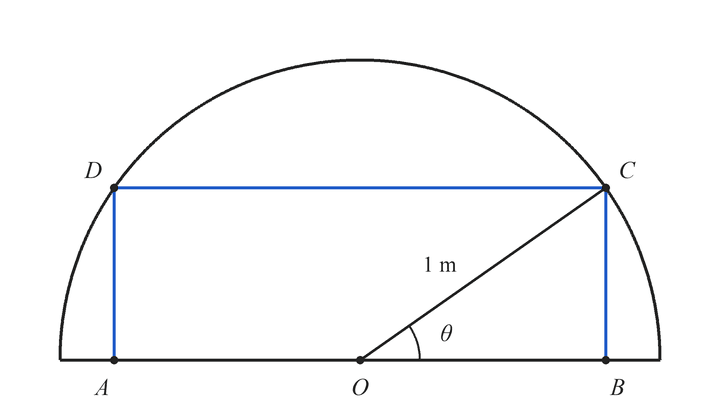
(a) Show that the area of the panel is m², and use the product rule to find .
(b) Find at , and say what its sign tells you.
(c) Find the value of for which , and the width, height and area of the panel for this .
- 395 marks
Question 39
Competency: Analysis & Evaluation
After a small oil leak at sea, the oil spreads out as a roughly circular patch. A coast-guard team measures the radius of the patch at a few times.
Time after the leak, (hours) Radius of the patch, (metres) (Hypothetical data.)
(a) Show that every reading fits the model . Find , and its values at and at .
(b) Write the area of the patch in terms of , and find . What do you notice?
(c) A news report says: “The oil spill is slowing down. In the first hour its edge moved m, but between the th and the th hours it moved only m in nine hours.” Use your answers to comment on this report.
- 405 marks
Question 40
Competency: Creativity & Evaluation
A playground slide is to be designed. In a side view, with and in metres, the top of the slide is at and the bottom is at , and the slide follows a curve for . A child should start and finish moving horizontally, so the slope of the slide must be at both ends. For safety, in this question the slope must nowhere be steeper than in size (about ). (Hypothetical data.)
(a) Write the four conditions that must satisfy, and design a function that meets them. (Hint: try .)
(b) Find where your slide is steepest, and check whether it meets the safety rule.
(c) The designer now wants a shorter slide of the same kind and the same height, from to . Find its steepest slope, and decide whether it is safe.