
Opening your dashboard
Class 11 Maths Chapter 15 Parabola: Competency-Based Questions (CBQ)
40 questions on Chapter 15, each worked through on its own page with the AI tutor. Class 11 Maths, ICSE 2026-27.
40 questions
1–5 marks · Mixed difficulty
- 14 marks
Question 1
Competency: Application & Analysis
A suspension footbridge crosses a gorge. Its main cable hangs between the tops and of two towers that stand m apart horizontally, and the lowest point of the cable lies between the towers. The top of tower is m above , and the top of tower is m above . (Hypothetical data.) Take as the origin, the horizontal line through in the plane of the cable as the -axis (positive towards ) and the vertical line through as the -axis, with lengths in metres. In these axes the cable is the parabola for some .
(a) Find, in terms of , the horizontal distances of and from the -axis, and hence find and the equation of the cable.
(b) Find the co-ordinates of and , and state how far the lowest point of the cable is, horizontally, from each tower.
(c) Find the height of the cable above at the point directly above the middle of the span between the towers.
- 21 mark
Question 2
Competency: Application
The main mirror of a reflecting telescope is cm across. A cross-section of the mirror through its axis is part of a parabola, and the focus of the mirror is cm from its vertex, the centre of the mirror's surface. (Hypothetical data.)
Measured along the axis, how much lower is the centre of the mirror's surface than its rim?
- 31 mark
Question 3
Competency: Analysis
A lamp stands close to a vertical wall. Its shade lets the light out downwards in a right circular cone whose axis is vertical and whose semi-vertical angle is . (Hypothetical data.) The wall is therefore parallel to the axis of the cone of light, and it does not pass through the vertex of the cone.
Assertion (A): The curved edge of the patch of light on the wall is part of a parabola.
Reason (R): A plane that is parallel to the axis of a double right circular cone, but does not contain the axis, cuts both nappes (both halves) of the double cone.
- 43 marks
Question 4
Competency: Application
A dish-type solar cooker has a reflecting dish whose cross-section through its axis is a parabola. The axis is pointed at the sun, and the cooking pot is held at the focus, cm from the vertex (the lowest point of the dish). The rim of the dish is cm across. (Hypothetical data.) Take the vertex as the origin and the axis as the -axis, with lengths in centimetres. A parabolic reflector sends every ray that arrives parallel to its axis through its focus.
(a) Find the equation of the cross-section of the dish.
(b) Find the depth of the dish, and how far the pot is above the plane of the rim.
(c) A ray of sunlight parallel to the axis meets the dish at a point cm from the axis and is reflected to the pot. Find the length of the reflected ray, from the dish to the pot.
- 51 mark
Question 5
Competency: Application
A sound engineer at a cricket ground uses a parabolic microphone: a dish cm across with the microphone at its focus. In this design the rim of the dish is level with the focus, so a diameter of the rim passes through the focus at right angles to the axis. (Hypothetical data.)
How far is the microphone from the vertex, the centre of the dish?
- 61 mark
Question 6
Competency: Analysis
A science club lights a matchstick with sunlight using a small polished dish. A cross-section of the dish through its axis is the parabola , in centimetres, with the vertex at the centre of the dish and the -axis along its axis. They hold the match head on the axis cm from the vertex and point the axis at the sun, whose rays arrive almost parallel. (Hypothetical data.) A parabolic mirror reflects every ray that arrives parallel to its axis through its focus.
Assertion (A): Sunlight that strikes any part of the dish is reflected to the match head.
Reason (R): The focus of is the point , and every ray parallel to the axis of a parabolic mirror is reflected through its focus.
- 73 marks
Question 7
Competency: Application & Analysis
A batter hits a lofted shot straight down the ground. Treat the ball as a point and ignore air resistance, so that its path is a parabola in a vertical plane. Take the point of the ground directly below the bat as the origin, the ground line in the plane of the path as the -axis (positive in the direction of the shot) and the upward vertical as the -axis, with lengths in metres. The ball leaves the bat at and reaches its highest point at , and the boundary rope is m from the origin along the -axis. (Hypothetical data.) A parabola whose vertex is , whose axis is vertical and which opens downwards has an equation of the form , with .
(a) Find the equation of the path of the ball.
(b) A fielder stands under the path, m from the origin. With a jump, the fielder can catch a ball up to m above the ground. Can the fielder catch this ball as it passes overhead? Give a reason.
(c) Find where the ball would first touch the ground, and decide whether the shot is a six (the ball lands beyond the rope without touching the ground first).
- 81 mark
Question 8
Competency: Application
The two towers of a suspension bridge are m apart, and the tops of both towers are m above the deck. The main cable hangs between the tower tops, and its lowest point is midway between the towers, m above the deck. (Hypothetical data.) On the engineer's drawing the origin is the foot of the left tower on the deck, the -axis runs along the deck towards the right tower and the -axis is vertical, with lengths in metres. A parabola whose vertex is , whose axis is vertical and which opens upwards has an equation of the form , with .
Which equation does the drawing give for the cable?
- 91 mark
Question 9
Competency: Analysis
Two stone basins for a garden water feature, and , are each cm across. A cross-section through the axis of basin is the parabola , and one through the axis of basin is the parabola , in centimetres, each with its vertex at the lowest point of the basin. (Hypothetical data.)
Assertion (A): Basin is deeper than basin .
Reason (R): For the parabola with , a larger value of gives a smaller value of at the same distance from the axis.
- 103 marks
Question 10
Competency: Application
A flower bed on a school lawn has a curved edge in the shape of a parabola. On the gardener's plan, in metres, the vertex of the edge is the origin , its axis is the -axis, the bed opens towards the positive -direction, and the edge passes through a marker peg at . A straight paved path runs across the bed along the line . (Hypothetical data.)
(a) Find the equation of the edge of the bed.
(b) Find the points where the path crosses the edge of the bed.
(c) Find the length of the part of the path that lies inside the bed.
- 111 mark
Question 11
Competency: Application
In a solar power plant, long mirrors with a parabolic cross-section focus sunlight onto a pipe that carries oil. In one design the pipe runs along the focus of the cross-section, m from its vertex, and the two long edges of the mirror are m above the vertex, measured along the axis. (Hypothetical data.)
What is the width of the mirror's opening, from one long edge to the other?
- 123 marks
Question 12
Competency: Application
A physics laboratory spins a wide, shallow dish of liquid about a vertical axis through its centre; astronomers use this effect to make liquid mirrors. When the dish turns steadily at radians per second, the cross-section of the liquid surface through the axis is the parabola , where the vertex is the lowest point of the surface, the -axis is the axis of spin, lengths are in metres and . The dish is m across and turns at radians per second. (Hypothetical data.)
(a) Find the equation of the cross-section of the surface, and the distance of its focus from the vertex.
(b) Find how much higher the liquid stands at the edge of the dish than at its centre.
(c) At what rate must the dish turn for the focus to be m above the vertex?
- 131 mark
Question 13
Competency: Analysis
For a logo, a designer draws the curve on a co-ordinate grid, and the drawing software also draws its directrix. (Hypothetical data.) A parabola , with , has the same shape as , moved without turning so that its vertex is at .
Assertion (A): The directrix of the logo curve is the line .
Reason (R): The directrix of the parabola , for any and , is the line .
- 144 marks
Question 14
Competency: Application & Analysis
A concrete-lined irrigation channel has a parabolic cross-section, m wide at the top and m deep at the middle. (Hypothetical data.) Take the lowest point of the cross-section as the origin and the vertical line through it as the -axis, with lengths in metres. Archimedes showed that the region between a parabola and a chord at right angles to its axis has an area equal to of the rectangle with the same width and depth.
(a) Find the equation of the cross-section.
(b) Water flows in the channel to a depth of m at the middle. Find the width of the water surface.
(c) Find the area of the cross-section of the flowing water. If the water moves along the channel at m/s, find the volume of water that flows past a point each second.
- 151 mark
Question 15
Competency: Analysis
The top bar of a decorative railing between two posts is bent to the parabola , in centimetres, with the vertex at its lowest point; the posts stand at and . (Hypothetical data.)
Assertion (A): The bar meets both posts at the same height, cm above its lowest point.
Reason (R): The latus rectum of the parabola is cm long.
- 161 mark
Question 16
Competency: Application
A jewellery designer bends a wire into a pendant shaped like a parabola that opens downwards, with its vertex at the top. The designer solders a straight bar mm long across the pendant through the focus, at right angles to the axis, with both ends of the bar on the wire. (Hypothetical data.) Take the vertex as the origin and the axis as the -axis, with the positive -direction upwards and lengths in millimetres.
What is the equation of the wire?
- 173 marks
Question 17
Competency: Application
Astronomers model the path of a comet near the Sun as a parabola with the Sun at its focus. In the plane of the path they take the comet's closest point to the Sun as the origin and the axis of the parabola as the -axis, with distances in astronomical units (AU), so that the Sun is at . (Hypothetical data.)
(a) Find the equation of the path and the equation of its directrix.
(b) One night the comet is at . Use the definition of a parabola to find its distance from the Sun.
(c) Find the two positions of the comet at which it is AU from the Sun, and the distance between these two positions.
- 181 mark
Question 18
Competency: Analysis
A metalworker cuts a curved slot along the parabola in a metal plate, with lengths in centimetres, and drills a mounting hole centred at the point . (Hypothetical data.)
Assertion (A): The centre of the mounting hole lies on the curve of the slot.
Reason (R): The latus rectum of the parabola is cm long.
- 193 marks
Question 19
Competency: Application & Analysis
A relief helicopter flies level at a height of m and releases a sack of grain when it is directly above a point on flat ground. Ignore air resistance, so that the sack's path is a parabola in a vertical plane, with its vertex at the point of release and its axis vertical. Take as the origin, the ground line in the direction of flight as the -axis and the upward vertical as the -axis, with lengths in metres. The sack lands at . (Hypothetical data.) A parabola whose vertex is , whose axis is vertical and which opens downwards has an equation of the form , with .
(a) Find the equation of the path of the sack.
(b) How far ahead of , horizontally, is the sack when it is m above the ground?
(c) A tree m tall stands m ahead of , in the vertical plane of the path. Does the sack clear the treetop? Give a reason.
- 201 mark
Question 20
Competency: Application
In a graphing app, Tanvi defines the point , where is a slider that can take any real value. As Tanvi moves the slider, traces a parabola. (Hypothetical data.)
For which values of is at an end of the latus rectum of this parabola?
- 213 marks
Question 21
Competency: Analysis
In a geometry app, Asha draws several circles that all pass through the fixed point and all touch the fixed line with equation . (Hypothetical data.) Asha notices that their centres seem to lie on one curve.
(a) Let be the centre of one of these circles. Explain why is as far from as from the line , and hence show that every centre lies on the parabola .
(b) One circle of the family has its centre on the line , with a positive -co-ordinate. Find its centre and its radius, and the point where it touches .
(c) Find the centre and the radius of the smallest circle of the family.
- 221 mark
Question 22
Competency: Analysis
A small steel ball rolls in a groove cut along the parabola in a wooden board, with lengths in centimetres. At one moment the ball is at . (Hypothetical data.)
Assertion (A): At that moment the ball is cm from the point .
Reason (R): Every point of a parabola is as far from its focus as from its directrix, and for the focus is and the directrix is the line .
- 233 marks
Question 23
Competency: Application & Analysis
An engineering student draws a parabola with a T-square and a string. A straight ruler is fixed along a line , and the T-square slides along it with its arm at right angles to , the end on and the far end cm from . A string cm long is tied at and at a pin , cm from . A pencil point keeps the string taut and pressed against the arm, so the string runs from along the arm to and then straight to . (Hypothetical data.) Take the line through at right angles to as the -axis and the point midway between and as the origin, so that is and is the line , with lengths in centimetres.

(a) Show that for every position of the pencil, and hence that the pencil draws part of the parabola .
(b) The pencil can draw only while it is on the arm, so is at most cm. Find the points where the drawn curve ends, and the straight-line distance between them.
(c) Using the same method, how far from the ruler must the pin be placed for the parabola drawn to have a latus rectum cm long?
- 241 mark
Question 24
Competency: Analysis
In a graphing app, Meera enters the focus and the directrix , and the app draws the parabola they define. (Hypothetical data.)
Assertion (A): The vertex of this parabola is the point .
Reason (R): The vertex of a parabola is the point where its axis meets its directrix.
- 251 mark
Question 25
Competency: Application
A designer has drawn the parabola in a drawing program. The designer drags it, without turning it, until its focus is at the point . (Hypothetical data.)
Where is the vertex of the moved parabola?
- 264 marks
Question 26
A parabola has its focus at and its directrix along the line .
(a) Find the equation of its axis.
(b) Find its vertex.
(c) Find the length of its latus rectum.
(d) Find its equation.
- 274 marks
Question 27
The latus rectum of a parabola is the segment joining and . Find the equations of the two parabolas with this latus rectum, and give the vertex and the directrix of each.
- 281 mark
Question 28
Competency: Analysis
A robot lawn-mower is programmed so that, at every moment, its distance from a charging post is twice its perpendicular distance from a straight hedge. The post and the hedge lie in the plane of the lawn, and the post is not on the hedge. (Hypothetical data.)
Assertion (A): The path of the robot is part of a parabola.
Reason (R): A conic is a parabola exactly when its eccentricity, the constant ratio of a point's distance from the focus to its distance from the directrix, is .
- 291 mark
Question 29
Competency: Application & Analysis
A survey drone flies a parabolic route over a field. Its flight software lists the waypoints , in metres, for values of a parameter . A ground beacon keeps a radio link with the drone. The beacon stands at the focus of the route, and the link works only while the drone is at most m from the beacon. Treat the route and the beacon as lying in one plane, so that the drone's height is ignored. (Hypothetical data.)
For which values of is the drone within range of the beacon?
- 301 mark
Question 30
Competency: Analysis
A design engineer types a curve into a CAD program as
where is a constant still to be chosen. The program labels a second-degree curve a parabola only when its second-degree terms form a perfect square, as they do in the general equation of a parabola. (Hypothetical data.)
For which value of can the program label this curve a parabola?
- 311 mark
Question 31
Competency: Understanding
The arch of a temple gateway is built from carved stone blocks. On the architect's drawing, in metres, the inner edge of the arch is the parabola , with the top of the arch at the origin, the -axis horizontal and the -axis vertically upwards. The masons carve the blocks for the right half first. They then make the left half by copying each block's shape reflected in the vertical line through the top. (Hypothetical data.)
Assertion (A): The copied left half fits the drawing exactly: for every point of the right half, the point is also on the arch.
Reason (R): Replacing by leaves the equation unchanged, so the parabola is symmetric about the -axis.
- 321 mark
Question 32
Competency: Analysis
A plotter draws a curve on a grid of unit squares, as shown in the figure below. The curve is a parabola whose axis is parallel to the -axis. Its vertex is , and it passes through the point . (Hypothetical data.) A parabola whose vertex is and whose axis is parallel to the -axis has an equation of the form .
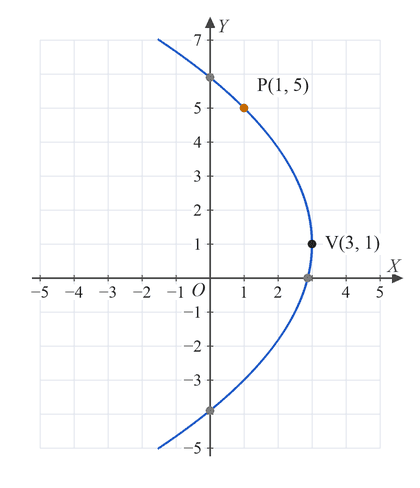
Which equation did the plotter draw?
- 332 marks
Question 33
Competency: Evaluation
In a class test, Ankit was asked for the parabola that has its vertex at the origin, its axis along the -axis and passes through the point , together with its focus and directrix. (Hypothetical data.) His working was:
- The equation has the form .
- He put in and got .
- He solved this to get .
- He wrote the parabola as , its focus as and its directrix as .
(a) Use the definition of a parabola at the point to test Ankit's answer, and say which part of it is wrong.
(b) Write the correct focus and directrix.
- 342 marks
Question 34
Competency: Application
A carpenter cuts a wooden template whose curved edge is the parabola , in centimetres, with the vertex at the origin and the axis along the -axis. To stiffen it, a straight cross-piece cm long is glued across the template at right angles to the axis, with both ends on the curved edge. (Hypothetical data.)
How far from the vertex, along the axis, must the cross-piece be placed? Is it nearer to the vertex than the latus rectum, or farther away?
- 352 marks
Question 35
Competency: Analysis & Evaluation
A road tunnel has a parabolic roof. At road level the tunnel is m wide, and the top of the roof is m above the road at the middle. (Hypothetical data.) Two surveyors describe the roof in metres, each with the -axis vertically upwards:
- Riya takes the top of the roof as the origin and writes .
- Sameer takes the left end of the roof at road level as the origin, with the -axis along the road, and writes .
A parabola whose vertex is , whose axis is vertical and which opens downwards has an equation of the form , with .
Are both equations correct descriptions of the roof? Justify your answer, and explain why the two equations look different.
- 363 marks
Question 36
Competency: Analysis
A district hospital stands at , and a straight national highway runs along the line , with distances in kilometres. The district office marks the boundary made of all the points that are equally far from the hospital and from the highway. On one side of this boundary the hospital is nearer, and on the other side the highway is nearer. (Hypothetical data.)
(a) Find the equation of the boundary, and say what kind of curve it is.
(b) For the village and the village , decide which is nearer to each village: the hospital or the highway.
- 373 marks
Question 37
Competency: Application & Analysis
A basketball player takes a jump shot. Treat the ball as a point and ignore air resistance, so that its path is a parabola with a vertical axis. Take the point on the floor directly below the release point as the origin, the -axis along the floor towards the basket and the -axis vertically upwards, with lengths in metres. The ball leaves the player's hands at , is at its highest when it is m ahead of the origin, and drops through the centre of the hoop at . (Hypothetical data.) A parabola whose vertex is , whose axis is vertical and which opens downwards has an equation of the form , with .
(a) Find and , write the equation of the path, and state the greatest height of the ball.
(b) At what other horizontal distance from the origin is the ball at the height of the hoop?
- 383 marks
Question 38
Competency: Creativity & Analysis
Meera is designing a rangoli tile. On her drawing, in centimetres, the tile is the rectangle , . She wants a curved border that meets all of these conditions:
- it is a parabola with its axis along the -axis, opening downwards;
- it passes through the points and on the lower edge of the tile;
- its vertex and its focus both lie strictly inside the tile, with .
(Hypothetical design.)
(a) Design one such parabola. Give its equation, its vertex, its focus and the length of its latus rectum.
(b) Find every possible height of the vertex above the lower edge for which all the conditions hold.
- 395 marks
Question 39
Competency: Analysis & Evaluation
Under a railway bridge, a road dips and rises again along a sag curve, which is a parabola with a vertical axis. A surveyor records the level of the road, in metres above a fixed mark, at stations metres along the road:
(m) (m) Exactly one reading was written down wrongly. (Hypothetical data.) A parabola whose vertex is , whose axis is vertical and which opens upwards has an equation of the form , with .
(a) Use the symmetry of a parabola about its axis to find the axis and the lowest point of the road. Which two readings cannot both be correct?
(b) Find the equation of the road's profile. Hence find the wrong reading and its correct value.
(c) After rain, water stands on the part of the road that is less than m above its lowest point. Find the length of this part, measured along the -axis.
- 404 marks
Question 40
Competency: Application & Analysis
A marble is flicked sideways across a smooth, tilted table. A camera takes photos at equal time intervals, starting at the moment of the flick. Take the starting point as the origin , the -axis straight down the slope and the -axis across the slope in the direction of the flick, with lengths in centimetres. The photos give these positions:
Photo (cm) (cm) (Hypothetical data.)
(a) Show that all five positions lie on one parabola of the form , and find its equation.
(b) Find the focus and the length of the latus rectum of this parabola. In which photo is the marble at an end of the latus rectum?
(c) The lower edge of the table is the line and its side edge is the line . Assuming the marble keeps to the same parabola, which edge does it reach first, and at which point?