
Opening your dashboard
Class 11 Maths Chapter 14 Circle: Competency-Based Questions (CBQ)
40 questions on Chapter 14, each worked through on its own page with the AI tutor. Class 11 Maths, ICSE 2026-27.
40 questions
1–5 marks · Mixed difficulty
- 13 marks
Question 1
Competency: Application
A giant wheel at a fair turns in a vertical plane. Its axle is m above level ground, and each cabin is fixed to the rim m from the axle; treat every cabin as a point on the rim. Take the point of the ground directly below the axle as the origin , the ground line in the plane of the wheel as the -axis and the vertical line through the axle as the -axis, with lengths in metres. (Hypothetical data.)
(a) Write the equation of the circle on which the cabins move, in the form .
(b) A cabin is m above the ground. Find its possible positions.
(c) Use the equation of part (a) to show that the rim never reaches the ground, and find the least height of a cabin above the ground.
- 21 mark
Question 2
Competency: Application
In a discus event the throwing circle has an inside diameter of m. A throw is measured from the nearest mark made by the discus on landing to the inside edge of the circle, along the line joining that mark to the centre of the circle. On the measuring plan the centre of the circle is the origin and lengths are in metres, so the inside edge is . One throw leaves its mark at . (Hypothetical data.)
What distance is recorded for this throw?
- 31 mark
Question 3
Competency: Analysis
Two engineers each draw the outline of a circular washer in a different drawing program, using the same origin, axes and units. One program saves its outline as , and the other saves its outline as . (Hypothetical data.)
Assertion (A): The two saved equations describe the same circle.
Reason (R): Multiplying every term of an equation by the same non-zero number does not change the set of points that satisfy it.
- 44 marks
Question 4
Competency: Application & Analysis
Archaeologists excavating an ancient village find three post holes, , and , which they believe were on the circular wall of one hut. Their site plan uses a fixed datum peg as the origin, with the -axis pointing east, the -axis pointing north, and lengths in metres. (Hypothetical data.)
(a) Find the equation of the circle through , and , in the form .
(b) Find the centre and the radius of this circle, and hence the diameter of the hut.
(c) Huts of this kind had their posts about m apart all round the wall. Taking , estimate how many posts the hut had.
- 51 mark
Question 5
Competency: Application
During a storm, Riya is at a campsite on a map whose units are kilometres. She sees a flash of lightning and hears its thunder seconds later. Sound travels about km in seconds, and the light of the flash reaches her almost at once. (Hypothetical data.)
On which circle on the map does the point of the lightning strike lie?
- 61 mark
Question 6
Competency: Analysis
A designer's software stores the outline of a round drinks coaster as , with lengths in centimetres. (Hypothetical data.)
Assertion (A): The centre of the coaster's outline is the point .
Reason (R): The circle has its centre at the point .
- 73 marks
Question 7
Competency: Application
On a basketball court marked to FIBA rules, the point on the floor directly below the centre of the basket is m from the end line. The three-point line is an arc of a circle of radius m about that point; near the sidelines the arc joins two straight lines, parallel to the sidelines and m from them. The court is m wide. Take the end line as the -axis and the line through the basket at right angles to the end line as the -axis, pointing into the court, with lengths in metres. Treat every line as having no width.
(a) Write the equation of the circle of which the three-point arc is a part.
(b) Show that the straight parts of the line are and , and find how far from the end line the arc meets them, correct to two decimal places.
(c) Find the distance of the farthest point of the three-point line from the end line.
- 81 mark
Question 8
Competency: Application
On the plan of a village well, with lengths in metres, the inside edge of the well is and the outer edge of the flat concrete platform built round it is . (Hypothetical data.)
What is the area of the platform between the two edges?
- 91 mark
Question 9
Competency: Analysis
A designer draws a logo made of two rings, with the centre of the logo at the origin and lengths in centimetres. The rings are and . (Hypothetical data.)
Assertion (A): The two rings have equal radii.
Reason (R): Both rings pass through the origin.
- 104 marks
Question 10
Competency: Application & Analysis
On a carrom board, take one corner of the playing surface as the origin and the two edges through it as the axes, with lengths in centimetres. A coin of radius cm rests with its centre at , and the striker, of radius cm, is placed with its centre at . (Hypothetical data.) Two circles touch each other externally when the distance between their centres equals the sum of their radii.
(a) Write the equations of the edge of the coin and the edge of the striker.
(b) Show that the striker and the coin are not touching, and find the gap between their edges measured along the line of centres.
(c) The striker is slid straight towards until it just touches the coin. Find the new centre of the striker and the point where the striker and the coin touch.
- 111 mark
Question 11
Competency: Application
On the floor plan of a clinic, with lengths in metres, a door is hinged at the corner and opens into the first quadrant, so the outer edge of the door moves along part of the circle , where is the width of the door. A pillar stands in the room, and the point of the pillar nearest to the hinge is . (Hypothetical data.)
Which of these doors can swing fully open without touching the pillar?
- 124 marks
Question 12
Competency: Application & Analysis
The large wheel of a wheelchair, of radius cm, rolls along level ground towards a step cm high. Take the ground as the -axis and the vertical face of the step as the -axis, with lengths in centimetres, so that the corner of the step is , the top of the step is the line for , and the wheel is on the side where . (Hypothetical data.)
(a) When the centre of the wheel is at , write the equation of the rim in the form , and show that the rim touches the ground at exactly one point.
(b) The wheel rolls to the right, keeping its centre cm above the ground. Find the exact -coordinate of the centre when the rim first touches the corner .
(c) Write the equation of the rim in that position, and check that satisfies it.
- 131 mark
Question 13
Competency: Analysis & Evaluation
A robot arm on a workbench has two straight links, dm and dm long. The first link turns about a fixed base at the origin . The second link is joined to the free end of the first link by an elbow that can turn to any angle, and the gripper is at the other end of the second link. The whole arm moves in the plane of the bench, with lengths in decimetres. (Hypothetical data.) As the two joints turn, the distance can take every value from to , in every direction from , and no other value.
Assertion (A): The gripper can reach the point .
Reason (R): The gripper can reach exactly those points that lie inside or on the circle .
- 144 marks
Question 14
Competency: Application
A harbour's surveillance radar detects ships inside the circle , where the -axis points east, the -axis points north and lengths are in kilometres; the radar stands at the centre of this circle. A cargo ship sails along the straight course , moving from west to east at a steady km/h. (Hypothetical data.)
(a) Find the position of the radar and its range, the radius of the circle.
(b) Find the points where the ship enters and leaves the radar's range.
(c) For how long, to the nearest minute, is the ship inside the radar's range?
- 151 mark
Question 15
Competency: Analysis
A town's ring road is drawn on a map, with unit representing km, as the circle . A new map of the town keeps the same origin and the same directions of the axes, but unit now represents m. (Hypothetical data.)
Assertion (A): On the new map, the ring road has the equation .
Reason (R): Every distance in the new units is twice the same distance in the old units, so on the new map the coordinates of the centre and the radius are all doubled.
- 161 mark
Question 16
Competency: Application
Rainwater flows through a circular concrete pipe under a road. In a cross-section of the pipe, take the centre of the pipe as the origin, the -axis horizontal and the -axis vertical, with lengths in metres, so that the inside of the pipe is . The water in the pipe is m deep, measured from the lowest point of the pipe. (Hypothetical data.)
How wide is the surface of the water?
- 173 marks
Question 17
Competency: Application
A pebble falls into still water in a straight canal m wide, at a point m from the near bank. Take the near bank as the -axis, the far bank as the line , and the line through the point where the pebble falls, at right angles to the banks, as the -axis, with lengths in metres. The front of the ripple is a circle about whose radius grows by m every second. (Hypothetical data.)
(a) Write the equation of the ripple front seconds after the pebble falls, in the form .
(b) Using the intercept of this circle on the -axis, find the length of the near bank that lies inside the ripple front at that moment.
(c) When does the ripple first reach the far bank, and at which point?
- 181 mark
Question 18
Competency: Analysis
Meera draws the circle on graph paper and makes two claims about it.
Assertion (A): The circle cuts the -axis at two points that are units apart.
Reason (R): The circle touches the -axis.
- 194 marks
Question 19
Competency: Application & Analysis
A straight footbridge crosses a circular lake through its centre, from a jetty at to a jetty at , both on the shore. On the park's map the -axis points east, the -axis points north, and unit represents m. (Hypothetical data.)
(a) Using the diameter form, find the equation of the shore, and simplify it to the form .
(b) Find the centre and the radius of the lake from this equation, and find the length of the footbridge in metres.
(c) A new map puts the origin at the jetty , with the axes in the same directions and the same unit, so that a point with old coordinates has new coordinates , where and . Find the equation of the shore on the new map, and explain why it has no constant term.
- 201 mark
Question 20
Competency: Evaluation
A surveyor knows that the boundary of a circular plot passes through the points and , with lengths in metres. (Hypothetical data.) The surveyor can measure one more fact about the boundary.
Which one extra fact fixes the boundary circle completely?
- 214 marks
Question 21
Competency: Application & Analysis
A goat is tied by a rope m long to a peg at in a field. Take the corner of the field as the origin and its two straight edges as the axes, with lengths in metres. The edge of a vegetable patch is the straight fence , and the patch lies on the side of the fence away from . (Hypothetical data.) The distance of a point from the line is .
(a) Write the equation of the circle traced by the end of the tight rope, in the form , and say what its constant term tells you.
(b) Find the shortest distance from the peg to the fence, and decide whether the goat can reach the fence.
(c) The farmer moves the peg along the line , towards the -axis, to the point where the goat can only just touch the fence. Find the new position of the peg.
- 221 mark
Question 22
Competency: Evaluation
Tanvi studies circles that touch both coordinate axes and writes down two statements.
Assertion (A): Every circle that touches both coordinate axes has its centre on the line .
Reason (R): The centre of any circle that touches both coordinate axes is equally far from the two axes.
- 233 marks
Question 23
Competency: Application
A pipe flange has four bolt holes whose centres are equally spaced on a circle, called the bolt circle. On the engineering drawing, with lengths in centimetres, two opposite holes have their centres at and . (Hypothetical data.)
(a) Using the diameter form, find the equation of the bolt circle.
(b) The other two holes, and , lie on the diameter at right angles to , with above . Find their centres and check that they lie on the bolt circle.
(c) Find the distance between the centres of two neighbouring holes, correct to two decimal places.
- 241 mark
Question 24
Competency: Analysis
A round jar lid lies flat on a sheet of graph paper, with lengths in centimetres, and a ruler lies along the -axis. The edge of the lid is the circle . (Hypothetical data.)
Assertion (A): The edge of the lid touches the -axis.
Reason (R): The centre of the edge of the lid is cm from the -axis.
- 251 mark
Question 25
Competency: Application
On a building-site plan, with lengths in metres, the mast of a tower crane stands at , and the tip of its m jib sweeps the circle ; the near edge of a public road is the straight line . (Hypothetical data.) The distance of a point from the line is .
How long a stretch of the road's near edge lies under the circle swept by the jib?
- 261 mark
Question 26
Competency: Analysis & Evaluation
A circular skating rink is painted on a sports ground. On the ground plan, with lengths in metres, two straight white lines run along the -axis and the -axis. The edge of the rink crosses the -axis at and , and it also crosses the -axis at two points. Four students each read these two crossing points on the -axis from a faded photograph of the plan. (Hypothetical data.)
Which reading can be correct?
- 271 mark
Question 27
Competency: Analysis
In a café, two round tables are pushed together. On the floor plan, with unit representing cm, the edge of the smaller table top is and the edge of the larger table top is . (Hypothetical data.)
Assertion (A): The edges of the two table tops touch each other at exactly one point.
Reason (R): The distance between the centres of the two edges is equal to the sum of their radii.
- 281 mark
Question 28
Competency: Application & Analysis
A circular stage is being built in a school ground. On the plan, with lengths in metres, two pillars stand at and , at the two ends of a diameter of the edge of the stage. A straight cable trench runs along the -axis, under the stage. (Hypothetical data.)
What length of the trench lies under the stage?
- 291 mark
Question 29
Competency: Analysis
Two spotlights light up two circular pools of light on a theatre stage. On the stage plan, with unit representing cm, the edge of the first pool is and the edge of the second pool is . The two edges cross at two points, and the director sticks a straight strip of tape through both of these points. (Hypothetical data.)
Which is the equation of the line of the tape?
- 301 mark
Question 30
Competency: Analysis
A small lamp is fixed to the rim of a turning display wheel in a shop window. On the plan of the window, with lengths in decimetres, the position of the lamp at time seconds is given by and . (Hypothetical data.)
Assertion (A): The lamp moves on the circle .
Reason (R): For every value of , , because .
- 311 mark
Question 31
Competency: Application & Analysis
Asha prints a circle on a sheet of paper and then folds the sheet along a straight crease. On her plan, with lengths in centimetres, the crease is the line . When the sheet is folded along the crease, the printed circle falls exactly on itself. (Hypothetical data.)
Which of these can be the printed circle?
- 322 marks
Question 32
Competency: Application & Analysis
A ladder m long stands on level ground and leans against a vertical wall. It starts to slip: its foot moves along the ground away from the wall while its top slides down the wall. A paint mark is at the middle point of the ladder. Take the foot of the wall as the origin , the ground as the -axis and the wall as the -axis, with lengths in metres. (Hypothetical data.)
(a) Show that the paint mark moves along part of a circle, and write the equation of that circle.
(b) Find the height of the mark above the ground when the foot of the ladder is m from the wall.
- 332 marks
Question 33
Competency: Analysis & Evaluation
Kabir draws several circles on graph paper and notices that some of them cut off chords of equal length on the two axes. He claims: “If the circle cuts off intercepts of equal length on the -axis and on the -axis, then .”
Is Kabir's claim always true? Justify your answer and support it with an example.
- 342 marks
Question 34
Competency: Application
On the design drawing of a desk clock, with lengths in centimetres, the tip of the minute hand moves on the circle . (Hypothetical data.)
(a) Find the length of the minute hand.
(b) Find the distance moved by the tip of the minute hand between 9:00 a.m. and 9:20 a.m., correct to two decimal places.
- 352 marks
Question 35
Competency: Analysis
In a graphing app, Meera types the equation and moves a slider that changes the real number .
(a) Show that the equation gives a real circle, with a positive radius, for every real value of .
(b) Find the value of for which the circle is the smallest, and its radius for that value.
- 363 marks
Question 36
Competency: Creativity
A school lawn is the rectangle , , with lengths in metres, and a water tap stands at . The gardener wants a circular flower bed of radius m that lies completely inside the lawn (it may touch the edges of the lawn), with every point of the bed at least m away from the tap. (Hypothetical data.)
(a) Write the conditions that the centre of the bed must satisfy.
(b) Propose one position for the centre, check that it meets every condition, and write the equation of the edge of the bed in the form .
- 373 marks
Question 37
Competency: Application & Analysis
A circular jogging track is to be laid out in a park. On the plan, with unit representing m, a straight footpath runs along the -axis, and the park lies between two straight boundary walls, the north wall and the south wall . The track must pass through two lamp posts on the footpath, at and , and it must just touch the north wall, meeting it at one point only. A pond lies to the west of the footpath, so the centre of the track must be on the east side, where . Treat the track as a circle and the lamp posts as points on it. (Hypothetical data.)
(a) Explain why the centre of the track lies on the -axis.
(b) Find the two circles that pass through both lamp posts and touch the north wall, and choose the one that suits the pond condition. Give the radius of the track in metres.
(c) Write the equation of the chosen track in the form , find the point where it touches the north wall, and show that it also just touches the south wall.
- 383 marks
Question 38
Competency: Analysis & Evaluation
In a toy, a small wheel of radius cm rolls round the outside of a fixed circular disc, always touching it. On the drawing of the toy, with lengths in centimetres, the edge of the fixed disc is . (Hypothetical data.)
(a) Find the equation of the path traced by the centre of the small wheel.
(b) Can the centre of the small wheel ever be at the point ? Give a reason.
(c) Find the points where the path of the centre of the small wheel crosses the -axis.
- 395 marks
Question 39
Competency: Analysis & Evaluation
A straight highway runs along the -axis from to , with lengths in kilometres. Three mobile towers serve the highway; a point is covered by a tower when its distance from the tower is at most the range of that tower. (Hypothetical data.)
Tower Position Range T1 km T2 km T3 km (a) Write the equation of the boundary of the region covered by T1 in the form , and find the stretch of the highway that T1 covers.
(b) Find the stretches covered by T2 and T3, and hence the stretches of the highway between and that no tower covers.
(c) The company can increase the range of T2 only. Find the least range of T2 that closes both uncovered stretches, and decide whether a range of km is enough.
- 404 marks
Question 40
Competency: Application & Analysis
For a festival, a rangoli is drawn on a floor marked with a square grid, with lengths in decimetres. Its outer circle is drawn with the segment joining and as a diameter, and is the centre of this circle. Two smaller circles are then drawn, one with as a diameter and one with as a diameter, as shown in the figure. (Hypothetical data.)
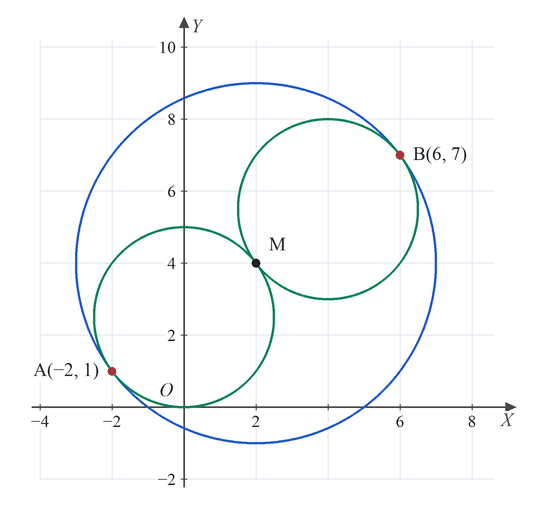
(a) Using the diameter form, find the equation of the outer circle and the co-ordinates of .
(b) Using the diameter form, find the equations of the two smaller circles.
(c) Show that the two smaller circles touch each other at , and that each of them touches the outer circle. Find, correct to two decimal places, the area of the part of the rangoli that lies inside the outer circle but outside both smaller circles.