
Opening your dashboard
Class 11 Maths Chapter 11 Sequence and Series: Competency-Based Questions (CBQ)
40 questions on Chapter 11, each worked through on its own page with the AI tutor. Class 11 Maths, ICSE 2026-27.
40 questions
1–5 marks · Mixed difficulty
- 13 marks
Question 1
Competency: Application
Ravi climbs a ladder whose rungs are numbered from the bottom, starting from the ground. With each move he goes up either one rung or two rungs. Let be the number of different ways (orders of moves) in which he can reach rung from the ground.
(a) By listing the orders of moves, find , , and .
(b) Explain why for , and use this rule to find .
(c) Use the first four terms to decide whether the sequence is an A.P., a G.P. or neither.
- 21 mark
Question 2
Competency: Application
In the Tower of Hanoi puzzle, discs of different sizes sit on one of three pegs, largest at the bottom. A move takes the top disc of one peg to another peg, and a disc may never be placed on a smaller disc. Let be the least number of moves needed to shift a tower of discs to another peg. To shift discs, a player shifts the top discs to the spare peg, moves the largest disc, and then shifts the discs back on top of it. So
A puzzle app uses discs. What is the least number of moves needed?
- 31 mark
Question 3
Competency: Analysis & Evaluation
A new library opened with a ceremony on day , and its guests were counted as visitors that day. The library's counter shows the total number of visitors from the opening up to the end of day as . (Hypothetical data.) Let be the number of visitors on day alone.
Assertion (A): The daily numbers of visitors form an A.P.
Reason (R): A sequence is an A.P. exactly when the sum of its first terms has the form for some constants and .
- 41 mark
Question 4
Competency: Application
A botanist models the height of a seedling at the end of week as
(Hypothetical data.) The growth in the week after week is . What is the smallest value of for which is less than cm?
- 53 marks
Question 5
Competency: Application
Neha has two job offers. (Hypothetical data.)
- Offer P: a salary of ₹ in the first year, rising by ₹ every year.
- Offer Q: a salary of ₹ in the first year, rising by ₹ every year.
(a) Find her salary in the th year under each offer.
(b) From which year onwards is the yearly salary under Offer P greater than under Offer Q?
(c) Find her total earnings over the first years under each offer. Which offer pays more over these years, and by how much?
- 61 mark
Question 6
Competency: Analysis & Evaluation
A town-hall clock strikes the hours only: once at o'clock, twice at o'clock, and so on, up to times at o'clock. Its hour hand goes round the dial twice a day.
Assertion (A): The clock strikes times in a full day of hours.
Reason (R): The sum of the first natural numbers is .
- 71 mark
Question 7
Competency: Application
In a stadium stand, the seats are numbered continuously, row by row, starting from the front row. The front row has seats, and each row has seats more than the row in front of it. (Hypothetical data.)
In which row is seat number ?
- 83 marks
Question 8
Competency: Application
During a heatwave, a housing society's reserve tank holds litres of water and receives no refill. On day the residents use litres, and on every later day they use litres more than on the day before. (Hypothetical data.)
(a) How much water is used on day ?
(b) How much water is used in the first days together? What fraction of the tank is this?
(c) By the end of which day is the tank empty?
- 91 mark
Question 9
Competency: Analysis & Evaluation
Before a model-rocket launch at a science fair, a display counts down in steps of . It shows , and then the rocket lifts off.
Assertion (A): The display shows numbers in all.
Reason (R): The number of terms in the A.P. is .
- 103 marks
Question 10
Competency: Analysis & Evaluation
On a monthly calendar the dates are arranged in rows of , one column for each day of the week. Riya draws a square around nine dates that lie inside the month's grid, and calls the date in the centre of her square .
(a) Show that is the arithmetic mean of the two end dates of each of the four lines through the centre of the square (the middle row, the middle column and the two diagonals).
(b) Hence show that the nine dates add up to . If the nine dates in such a square add up to , find all nine dates.
(c) Her friend says he has drawn such a square whose dates add up to . Is this possible? Give a reason.
- 111 mark
Question 11
Competency: Analysis & Evaluation
A tailor marks the buttons on a shirt front. The top button is cm below the collar and the bottom button is cm below the collar. She places more buttons between them so that all buttons are equally spaced.
Assertion (A): The four middle buttons are cm, cm, cm and cm below the collar.
Reason (R): The arithmetic mean of two numbers and is .
- 121 mark
Question 12
Competency: Application
On a summer morning a weather station records C at a.m. and C at p.m. A student assumes that the temperature rose by the same amount every hour, so that the six hourly readings from a.m. to noon are the six arithmetic means between and . (Hypothetical data.)
What reading does this model give for a.m.?
- 134 marks
Question 13
Competency: Application
The Koch snowflake is built in stages. Stage is an equilateral triangle of side cm. To get the next stage, every side is divided into three equal parts, an equilateral bump is drawn outwards on the middle part, and the base of that bump is removed. So each side is replaced by sides, each one-third as long.

(a) For stages to , find the number of sides, the length of each side and the perimeter.
(b) Show that the perimeters form a G.P., and state its common ratio.
(c) Find the perimeter at stage .
(d) Show that the perimeter at stage is the geometric mean of the perimeters at stages and .
- 141 mark
Question 14
Competency: Application
A pendulum in a science museum is set swinging. Its first swing covers an arc of cm, and because of air resistance each swing covers of the arc of the swing before it. (Hypothetical data.)
What is the length of the arc of the th swing, correct to one decimal place?
- 151 mark
Question 15
Competency: Analysis & Evaluation
A hospital laboratory stores mg of a radioactive isotope whose half-life is days, so in every days half of the amount present decays. (Hypothetical data.)
Assertion (A): After days, mg of the isotope remains.
Reason (R): The amounts left at the end of each successive -day period form a G.P. with common ratio .
- 161 mark
Question 16
Competency: Analysis & Evaluation
A photo cm wide is enlarged twice on a photocopier, and both enlargements use the same scale factor. The final copy is cm wide.
Assertion (A): After the first enlargement the photo is cm wide.
Reason (R): If , , are positive numbers in G.P., then .
- 173 marks
Question 17
Competency: Analysis & Evaluation
A school wants a rectangular vegetable garden with an area of m², fenced on all four sides. Let its sides be m and m. For two positive numbers, the arithmetic mean and the geometric mean satisfy , with equality only when the two numbers are equal.
(a) Use for the numbers and to show that the fence must be at least m long. For which shape is it exactly m?
(b) The gardener suggests a m by m plot instead. Find and for the numbers and , and find how much more fencing this plot needs than the plot in part (a).
(c) Another school has only m of fencing for a rectangular garden. Use to find the largest area it can enclose.
- 184 marks
Question 18
Competency: Application
Arjun takes a loan of ₹ to buy a scooter. The lender charges interest at per annum, compounded yearly, and Arjun will clear the loan with equal instalments of ₹ each, paid at the end of each year. (Hypothetical data.)
(a) If Arjun paid nothing, how much would he owe at the end of years?
(b) Money paid early can be thought of as growing at the same until the end of year . Show that the values of the three instalments at the end of year form a G.P., and find their sum in terms of using the formula for the sum of a G.P.
(c) The loan is cleared exactly when the value in part (b) equals the amount in part (a). Find .
(d) How much interest does Arjun pay in all?
- 191 mark
Question 19
Competency: Application
A short science video gets views on the day it is posted. For each of the next few days, the number of views in a day is times the number on the day before. (Hypothetical data.)
How many views does the video get in its first days altogether?
- 201 mark
Question 20
Competency: Analysis & Evaluation
A learning app gives a player bonus points on the first day. On each later day the bonus is of the bonus of the day before, so the daily bonuses are points.
Assertion (A): However many days the player keeps playing, the total bonus never reaches points.
Reason (R): The bonus for every day is a positive number.
- 213 marks
Question 21
Competency: Application
An artist builds a metal “tree” from rods. A vertical trunk m long is level . At the top of each rod, two new branches grow, and each new branch is times as long as the rod it grows from. The branches at level grow from the trunk, those at level grow from the level- branches, and so on. The figure shows levels to .

(a) For levels to , find the number of rods, the length of each rod and the total length of rod used at that level. Show that these totals form a G.P.
(b) Find the total length of rod needed for levels to (six levels), correct to two decimal places.
(c) The artist says, “Even if the branching went on for ever, m of rod would be enough.” Is she right? Explain using the sum of an infinite G.P.
- 223 marks
Question 22
Competency: Application
A supermarket builds displays of cans in the shape of a square pyramid. The top layer has can, the next layer is a square of cans, the next a square of cans, and so on, each layer resting on the one below.
(a) How many cans are needed for a complete display of layers?
(b) The store has cans. How many layers does the tallest complete display it can build have, and how many cans are left over?
(c) To save height, a second display is built without the top layers, so its top layer is a square and its bottom layer is a square. How many cans does it use?
- 234 marks
Question 23
Competency: Analysis & Evaluation
A pizza is cut with straight cuts that go right across it. To get the most pieces, each new cut crosses every earlier cut at a point inside the pizza, and no three cuts pass through the same point. Let be the greatest number of pieces after cuts, with (the whole pizza).
(a) Explain why the th cut adds exactly new pieces. Hence write , , and .
(b) Use the method of differences to show that , and find .
(c) A canteen wants at least pieces from one pizza. What is the least number of cuts?
(d) In a class activity, ten groups get one pizza each, and group makes cuts (), each group getting the most pieces it can. Using and , find the total number of pieces.
- 241 mark
Question 24
Competency: Application
For an exhibition, a student builds solid cubes from unit blocks. The first cube has edge block, the second has edge blocks, the third has edge blocks, and so on, one cube of each size, in this order. She wants to use more than blocks in all.
What is the least number of cubes she must build?
- 251 mark
Question 25
Competency: Analysis & Evaluation
At a meeting of delegates, every delegate shakes hands exactly once with every other delegate. Counting them in turn, the first delegate shakes hands, the second shakes new hands, and so on, so the number of handshakes is .
Assertion (A): There are handshakes at the meeting.
Reason (R): If the number of delegates is doubled, the number of handshakes is also doubled.
- 261 mark
Question 26
Competency: Analysis
Meera types in cell A1 of a spreadsheet. In every later cell of column A she enters a formula that takes the number in the cell just above and shows . So the numbers in the column are given by
What is the sum of the first numbers in the column?
- 272 marks
Question 27
Competency: Analysis & Evaluation
A city launches a bicycle-sharing app. At the end of days , and it has , and hundred registered users. (Hypothetical data.) Two members of the app team suggest a formula for the count , in hundreds, at the end of day .
- Arun:
- Bela:
(a) Show that both formulas give the counts for days , and .
(b) At the end of day the app has hundred registered users. Which formula fits all four days? Use it to predict the count at the end of day .
- 282 marks
Question 28
Competency: Application & Analysis
In a housing colony, the houses on one side of a long road carry the odd numbers in order. Seven neighbours living in seven houses next to one another on this side add their house numbers and get .
(a) Find the seven house numbers.
(b) Another group of seven neighbours on the same side says that their house numbers add up to . Show that this is impossible.
- 291 mark
Question 29
Competency: Analysis & Evaluation
A gardener lays out square flower beds in a row. Their sides are m, m, m, m, and so on, so the sides form an A.P. with first term and common difference .
Assertion (A): The areas of the beds, in , form an A.P.
Reason (R): The differences between the areas of consecutive beds form an A.P. with common difference .
- 303 marks
Question 30
Competency: Application & Analysis
Two city bus routes start from the same depot. (Hypothetical data.)
- Route A: the first bus leaves at a.m., and then one bus leaves every minutes.
- Route B: the first bus leaves at a.m., and then one bus leaves every minutes.
Measure the time in minutes after a.m.
(a) Write the departure times of each route as an A.P., and give the th departure time of each route.
(b) At what time do buses of both routes first leave the depot together?
(c) Show that the times at which buses of both routes leave together form an A.P., and find how many such times there are from a.m. to noon.
- 311 mark
Question 31
Competency: Application
A shed has a straight sloping roof. The roof rests on vertical poles that stand on level ground at equal distances apart. The shortest pole, at one end, is m tall and the tallest, at the other end, is m tall. The poles between these two end poles have a total height of m. (Hypothetical data.)
How many poles stand between the two end poles?
- 322 marks
Question 32
Competency: Creativity
A teacher is setting a quiz of questions worth marks in all. She wants
- the marks to rise by the same amount from question to question ,
- every question to carry a whole number of marks, at least , and
- question to carry more marks than question .
(a) Explain why question must carry exactly marks.
(b) Design two different mark schemes that meet all her conditions, and find how many different schemes are possible in all.
- 331 mark
Question 33
Competency: Analysis
In the A-series of paper sizes, sheet A1 is made by cutting a sheet of A0 in half across its longer side, A2 is made by cutting A1 in half in the same way, and so on. Every sheet in the series has the same shape, that is, the same ratio of its longer side to its shorter side. The longer side of A0 is mm.
What is the longer side of an A4 sheet, to the nearest millimetre?
- 342 marks
Question 34
Competency: Application
A stage technician dims a bright lamp by placing identical coloured filters one behind another in front of it. Each filter lets through of the light falling on it and blocks the rest. (Hypothetical data; ignore reflections between the filters.)
(a) What percentage of the lamp's light passes through filters?
(b) What is the least number of filters needed so that less than of the lamp's light passes through?
- 354 marks
Question 35
Competency: Application & Evaluation
On a keyboard tuned in equal temperament, the notes from Sa up to the next (upper) Sa have frequencies in G.P.: each note's frequency is the same multiple of the frequency of the note before it, and upper Sa has exactly twice the frequency of Sa. A singer sets Sa at Hz. (Hypothetical data.)
(a) Find the common ratio of this G.P.
(b) Pa is the th of the notes, steps above Sa. Find its frequency, correct to one decimal place.
(c) A student says, “The th note, exactly halfway between Sa and upper Sa, should have the A.M. of Hz and Hz, that is Hz.” Use geometric means to find the true frequency of the th note. Which note has a frequency close to Hz?
- 361 mark
Question 36
Competency: Analysis & Evaluation
A designer starts with a square tile of area . At stage she divides it into equal squares and cuts out the middle one. At stage she does the same to each of the squares left, and she goes on in this way at every stage.
Assertion (A): If the process could go on for ever, the pieces cut out would together have an area of .
Reason (R): The areas cut out at stages form a G.P. with common ratio .
- 373 marks
Question 37
Competency: Analysis
A toy robot starts at a point on a large floor. It moves m east, turns left and moves m north, turns left and moves m west, and so on: after each move it turns left through , and its next move is half as long as the one before. The figure shows its first four moves. (Hypothetical data.)
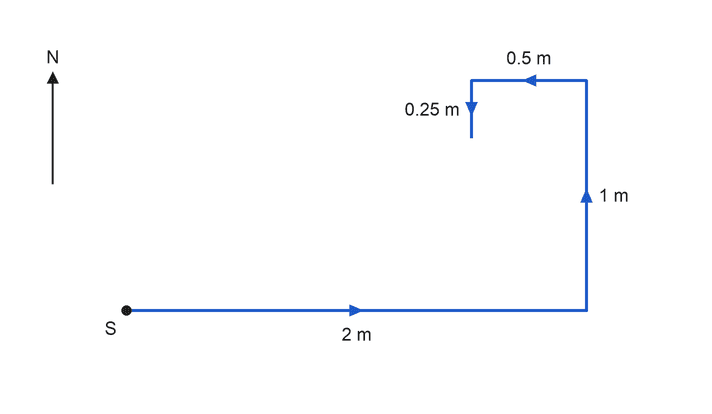
Take as the origin, east as the positive -direction and north as the positive -direction, with distances in metres.
(a) If the robot could go on for ever, what total distance would it travel?
(b) Find the point that the robot gets closer and closer to.
(c) A friend says, “The robot travels m in all, so it ends up m from .” Is the friend right? Find the distance .
- 381 mark
Question 38
Competency: Analysis
Grid of a pattern is a square grid small squares wide and small squares tall, made of matchsticks of equal length, with one matchstick on each side of every small square. The numbers of matchsticks in the first four grids are given below.
Grid Matchsticks A student makes Grids to , one of each, separately. How many matchsticks does she use in all?
- 393 marks
Question 39
Competency: Application & Evaluation
During a long spell of rain, water from a school roof runs into an empty underground tank that holds kilolitres (kL). In the th hour of the rain the inflow is kL. (Hypothetical data.)
(a) Find the inflow in each of the first three hours, and the total inflow after hours.
(b) Using , show that the total inflow in the first hours is kL.
(c) At the end of which hour is the tank first full? The caretaker hopes that kL of water will run in if the rain lasts long enough. Is he right?
- 405 marks
Question 40
Competency: Analysis & Evaluation
Two wards of a city run tree-planting drives. The numbers of saplings planted in the first four months are given below. (Hypothetical data.)
Month Ward P Ward Q Assume that each ward's numbers go on following the same pattern.
(a) Decide which ward's monthly numbers form an A.P. and which form a G.P., and find the number each ward plants in month .
(b) Using the sum formulas, find the total number of saplings each ward plants in the first months.
(c) The city gives each ward saplings in all. In which month does each ward run out of saplings? Comment on the result in the light of part (b).