
Opening your dashboard
Class 11 Chemistry Chapter 9 Redox Reactions: Competency-Based Questions (CBQ)
40 questions on Chapter 9, each worked through on its own page with the AI tutor. Class 11 Chemistry, ICSE 2026-27.
40 questions
1–5 marks · Mixed difficulty
- 11 mark
Question 1
Competency: Application
Redox reactions go on all around us at home. A student lists four changes noticed in one day. Which of these changes is NOT a redox reaction?
- 24 marks
Question 2
Competency: Application
Fertiliser plants in India make the hydrogen they need for ammonia from natural gas. In the first stage, called steam reforming, methane and steam are passed over a hot nickel catalyst:
In the second stage, the carbon monoxide formed reacts with more steam:
(a) Using the classical concept, state whether methane is oxidised or reduced in the first stage, giving the criterion. Explain why the classical concept gives a confusing answer for the water in this stage.
(b) Use oxidation numbers to find which element is oxidised and which is reduced in the first stage, and show that the electrons lost equal the electrons gained.
(c) In the second stage, identify the reducing agent from the oxidation numbers. How many moles of hydrogen does one mole of methane give in the two stages together?
- 31 mark
Question 3
Competency: Analysis & Evaluation
In a chlor-alkali factory, part of the hydrogen and chlorine produced is burnt together in a special furnace. The hydrogen chloride formed is dissolved in water and sold as hydrochloric acid:
Assertion (A): Judged by the classical definitions, hydrogen is the substance oxidised when it burns in chlorine.
Reason (R): In the classical concept, the addition of an electronegative element to a substance is called oxidation.
- 41 mark
Question 4
Competency: Application
Titanium, used for aircraft parts and artificial hip joints, is made by the Kroll process. Titanium(IV) chloride vapour is passed over molten magnesium at about 850 °C under argon:
Which statement correctly describes this reaction by the classical concept of oxidation and reduction?
- 54 marks
Question 5
Competency: Application
The iron gate of a house in a coastal town in Kerala rusts much faster than an identical gate in a dry inland town. Rusting begins where a thin film of water containing dissolved oxygen covers the iron. In this film, iron atoms lose electrons at one spot, and oxygen molecules take up electrons, together with water, at another spot to form hydroxide ions.
(a) Write the oxidation half-reaction and the reduction half-reaction, and combine them into one balanced ionic equation for this first stage of rusting.
(b) The iron(II) hydroxide formed is then oxidised further by air:
The iron(III) hydroxide slowly loses water to give rust, . Find the oxidation number of iron in and in , and state how many electrons each iron atom loses altogether in going from the metal to rust.
(c) Use the electronic concept to explain why salty sea spray makes the gate rust faster, and why a coat of paint slows rusting down.
- 61 mark
Question 6
Competency: Analysis & Evaluation
In a demonstration done in a fume cupboard, a small piece of hot sodium is lowered into a gas jar of chlorine. It burns with a bright yellow flame, and a white solid, sodium chloride, made of and ions, forms:
Assertion (A): Chlorine acts as the oxidising agent in this reaction.
Reason (R): In this reaction, each chlorine atom loses one electron to a sodium atom and becomes a chloride ion.
- 71 mark
Question 7
Competency: Application
In a college laboratory, the copper in a sample of brass is estimated. The brass is dissolved to give a solution of copper(II) ions, and excess potassium iodide solution is added. A white precipitate of copper(I) iodide forms, and the solution turns brown because iodine is set free:
Which statement correctly describes the electron transfer in this reaction?
- 84 marks
Question 8
Competency: Application
A pharmacy sells vitamin C tablets labelled “500 mg ascorbic acid”. (Hypothetical data.) A student dissolves one tablet in water and titrates the solution with 0.100 M iodine solution, using starch as the indicator. The blue-black starch–iodine colour first stays when 28.2 mL of the iodine solution has been added. The reaction is
(C = 12, H = 1, O = 16)
(a) Find the average oxidation number of carbon in ascorbic acid, , and in its product, dehydroascorbic acid, . Hence identify the oxidising agent and the reducing agent.
(b) How many electrons does one molecule of ascorbic acid lose? Write the oxidation and reduction half-reactions.
(c) Calculate the mass of ascorbic acid in the tablet, and express it as a percentage of the mass on the label.
- 94 marks
Question 9
Competency: Application
Black powder, the oldest explosive, is still used in many fireworks. It is a mixture of potassium nitrate, sulphur and charcoal (carbon). A simplified equation for its burning is
(a) Find the change in oxidation number of nitrogen, of sulphur and of carbon.
(b) Identify the oxidising agent or agents and the reducing agent. Explain why black powder burns fiercely even when it is packed inside a closed paper shell with no air.
(c) Show that the total number of electrons lost in this equation equals the total number gained.
- 101 mark
Question 10
Competency: Analysis & Evaluation
In one method of extracting gold, crushed ore is treated with sodium cyanide solution and air, which dissolve the gold as the complex ion . Zinc dust is then stirred into the solution, and gold metal separates out:
Assertion (A): The zinc dust is oxidised as it sets the gold free, so zinc is the reducing agent here.
Reason (R): Gold is in the +3 oxidation state in , and zinc reduces it to 0.
- 111 mark
Question 11
Competency: Application
Petrol cars sold in India today carry a three-way catalytic converter in the exhaust pipe. One reaction on its platinum–rhodium catalyst removes two poisonous gases at once:
Which statement about this reaction is correct?
- 124 marks
Question 12
Competency: Application
The solid booster motors of many rockets, including India's PSLV, burn a propellant made of fine aluminium powder and ammonium perchlorate, , held together by a rubbery binder. A simplified equation for the reaction between aluminium and ammonium perchlorate (ignoring the binder, which also burns) is
(a) Ammonium perchlorate is made of and ions. Find the oxidation numbers of nitrogen and of chlorine in it.
(b) Find the oxidation number of every element on both sides of the equation, and name each element that is oxidised and each element that is reduced.
(c) Show that the electrons lost in the equation equal the electrons gained.
- 131 mark
Question 13
Competency: Analysis & Evaluation
Osmium tetroxide, , is used in biology laboratories to stain the fats in cell samples for the electron microscope. Where it reacts with the fats, it is converted into a black, lower oxide of osmium, so the fatty parts of the cells show up dark.
Assertion (A): The oxidation number of osmium in is +8.
Reason (R): Osmium tetroxide acts as an oxidising agent when it reacts with the fats.
- 141 mark
Question 14
Competency: Application
In a school laboratory, a food sample is tested for glucose. The sample is heated with blue Benedict's solution, which contains copper(II) ions held in a citrate complex. A brick-red precipitate of copper(I) oxide, , forms, showing that glucose is present. Which statement is correct?
- 154 marks
Question 15
Competency: Application
Silver jewellery and utensils slowly turn black because a thin film of silver sulphide, , forms on them. A popular home method removes the tarnish without scrubbing away any silver: the silver item is placed on a sheet of aluminium foil in a hot solution of baking soda, so that the silver touches the foil. A silver tray carries 0.124 g of tarnish. (Hypothetical data.) A simplified ionic equation for the cleaning is
(Ag = 108, S = 32, Al = 27; V; for , V)
(a) Find the oxidation numbers of silver and sulphur in , and identify the element oxidised and the element reduced.
(b) Name the type of redox reaction, and use the electrode potentials to explain why aluminium can bring it about.
(c) Calculate the mass of aluminium used up, and the mass of silver returned to the surface of the tray, when all the tarnish is removed.
- 164 marks
Question 16
Competency: Application
Labels on household bleach warn: “Do not mix with acidic toilet cleaners.” Bleach contains sodium hypochlorite, NaOCl, and many toilet cleaners contain hydrochloric acid. When the two are mixed, poisonous chlorine gas is given off:
(a) Find the oxidation number of chlorine in NaOCl, in HCl and in , and identify the oxidising agent and the reducing agent.
(b) Only one element changes its oxidation number in this reaction, yet it is not a disproportionation reaction. Explain why, and name the type of reaction it is.
(c) A cupful (100 mL) of a bleach contains 3.725 g of NaOCl. (Hypothetical data.) Calculate the volume of chlorine, at S.T.P., that this bleach could give off with excess acid. (Na = 23, O = 16, Cl = 35.5; molar volume at S.T.P. = 22.4 L)
- 171 mark
Question 17
Competency: Analysis & Evaluation
The water of many swimming pools is disinfected with chlorine. When chlorine gas dissolves in water, an equilibrium is set up, and the hypochlorous acid formed is the main disinfectant:
Assertion (A): Chlorine undergoes disproportionation when it dissolves in water.
Reason (R): In this reaction, the oxidation number of chlorine changes from 0 in to −1 in HCl and to +1 in HOCl.
- 181 mark
Question 18
Competency: Application
In many Indian sugar factories, the cane juice is purified by sulphitation, which uses the products of two combination reactions. Sulphur is burnt in air to make sulphur dioxide, and quicklime is slaked with water to make milk of lime:
Which statement about these two combination reactions is correct?
- 194 marks
Question 19
Competency: Application
Waste water from electroplating units contains poisonous cyanide ions, . It is treated in two stages with sodium hypochlorite in alkaline solution. In the first stage, cyanide is oxidised to the much less toxic cyanate ion, , and hypochlorite is reduced to chloride:
In the second stage, more hypochlorite oxidises the cyanate to carbon dioxide and nitrogen gas.
(a) Taking the oxidation number of nitrogen as −3 in both and , find the oxidation number of carbon in each ion, and of chlorine in and .
(b) By the half-reaction (ion-electron) method, write the balanced oxidation and reduction half-reactions of the first stage for a basic solution, showing every step, and show that they add up to the equation above.
(c) The skeleton equation for the second stage is . Use the oxidation number method to find the mole ratio in which and react, and write the balanced equation for a basic solution.
- 201 mark
Question 20
Competency: Analysis & Evaluation
Well water in some areas smells of rotten eggs because it contains dissolved hydrogen sulphide. When enough chlorine is added, the hydrogen sulphide is oxidised all the way to sulphuric acid, and the chlorine is reduced to hydrochloric acid.
Assertion (A): In the balanced equation for this reaction, chlorine and hydrogen sulphide react in the mole ratio 2 : 1.
Reason (R): Each sulphur atom changes its oxidation number from −2 to +6, while each chlorine molecule gains two electrons.
- 211 mark
Question 21
Competency: Application
At some water-treatment plants, dissolved iron(II) ions are removed from groundwater by adding potassium permanganate. In the nearly neutral water, the iron comes out as a brown precipitate of iron(III) hydroxide, and the permanganate is reduced to solid manganese dioxide, which is filtered off with it. Which is the correctly balanced ionic equation for this treatment?
- 224 marks
Question 22
Competency: Application
The figure shows an alkaline fuel cell of the kind that supplied electricity, and drinking water, to astronauts on the Apollo missions. Hydrogen gas is fed to porous electrode P and oxygen gas to porous electrode Q, and both electrodes dip into potassium hydroxide solution.
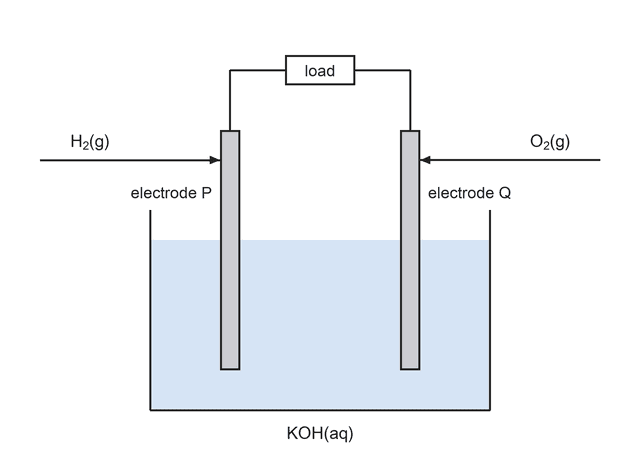
The two reduction half-reactions involved, with their standard potentials, are:
V
V
(a) Which electrode is the anode? Write the half-reaction that takes place there.
(b) Write the half-reaction at the other electrode, and combine the two into the overall cell reaction. Show that the potassium hydroxide is not used up.
(c) Calculate for this fuel cell.
- 234 marks
Question 23
Competency: Application
A student makes a “lemon cell” by pushing a zinc strip and a copper strip into lemon juice, as shown in the figure, and the voltmeter shows a small reading. Lemon juice contains citric acid, so it has plenty of ions, but it contains no ions.
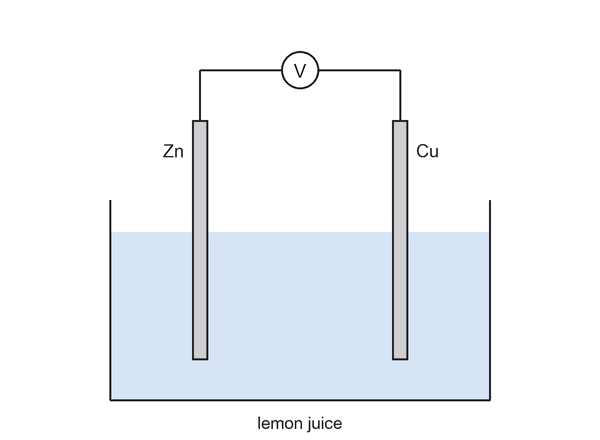
( V, V, V, V)
(a) Which strip is the anode? Write the half-reaction that takes place on it.
(b) Write the main reduction half-reaction on the copper strip, and explain why the copper strip is not used up.
(c) Predict the voltmeter reading if the copper strip were replaced by a second zinc strip. Then, treating the electrode reactions as standard, compare the e.m.f. of the zinc–hydrogen cell with that of a cell in which a magnesium strip replaces the zinc strip.
- 241 mark
Question 24
Competency: Analysis & Evaluation
The figure shows a Daniell cell. A zinc rod dips in zinc sulphate solution and a copper rod dips in copper(II) sulphate solution. The rods are joined by a wire through a voltmeter, and the solutions are joined by a salt bridge of potassium nitrate solution set in agar jelly.

Assertion (A): The salt bridge could be replaced by a copper wire dipping into both solutions, and the cell would go on working in the same way.
Reason (R): The salt bridge completes the circuit by letting ions move between the two half-cells, which keeps each solution electrically neutral.
- 251 mark
Question 25
Competency: Analysis & Evaluation
The figure shows a standard hydrogen electrode (right) joined to a zinc half-cell to measure . In the hydrogen electrode, hydrogen gas at 1 bar bubbles over a platinum foil that dips into a solution of ions at 1 M.

Assertion (A): The platinum foil of the hydrogen electrode is coated with platinum black (finely divided platinum) so that the equilibrium between hydrogen gas and hydrogen ions is set up quickly at its surface.
Reason (R): Platinum is an unreactive metal that is not attacked by the acid solution.
- 261 mark
Question 26
Competency: Analysis
Mine-rescue teams carry breathing sets with a canister of potassium superoxide, , which contains ions and superoxide ions, . The carbon dioxide breathed out reacts with it and oxygen is given back. A simplified equation is
Which statement correctly classifies this reaction?
- 271 mark
Question 27
Competency: Evaluation
Aluminium pressure cookers and kettles are used in many Indian kitchens to boil plain water every day. The standard reduction potential of aluminium is V.
Assertion (A): A clean aluminium kettle can be used to boil plain water for years without giving off any noticeable hydrogen or being visibly eaten away.
Reason (R): The standard reduction potential of aluminium is more positive than that of the standard hydrogen electrode, so aluminium is a weaker reducing agent than hydrogen.
- 281 mark
Question 28
Competency: Evaluation
Delicate fabrics such as silk and wool are spoilt by chlorine bleach, so they are often bleached with moist sulphur dioxide instead. The bleached fabric slowly turns yellowish again over many months in air.
Assertion (A): Moist sulphur dioxide bleaches silk and wool by reducing the coloured matter in them to colourless products.
Reason (R): During the bleaching, sulphur dioxide is itself oxidised to sulphate ions, the oxidation number of sulphur rising from +4 to +6.
- 291 mark
Question 29
Competency: Application
Brine pumped up with crude oil from some wells contains both iodide and bromide ions. A chemist wants a reagent that sets free the iodine but cannot oxidise the bromide ions, even if a little more of it is added than the iodide needs. The standard reduction potentials are given below.
Couple (V) (acidic) +1.51 +1.36 +1.09 +0.77 +0.54 +0.15 Under standard conditions, which reagent should the chemist choose?
- 301 mark
Question 30
Competency: Analysis
Indigo does not dissolve in water, so denim factories first reduce it with sodium dithionite, , in an alkaline dye bath. The dithionite ion is itself oxidised to sulphite ions:
What is the equivalent weight of sodium dithionite in this reaction? (Na = 23, S = 32, O = 16)
- 311 mark
Question 31
Competency: Analysis
Much of the world's iodine is made in Chile from sodium iodate solution obtained from caliche ore. Just enough sodium hydrogensulphite is added to reduce the iodate ions to iodine, and the hydrogensulphite ions are oxidised to sulphate ions in the acidic solution:
Which statement about the correctly balanced ionic equation is true?
- 322 marks
Question 32
Competency: Analysis
In the cells of our body, glucose is "burnt" slowly in respiration to release energy. The overall change is
(a) Find the average oxidation number of carbon in glucose and in carbon dioxide, and hence the total number of electrons lost by the carbon atoms of one glucose molecule.
(b) Show that the six oxygen molecules gain exactly this number of electrons.
- 332 marks
Question 33
Competency: Understanding
Photochromic spectacle lenses of the silver halide type darken in bright sunlight and clear again indoors. The glass holds tiny crystals of silver chloride together with a small amount of copper(I) chloride. In sunlight, a chloride ion in a crystal gives up an electron, which is taken up by a nearby silver ion, so specks of silver metal form and the lens darkens. The chlorine atoms formed are trapped by the copper(I) ions, which change to copper(II) ions.
(a) Write the oxidation half-reaction and the reduction half-reaction for the darkening, and name the species oxidised and the species reduced.
(b) Indoors, the copper(II) ions take electrons back from the silver specks. Write the equation for this step, name the oxidising agent in it, and explain how it makes the lens clear.
- 342 marks
Question 34
Competency: Evaluation
An oil company protects a buried steel pipeline by joining blocks of magnesium to it at intervals with insulated copper cables. A trainee engineer suggests replacing the magnesium blocks with scrap copper blocks, "because copper hardly corrodes, so the copper blocks will never need replacing". ( V, V, V)
Evaluate the trainee's suggestion, using the values to explain how the magnesium blocks protect the pipe.
- 352 marks
Question 35
Competency: Evaluation
When lead nitrate is heated, a brown gas, nitrogen dioxide, is given off:
A student argues: "Nitrogen has five valence electrons, an odd number, so it can show only odd oxidation numbers, such as −3, +1, +3 and +5. So the formula must be wrong." Evaluate the student's argument, using oxidation numbers.
- 363 marks
Question 36
Competency: Analysis
In some coal-mining areas of north-east India, water draining out of old mines turns streams orange and acidic. The cause is the mineral pyrite, , which is made of ions and disulphide ions, . When it meets air and water, the overall change is
(a) Find the oxidation numbers of iron and of sulphur in pyrite.
(b) Find the total number of electrons lost when one formula unit of is changed into and sulphate ions.
(c) Use your answer to (b) to explain why exactly 15 molecules of oxygen are needed for every 4 formula units of pyrite, and state why the stream water becomes acidic.
- 373 marks
Question 37
Competency: Application
In a thermal power station, the water fed to the boilers must be almost free of dissolved oxygen, which would corrode the steel tubes. After most of the gas is driven out by heating, the last traces of oxygen are removed by adding hydrazine, , in alkaline conditions. Nitrogen gas and water are formed. The feed water still holds 0.020 mg of oxygen per litre, and the station uses L of feed water a day. (Hypothetical data.) (N = 14, H = 1, O = 16)
(a) Find the change in oxidation number of nitrogen, and identify the reducing agent.
(b) Write the oxidation and reduction half-reactions in basic solution, and add them to obtain the balanced equation.
(c) Calculate the least mass of hydrazine needed each day.
- 383 marks
Question 38
Competency: Creativity
A college chemistry laboratory collects 2.00 L of waste silver nitrate solution from its practical classes, containing 0.0500 M silver ions, , and wants to recover the silver as the metal. The store room has sodium, zinc granules and a piece of gold. (Hypothetical data.) ( V, V, V, V; Zn = 65, Ag = 108)
(a) Choose the most suitable of the three metals. Give the reason for rejecting each of the other two, and name the type of redox reaction your method uses.
(b) Calculate the least mass of your chosen metal needed, and the mass of silver recovered.
(c) Design a simple test the laboratory can carry out on the solution afterwards to show that all the silver has been removed.
- 395 marks
Question 39
Competency: Evaluation
Waste water from a textile dyeing unit is rich in organic dyes. Before it can be let into a river, its chemical oxygen demand (COD) is measured: the organic matter in a sample is oxidised by heating it with acidified potassium dichromate, and the amount of dichromate used up is found by titration. The COD is the mass of oxygen, in mg per litre of sample, that would do the same amount of oxidation as the dichromate used up. A technician tests 20.0 mL portions of the waste water with 0.0200 M potassium dichromate and records the volume of dichromate solution used up. (Hypothetical data.) (O = 16)
Trial 1 2 3 Dichromate solution used up (mL) 6.10 6.00 6.00 (a) Write the reduction half-reactions of dichromate ions and of oxygen in acidic solution. Hence show that 1 mol of dichromate ions does the same oxidising work as 1.5 mol of oxygen.
(b) Using the concordant readings, calculate the COD of the waste water.
(c) The limit for discharge into inland surface water is a COD of 250 mg per litre. Evaluate whether the waste water can be let into the river without treatment, and find the least percentage reduction in COD that treatment must achieve.
- 404 marks
Question 40
Competency: Analysis
Zawar in Rajasthan has some of the oldest known zinc works in the world. Centuries ago, workers there roasted zinc ore and then heated it with charcoal in closed clay retorts, collecting the zinc vapour in cooler vessels below. Today, the zinc sulphide ore is still first roasted in air:
In the carbon-reduction (smelting) route, the zinc oxide is then heated strongly with carbon, above about 1000 °C:
Zinc boils at 907 °C.
(a) For the roasting, use oxidation numbers to identify the element oxidised and the element reduced, and show that the electrons lost equal the electrons gained in the equation.
(b) Describe the second reaction in terms of the classical concept of oxidation and reduction, naming the oxidising agent and the reducing agent.
(c) Explain why the zinc had to be collected away from air, and write the equation for what would happen if hot zinc vapour met air.