
Opening your dashboard
Class 11 Chemistry Chapter 8 Equilibrium: Ionic Equilibrium: Competency-Based Questions (CBQ)
40 questions on Chapter 8, each worked through on its own page with the AI tutor. Class 11 Chemistry, ICSE 2026-27.
40 questions
1–4 marks · Mixed difficulty
- 11 mark
Question 1
Competency: Analysis & Evaluation
In the industrial production of sodium, molten sodium chloride (mixed with calcium chloride to lower its melting point) conducts electricity well enough to be electrolysed. A solid block of rock salt, which is also sodium chloride, conducts practically no electricity.
Assertion (A): Molten sodium chloride conducts electricity, but solid sodium chloride does not.
Reason (R): Solid sodium chloride contains no ions; the ions are formed only when the solid melts.
- 21 mark
Question 2
Competency: Analysis & Evaluation
Household "ammonia" used for cleaning glass is a solution of ammonia gas in water. A conductivity meter shows that this solution conducts electricity weakly, while pure liquid ammonia conducts hardly at all.
Assertion (A): An aqueous solution of ammonia conducts electricity weakly, even though ammonia molecules contain no ions.
Reason (R): Ammonia reacts partly with water, forming a small concentration of and ions.
- 34 marks
Question 3
Competency: Analysis & Evaluation
Butanoic acid, , is the weak monobasic acid that gives rancid butter its unpleasant smell. A student measures the pH of three butanoic acid solutions at 25 °C and converts each reading into the hydronium ion concentration. (Hypothetical data.)
Concentration of acid, c (mol L⁻¹) (mol L⁻¹) 0.100 0.0100 0.00100 (a) Calculate the degree of ionisation, α, of the acid at each concentration, and describe how α changes on dilution.
(b) Use Ostwald's dilution law in the form to calculate from each row of the table. What do your three values show?
(c) Another student uses the short form . Find the value it gives for the most dilute solution, and explain why the short form is less reliable for that solution.
- 41 mark
Question 4
Competency: Analysis & Evaluation
A student plots the degree of ionisation of acetic acid ( at 25 °C) against its concentration, using Ostwald's dilution law , for concentrations from 0.1 M down to M.
Assertion (A): According to Ostwald's dilution law, the degree of ionisation of a weak acid gets closer and closer to 1 as its solution is made more and more dilute.
Reason (R): The ionisation constant of a weak acid increases when its solution is diluted.
- 54 marks
Question 5
Competency: Application
A laboratory assistant finds two bottles, each labelled only "pH 3.0". Bottle P holds M hydrochloric acid, and bottle Q holds 0.057 M acetic acid ( of = at 25 °C). (Hypothetical data.)
(a) Show that the acetic acid in bottle Q also has a pH of about 3.0, and find its percentage ionisation.
(b) 1.0 mL of each solution is diluted with water to 100 mL. Calculate the new pH of each diluted solution. ()
(c) Calculate the volume of 0.10 M NaOH needed to neutralise 25.0 mL of each original solution, and explain why the two volumes are so different although the two solutions have the same pH.
- 61 mark
Question 6
Competency: Analysis & Evaluation
The hydrogen halides HF, HCl, HBr and HI all dissolve in water to give acidic solutions. Their bond enthalpies are H–F 567, H–Cl 431, H–Br 366 and H–I 299 kJ mol⁻¹.
Assertion (A): In dilute aqueous solution, hydrofluoric acid is the strongest of the four hydrogen halide acids.
Reason (R): Fluorine is the most electronegative halogen, so the H–F bond is the most polar of the four bonds.
- 71 mark
Question 7
Competency: Application
Swimming-pool water is disinfected by hypochlorous acid, HOCl, which is a weak acid ( at 25 °C). Perchloric acid, (structure ), ionises completely in water and is one of the strongest acids known. In both molecules the acidic hydrogen is bonded to an oxygen atom that is joined to chlorine. Which statement best explains why perchloric acid is so much stronger than hypochlorous acid?
- 81 mark
Question 8
Competency: Application
A laboratory keeps a stock of 0.10 M sulphuric acid at 25 °C. The first ionisation, , is complete, but the second, , is only partial, with . (; ; ) The pH of the stock solution is closest to
- 94 marks
Question 9
Competency: Application
The "fishy" smell of fish that is no longer fresh comes mainly from trimethylamine, , a volatile weak base ( at 25 °C; ). Cooks often sprinkle lemon juice on fish to reduce the smell.
(a) Write the equation for the reaction of trimethylamine with water, and name the two conjugate acid–base pairs in it.
(b) Calculate the pH of a 0.050 M aqueous solution of trimethylamine, and check any approximation you make. ()
(c) Lemon juice has a pH of about 2.5, that is mol L⁻¹. Calculate the ratio in lemon juice, and use it to explain why the smell goes.
- 101 mark
Question 10
Competency: Application
Liquid ammonia (boiling point −33 °C) is used as a solvent in some industrial syntheses. Like water, it ionises very slightly:
A chemist dissolves ammonium chloride in one sample of liquid ammonia and sodium amide, , in another. When the two solutions are mixed, the reaction takes place. Which statement about this reaction is correct?
- 114 marks
Question 11
Competency: Application
A patient's stomach contains 0.200 L of gastric juice with pH 1.00, that is mol L⁻¹, the acid being hydrochloric acid. The patient chews antacid tablets, each containing 0.290 g of magnesium hydroxide, . (Hypothetical data.) Assume that each tablet reacts completely, that the volume stays 0.200 L and that no more acid is secreted. (Mg = 24, O = 16, H = 1; )
(a) Calculate the pH of the stomach contents after one tablet has reacted.
(b) How many tablets, in total, are needed to raise the pH to 3.00?
(c) The first tablet removes half of the acid but raises the pH by only 0.30. Explain this, and say what happens to the pH when the second tablet reacts.
- 121 mark
Question 12
Competency: Application
A sample of rainwater collected on a school roof is analysed at 25 °C. Its hydronium ion concentration is found to be 400 times its hydroxide ion concentration. (Hypothetical data.) Taking , and , the pH of the rainwater is
- 131 mark
Question 13
Competency: Analysis & Evaluation
A student takes 1 mL of 0.010 M sodium hydroxide solution at 25 °C and dilutes it again and again with pure water, measuring the pH after each tenfold dilution.
Assertion (A): However much water is added, the pH of the diluted sodium hydroxide solution never falls below 7.
Reason (R): Sodium hydroxide is a strong electrolyte, which is completely ionised in water.
- 143 marks
Question 14
Competency: Application
Steel bars inside reinforced concrete stay protected from rusting as long as the water in the pores of the concrete is strongly alkaline, with a pH of about 12.5 or more, mainly because of dissolved calcium hydroxide. Over many years, carbon dioxide from the air reacts with this calcium hydroxide, and the pH in the "carbonated" outer layer falls to about 8. (Hypothetical data.) To find how deep the carbonation has gone, an engineer splits a freshly drilled core of concrete and sprays the fresh surface with phenolphthalein solution, which is colourless below pH 8.3 and pink above pH 10.0.
(a) Describe what the engineer sees on the sprayed surface, and explain it.
(b) Write the equation for the reaction that lowers the pH of the carbonated layer, and explain why the pH falls.
(c) Methyl orange is red below pH 3.1 and yellow above pH 4.4. Explain why methyl orange could not be used for this test.
- 153 marks
Question 15
Competency: Application
Aspirin (acetylsalicylic acid, written here as HA) is a weak monobasic acid with at body temperature. A doctor explains that the un-ionised HA molecules pass through the fatty membranes of cells much more easily than the ions do. Take the pH of gastric juice as 2.0 and the pH inside the small intestine as 7.0. (Hypothetical data.)
(a) Show that , and calculate this ratio and the percentage of aspirin present as un-ionised HA in gastric juice.
(b) Calculate the same ratio and percentage in the small intestine.
(c) Use the common ion effect to explain why aspirin in the stomach is almost entirely un-ionised, and say in which form it is expected to cross cell membranes there.
- 161 mark
Question 16
Competency: Analysis & Evaluation
Magnesium hydroxide is a sparingly soluble base: , with at 25 °C. A student compares how much of it dissolves in pure water and in 0.10 M aqueous ammonia ( of = ).
Assertion (A): Magnesium hydroxide is less soluble in 0.10 M aqueous ammonia than in pure water.
Reason (R): Aqueous ammonia supplies ions, which shift the solubility equilibrium of magnesium hydroxide to the left.
- 171 mark
Question 17
Competency: Application
In a works laboratory, chlorine gas is collected by displacing saturated sodium chloride solution (brine) instead of water, because far less chlorine is then lost by dissolving. In water, dissolved chlorine sets up the equilibrium below.
Which statement best explains why brine reduces the loss of chlorine?
- 183 marks
Question 18
Competency: Application
A farmer prepares a stock solution of ammonium nitrate, , for a drip-irrigation system. A pH meter shows that the stock solution has pH 5.00 at 25 °C. (Hypothetical data.) of = and ; N = 14, H = 1, O = 16.
(a) Write the equation for the hydrolysis of the ammonium ion, and calculate its hydrolysis constant, .
(b) Calculate the concentration of ammonium nitrate in the stock solution, and the mass of ammonium nitrate dissolved per litre.
(c) Calculate the degree of hydrolysis of the ammonium ion in the stock solution, and explain why the nitrate ion has no effect on the pH.
- 191 mark
Question 19
Competency: Analysis & Evaluation
Potassium acetate, , is used as a de-icing salt on some airport runways because it is less corrosive than sodium chloride. A student dissolves some in distilled water and tests the solution with red and blue litmus paper.
Assertion (A): An aqueous solution of potassium acetate is neutral to litmus.
Reason (R): The acetate ion accepts a proton from water, forming acetic acid molecules and hydroxide ions.
- 201 mark
Question 20
Competency: Application
A gardener grows blueberries, which do best when the soil water is slightly acidic. The gardener has four fertiliser salts on the shelf. Which one gives an acidic solution when it is dissolved in water?
- 214 marks
Question 21
Competency: Application
Since about the year 1750, the average pH of surface seawater has fallen from about 8.2 to about 8.1, because the oceans absorb part of the extra carbon dioxide released into the air. Seawater is buffered partly by the hydrogencarbonate–carbonate pair, , which in seawater has an apparent of about 9.0. (Hypothetical data.) (; ; )
(a) By what percentage has the hydrogen ion concentration of surface seawater increased?
(b) Use the Henderson equation to calculate the ratio at pH 8.2 and at pH 8.1, and find the percentage fall in this ratio.
(c) Corals and shellfish build their skeletons and shells from calcium carbonate, which is sparingly soluble (). Use your answer to (b) to explain why the fall in pH makes it harder for them to build shells.
- 221 mark
Question 22
Competency: Analysis & Evaluation
A biology teacher keeps an ammonia–ammonium chloride buffer (0.10 M and 0.10 M ) for an experiment that must stay near pH 9.3.
Assertion (A): When a few drops of dilute hydrochloric acid are added to this buffer, the added ions are removed mainly by the reaction .
Reason (R): A solution of ammonium chloride on its own in water is acidic, because the ammonium ion hydrolyses.
- 234 marks
Question 23
Competency: Application
A water-treatment plant softens hard water that contains mol L⁻¹ of ions by adding anhydrous sodium carbonate (soda ash), which precipitates calcium carbonate. (Hypothetical data.) The aim is to bring down to mol L⁻¹. of = at 25 °C; Na = 23, C = 12, O = 16. Ignore any reaction of carbonate ions with water.
(a) Show that calcium carbonate begins to precipitate as soon as exceeds mol L⁻¹.
(b) What concentration of carbonate ions must remain in the water when has been brought down to mol L⁻¹?
(c) Calculate the minimum mass of sodium carbonate that must be added to 1000 L of the hard water to reach this aim.
- 241 mark
Question 24
Competency: Application
In a teacher's demonstration behind a safety screen, a little yellow lead(II) iodide, , is boiled with water in a flask until it all dissolves, giving a colourless solution. As the flask cools on the bench, glittering golden crystals of lead(II) iodide appear and slowly settle ("golden rain"). Which conclusion follows from this observation?
- 254 marks
Question 25
Competency: Analysis & Evaluation
A quality-control chemist checks a brand of vinegar, in which acetic acid is the only acid. The chemist dilutes 10.0 mL of the vinegar to 100.0 mL with water, then titrates 20.0 mL of the diluted solution with 0.100 M NaOH, following the pH with a pH meter. (Hypothetical data.) The figure shows how the pH changed. of = and at 25 °C; C = 12, H = 1, O = 16.
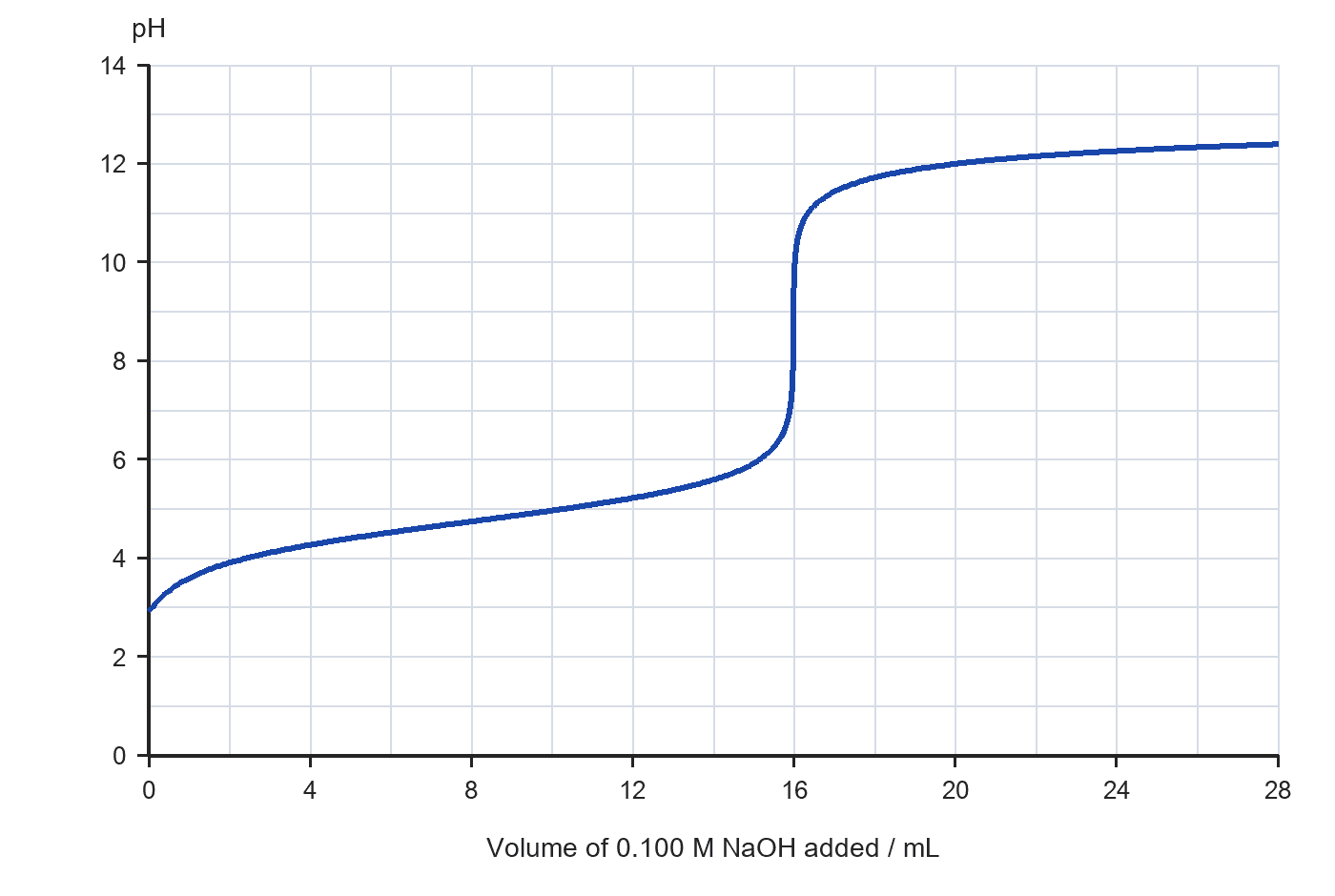
(a) Read from the figure the volume of NaOH at the equivalence point, and calculate the concentration of acetic acid in the original vinegar in mol L⁻¹ and in grams per 100 mL.
(b) After 8.0 mL of NaOH had been added, the meter read pH 4.74. Explain why the pH at this point is equal to the of acetic acid.
(c) Calculate the pH at the equivalence point, and explain why it is above 7. ()
- 264 marks
Question 26
Phosphoric acid, , ionises in three steps with , and at 25 °C. Consider a 0.10 M solution of .
(a) Show that the approximation is not acceptable for this solution, and calculate and the pH from the first step by solving the full expression. ()
(b) Find the concentration of in the solution, and use it to explain why the second step adds practically nothing to .
- 274 marks
Question 27
A solution is 0.40 M in formic acid, ( = 1.8 × 10⁻⁴), and also 0.40 M in acetic acid, ( = 1.8 × 10⁻⁵).
(a) Show that, for this mixture, , where and are the two acid concentrations, and use it to find the pH.
(b) Calculate the degree of ionisation of acetic acid in the mixture and compare it with its value in 0.40 M acetic acid alone.
(c) Explain the difference you find in (b).
- 284 marks
Question 28
For a 0.20 M solution of sodium carbonate at 25 °C, of = 4.3 × 10⁻⁷, = 4.7 × 10⁻¹¹ and = 1.0 × 10⁻¹⁴.
(a) Write the equation for the main hydrolysis reaction of the carbonate ion.
(b) Calculate its hydrolysis constant.
(c) Calculate the pH of the solution.
(d) Show that the second step, , adds almost nothing to .
- 294 marks
Question 29
A laboratory phosphate buffer contains 0.050 M and 0.080 M . (Hypothetical data.) For , = 7.21 at 25 °C.
(a) Calculate the pH of the buffer.
(b) How many moles of solid NaOH can be added to 1.00 L of the buffer before its pH rises by 0.30 unit? (Neglect any change in volume.)
(c) Write the ionic equation for the reaction by which the buffer removes added ions.
- 304 marks
Question 30
A solution contains 0.010 M ions and 0.010 M ions. Solid sodium sulphate is added little by little, so that the volume does not change. (Hypothetical data.) of = 1.1 × 10⁻¹⁰ and of = 3.4 × 10⁻⁷.
(a) Which sulphate precipitates first, and at what sulphate ion concentration does it begin to form?
(b) At what sulphate ion concentration does the second sulphate begin to precipitate?
(c) What is the concentration of the first metal ion still left in solution at that moment, and what percentage of it has been precipitated?
- 311 mark
Question 31
Competency: Application
In a school laboratory, a few drops of phenolphthalein are added to 0.10 M sodium carbonate solution, which turns pink. Carbon dioxide from a gas generator is then bubbled slowly through the pink solution. After some time the pink colour disappears, although no solid separates and the flask still holds plenty of dissolved sodium salts. Phenolphthalein is colourless below pH 8.3 and pink above pH 10.0. For carbonic acid, and at 25 °C.
Which statement best explains why the pink colour disappears?
- 321 mark
Question 32
Competency: Analysis
In a dairy, the milk pipes are cleaned by pumping 0.10 M sodium hydroxide solution through them at 60 °C. The ionic product of water is at 25 °C and at 60 °C. ()
Assertion (A): The pH of 0.10 M sodium hydroxide solution at 60 °C is close to 12.0, and not 13.0 as it is at 25 °C.
Reason (R): The ionic product of water increases with temperature, while the hydroxide ion concentration in 0.10 M sodium hydroxide stays 0.10 mol L⁻¹.
- 331 mark
Question 33
Competency: Analysis
A water-testing laboratory measures the chloride in drinking water by titrating it with silver nitrate solution, with a little potassium chromate in the flask as indicator. White silver chloride precipitates first. The end point is taken when the first permanent red-brown precipitate of silver chromate, , appears. At that moment the chromate ion concentration in the flask is mol L⁻¹. (Hypothetical data.) of AgCl = and of = at 25 °C; .
When the silver chromate just begins to precipitate, the chloride ion concentration still left in the solution is closest to
- 341 mark
Question 34
Competency: Application
A pharmacy student wants to predict, from a data book, which of four compounds will give bubbles of carbon dioxide when added to sodium hydrogencarbonate solution. The reaction is a proton transfer:
The carbonic acid formed breaks up into carbon dioxide and water. For carbonic acid, and at 25 °C. The values of the four compounds at 25 °C are:
Compound citric acid (first ionisation) benzoic acid 4-nitrophenol phenol Which compounds are expected to give a brisk effervescence?
- 352 marks
Question 35
Competency: Analysis
A student tests three liquids with a pair of electrodes connected in series with a battery and a torch bulb. With 0.10 M acetic acid the bulb glows dimly, and with 0.10 M aqueous ammonia it also glows dimly. When equal volumes of the two solutions are mixed, the bulb glows brightly. (Hypothetical data.) At 25 °C, of = , of = and .
(a) Write the equation for the reaction that takes place on mixing, and show that its equilibrium constant, , is very large.
(b) Explain why the mixture conducts much better than either solution on its own.
- 362 marks
Question 36
Competency: Evaluation
A poster made for a school science fair says: "0.001 M hydrochloric acid is a weak acid because it is very dilute, while concentrated acetic acid is a strong acid because it is concentrated." At 25 °C, of acetic acid = ().
(a) Calculate the degree of ionisation of acetic acid in a 1.0 M solution, using Ostwald's dilution law in the form , and compare it with that of hydrochloric acid.
(b) Evaluate the poster's statement, and rewrite it correctly.
- 373 marks
Question 37
Competency: Evaluation
Many medicines that are bases, B, are sold as their hydrochloride salts, . A research team studies one such salt, written here as BHCl, which is only sparingly soluble: , with at body temperature. (Hypothetical data.) Gastric juice is treated here as 0.10 M hydrochloric acid. Ignore any reaction of with water.
(a) Calculate the molar solubility of BHCl in pure water.
(b) Calculate its molar solubility in gastric juice, and check any approximation you make.
(c) A student says: "Since B is a base, its hydrochloride salt must dissolve better in the acid of the stomach than in water." Evaluate this claim.
- 383 marks
Question 38
Competency: Creativity
A laboratory assistant finds three unlabelled bottles. One holds 0.10 M ammonium chloride, one 0.10 M sodium chloride and one 0.10 M sodium acetate, all made with freshly boiled distilled water, and all three solutions are colourless. The only indicators on the shelf are phenolphthalein (colourless below pH 8.3, pink above pH 10.0) and bromothymol blue (yellow below pH 6.0, blue above pH 7.6, green in between). At 25 °C, of = , of = and . (; )
(a) Calculate the pH of each of the three solutions.
(b) Design a test, using one indicator only, that identifies all three bottles. State the colour you expect in each.
(c) Explain why phenolphthalein alone could not identify all three.
- 394 marks
Question 39
Competency: Analysis
A microbiology laboratory grows lactic acid bacteria in 1.00 L of a broth buffered with 0.050 mol of sodium dihydrogenphosphate, , and 0.050 mol of disodium hydrogenphosphate, . As the bacteria grow they release lactic acid, , a weak monobasic acid. A technician records the pH of the broth. (Hypothetical data.)
Time (h) 0 8 16 24 pH 7.21 7.08 6.92 6.71 For , take ; for lactic acid, . Assume the volume stays 1.00 L. (C = 12, H = 1, O = 16; ; )
(a) Explain why the pH at 0 h is exactly 7.21, and why the pH falls so slowly.
(b) Use the reading at 24 h to calculate the amount, in moles, and the mass of lactic acid formed in the broth.
(c) Calculate the pH that the same amount of lactic acid would give in 1.00 L of pure water, and comment on the difference.
- 404 marks
Question 40
Competency: Evaluation
Calcium oxalate, , is the main mineral in most kidney stones. A research group tests three model solutions, made in the laboratory to imitate urine, to see which of them could deposit calcium oxalate. Take of = at 37 °C. (Hypothetical data.)
Sample (mol L⁻¹) (mol L⁻¹) S1 S2 S3 (a) Calculate the ionic product of calcium oxalate in each sample and say which samples can deposit it.
(b) Sample S3 is diluted with water. Find the smallest factor by which its volume must be increased so that it can no longer deposit calcium oxalate. ()
(c) A student claims: "Adding sodium citrate, which binds calcium ions as a soluble complex, stops calcium oxalate depositing because it lowers the solubility product of calcium oxalate." Evaluate this claim.