
Opening your dashboard
Class 11 Chemistry Chapter 7 Equilibrium: Chemical Equilibrium: Competency-Based Questions (CBQ)
40 questions on Chapter 7, each worked through on its own page with the AI tutor. Class 11 Chemistry, ICSE 2026-27.
40 questions
1–5 marks · Mixed difficulty
- 11 mark
Question 1
Competency: Analysis & Evaluation
At a sweet shop, crushed ice and water are kept together in a well-insulated flask at 0 °C and 1 atm, so that almost no heat enters or leaves. The shopkeeper notices that the mass of ice in the flask stays the same for hours.
Assertion (A): In the flask, the amounts of ice and water stay constant, even though water molecules keep passing between the solid and the liquid.
Reason (R): At 0 °C and 1 atm, ice melts and water freezes at the same rate, so the ice–water system is in dynamic equilibrium.
- 21 mark
Question 2
Competency: Analysis & Evaluation
Quicklime (CaO), which is slaked with water to make whitewash, is made by heating limestone in a lime kiln, a tall furnace that is open at the top, so that the hot gases flow up through the limestone and out into the air.
ΔH = +178 kJ mol⁻¹
Assertion (A): When limestone is heated strongly in an open lime kiln, it can be changed completely into quicklime.
Reason (R): The decomposition of calcium carbonate is an endothermic reaction.
- 31 mark
Question 3
Competency: Analysis & Evaluation
In a research laboratory, the reaction between nitrogen monoxide and hydrogen is studied at a high temperature in a closed vessel:
Experiments show that the forward reaction takes place in more than one step, and that its rate is given by rate = .
Assertion (A): The equilibrium constant of this reaction is , even though the reaction takes place in several steps.
Reason (R): The orders of the reactants in the rate law of a reaction are always equal to their coefficients in the balanced equation.
- 44 marks
Question 4
Competency: Application
Iodine dissolves only slightly in pure water (about 0.3 g per litre at 25 °C), but it dissolves much better in potassium iodide solution; Lugol's iodine, used in hospitals, is iodine dissolved in potassium iodide solution. In the solution, iodine molecules combine with iodide ions to form triiodide ions:
A student dissolves iodine and potassium iodide in water so that the solution starts with [] = 1.00 × 10⁻³ mol L⁻¹ and [] = 1.00 × 10⁻² mol L⁻¹, and keeps it at 25 °C. (Hypothetical data.) A separate measurement shows that at equilibrium the concentration of free is 1.50 × 10⁻⁴ mol L⁻¹.
(a) Use the law of mass action to write the expression for of this equilibrium, and state its unit.
(b) Calculate the equilibrium concentrations of and , and the value of .
(c) Use your answers and the equilibrium to explain why much more iodine dissolves in potassium iodide solution than in pure water.
- 51 mark
Question 5
Competency: Application
A pilot plant turns captured carbon dioxide into methanol over a copper–zinc oxide catalyst at 250 °C (523 K), where all the substances are gases:
At 523 K, = 50.0 L² mol⁻². (Hypothetical data.) What is the value of at this temperature? (R = 0.0821 L atm K⁻¹ mol⁻¹)
- 61 mark
Question 6
Competency: Analysis & Evaluation
Propene for making plastics is obtained by removing hydrogen from propane over a catalyst at about 900 K:
Assertion (A): At 900 K, the value of of this reaction (pressures in atm) is larger than the value of (concentrations in mol L⁻¹).
Reason (R): , where Δn is the number of moles of gaseous reactants minus the number of moles of gaseous products.
- 73 marks
Question 7
Competency: Application
Hydrogen can be stored safely by loading it onto toluene to make methylcyclohexane, a liquid that can be carried in ordinary tankers. To release the hydrogen, methylcyclohexane vapour is heated over a catalyst at 550 K:
At 550 K, = 2.0 × 10⁻⁴ mol³ L⁻³. (Hypothetical data.) (R = 0.0821 L atm K⁻¹ mol⁻¹)
(a) Find Δn for the reaction and write the relation between and for it.
(b) Calculate at 550 K, with its unit.
(c) In the reactor, the partial pressures of methylcyclohexane and toluene at equilibrium are equal. Calculate the partial pressure of hydrogen.
- 83 marks
Question 8
Competency: Analysis & Evaluation
But-2-ene, , exists as a cis form and a trans form, which change into each other in the gas phase when a trace of iodine vapour is present as a catalyst:
A student analyses four runs carried out in sealed flasks. (Hypothetical data.) Run 3 used twice as much iodine as the other runs.
Run Temperature (K) Start: [cis] (mol L⁻¹) Start: [trans] (mol L⁻¹) Equilibrium: [cis] (mol L⁻¹) Equilibrium: [trans] (mol L⁻¹) 1 400 0.90 0 0.30 0.60 2 400 0 0.60 0.20 0.40 3 400 0.90 0 0.30 0.60 4 500 0.90 0 0.36 0.54 (a) Calculate for each run.
(b) State which factor was changed in run 2, in run 3 and in run 4 (each compared with run 1), and which of these factors changes the value of .
(c) 0.50 mol L⁻¹ of trans-but-2-ene is sealed in a flask with the catalyst at 500 K. Calculate the equilibrium concentrations of both forms.
- 91 mark
Question 9
Competency: Analysis & Evaluation
In a water-treatment plant, ozone is made from oxygen by an electric discharge. Ozone and oxygen are linked by the equilibrium
Assertion (A): The numerical value of for this equilibrium changes if the concentrations are expressed in mmol L⁻¹ instead of mol L⁻¹.
Reason (R): for this equilibrium has the unit L mol⁻¹, because the number of moles of gas falls from 3 to 2.
- 104 marks
Question 10
Competency: Application
In a school laboratory, a student mixes 10.0 mL of 2.00 × 10⁻³ mol L⁻¹ iron(III) nitrate solution with 10.0 mL of 2.00 × 10⁻³ mol L⁻¹ potassium thiocyanate solution at 25 °C. (Hypothetical data.) A blood-red colour appears because of the equilibrium
A colorimeter shows that the equilibrium concentration of the red complex ion is 1.00 × 10⁻⁴ mol L⁻¹.
(a) Calculate the concentrations of and in the mixture just after mixing, before any reaction.
(b) Calculate the equilibrium concentrations of and , and the value of with its unit.
(c) A few drops of sodium fluoride solution are then added to the red solution. Fluoride ions combine with ions to form colourless complex ions, and the red colour fades. Explain the fading.
- 114 marks
Question 11
Competency: Application
Gas made from coal often contains hydrogen sulphide, and in hot gas-cleaning units part of it reacts with carbon monoxide to form carbonyl sulphide, COS:
In a test, 0.300 mol of CO and 0.200 mol of are heated in a closed 2.00 L vessel at a fixed temperature. (Hypothetical data.) At equilibrium the vessel contains 0.0500 mol of COS.
(a) Calculate the equilibrium concentration of each gas.
(b) Calculate , and explain why the volume of the vessel did not need to be known to find for this reaction.
(c) At the same temperature, how many moles of CO must be heated with 0.200 mol of in the same vessel so that 40.0 % of the is converted into COS?
- 121 mark
Question 12
Competency: Application
Dinitrogen trioxide, (molar mass 76.0 g mol⁻¹), is a blue substance that breaks up into two gases when it vaporises:
A sample is vaporised in a sealed flask at a fixed temperature, and the average molar mass of the equilibrium gas mixture, found from its density, is 50.0 g mol⁻¹. (Hypothetical data.) What percentage of the molecules have dissociated?
- 133 marks
Question 13
Competency: Application
Rainwater containing dissolved carbon dioxide slowly dissolves limestone underground, setting up the equilibrium
Water from such regions is called hard water. When drops of this water hang from the roof of a limestone cave, they lose carbon dioxide to the cave air, and over many years they build up stalactites of calcium carbonate. In homes, a white scale forms inside kettles in which such water is boiled.
(a) Write the expression for of this equilibrium, and give a reason for leaving out each species you omit.
(b) Use Le Chatelier's principle to explain how stalactites form.
(c) Explain why a white scale forms in a kettle when this hard water is boiled.
- 144 marks
Question 14
Competency: Analysis & Evaluation
Very pure nickel is made by the Mond process. Impure nickel is warmed with carbon monoxide at about 50 °C (323 K), when nickel tetracarbonyl, a very poisonous volatile compound, is formed as a gas; the gas is then passed into a chamber at about 230 °C (503 K), where it breaks down and pure nickel is deposited:
ΔH ≈ −161 kJ mol⁻¹
Approximate values of are 4 × 10⁴ atm⁻³ at 323 K and 2 × 10⁻⁵ atm⁻³ at 503 K. In a trial run, the gas is analysed at both temperatures. (Hypothetical data.)
(a) Write the expression for , and explain why nickel does not appear in it.
(b) At 323 K, the partial pressure of in the equilibrium gas is 0.40 atm. Calculate the partial pressure of CO.
(c) At 503 K, the partial pressure of CO is 1.0 atm. Calculate the equilibrium partial pressure of , and use Le Chatelier's principle and the two values of to explain why the process uses these two temperatures.
- 151 mark
Question 15
Competency: Application
In a study of coal gasification, carbon is heated with hydrogen at 1000 K, and methane is formed:
At 1000 K, = 0.100 atm⁻¹. (Hypothetical data.) What is the value of at this temperature? (R = 0.0821 L atm K⁻¹ mol⁻¹)
- 161 mark
Question 16
Competency: Analysis & Evaluation
A car's catalytic converter contains platinum and rhodium spread on a ceramic honeycomb. In the hot exhaust gases, one of the reactions it speeds up is
Assertion (A): The platinum–rhodium catalyst increases the percentage of CO and NO that can be converted into and at equilibrium.
Reason (R): A catalyst lowers the activation energies of the forward and the backward reactions by the same amount.
- 171 mark
Question 17
Competency: Application
In a methanol plant, carbon monoxide and hydrogen react over a catalyst at about 523 K:
The unreacted gases are recycled round a loop that is kept at a constant total pressure of about 80 atm. Small amounts of methane and argon in the feed take no part in the reaction, so they slowly build up in the loop unless some gas is bled off. What is the effect of this build-up on the equilibrium yield of methanol?
- 184 marks
Question 18
Competency: Analysis & Evaluation
Phosgene, , an important raw material for making polyurethane foams, is formed from carbon monoxide and chlorine:
ΔH = −108 kJ mol⁻¹
A mixture of the three gases is at equilibrium in a sealed, rigid 1.00 L flask. (Hypothetical data.) The graph shows how their concentrations change when one change is made to the flask at = 10 min and another at = 20 min.
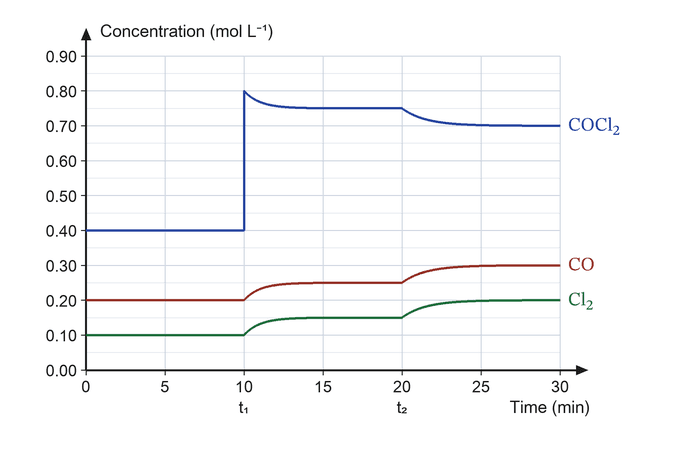
(a) State what change was made at , and explain the shapes of the three curves just after .
(b) Read the concentrations from the graph, and show that has the same value just before and just before .
(c) No concentration jumps at . State the change that was made at , and support your answer with the value of after .
- 194 marks
Question 19
Competency: Application
On the International Space Station, the carbon dioxide breathed out by the crew is made to react with hydrogen, produced by the electrolysis of water, in a Sabatier reactor:
ΔH = −165 kJ mol⁻¹
The water formed is condensed and used again, and the methane is vented into space.
(a) Using Le Chatelier's principle, predict the effect on the equilibrium yield of methane of raising the pressure and of raising the temperature. Give a reason for each.
(b) Explain how condensing out the water as it forms helps the reaction.
(c) At 600 K, is about 2 × 10⁵ atm⁻². In a test, a gas sample at 600 K has partial pressures of 0.20 atm, 0.40 atm, 1.50 atm and 3.00 atm. (Hypothetical data.) Calculate the reaction quotient and state the direction of net reaction.
- 201 mark
Question 20
Competency: Application
Tooth enamel is made mainly of hydroxyapatite, which is in equilibrium with its ions in the saliva:
After a sugary snack, bacteria on the teeth produce acids, and the saliva around the teeth becomes acidic for some time. Which statement explains why frequent sugary snacks lead to tooth decay?
- 211 mark
Question 21
Competency: Application
Household bleach is an alkaline solution of sodium hypochlorite, NaOCl, which also contains chloride ions. Its label warns: “Do not mix with acidic toilet cleaners.” In the solution, hypochlorite and chloride ions are linked to chlorine by the equilibrium
Which statement best explains the warning?
- 221 mark
Question 22
Competency: Analysis & Evaluation
Hydrogen, violet iodine vapour and hydrogen iodide are at equilibrium in a sealed cylinder fitted with a piston and kept at 700 K:
The piston is pushed in until the volume is halved, and the temperature is kept at 700 K.
Assertion (A): Just after the compression, and also after the mixture has settled, the violet colour in the cylinder is deeper than before.
Reason (R): Increasing the pressure on an equilibrium mixture of gases shifts the equilibrium towards the side with fewer gas molecules.
- 233 marks
Question 23
Competency: Analysis & Evaluation
In the second step of glycolysis, the breakdown of glucose in cells, glucose 6-phosphate (G6P) is changed into fructose 6-phosphate (F6P):
For this change take ΔG° = +1.7 kJ mol⁻¹ at 310 K (body temperature). In red blood cells, typical concentrations are about [G6P] = 0.083 mmol L⁻¹ and [F6P] = 0.014 mmol L⁻¹. Use ΔG° = −RT ln K, with R = 8.314 J K⁻¹ mol⁻¹.
(a) Calculate the equilibrium constant K at 310 K, and say what it tells you about an equilibrium mixture of the two compounds.
(b) Calculate the reaction quotient Q in the red blood cell, and decide whether the change G6P → F6P can go forward there.
(c) The next step of glycolysis uses up F6P all the time. Explain why the change G6P → F6P keeps going forward in the cell even though its ΔG° is positive.
- 241 mark
Question 24
Competency: Analysis & Evaluation
In a refinery, cyclohexane vapour is passed over an acid catalyst at a fixed temperature, where it changes into its isomer methylcyclopentane until the composition of the gas stops changing:
Assertion (A): Once the composition stops changing, the standard free energy change ΔG° of the isomerisation has become zero.
Reason (R): At equilibrium, the reaction quotient Q of a reaction is equal to its equilibrium constant K.
- 251 mark
Question 25
Competency: Application
An online gas analyser on a reactor kept at 500 K shows that the reaction quotient of the mixture inside is one-tenth of the equilibrium constant, Q = K/10. (Hypothetical data.) Using ΔG = ΔG° + RT ln Q and ΔG° = −RT ln K, with R = 8.314 J K⁻¹ mol⁻¹, which statement about the mixture is correct?
- 264 marks
Question 26
Antimony pentachloride dissociates on heating, and at 248 °C (521 K) = 0.0250 mol L⁻¹. (Hypothetical data.)
(a) 0.400 mol of is heated alone in a 2.00 L vessel at 521 K. Calculate the equilibrium concentrations and the percentage of dissociated.
(b) In a second experiment, 0.400 mol of and 0.100 mol of are heated together in the same vessel at 521 K. Calculate the percentage of dissociated now.
(c) Use the equilibrium-constant expression to explain the difference between the two results.
- 274 marks
Question 27
Tetrafluorohydrazine dissociates into radicals on warming. At a certain temperature = 0.80 bar. (Hypothetical data.)
(a) 1 mol of pure reaches equilibrium at a constant total pressure of 1.00 bar. Calculate its degree of dissociation, α.
(b) The experiment is repeated with 4.0 mol of argon mixed with 1 mol of , again at a constant total pressure of 1.00 bar. Calculate the new value of α.
(c) State how α would change if the 4.0 mol of argon were instead added to the equilibrium mixture of (a) at constant volume. Give a reason.
- 281 mark
Question 28
Competency: Analysis
In a school laboratory, Neha prepares a saturated solution of cane sugar (sucrose) in water at 25 °C and pours it into a clean jar, leaving no undissolved sugar behind. She drops in one large sugar crystal of mass 5.00 g, made from sucrose in which some of the carbon atoms are radioactive carbon-14, seals the jar and keeps it at 25 °C. After 7 days she lifts the crystal out, dries it and weighs it, and checks the crystal and the whole solution with a radiation counter. (Hypothetical data.)
Reading At the start After 7 days Mass of the crystal (g) 5.00 5.00 Activity of the crystal (counts per minute) 900 600 Activity of the solution (counts per minute) 0 300 The half-life of carbon-14 is about 5730 years. Which conclusion do these readings support?
- 291 mark
Question 29
Competency: Application
Two identical sealed glass bulbs are filled with the same amount of pure hydrogen iodide and kept side by side in a furnace at the same fixed temperature. Bulb X also contains a little platinum gauze, and bulb Y contains none. The colour of the violet iodine vapour is measured through the glass from time to time, and from it the percentage of the hydrogen iodide that has decomposed is worked out. (Hypothetical data.)
Time (h) 1 4 12 24 HI decomposed in bulb X (%) 16.8 21.0 21.0 21.0 HI decomposed in bulb Y (%) 1.0 3.8 9.5 14.7 What is the most likely reading for bulb Y after 5 days at the same temperature?
- 301 mark
Question 30
Competency: Analysis
A gas A changes into its isomer B in a closed vessel kept at a fixed temperature and pressure:
The graph shows how the total Gibbs energy G of the mixture changes with the extent of reaction, from pure A (0) to pure B (1). At any point, the slope of the curve is equal to ΔG of the reaction for the mixture at that point. Three mixtures are marked X, Y and Z; Y is at the lowest point of the curve. (Hypothetical data.)

Which statement is correct?
- 311 mark
Question 31
Competency: Analysis
Washing soda crystals, , are left in open bowls in a laboratory kept at 25 °C. On a dry day the clear crystals slowly crumble to a white powder of the monohydrate, but on a humid day they stay clear. In simplified form, the change is:
Assertion (A): At 25 °C the crystals lose water only when the partial pressure of water vapour in the air is below one fixed value, whatever the mass of crystals in the bowl.
Reason (R): The active masses of the two pure solid hydrates are constant, so , and this fixes the equilibrium pressure of water vapour at a given temperature.
- 321 mark
Question 32
Competency: Evaluation
In a school demonstration, a thin copper wire with heavy weights hanging from both ends is placed over a block of ice at 0 °C. Over an hour the wire slowly cuts down through the block, yet the block stays in one piece, because the water formed under the wire freezes again above it.
Assertion (A): The ice just under the wire melts even though the block is at 0 °C, because the high pressure there lowers the melting point of ice slightly below 0 °C.
Reason (R): The melting of ice is an endothermic change.
- 332 marks
Question 33
Competency: Application
On a cold winter night, a family sleeping in a closed room with a burning charcoal stove (angithi) is found drowsy and confused, because carbon monoxide from the stove has combined with the haemoglobin (Hb) in their blood. They are first carried out into fresh air, an ambulance is called, and in hospital they are given pure oxygen to breathe through a tight face mask. In simplified form, oxygen and carbon monoxide compete for the haemoglobin:
Haemoglobin binds carbon monoxide about 200 to 250 times as strongly as it binds oxygen.
(a) Use Le Chatelier's principle to explain why breathing pure oxygen frees the haemoglobin from carbon monoxide faster than breathing ordinary air.
(b) Explain why moving the family out into fresh air is the essential first step.
- 342 marks
Question 34
Competency: Analysis
In a test for copper(II) ions, excess ammonia solution is added to copper(II) sulphate solution, and a deep blue solution forms:
Treat this as a single equilibrium, with at 25 °C. In the blue solution, the concentration of free ammonia at equilibrium is 0.10 mol L⁻¹, and the total concentration of copper (in both forms) is 0.010 mol L⁻¹.
(a) Calculate the ratio at equilibrium.
(b) Calculate the concentration of free ions, and state what your answer shows about the meaning of a very large equilibrium constant.
- 352 marks
Question 35
Competency: Evaluation
In a laboratory study, 0.400 mol of ethene and 0.300 mol of hydrogen are heated with a catalyst in a closed 2.00 L vessel at a fixed high temperature. At equilibrium the vessel contains 0.200 mol of ethane. (Hypothetical data.)
A student works out the equilibrium constant like this:
(a) Point out the mistake in the student's working, and explain why the same short cut would have given the right answer for a reaction such as .
(b) Calculate the correct value of , with its unit.
- 363 marks
Question 36
Competency: Creativity
Riya wants to follow four gas reactions as they approach equilibrium. Each reaction is started with only the substance(s) on the left in a rigid, sealed steel flask kept at a fixed temperature, and the flask is fitted with a pressure gauge.
Reaction P:
Reaction Q:
Reaction R:
Reaction S:
(a) For which reactions will the gauge reading stay the same as the reaction goes on? Explain, and state for which of the four reactions .
(b) For each of the other reactions, state whether the gauge reading rises or falls on the way to equilibrium, with a reason.
(c) Suggest another property that Riya could measure to follow reaction P, and explain why it would work.
- 373 marks
Question 37
Competency: Evaluation
In the late 1800s, before oxygen was obtained from liquid air, it was made by the Brin process, in which barium oxide takes up oxygen from air and later gives it out again:
A laboratory measures the equilibrium pressure of oxygen above a mixture of barium oxide and barium peroxide at different temperatures. (Hypothetical data.)
Temperature (K) 800 900 1000 1100 Equilibrium pressure of oxygen (atm) 0.016 0.10 0.45 1.6 In air at 1 atm, the partial pressure of oxygen is 0.21 atm.
(a) Write the expression for of the reaction. Use the data to decide whether the forward reaction is exothermic or endothermic.
(b) At which of the temperatures in the table will barium oxide take up oxygen from air at 1 atm? Explain.
(c) An engineer wants to keep the furnace at 1000 K all the time. Find the smallest total pressure of air that must be pumped in for barium oxide to take up oxygen, and state how the oxygen can then be released at the same temperature.
- 383 marks
Question 38
Competency: Analysis
For the formation of ethyl ethanoate in a pure liquid mixture (no added solvent) at 25 °C, take = 4.0:
A food chemist notices that the fruity smell of ethyl ethanoate slowly fades in a dilute water-based drink. In such a solution, with a trace of acid as catalyst, the ester is hydrolysed:
(a) Explain why water must be included in the expression for of the reaction in the pure liquid mixture.
(b) Explain why water is left out of the equilibrium-constant expression for the hydrolysis in a very dilute aqueous solution, and write that expression.
(c) Taking = 55.6 mol L⁻¹ in the dilute solution, calculate . Then find what percentage of the ester remains when a solution made with 0.010 mol L⁻¹ of ethyl ethanoate reaches equilibrium.
- 394 marks
Question 39
Competency: Application
Dimethyl ether (DME) is a clean-burning gas that is being tried out in India as a fuel to blend with LPG for cooking. It is made by passing methanol vapour over a solid acid catalyst such as alumina at about 250–300 °C, where two methanol molecules join and lose a molecule of water:
In a pilot reactor kept at a fixed temperature, = 9.00 for this reaction. (Hypothetical data.) The plant engineer runs one test with pure methanol vapour and another with methanol from a storage tank that contains some water, and compares how much methanol is converted at equilibrium.
(a) Explain why neither the volume of the reactor nor the total pressure affects the percentage of methanol converted at equilibrium.
(b) 0.500 mol of pure methanol vapour reaches equilibrium in the reactor. Calculate the percentage of the methanol converted into DME.
(c) In the second test, 0.500 mol of methanol vapour is fed together with 0.100 mol of water vapour. Calculate the new percentage conversion, and explain the change using Le Chatelier's principle.
- 405 marks
Question 40
Competency: Analysis
Ammonia is being studied as a way to carry hydrogen fuel, because it is easily liquefied and stored. At a filling station, the ammonia is "cracked" back into nitrogen and hydrogen over a heated catalyst:
The table gives the percentage of the ammonia that has decomposed at equilibrium when pure ammonia is fed in, at two total pressures and three temperatures. (Hypothetical data.)
Temperature (K) 500 600 700 Ammonia decomposed at 1 bar (%) 84.2 96.9 99.1 Ammonia decomposed at 10 bar (%) 44.2 77.9 92.3 (a) Use the data to decide whether the cracking of ammonia is exothermic or endothermic. Explain your reasoning.
(b) Explain, with the help of the balanced equation, why less ammonia is decomposed at 10 bar than at 1 bar at the same temperature.
(c) Calculate at 500 K from the value at 1 bar, with its unit. Then use the value at 10 bar to show that does not depend on the total pressure.