
Opening your dashboard
Class 11 Biology Chapter 28 Neural Control and Coordination: Competency-Based Questions (CBQ)
40 questions on Chapter 28, each worked through on its own page with the AI tutor. Class 11 Biology, ICSE 2026-27.
40 questions
1–10 marks · Mixed difficulty
- 13 marks
Question 1
Students of a school robotics club in Bengaluru build a small robot vacuum cleaner.
- A bump sensor on its front detects a wall.
- Input wires carry a signal from the sensor to a microcontroller chip, which decides to turn the robot.
- Output wires carry the command from the chip to the wheel motors, which turn the robot away.
- A separate cooling circuit keeps checking the temperature of the battery and switches on a small fan by itself, without any command from the remote control.
(a) Name the part of the human nervous system that matches each of the five parts printed in bold in the first three points. (1 mark)
(b) Which division of the human peripheral nervous system does the cooling circuit resemble? Give two features of that division. (1 mark)
(c) State one way in which a message travelling along a human nerve differs from the electric signal in the robot's wires. (1 mark)
- 21 mark
Question 2
Assertion (A): When a person reads Braille by running a fingertip over the raised dots, impulses from the touch receptors in the fingertip reach the spinal cord along efferent (motor) nerve fibres.
Reason (R): Sensory or afferent pathways carry impulses from the sense organs to the central nervous system.
- 34 marks
Question 3
A traffic police unit in Pune studies 400 crashes of two-wheelers in one year. (Hypothetical data.)
Riders Number of crashes Riders with a brain injury Wearing a fastened helmet 250 10 Without a helmet 150 27 (a) Calculate the percentage of riders with a brain injury in each group. (1 mark)
(b) The brain already lies inside the skull, wrapped in the meninges and bathed in cerebrospinal fluid. Explain how each of these protects the brain, and why a hard blow can still injure the brain without breaking the skull. (2 marks)
(c) After a fall, a cyclist wearing a helmet gets up dazed, with a headache, and cannot remember the fall. A concussion (a mild brain injury caused by a jolt to the head) is suspected. What should the cyclist's friends do now? (1 mark)
- 44 marks
Question 4
In a trauma centre in Nagpur, doctors use a simplified form of the Glasgow Coma Scale to follow a patient after a road accident. Three responses are scored and the scores are added:
- eye opening: 1 (none) to 4 (opens eyes without any prompting);
- speech: 1 (no sound) to 5 (talks normally and knows where they are);
- movement: 1 (no movement) to 6 (obeys a command such as "squeeze my hand").
A total of 13–15 means a mild injury, 9–12 a moderate injury and 3–8 a severe injury. (Hypothetical data.)
Day Eye opening Speech Movement Day 1 2 2 4 Day 4 3 4 6 (a) Calculate the patient's total score on day 1 and on day 4, and state how severe the injury was on each day. (1 mark)
(b) On day 4 the patient squeezes the doctor's hand when asked to. Trace how this response depends on different parts of the brain. (2 marks)
(c) On day 1, when a torch was shone into the patient's eyes, both pupils narrowed. In which part of the brain does this reflex pass, and what does the result tell the doctors? (1 mark)
- 54 marks
Question 5
A 7-year-old girl in Kolkata develops a fever during an infection. During an infection, chemicals released by the body's defence cells reset the brain's "thermostat" to a higher temperature, called the set point. Her temperature is measured every hour, as shown in the graph. (Hypothetical data.)
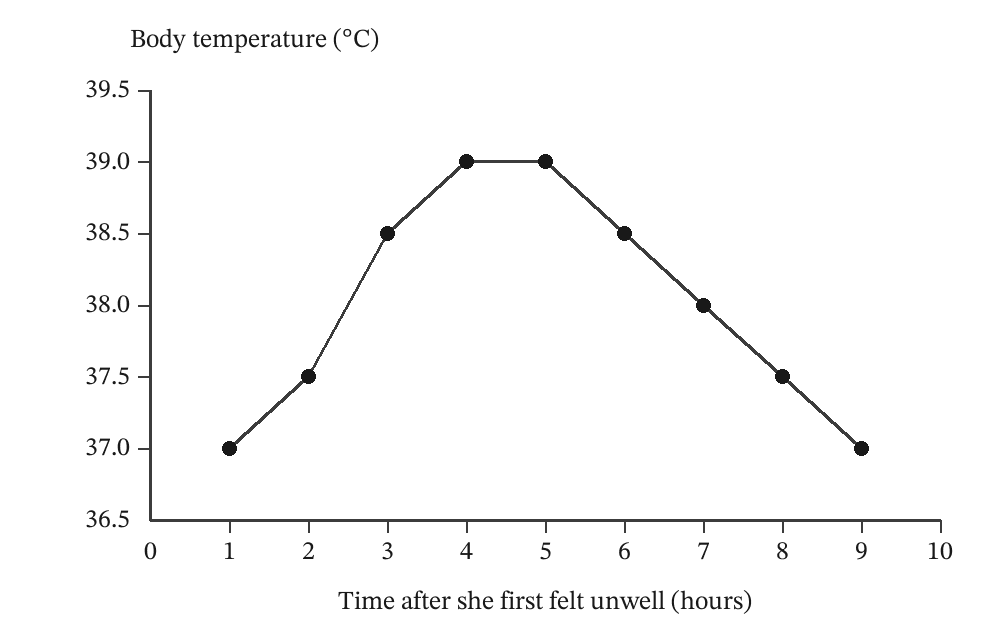
- From 1 h to 4 h she shivered, her hands felt cold and she asked for a blanket.
- At 5 h she was given a dose of paracetamol, a medicine that lowers the set point back towards normal.
- From 6 h to 8 h she sweated, her face looked flushed and she pushed the blanket off.
(a) Read the highest temperature from the graph, and name the part of the brain that acts as the body's thermostat, saying where it lies. (1 mark)
(b) Explain why she shivered and felt cold from 1 h to 4 h, although from 2 h onwards her temperature was already above the normal 37 °C. (2 marks)
(c) Explain why she sweated and looked flushed from 6 h to 8 h. (1 mark)
- 61 mark
Question 6
Assertion (A): A person who has drunk too much alcohol often sways while standing and cannot walk in a straight line.
Reason (R): Alcohol slows down the working of the cerebellum, the part of the hindbrain that coordinates muscular movements and maintains balance.
- 74 marks
Question 7
At an eye hospital in Chennai, a nurse puts drops into a patient's eyes before the doctor examines the retina. The drug in the drops blocks the acetylcholine receptors on the circular muscles of the iris and on the ciliary muscles. The diameter of the pupil is measured. (Hypothetical data.)
Time Diameter of the pupil Before the drops 3 mm 30 minutes after the drops 7.5 mm (a) The amount of light entering the eye depends on the area of the pupil. How many times larger is the area of the pupil after the drops? (1 mark)
(b) Explain, in terms of the autonomic nervous system, why the pupils widen after the drops. (2 marks)
(c) For a few hours after the test, the patient cannot read small print clearly and is told not to drive. Give a reason for the blurred near vision. (1 mark)
- 81 mark
Question 8
Assertion (A): On a cold winter morning, the skin of the fingers turns pale.
Reason (R): Parasympathetic nerve fibres supply the blood vessels of the skin and make them dilate.
- 91 mark
Question 9
Some people sweat so heavily from the palms that they cannot hold a pen. In one treatment, a surgeon cuts the sympathetic chain in the upper chest, which carries the sympathetic fibres to the hands. Which change is expected in the hands after the operation?
- 103 marks
Question 10
A carpenter in Jaipur cuts the nerve at the base of one index finger with a chisel. A surgeon stitches the cut ends of the nerve together. The doctor explains that the cut axons will regrow slowly from the cut, at about 1 mm per day, along the path of the old nerve. The distance from the cut to the fingertip is 54 mm. (Hypothetical data.)
(a) The part of each axon beyond the cut dies, but the part still joined to the cell body survives and regrows. Explain why. (1 mark)
(b) Where do the cell bodies of the sensory neurons and of the motor neurons in this nerve lie? (1 mark)
(c) Calculate how many days it should take for feeling to return to the fingertip, and explain why feeling returns first in the skin nearest the cut. (1 mark)
- 111 mark
Question 11
Assertion (A): Neurons in the adult human brain that die from a lack of oxygen are quickly replaced by the division of the neighbouring neurons.
Reason (R): Glial cells in the adult nervous system keep the ability to divide.
- 124 marks
Question 12
In a hospital in Lucknow, a patient whose kidneys are failing has too much potassium in the blood. A doctor explains how this affects the patient's nerve and muscle cells, using values for a typical nerve cell. Its threshold (the membrane potential at which an action potential starts) is −55 mV. (Hypothetical data.)
K⁺ in the blood (mmol/L) Resting membrane potential Normal person 4 −70 mV This patient 7 −60 mV (a) Which ion's movement mainly sets the resting membrane potential, and how? (1 mark)
(b) Suggest why a higher K⁺ level outside the cell makes the resting potential less negative. (1 mark)
(c) Calculate how much the membrane must be depolarised to reach threshold in each case, and state what this means for how easily the patient's nerve cells fire. (2 marks)
- 131 mark
Question 13
Assertion (A): During the rising phase of an action potential, the inside of the axon becomes positive, reaching about +30 to +40 mV.
Reason (R): During this phase, Na⁺ ions flow out of the axon through the opened voltage-gated Na⁺ channels.
- 141 mark
Question 14
(Hypothetical data.) A nerve fibre is given two equal stimuli, each well above threshold. When the stimuli are 5 ms apart, each one produces an action potential. When they are only 0.5 ms apart, the second stimulus produces no action potential at all. Which statement best explains this?
- 153 marks
Question 15
During waking hours, a substance called adenosine slowly builds up in the brain. It binds to adenosine receptors on neurons and makes a person feel sleepy. Caffeine, found in coffee and tea, has a shape similar to adenosine: it attaches to the same receptors but does not activate them, and it stays active in the body for several hours.
A college in Hyderabad asks 20 students to record their sleep on two nights. (Hypothetical data.)
Night Average time taken to fall asleep Average total sleep No coffee after noon 15 minutes 7.5 hours Two cups of coffee at 9 pm 40 minutes 6.75 hours (a) Where are the receptor molecules for a chemical messenger located at a chemical synapse? (1 mark)
(b) Explain how caffeine makes a person feel more alert. (1 mark)
(c) Calculate how much less the students slept after the late coffee, and explain why late-night coffee before an examination may lower a student's performance the next day. (1 mark)
- 161 mark
Question 16
Assertion (A): An impulse passing through a chain of several neurons joined by chemical synapses takes longer than an impulse passing along a single axon of the same kind and the same total length.
Reason (R): Each synaptic vesicle in a synaptic knob contains thousands of molecules of a neurotransmitter.
- 171 mark
Question 17
Doctors inject tiny doses of botulinum toxin to relax over-active muscles in some patients. The toxin acts in the axon terminals of motor neurons, where it stops the synaptic vesicles from fusing with the presynaptic membrane. What happens in a treated muscle when an impulse travels down the motor neuron?
- 184 marks
Question 18
A transport safety institute in Delhi tests 12 bus drivers in a driving simulator, once after a normal night's sleep and once after staying awake for 24 hours. Two times are measured: the brake reaction time (from a child appearing on the road in the simulator to the foot pressing the brake) and the blink reflex time (from a gentle puff of air at the eye to the blink). (Hypothetical data.)
Test After normal sleep After 24 hours awake Brake reaction time 0.75 s 1.05 s Blink reflex time 50 ms 52 ms (a) A bus travels at 72 km/h. Calculate the distance it covers during the brake reaction time in each case, and the extra distance after 24 hours awake. (1 mark)
(b) Using the pathways involved, explain why lack of sleep slowed the brake response much more than the blink. (2 marks)
(c) Suggest one safety rule for long-distance bus drivers based on these results. (1 mark)
- 191 mark
Question 19
Assertion (A): A person who steps barefoot on a sharp stone lifts the foot faster than they could lift it if they were simply told to do so.
Reason (R): In this response, the impulse passes from the sensory neuron to the motor neuron through an interneuron in the spinal cord, without waiting for a decision by the brain.
- 201 mark
Question 20
(Hypothetical case.) A man with long-standing diabetes has damage to some long nerve fibres in his legs. When a doctor taps the tendon at the back of his ankle, his foot does not jerk. He can still stand on tiptoe by contracting the same calf muscle at will, but he cannot feel a vibrating tuning fork placed on his ankle bone. Which part of the ankle-jerk reflex arc is most likely damaged?
- 214 marks
Question 21
At a free eye camp in Madurai, a 58-year-old man has his eye pressure measured. The normal range is 10 to 21 mmHg. (Hypothetical data.)
Eye Eye pressure (mmHg) Vision Right 32 Part of the side vision lost; central vision clear Left 16 Normal The doctor explains that aqueous humour is made all the time by the ciliary body and drains out of the eye through a fine meshwork in the angle between the iris and the cornea. In the man's right eye, this drainage is partly blocked. The diagnosis is glaucoma.
(a) By how many mmHg is the pressure in the right eye above the upper limit of the normal range? (1 mark)
(b) Explain why the pressure rises when the drainage is partly blocked, even though the ciliary body makes aqueous humour at the normal rate, and how the raised pressure harms vision. (2 marks)
(c) The doctor says eye drops (and surgery, if needed) can control the pressure, but the side vision already lost will not come back. Explain why, and say why eye-pressure checks are advised for adults over 40. (1 mark)
- 221 mark
Question 22
Assertion (A): Inside a lift, with the eyes shut, a person can still feel the lift starting to rise and coming to a stop.
Reason (R): The three semicircular canals of the inner ear lie at right angles to one another.
- 231 mark
Question 23
In a cataract operation, the cloudy natural lens of a 68-year-old woman's eye is replaced by a clear artificial lens of fixed shape. Afterwards she sees distant objects sharply without glasses, but she needs reading glasses to read a newspaper. Why?
- 241 mark
Question 24
A 6-year-old boy with a heavy cold is on a flight. As the plane comes down to land, the air pressure in the cabin rises, and he cries with sharp ear pain. His mother gives him water to sip, and the pain eases after he swallows a few times. Which statement explains this?
- 251 mark
Question 25
In an inherited eye disease, the rods of the retina die first, while most of the cones keep working for many years. The human retina has roughly 90 to 120 million rods and roughly 4.5 to 6 million cones, with the cones packed most closely at the fovea. Which early complaint fits this disease?
- 2610 marks
Question 26
Match the following:
Column A Column B 1. Sympathetic nerve fibre (a) Nodes of Ranvier 2. Dorsal root ganglion (b) Cranial-sacral outflow 3. Hypothalamus (c) Retina 4. Parasympathetic nerve fibres (d) Posture and equilibrium 5. Saltatory conduction (e) Cochlea 6. Cerebellum (f) Forebrain 7. Photoreceptor cells (g) Thoracic-lumbar outflow 8. Organ of Corti (h) Eustachian tube 9. Vagus nerve (i) Spinal nerve 10. Middle ear (j) Cranial nerve - 275 marks
Question 27
Read the sources given and answer any four from the questions given below.
The hind brain consists of cerebellum, pons and medulla. Cerebellum is present just below the cerebrum at the back of the head. It consists of two hemispheres which are connected by a narrow midline area. Each cerebellar hemisphere controls the same side of the body, thus if damaged the symptoms will occur on the same side. The cerebellum consists of two major components: cerebellar cortex and cerebellar nuclei. Cerebellar cortex is a layer of tightly folded tissue that contains most of the nerve cells in the cerebellum. It is divided into three layers—an outermost molecular layer; a middle—Purkinje cell layer and an internal—the granular layer. Cerebellar nuclei are present underneath the cerebellar cortex. The cerebellum, although small in size, is a crucial part of the brain. It is mainly associated with coordination of movement and balance of body or equilibrium.
(1) If right cerebellar hemisphere is damaged, the following would be affected
(a) left side of body
(b) mid-line of body
(c) right side of body
(d) whole body
(2) The highly folded part of cerebellum forms the
(a) cerebrum
(b) cerebral cortex
(c) cerebellar nuclei
(d) cerebellar cortex
(3) The Purkinje cell layer is present in the
(a) outermost nuclear layer
(b) inner layer of cerebellar cortex
(c) middle layer of cerebrum
(d) middle layer of cerebellar nuclei
(4) The cerebellum is mainly associated with
(a) body temperature
(b) equilibrium of body
(c) reflex action
(d) eye movement
(5) Cerebellum is a part of the
(a) cerebrum
(b) cerebellar cortex
(c) hind brain
(d) mid brain
- 285 marks
Question 28
Read the sources given and answer any four from the questions given below.
A reflex action is a rapid, involuntary and instant response to a stimulus. It is without the conscious involvement of higher centres of brain. The nerve path involved in a reflex action is called a reflex arc. The impulse in a reflex arc goes in a single direction only. The reflex actions occur quickly by activating spinal motor neurons without the delay of routing signals through the brain. Most reflex arcs involve only three neurons. The stimulation of pain receptors in skin initiate an impulse in a sensory neuron which travels to an inter neuron called the relay neuron present in the spinal cord. The relay neuron passes it to the motor neuron which transmit the impulse to the muscles or gland invoking a reflex action. The reflex could be a simple reflex or conditioned reflex. Simple reflex can be evoked even immediately after birth and needs no past experience like grasp reflex of a newborn. Conditioned reflex is an acquired response after birth when an animal associates a previously unrelated stimulus to a conditioned stimulus and gives the same reflex response. For example, salivation reflex in a hungry dog in response to ringing of bell.
(1) Which of the following is not a correct statement for a reflex action?
(a) instant response
(b) involuntary response
(c) does not require input from brain
(d) requires input from brain
(2) The role of a relay neuron is to pass the stimulus
(a) from sensory neuron to spinal cord
(b) from spinal cord to sensory neuron
(c) from sensory neuron to motor neuron
(d) from motor neuron to muscles
(3) The pathway and sequence of neurons in a reflex arc is
(a) stimulus → motor neuron → inter neuron → sensory neuron → muscles
(b) stimulus → sensory neuron → inter neuron → motor neuron → muscles
(c) stimulus → sensory neuron → motor neuron → inter neuron → muscles
(d) muscle → sensory neuron → inter neuron → motor neuron → stimulus
(4) Constriction of pupils in strong light, after birth in a newborn, is an example of
(a) reflex arc
(b) simple reflex
(c) conditioned reflex
(d) reaction to light
(5) Which statement is not true for a conditioned reflex?
(a) reflex response present from birth
(b) acquired response
(c) association of an unrelated stimulus to a conditioned stimulus
(d) salivation in a dog on hearing a bell
- 295 marks
Question 29
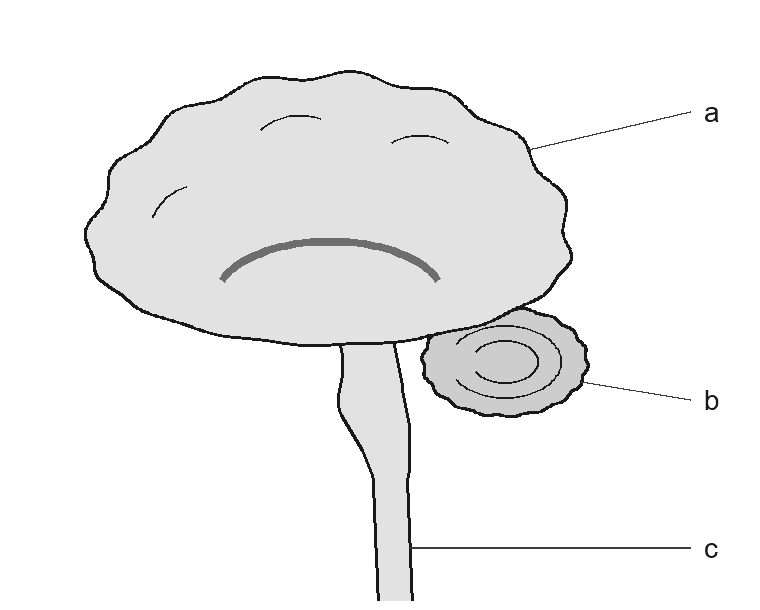
(i) Name the parts a, b and c.
(ii) Give one function each of a and b.
(iii) Name the fluid that surrounds the brain.
(iv) Name that important part present in 'a' that regulates body temperature and blood pressure of the body.
- 304 marks
Question 30
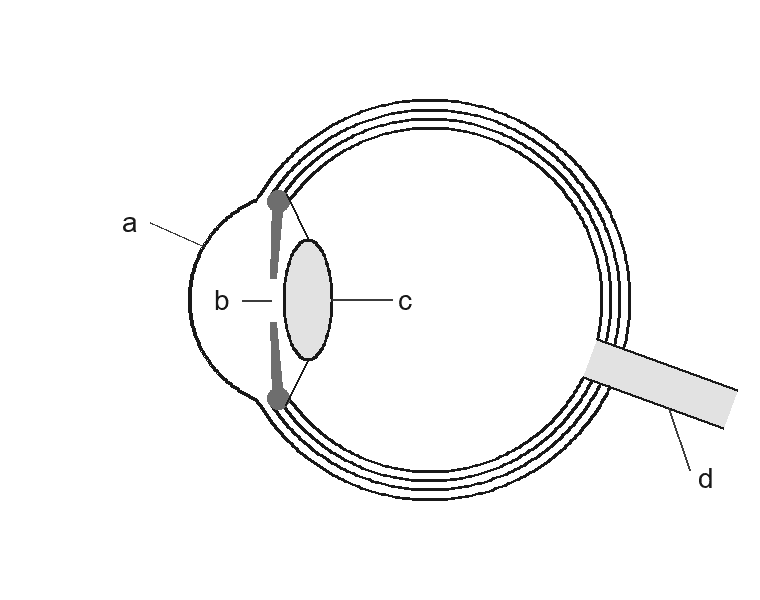
(i) Label the parts a, b, c and d.
(ii) Name the fluid present between a and c.
(iii) Which layer of eye has rods and cones?
- 315 marks
Question 31

(i) Label the parts a, b, c and d.
(ii) Indicate by the arrow's direction in which the nerve impulse travels in e, a, b.
(iii) Which part in the given diagram is the effector?
(iv) Give the scientific name used for nerve pathway shown in the diagram.
- 323 marks
Question 32
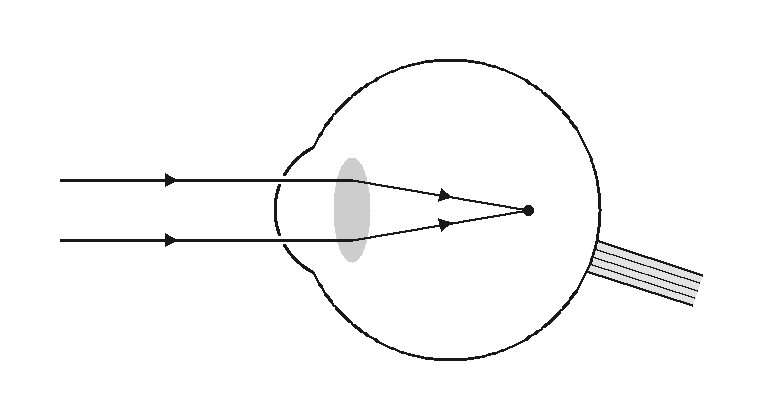
(i) Name the defect of vision shown in the diagram.
(ii) How can this be rectified?
(iii) What is the reason for this defect?
- 335 marks
Question 33
Write short notes on the following:
(i) Neural coordination
(ii) Forebrain
(iii) Midbrain
(iv) Hindbrain
(v) Retina
(vi) Ear ossicles
(vii) Cochlea
(viii) Organ of Corti
(ix) Synapse
- 341 mark
Question 34
Arjun is reading in a quiet library in Bhopal when a heavy book crashes to the floor behind him. Before he has even worked out what the noise was, his head and eyes have already turned towards it. Which part of his brain contains the reflex centre that mainly brings about this quick turning towards the sound?
- 351 mark
Question 35
In a research laboratory in Pune, a scientist stimulates a nerve fibre 100 times per second for 2 minutes. One electrode records the impulses arriving at the synaptic knob of this presynaptic neuron, and another records the response of the postsynaptic neuron. (Hypothetical data.)
Time from the start of stimulation (s) 0 30 60 90 120 Impulses arriving at the synaptic knob per second 100 100 100 100 100 Size of the postsynaptic response (% of the first response) 100 72 45 24 18 After a rest of 5 minutes, the first impulse again gives a postsynaptic response of full size. Which explanation fits all these results?
- 361 mark
Question 36
Assertion (A): During a heavy cold with a blocked nose, food often seems to have very little flavour, although sweet, sour, salty and bitter can usually still be told apart.
Reason (R): Much of the flavour of food comes from odour molecules that pass from the back of the mouth up to the olfactory epithelium in the roof of the nasal cavity, and swelling and thick mucus stop them reaching it.
- 372 marks
Question 37
Researchers in a physiology laboratory record the impulses in a single sensory nerve fibre that comes from one pressure receptor in the skin of a fingertip. Small weights are rested on the skin over the receptor, one at a time, and the impulses are counted for one second each time. (Hypothetical data.)
Weight resting on the skin 1 g 5 g 20 g Peak of each action potential +35 mV +35 mV +35 mV Number of impulses in one second 8 35 110 (a) Every impulse in this fibre reaches the same peak. Using the table, explain how the brain can still tell a firm press from a light touch. (1 mark)
(b) The absolute refractory period of this fibre is 2 ms. Calculate the greatest number of impulses the fibre could carry in one second, and explain why no stimulus, however strong, can make it fire faster. (1 mark)
- 382 marks
Question 38
At a community kitchen in Amritsar, Simran picks up a large steel pot of hot dal by its two metal handles. The handles are much hotter than she expected. Instead of letting go at once, she keeps holding the pot for about two seconds, sets it down safely on the table, and then shakes her stinging hands. Her younger brother says, "That proves that pulling the hand away from something hot is not a reflex at all, because she was able to stop it."
(a) Explain how Simran was able to keep holding the hot pot. (1 mark)
(b) Is her brother's conclusion correct? Give a reason. (1 mark)
- 393 marks
Question 39
At a cricket academy in Indore, a coach runs a catching drill for 8 young fielders. Each fielder tries 20 high catches with a tennis ball with both eyes open, and 20 more high catches with a soft patch over one eye. (Hypothetical data.)
Condition Catches tried Catches taken Both eyes open 160 144 One eye covered 160 96 (a) Calculate the percentage of catches taken in each condition. (1 mark)
(b) Explain, from the position of the two human eyes and the way the brain uses their images, why the fielders caught better with both eyes open. (1 mark)
(c) The coach concludes: "With one eye covered, a person cannot judge distance at all." Do the data support this conclusion? Give a reason. (1 mark)
- 405 marks
Question 40
At a hospital in Chennai, a 45-year-old man has received a heart transplant. The nerves that reached his old heart cannot be joined to the new one, so for many months the new heart has no sympathetic or parasympathetic (vagus) nerve supply. It keeps beating because its own pacemaker, the SA node, starts every beat; left to itself, the SA node fires about 100 times per minute. Six months after the operation, his heart rate is compared with that of his healthy brother of about the same age, before, during and after brisk walking on a treadmill. (Hypothetical data.)
Heart rate (beats per minute) Healthy brother Patient At rest 70 100 After 1 minute of brisk walking 105 104 After 6 minutes of brisk walking 125 118 5 minutes after stopping 78 112 (a) Calculate the rise in heart rate during the first minute of walking for each man, as a percentage of his resting rate. (1 mark)
(b) Explain why the patient's resting heart rate is higher than his brother's. (2 marks)
(c) The patient's heart has no nerves, yet his heart rate rose to 118 after 6 minutes and fell back only slowly after he stopped. Explain how his heart rate rose, and why it changed so slowly compared with his brother's. (2 marks)