
Opening your dashboard
Class 11 Biology Chapter 26 Excretory Products and Their Elimination: Competency-Based Questions (CBQ)
40 questions on Chapter 26, each worked through on its own page with the AI tutor. Class 11 Biology, ICSE 2026-27.
40 questions
1–10 marks · Mixed difficulty
- 14 marks
Question 1
An ornamental-fish farm near Kolkata sends goldfish to pet shops by road. For a 10-hour journey, 10 goldfish are sealed in a plastic bag with 4 litres of water and pure oxygen. Each goldfish gives out about 0.1 mg of ammonia per hour, mainly through its gills, and fish keepers treat an ammonia level above about 1 mg per litre of water as harmful. (Hypothetical data.)
(a) Goldfish are freshwater bony fish that excrete most of their waste nitrogen as ammonia. Explain why this works well in a pond but becomes a problem in a sealed bag. (1 mark)
(b) Calculate the ammonia concentration in the bag at the end of the journey, and the time after which it first reaches the harmful level. (2 marks)
(c) The farm stops feeding the fish for a day before packing them. Explain how this lowers the amount of ammonia the fish produce. (1 mark)
- 21 mark
Question 2
Assertion (A): Land snails that live in dry gardens excrete most of their waste nitrogen as uric acid.
Reason (R): Uric acid needs a larger volume of water for its removal than urea does.
- 31 mark
Question 3
A healthy gym trainer in Pune starts taking protein shakes and many extra eggs every day, so his protein intake becomes much higher than his body needs for growth and repair. After two weeks, which change in his urine is most expected, and why?
- 44 marks
Question 4
Gulls along the Gujarat coast often drink sea water. Above each eye a gull has a salt gland, which removes salt from the blood and gives out a very salty fluid that drips from its nostrils. A gull's kidneys cannot make urine as salty as sea water. The table gives the sodium chloride (NaCl) concentrations. (Hypothetical data.)
Fluid NaCl (millimoles per litre) Sea water 500 Most concentrated urine the gull's kidneys can make 300 Fluid from the salt glands 800 (a) A gull drinks 100 mL of sea water. Calculate the volume of urine it would need to remove all of this salt by its kidneys alone, and say whether it would gain or lose water by doing so. (1 mark)
(b) Calculate the volume of salt-gland fluid needed to remove the same salt, and the water the gull gains. (1 mark)
(c) The salt gland is an accessory excretory organ. Explain what this means, and explain why a person cannot use sweating in the same way to get rid of the salt from sea water. (2 marks)
- 51 mark
Question 5
A 50-year-old patient at a hospital in Chennai has a gallstone that blocks the common bile duct, the tube that carries bile from the liver to the duodenum. His skin and the whites of his eyes turn yellow, his faeces become pale, and his urine turns dark. Which explanation fits all three signs?
- 61 mark
Question 6
Assertion (A): The liver is counted among the accessory excretory organs of humans, although it does not form urine.
Reason (R): Bile salts made by the liver help to emulsify fats in the small intestine.
- 74 marks
Question 7
A 35-year-old woman in Delhi donated her left kidney to her brother. Each human kidney has about 1 million nephrons, and an adult cannot form new nephrons. Her glomerular filtration rate (GFR) was measured three times. (Hypothetical data.)
Time of test GFR (mL per minute) Before donation (two kidneys) 120 One week after donation 66 One year after donation 84 (a) Express her GFR one year after donation as a percentage of her GFR before donation. (1 mark)
(b) Calculate the average GFR of one nephron before donation and one year after it, and explain how her remaining kidney raised its GFR although no nephrons were added. (2 marks)
(c) Calculate the volume of filtrate her single kidney now forms in one day, and use it to explain why her blood urea stays normal. (1 mark)
- 81 mark
Question 8
Assertion (A): The urinary bladder can hold a growing volume of urine without its inner lining tearing.
Reason (R): The bladder is lined by transitional epithelium, whose cells change shape and flatten as the wall stretches.
- 91 mark
Question 9
During a kidney biopsy in a hospital in Hyderabad, a thin needle takes a sample of tissue only from the renal medulla, well away from the cortex. Which structure would the pathologist NOT expect to find in this sample?
- 104 marks
Question 10
At an antenatal clinic in Jaipur, two pregnant women have a routine urine dipstick test and a blood test. In pregnancy the GFR normally rises by up to about half, and the kidney tubules also reabsorb glucose a little less completely than before. The renal threshold for glucose is about 180 mg per 100 mL of blood. (Hypothetical data.)
Measurement Woman P (24 weeks) Woman Q (26 weeks) Blood glucose (mg per 100 mL) 95 230 GFR (mL per minute) 170 165 Glucose in urine Trace Large amount Before pregnancy, P had a GFR of 120 mL per minute and the same blood glucose.
(a) Explain why Q's urine contains a large amount of glucose. (1 mark)
(b) Calculate the percentage rise in the glucose filtered per minute by P compared with before pregnancy, and use it to explain the trace of glucose in her urine. (2 marks)
(c) Explain why the doctor confirms any suspected diabetes in pregnancy with a blood glucose test rather than with urine tests alone. (1 mark)
- 111 mark
Question 11
Assertion (A): Blood leaving a glomerulus in the efferent arteriole has a lower concentration of plasma proteins than blood entering it in the afferent arteriole.
Reason (R): Plasma proteins are held back by the filtration barrier of the glomerulus and do not pass into Bowman's capsule.
- 121 mark
Question 12
A six-year-old boy at a children's hospital in Bengaluru has puffy eyelids and swollen ankles. His urine is frothy and contains a large amount of albumin, but no red blood cells. Damage to which structure would best explain the albumin in his urine?
- 134 marks
Question 13
In a laboratory study of desert animals, a kangaroo rat is fed only on dry seeds and given no drinking water. While it eats 100 g of seeds, its water gains and losses are measured. (Hypothetical data.)
Water gained mL Water lost mL Water formed in its cells by aerobic respiration 54 In urine 14 Free water present in the seeds 6 In faeces 3 By evaporation from lungs and skin 43 (a) Show that the water budget balances, and calculate the percentage of its water gain that comes from respiration. (1 mark)
(b) The kangaroo rat's urine can be about four times as concentrated as the most concentrated human urine. Explain how the structure and working of its nephrons keep its urine loss so small. (2 marks)
(c) Predict how its water budget would change if it were fed dried insects rich in protein instead of seeds. Give a reason. (1 mark)
- 144 marks
Question 14
A baby is born at 28 weeks of pregnancy, about 12 weeks early, and is cared for in a neonatal unit in Hyderabad. The doctors explain that in such a baby the nephrons are still forming and maturing, the loops of Henle are short, and the medulla has not yet built up a high salt concentration. The baby must excrete about 18 mOsmol of waste solutes a day. Its kidneys can make urine of at most 600 mOsmol per litre, while an adult's can reach about 1200 mOsmol per litre. (Hypothetical data.)
(a) Calculate the least volume of urine the baby needs each day to excrete its waste solutes, and the volume an adult kidney would need for the same solute load. (1 mark)
(b) Explain why short loops of Henle and a weakly salty medulla limit how concentrated the baby's urine can be. (2 marks)
(c) Suggest why the nurses measure the baby's fluid feeds and weigh its nappies carefully, especially on a hot day. (1 mark)
- 151 mark
Question 15
Assertion (A): Even in a person who is badly dehydrated, the fluid leaving the ascending limb of the loop of Henle is hypotonic to blood plasma.
Reason (R): ADH makes the walls of the collecting duct more permeable to water.
- 164 marks
Question 16
A 30-year-old woman runs a full marathon in Mumbai in 5 hours. Worried about becoming dehydrated, she drinks about 1 litre of plain water every hour. At the finish she feels sick and has a bad headache. During long, hard exercise, the release of ADH often stays high and less blood flows to the kidneys. Her results are given below. (Hypothetical data.)
Measurement Value Body weight before the race 58.0 kg Body weight after the race 59.0 kg Blood sodium after the race 126 mmol per litre (normal 135–145) (a) Use the change in body weight to estimate her net gain of water, and explain why her blood sodium fell. (1 mark)
(b) State how the hypothalamus and ADH should normally respond to a fall in the osmotic pressure of the blood, and explain why her kidneys did not remove the extra water quickly enough during the race. (2 marks)
(c) State the current advice to runners about drinking during a long race. (1 mark)
- 171 mark
Question 17
Assertion (A): Atrial natriuretic factor (ANF) raises the blood volume by increasing the release of renin from the juxtaglomerular cells.
Reason (R): ANF is released by the walls of the atria of the heart when the blood volume and blood pressure rise.
- 181 mark
Question 18
A doctor prescribes spironolactone to a patient with heart failure. This medicine blocks the action of aldosterone on the kidney tubules. Which set of changes in the patient is expected?
- 194 marks
Question 19
At a veterinary clinic in Kochi, an old dog has been drinking much more water than before and passing large amounts of urine. The vet measures the specific gravity (SG) of urine samples. Healthy dogs can make urine with an SG well above 1.030, often up to about 1.050, while human urine rarely goes above about 1.030. The fluid filtered in the glomerulus has an SG of about 1.010. (Hypothetical data.)
Urine sample SG Healthy young dog, morning 1.042 Old dog, morning 1.009 Old dog, 2 hours after an injection of synthetic ADH 1.010 (a) What does the SG of urine measure? What does the young dog's value of 1.042 show? (1 mark)
(b) The old dog's urine stays close to an SG of 1.010 at all times. Explain what this shows about the work of its kidney tubules. (2 marks)
(c) Does the old dog's problem lie in releasing ADH or in its kidneys? Give a reason from the data. (1 mark)
- 204 marks
Question 20
On the first day after a stomach operation in a hospital in Lucknow, a nurse keeps a 24-hour fluid-balance chart for a 70 kg man. Nurses check that the urine output stays at least 0.5 mL per kg of body weight per hour. Stress after an operation increases the release of ADH and aldosterone for a day or two. (Hypothetical data.)
Fluid in mL Fluid out mL Drip into a vein 2000 Urine 1200 Sips of water by mouth 300 Fluid from a wound drain 150 Estimated loss from lungs and skin 700 (a) Calculate his fluid balance for the 24 hours. (1 mark)
(b) Calculate his average urine output per hour and check it against the nurses' minimum. (1 mark)
(c) Explain how the raised ADH and aldosterone after the operation affect the volume and composition of his urine. (2 marks)
- 211 mark
Question 21
Assertion (A): On a hot afternoon after hours of directing traffic in the sun, a traffic police officer's urine is a darker yellow than the officer's urine early on a cool morning.
Reason (R): Profuse sweating reduces the volume of urine, so its yellow pigment urochrome is dissolved in less water.
- 224 marks
Question 22
A 58-year-old man in Ludhiana has had diabetes for many years. His glomerular filtration rate (GFR) has been measured once a year, as shown in the graph. Doctors call it kidney failure, needing dialysis or a kidney transplant, when the GFR falls below about 15 mL per minute. (Hypothetical data.)
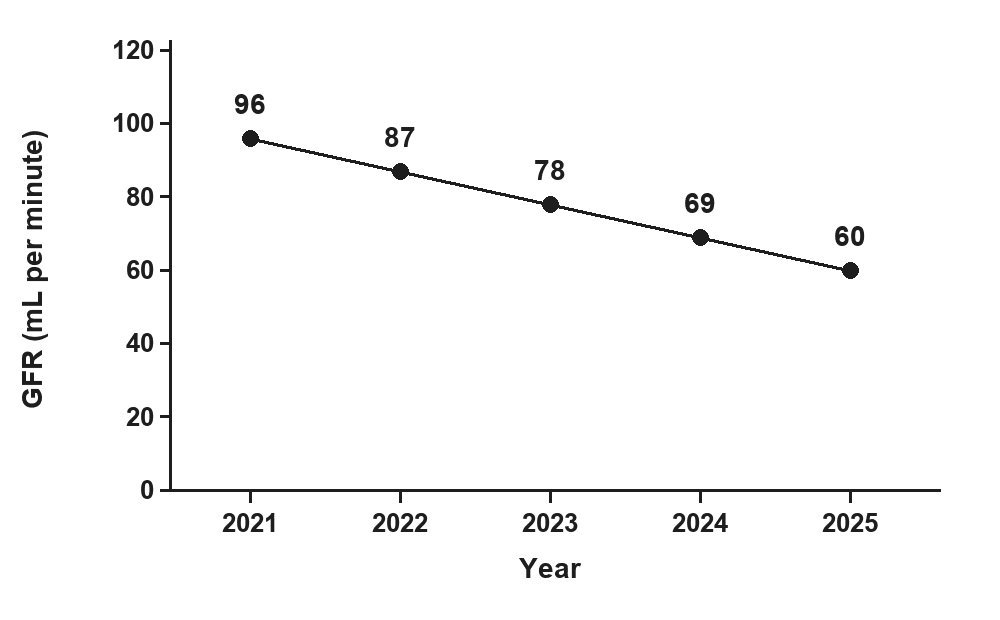
(a) Calculate the average fall in his GFR per year from 2021 to 2025. (1 mark)
(b) If his GFR keeps falling at the same rate, in which year will it reach 15 mL per minute? (1 mark)
(c) Explain why the urea level in his blood will rise as his GFR falls, and name this condition. (2 marks)
- 231 mark
Question 23
About ten days after a throat infection, an eight-year-old girl in Shimla passes reddish-brown urine, has puffy eyes and a raised blood pressure. Her urine contains red blood cells and some protein. Which condition best explains these findings?
- 241 mark
Question 24
During a blood transfusion in a hospital ward, a patient is given blood of an incompatible group by mistake, and his own antibodies destroy the donated red cells in his blood vessels. Within an hour his urine turns red. Under the microscope the urine shows no red blood cells, yet a test for haemoglobin is strongly positive. Which term describes his urine?
- 251 mark
Question 25
Assertion (A): In haemodialysis, the dialysing fluid contains sodium and other mineral ions at about the same concentrations as normal blood plasma.
Reason (R): Plasma proteins pass freely across the dialysis membrane into the dialysing fluid.
- 2610 marks
Question 26
Match the following:
Column A Column B 1. Ammonotelism (a) Glucose 2. Bowman's capsule (b) Birds 3. Urinary bladder (c) Cartilaginous fish 4. Vasa rectae (d) Glomerular filtration 5. Uricotelism (e) Renin 6. Antidiuretic hormone (f) Inner lining of Bowman's capsule 7. Ureotelism (g) Hypertonic urine 8. Juxtaglomerular apparatus (h) Micturition 9. Podocytes (i) Aquatic invertebrates 10. Tubular reabsorption (j) Counter-current system - 275 marks
Question 27
Haemodialysis done by using a dialysis machine to filter urea and other metabolic wastes from the blood when kidneys have failed. The entire blood of the body is pumped out of the body to a machine where it is passed through a series of semi-permeable membranes or tubes called ‘dialyser’. Before haemodialysis, usually a blood vessel called an arteriovenous fistula (AV fistula) is created in the arm. It is created by connecting an artery to a vein, which makes the blood vessel larger and stronger. This makes it easier to transfer the blood into the dialysis machine and back again. During haemodialysis, two thin needles are inserted into the AV fistula taped. One needle slowly removes blood and transfers it to a dialysis machine. The dialysis machine has a series of membranes that act as filters and a special liquid called dialysate. The membranes filter waste products from the blood, which are passed into the dialysate fluid. The used dialysate fluid is pumped out of the dialyser and the filtered blood is passed back into the body through the second needle.
(1) The series of semi-permeable membranes in hemodialysis are called
(a) dialysate
(b) dialyser
(c) haemodialysate
(d) dialysis
(2) AV fistula is a name given to
(a) an artery
(b) a vein
(c) capillary network
(d) blood vessel connecting artery to a vein
(3) During haemodialysis, the waste products from the blood pass out into the
(a) dialysate
(b) venous blood
(c) dialyser
(d) arterial blood
(4) The purpose of haemodialysis is to
(a) filter waste products from the kidney
(b) filter waste products from blood
(c) remove poisonous substances from blood
(d) purify the blood from germs
(5) Which of the following statements is correct for haemodialysis?
(a) filtered blood passes through the dialyser
(b) blood is mixed with dialysate for cleaning
(c) metabolic wastes get removed from the blood
(d) unfiltered blood passes into dialysate
- 285 marks
Question 28
Kidney stones are made up of millions of tiny crystals and form on the interior surface of the kidney, where urine leaves the kidneys in the renal pelvis. Kidney stones can be small, like a tiny pebble or large like a big stone. Most kidney stones are composed of calcium and oxalate. Many people who form calcium containing stones have too much calcium in their urine, a condition known as hypercalciuria. Some people form stones that are composed of a mixture of magnesium, ammonium and phosphate, known as struvite. These stones form as a result of infection with certain types of bacteria that can produce ammonia. Ammonia acts to raise the pH of urine, which makes it alkaline and promotes the formation of struvite. Some people have uric acid stones. These stones are more common in people who consume large amounts of protein and when there is too much uric acid in the urine.
(1) Most kidney stones are present in the following region of kidney
(a) outer surface of kidney
(b) renal pelvis
(c) renal cortex
(d) renal medulla
(2) Kidney stones that are composed of magnesium and ammonium phosphates are called
(a) calcerites
(b) struvite
(c) magnate
(d) phosphite
(3) The condition when there is too much of calcium in the urine, is called
(a) uraemia
(b) hypercalcaemia
(c) hypocalciuria
(d) hypercalciuria
(4) The following condition promotes the formation of struvite in the kidneys
(a) infection from bacteria
(b) acidic pH of urine
(c) consuming carbonated drinks
(d) high calcium diet
(5) Following type of stones are more common in people with high protein diet
(a) calcium stones
(b) calcium carbonate stones
(c) uric acid stones
(d) oxalate stones
- 294 marks
Question 29
Observe the diagram and answer the following:
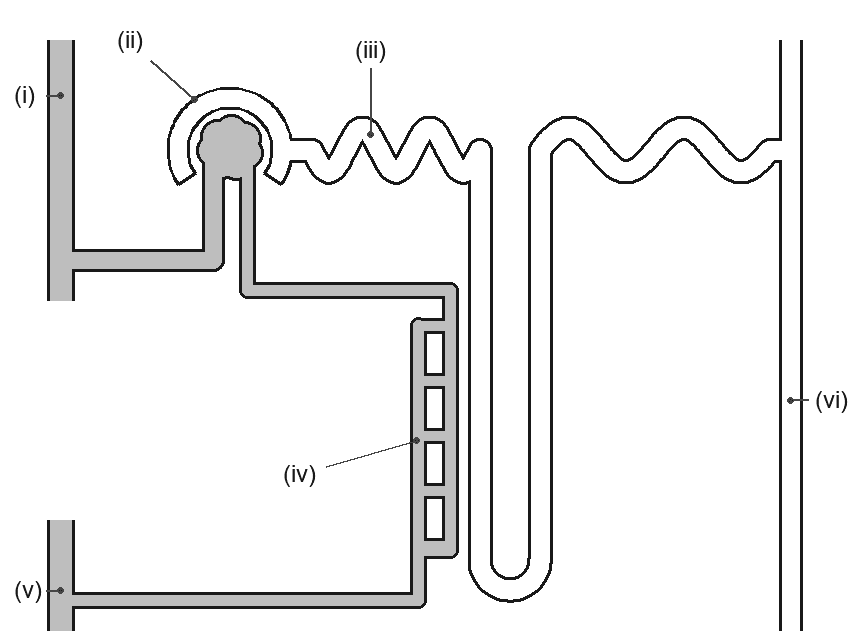
1. Label the parts shown.
2. What is the name of the part drawn?
3. Where is it present in the body?
4. What kind of blood is present in part (v)?
- 304 marks
Question 30
Study the diagram and answer the following questions:
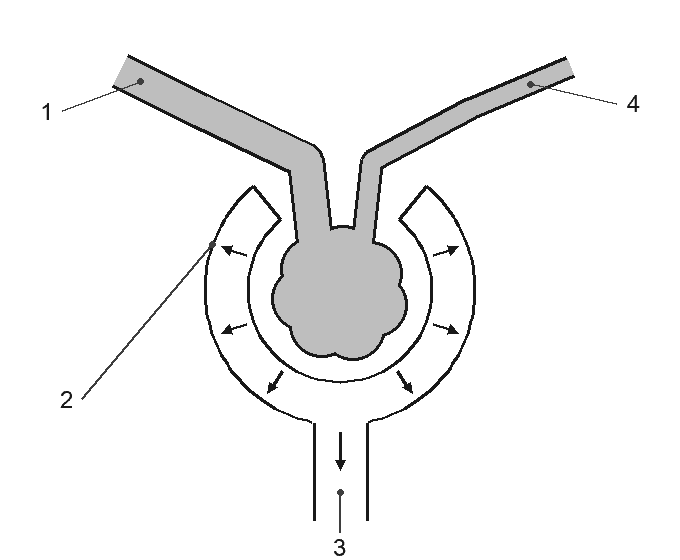
(i) Label the parts 1, 2, 3 and 4.
(ii) Give one structural difference between 1 and 4.
(iii) Name the process the arrows indicate.
(iv) From where is part 1 originating?
- 314 marks
Question 31
Given diagram is a part of excretory system. Answer the following questions:
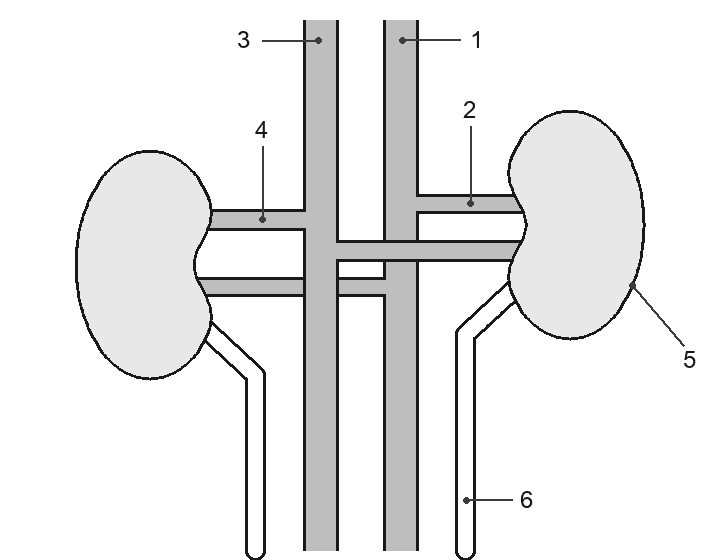
(i) Label parts 1 to 6.
(ii) List important functions of 5 and 6.
(iii) Name an important part present in 5 that is responsible for its function.
(iv) What kind of blood is present in 4?
- 324 marks
Question 32
Given diagram is a vertical section of kidney. Answer the following questions:

(i) Label parts 1 to 5.
(ii) What is the function of part 3?
(iii) Why does part 1 give dotted appearance?
(iv) Name important processes that occur for the formation of urine.
- 334 marks
Question 33
A simplified diagram of nephron is given here. Answer the following questions:
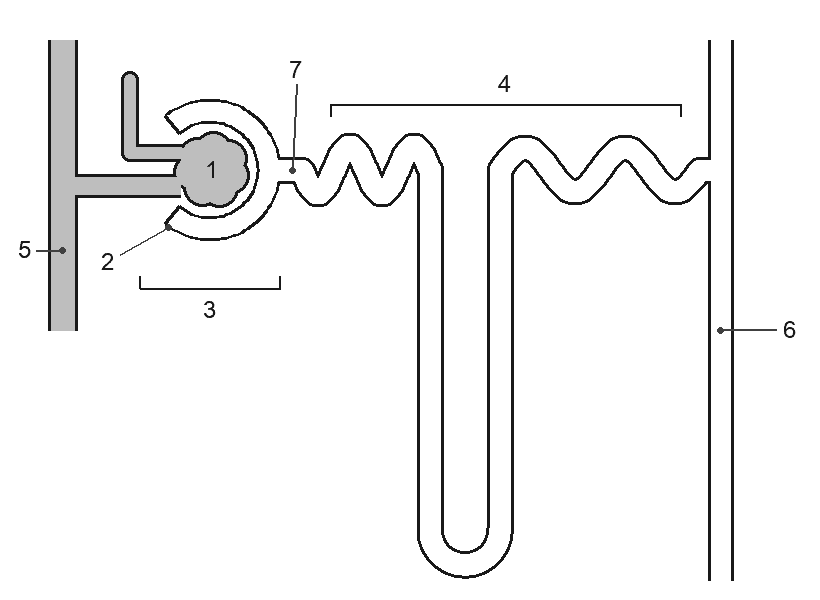
(i) Label parts 1 to 5.
(ii) Which structure in the part shown will contain highest amount of urea?
(iii) Compare parts 6 and 7 in the composition of glucose, salts and water as more or less.
(iv) Name the process that occurs in part 1.
- 344 marks
Question 34
A schematic diagram of excretory system is given. Observe and answer the following questions:
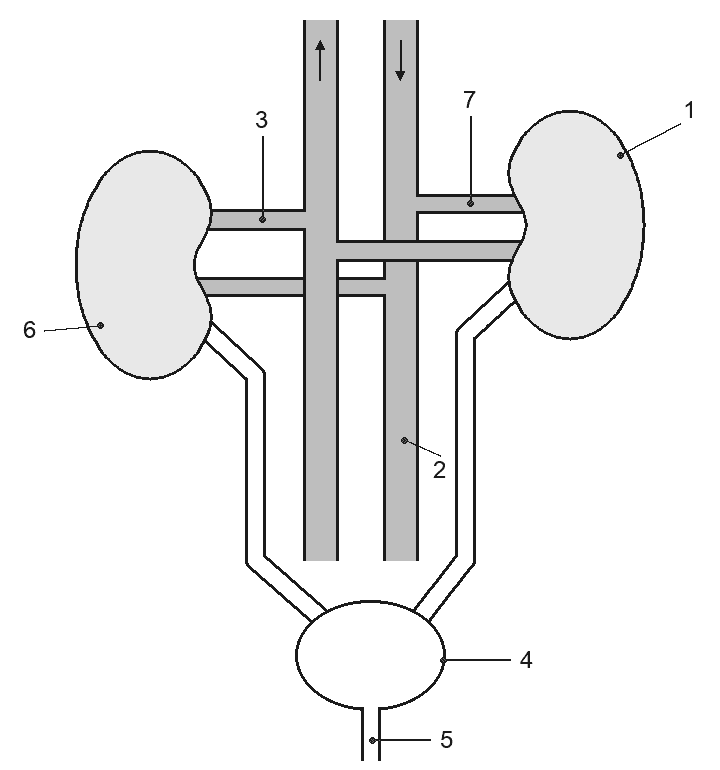
(i) Label parts 1 to 5.
(ii) Why is 6 placed lower than 1?
(iii) Give function of parts 4 and 5.
(iv) Compare the parts 3 and 7 for excretory wastes and blood pressure.
- 351 mark
Question 35
At a kidney research laboratory in Lucknow, these measurements are made on a healthy adult volunteer at rest. (Hypothetical data.)
Measurement Value Blood pumped out by the left ventricle per minute (cardiac output) 5.5 L Blood flowing through both kidneys per minute 1100 mL Share of the blood volume that is plasma 55% Glomerular filtration rate (GFR) 121 mL per minute Which conclusion do these data support?
- 361 mark
Question 36
A 40-year-old man in Jodhpur has sudden, severe pain in his left side. A scan shows a kidney stone that completely blocks his left ureter in its middle part. His right kidney, right ureter, urinary bladder and urethra are normal. If the stone stays in place for several days, which finding is expected on the next scan?
- 371 mark
Question 37
Assertion (A): A person who often eats large helpings of purine-rich food, such as organ meats like liver and kidney, tends to pass more uric acid in the urine.
Reason (R): In humans, uric acid is made in the liver from ammonia by the ornithine cycle.
- 382 marks
Question 38
After a building collapsed during an earthquake in Gujarat, a worker was rescued whose thigh muscles had been crushed under the rubble for many hours. Damaged muscle cells release myoglobin, an oxygen-storing protein, into the blood, and within hours his urine turned dark brown. The table gives the approximate molecular masses of some substances in his plasma.
Substance in plasma Approximate molecular mass Urea 60 Glucose 180 Myoglobin 17,000 Albumin (main plasma protein) 66,000 Small molecules pass the glomerular filter freely. Proteins pass less and less easily as their size increases, and albumin is almost completely held back.
(a) Use the data to explain why myoglobin reaches his urine while albumin does not. (1 mark)
(b) Doctors give him large volumes of fluid through a drip so that he keeps passing a lot of urine. Suggest how this protects his kidney tubules. (1 mark)
- 393 marks
Question 39
A dietitian at a hospital in Chennai wants to know whether a patient recovering from a major operation is losing body protein. All the urine he passes in 24 hours is collected, and it contains 24 g of urea. (Hypothetical data.)
Use these values:
- Urea, , has a molar mass of 60 g per mole, and each molecule contains 2 nitrogen atoms (atomic mass of N = 14).
- Take urea as carrying 80% of all the nitrogen the patient loses in a day.
- Protein contains about 16% nitrogen by mass.
- His diet supplies 60 g of protein a day.
(a) Calculate the mass of nitrogen in the 24 g of urea. (1 mark)
(b) Calculate the total mass of nitrogen he loses in a day, and the mass of protein that must have been broken down to release it. (1 mark)
(c) Is he gaining or losing body protein? Explain how the nitrogen of this protein ends up as urea in his urine. (1 mark)
- 404 marks
Question 40
A Class 11 project group in Bengaluru compares the waste removed by the lungs and by the kidneys of a healthy adult. They take the resting values below for the whole day, and take the volume of air breathed in each minute as equal to the volume breathed out. (Hypothetical data.)
Quantity Value Air breathed out per minute at rest 6.0 L Carbon dioxide (CO₂) in air breathed out 4.0% Carbon dioxide (CO₂) in air breathed in 0.04% Mass of 1 L of CO₂ at room temperature 1.8 g Urea passed in the urine per day 28 g (a) Calculate the volume of CO₂ removed by the lungs per minute and per day. (1 mark)
(b) Calculate the mass of CO₂ removed per day, and how many times the mass of urea passed in the urine this is. (1 mark)
(c) One student concludes: "The lungs remove about twenty times more waste by mass than the kidneys, so a person whose kidneys have failed could manage with the lungs alone." Evaluate this conclusion. (2 marks)