
Competency: Analysis
Case study: The lamp of a hotel corridor is controlled by two dual control switches, S₁ at one end and S₂ at the other end, joined by two wires called wire 1 and wire 2. The middle terminal of S₁ is joined to the live wire, and the middle terminal of S₂ is joined to the lamp, whose other terminal goes to the neutral wire. When the knob of a switch is UP, its middle terminal is joined to wire 1; when the knob is DOWN, it is joined to wire 2.
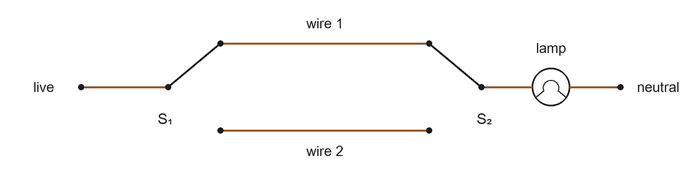
A maintenance worker starts the record below.
| Observation | Knob of S₁ | Knob of S₂ | Lamp |
|---|---|---|---|
| 1 | UP | UP | ON |
| 2 | UP | DOWN | OFF |
| 3 | DOWN | DOWN | ? |
| 4 | DOWN | UP | ? |
(a) Complete the record for observations 3 and 4. Give a reason.
(b) The switches are as in observation 3. A guest at S₂ operates it once, and then another guest at S₁ operates it once. State the positions of the two knobs and whether the lamp is on or off after each of these two steps.
(c) Some weeks later the lamp, which is not fused, glows with the knobs as in observation 1 but stays off with the knobs as in observation 3. Identify the fault. With this fault, can a guest at S₂ still switch the lamp both on and off, whatever the position of S₁ ? Explain.