
Opening your dashboard
Class 10 Physics Chapter 8 Current Electricity: Competency-Based Questions (CBQ)
40 questions on Chapter 8, each worked through on its own page with the AI tutor. Class 10 Physics, ICSE 2026-27.
40 questions
1–5 marks · Mixed difficulty
- 11 mark
Question 1
Competency: Understanding & Application
Given that the resistivity of Gold and Platinum is and ohm m, respectively, which is the correct statement?
STATEMENT A: 5 metres of platinum wire will have the same resistance as one metre of gold wire.
STATEMENT B: Gold wire of 1 cm radius will have the same resistance as platinum wire of 5 cm radius.
- 21 mark
Question 2
Competency: Analysis, Evaluation & Application

The above diagram shows different copper conductors of diameters and and lengths, which are multiples of . The increasing order of their resistances will be:
- 31 mark
Question 3
Competency: Analysis
If three resistors , and are connected in series and , then what is the relation between the currents , and respectively flowing through them?
- 42 marks
Question 4
Competency: Application & Evaluation
In the above diagram, calculate the ratio of the resistances A, B, C and D.
- 52 marks
Question 5
Competency: Understanding
There are two copper wires of length ratio 1:2 that have their cross-sectional areas in the ratio 1:4. What will be the ratio of their:
(a) resistances?
(b) specific resistances?
- 62 marks
Question 6
Competency: Application
You are given three resistors of magnitude 3 Ω each. You can join them either in a series or in a parallel combination. How will you arrange them so that the equivalent resistance would become:
(a) maximum
(b) minimum
(Your answer must be accompanied by proper mathematical calculations)
- 72 marks
Question 7
Competency: Application
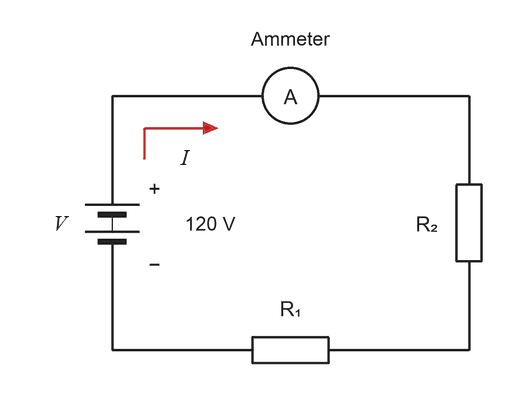
In the given circuit diagram, Minakshi replaced the ammeter by a voltmeter by mistake. Will this circuit work?
- 83 marks
Question 8
Competency: Application
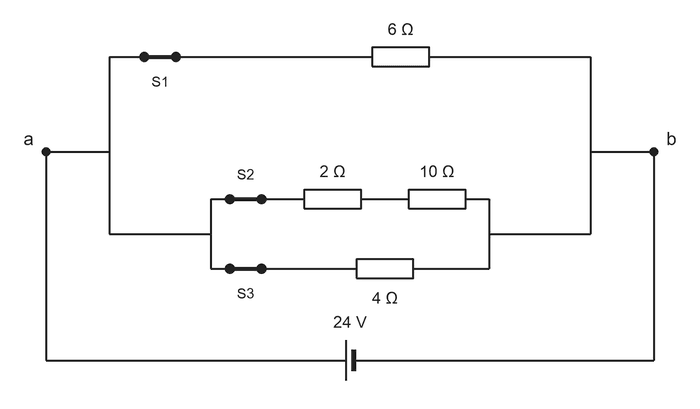
Which one of the switches, S1, S2 or S3, should be opened so that:
(a) total resistance is equal to 4 ohms.
(b) the total resistance is equal to 3 ohms.
(c) the current through 4 ohms is th of the total current.
- 93 marks
Question 9
Competency: Analysis, Application & Evaluation

Observe the electric circuit above and answer the questions that follow.
(a) If we increase the current in the above circuit using a rheostat, will the reading of the voltmeter decrease or increase?
(b) Give a reason for your answer in ‘a’.
(c) The present reading of the voltmeter is 2 V, and the current in the circuit is 0.8 A. Calculate the potential drop when the current in the circuit becomes 1 A. Given E = 3 V.
- 104 marks
Question 10
Competency: Understanding & Evaluation
The circuit depicted in the figure is employed to study Ohm's Law. Rather than employing a conventional resistor, a glass tube of length ‘’ and cross-sectional area ‘’, which is half-filled with mercury of resistivity ‘’, is connected to the circuit via two electrodes, E1 and E2. These electrodes are linked to a battery with an emf of ‘’ and negligible internal resistance. Provide the answer in terms of ‘’, ‘’, ‘’, and ‘’.
(a) Resistance of mercury in the tube.
(b) The ammeter reading.
(c) Voltmeter reading.
(d) Which of the measurements are altered when the tube is entirely filled with mercury?

- 114 marks
Question 11
Competency: Application & Evaluation
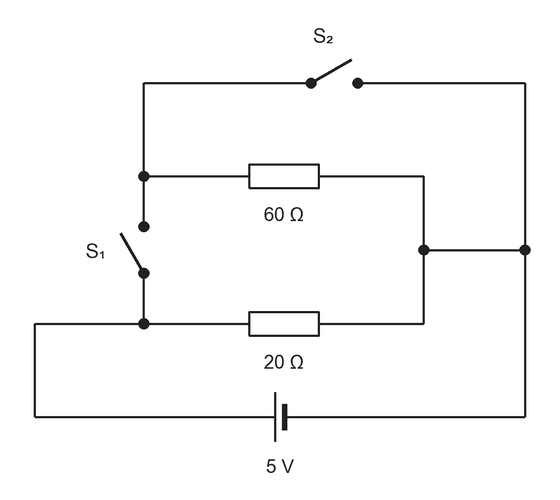
In the above circuit diagram, calculate the power consumed in the circuit when:
(a) the switch is closed, and the switch is open.
(b) the switch is closed, and the switch is open.
- 121 mark
Question 12
Competency: Understanding & Application
Assertion (A): A bird can sit on a single bare overhead power line, which is at 11 000 V, without getting an electric shock.
Reason (R): A current flows between two points of a conductor only when there is a potential difference between them, and both the feet of the bird are at almost the same potential.
- 131 mark
Question 13
Competency: Analysis
Assertion (A): A filament bulb is more likely to fuse at the moment it is switched on than after it has been glowing for some time.
Reason (R): The resistance of the tungsten filament is greater when it is cold than when it is white hot.
- 144 marks
Question 14
Competency: Analysis & Application
Case study: In the laboratory, Tara connects a fixed resistor and a small filament lamp, one after the other, to a supply whose potential difference can be changed. For each one she measures the current at several potential differences and plots the graphs P and Q shown below.
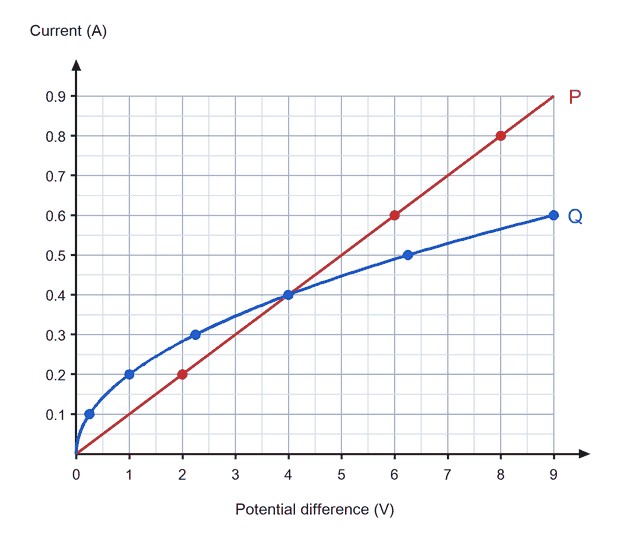
(a) Which graph, P or Q, is for the fixed resistor ? Give a reason, and find its resistance.
(b) Find the resistance of the lamp when the potential difference across it is 1 V and when it is 9 V. Account for the difference.
(c) The lamp and the resistor are now joined in series to the supply. Use the graph to find the potential difference of the supply when the current in the circuit is 0.2 A. Tara says, "In this series circuit the fixed resistor always gets the larger share of the supply voltage." Take readings from the graph at 0.6 A and judge whether she is right.
- 154 marks
Question 15
Competency: Application & Evaluation
Case study: The battery of Meera's phone is marked '3.7 V, 4000 mAh'. Her teacher explains that the mAh (milliampere-hour) is a unit of charge: 1 mAh is the charge that passes when a current of 1 mA flows for 1 hour. Meera charges the phone from empty to full once every day.
(a) Express 4000 mAh in coulomb.
(b) How many electrons pass through the battery while it receives this charge ? (Charge on an electron = C)
(c) Taking the potential difference across the battery to remain 3.7 V, find the energy needed for one full charge, in joule and in kWh. Meera's brother says, "Charging this phone every day adds at least ₹ 30 to our electricity bill each month." If electricity costs ₹ 8 per kWh, judge his claim for a month of 30 days.
- 164 marks
Question 16
Competency: Analysis & Evaluation
Case study: An electric kettle is marked '1500 W, 240 V'. Arjun uses it to boil the same amount of water, starting from the same temperature, once in the morning and once in the evening. Each time he notes the supply voltage shown on the display of the voltage stabiliser at home. His readings are given below.
Time of day Supply voltage Time taken to boil the water Morning 240 V 4 min Evening 200 V 5 min 46 s Assume that the resistance of the heating element stays the same and that all the heat produced goes to the water.
(a) Find the resistance of the heating element, and the electrical energy used by the kettle in the morning, in kWh.
(b) Find the power of the kettle in the evening.
(c) Check by calculation whether the time Arjun noted in the evening is what you would expect. His sister says, "In the evening the kettle runs for a longer time, so it uses more units of electricity to boil the same water." Judge her statement.
- 174 marks
Question 17
Competency: Analysis & Creation
Rohan finds three used dry cells X, Y and Z, each marked 1.5 V, and wants to know which one is the most worn out. His teacher tells him that as a dry cell gets used up, its internal resistance increases, while its e.m.f. changes very little. Rohan connects a high-resistance voltmeter directly across each cell in turn and reads 1.50 V, 1.48 V and 1.49 V. He also has an ammeter, a torch bulb in a holder, a key and connecting wires.
(a) Explain why Rohan's voltmeter readings hardly tell the three cells apart.
(b) Design a test, using only the things he has, that will show which cell is the most worn out. Describe the circuit and the readings to be taken for each cell.
(c) State how the readings should be used to reach the conclusion, and give two precautions that make the test fair and reliable.
- 181 mark
Question 18
Competency: Analysis
The graph shows the charge that has passed through two wires, P and Q, as time goes on. Both currents stay steady.
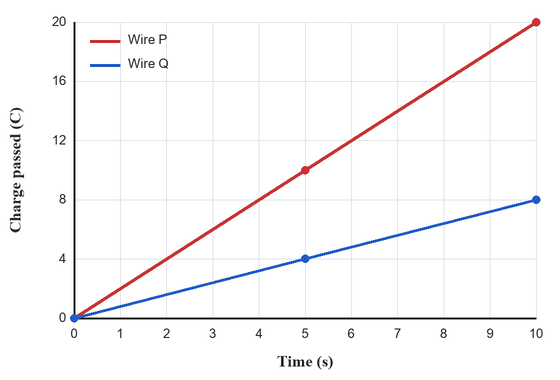
How many more coulombs of charge pass through wire P than through wire Q in 2 minutes ?
- 191 mark
Question 19
Competency: Application
A uniform wire AB, 1.00 m long and of the same thickness all along, carries a steady current. The potential difference between the end A and a point C, 40 cm from A, is 3.0 V. What is the potential difference between C and a point D, which is 90 cm from A ?
- 201 mark
Question 20
Competency: Understanding
Assertion (A): When the length of a wire is doubled, the resistivity of its material also becomes double.
Reason (R): The resistivity of a material depends on the nature of the material and on its temperature, and not on the size of the wire.
- 211 mark
Question 21
Competency: Analysis
The graph shows how the terminal voltage of two cells, X and Y, changes with the current drawn from them.

Which cell has the greater terminal voltage when each supplies a current of 2 A, and why ?
- 221 mark
Question 22
Competency: Analysis
A cell of e.m.f. 6 V and negligible internal resistance is joined to a resistor X and an ammeter, and the ammeter reads 0.6 A. A second resistor Y is then joined in parallel with X, and the ammeter reading rises to 1.0 A. What is the resistance of Y ?
- 231 mark
Question 23
Competency: Application
A heater coil of resistance , connected to the 230 V mains, consumes a power . One-third of the length of the coil is cut off, and the remaining part is connected to the same mains. Assume that the resistance per unit length of the coil does not change on heating. The power now consumed is :
- 241 mark
Question 24
Competency: Analysis
Assertion (A): Of two bulbs marked '230 V, 40 W' and '230 V, 100 W', the 100 W bulb has the smaller filament resistance.
Reason (R): The resistance of a bulb marked volt, watt is given by .
- 251 mark
Question 25
Competency: Analysis
Two wires X and Y are made of the same material and have the same length. The radius of Y is twice the radius of X. The wires are joined in parallel across a battery of negligible internal resistance. What is the ratio of the heat produced in X to the heat produced in Y in the same time ?
- 261 mark
Question 26
Competency: Application
In the circuit shown, the cell has an e.m.f. of 9 V and negligible internal resistance. A voltmeter of very high resistance is joined across the lamp, between the points P and Q.
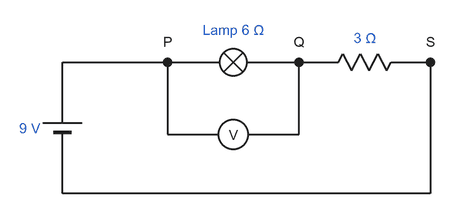
What does the voltmeter read ?
- 272 marks
Question 27
Competency: Understanding & Evaluation
The resistance of the human body between the two hands is about when the skin is dry and about when the skin is wet. (Typical values.) Ravi touches two points with a potential difference of 230 V between them, using both hands.
(a) Find the current through his body when his hands are dry and when they are wet.
(b) Ravi says, "Water on my hands makes no difference, because the voltage is 230 V in both cases." Judge his statement. (A current of a few tens of milliampere through the body can be dangerous.)
- 282 marks
Question 28
Competency: Application
A family replaces six 60 W filament lamps by six 9 W LED lamps that give the same light. Each lamp is used for 5 hours a day. (Hypothetical data.)
(a) Find the electrical energy saved in 30 days, in kWh.
(b) One unit (1 kWh) costs ₹ 6.50 and each LED lamp costs ₹ 90. Find the saving in 30 days in rupees, and the time in which the saving pays for the six LED lamps.
- 292 marks
Question 29
Competency: Analysis
A battery of e.m.f. 12 V and internal resistance 0.5 Ω is joined to a resistor so that a steady current of 4 A flows.
(a) How much electrical energy does the battery produce every second ?
(b) How much of it is wasted as heat inside the battery every second, and how much reaches the external resistor every second ?
- 302 marks
Question 30
Competency: Analysis
The graph shows the current against the potential difference for two wires P and Q. The wires are made of the same material and have the same area of cross-section.
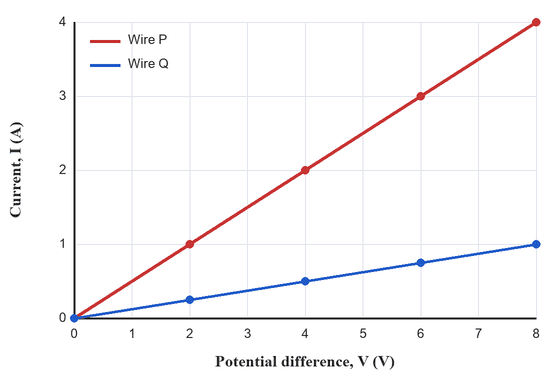
(a) Find the resistance of each wire.
(b) Which wire is longer, and by what factor ? If wire P is 30 cm long, find the length of wire Q.
- 312 marks
Question 31
Competency: Evaluation
Jaya has an extension board marked '6 A, 250 V'. She plugs a 1.2 kW room heater and a 1 kW electric iron into it at the same time, and says, "The supply is 230 V, which is less than the 250 V marked on the board, so both can be used safely together." Take the supply as 230 V.
(a) Find the total current drawn through the board.
(b) Judge Jaya's statement and say what she should do.
- 322 marks
Question 32
Competency: Application
The disc of an electricity meter makes 3200 revolutions for every 1 kWh of energy used. All other appliances in a house are switched off, and only a television is on. The disc makes 40 revolutions in 10 minutes. (Hypothetical data.)
(a) Find the power of the television.
(b) The television is used for 4 hours every day. Find the cost for 30 days at ₹ 7 per unit.
- 333 marks
Question 33
Competency: Application & Evaluation
A string of decorative lamps has 20 identical lamps joined in series and plugged into a 230 V supply. Each lamp is marked '11.5 V, 0.5 A'. (Hypothetical data.)
(a) Find the resistance of one lamp, and show that the lamps work at their rating on the 230 V supply.
(b) One lamp is removed and its holder is joined by a plain wire, so 19 lamps are left in series. Taking the resistance of each lamp as constant, find the new current and the potential difference across each lamp.
(c) Judge whether it is safe to keep using the string in this way.
- 343 marks
Question 34
Competency: Analysis
A student heats a coil of a metal wire in a water bath and measures its resistance at four temperatures :
Temperature (°C) 20 40 60 80 Resistance (Ω) 5.0 5.4 5.8 6.2 (a) Describe how the resistance changes, and give a reason in terms of the particles in the metal.
(b) Assume the same steady change continues. Find the resistance of the coil at 100 °C.
(c) Nina says, "At 0 °C the coil would have no resistance at all." Use the pattern in the table to judge her statement.
- 353 marks
Question 35
Competency: Analysis & Evaluation
A student verifies Ohm's law for a metal coil kept at a constant temperature and records :
Potential difference (V) 1.0 2.0 3.0 Current (A) 0.24 0.44 0.64 (a) Find for each reading. Is it constant ?
(b) The student suspects that the ammeter has a constant zero error, which means it reads some current even when no current flows. Use the change in and the change in between the readings to find the resistance of the coil, and the zero error.
(c) Why is the value found in part (b) better than the value found from a single reading ?
- 363 marks
Question 36
Competency: Understanding & Application
The reciprocal of the resistance of a conductor is called its conductance, . Its S.I. unit is the siemens (S), and . Two wires P and Q have resistances of and .
(a) Find the conductance of each wire.
(b) The wires are joined in parallel. Find the conductance of the combination by adding the conductances of the two wires.
(c) Hence find the equivalent resistance, and check it with the formula for two resistors in parallel.
- 373 marks
Question 37
Competency: Analysis & Evaluation
A thin copper wire of resistance and a thick copper wire of resistance are joined end to end in series. A steady current of 0.8 A flows through them. (Hypothetical data.) The charge on one electron is C.
(a) Find the charge that passes through any cross-section of the circuit in one minute, and the number of electrons that cross it in one second.
(b) Meena says, "The thin wire is narrower, so less current flows through it than through the thick wire." Judge her statement.
(c) Find the heat produced in each wire in one second, and say which wire gets hotter.
- 384 marks
Question 38
Competency: Analysis & Evaluation
Case study: Mohit charges his phone from a power bank. The power bank can be treated as a cell of e.m.f. 5.0 V and internal resistance . The charging circuit of the phone behaves like a resistor of . He has two USB cables, whose resistances are given below. Mohit says, "A cable is only a wire, so its resistance cannot matter." (Hypothetical data.)
Cable Resistance A B (a) With cable A, find the current and the terminal voltage of the power bank.
(b) Find the potential difference across the phone's charging circuit with cable A and with cable B.
(c) Find the power reaching the phone with each cable, and judge Mohit's statement. Suggest how a cable could have a smaller resistance.
- 395 marks
Question 39
Competency: Analysis & Application
Case study: In a laboratory, Asha measures the resistance of different lengths of a uniform constantan wire of diameter 0.40 mm, using an ammeter and a voltmeter. For each length she keeps the current small and steady, so that the wire does not heat up, and she works out the resistance from the two readings. She plots the graph below; the faint grid lines on the resistance axis are 0.1 Ω apart. The graph is a straight line through the origin.

Resistivities at room temperature (in m) : copper , constantan , nichrome . Take .
(a) What does the straight line through the origin tell you ? Read the resistance of 100 cm of the wire from the graph.
(b) Find the area of cross-section of the wire and the resistivity of its material, and name the material.
(c) Find the resistance of a 2.5 m length of this wire.
(d) A wire of the same material and length as in (c), but of diameter 0.80 mm, is used instead. Find its resistance.
- 405 marks
Question 40
Competency: Creation & Analysis
Case study: Sneha is making a night-lamp for her younger brother's room. She has a 9 V battery of negligible internal resistance, two identical bulbs, each marked '6 V, 3 W', and a box of resistors of many values. She wants both bulbs to glow at their normal brightness. Her first idea is to join the two bulbs in series directly across the battery, without any resistor. Take the resistance of each bulb as constant. (Hypothetical data.)
(a) Find the rated current and the resistance of one bulb.
(b) For her first idea, find the potential difference across each bulb and the power of each bulb, and say what Sneha will see.
(c) Explain why no resistor joined in series with the two bulbs in series can make them work at their rating on this battery.
(d) Design a circuit using both bulbs and one resistor in which both bulbs work at their rating. Find the resistance of the resistor and the fraction of the battery's power that reaches the bulbs.