
Opening your dashboard
Class 10 Physics Chapter 3 Machines: Competency-Based Questions (CBQ)
40 questions on Chapter 3, each worked through on its own page with the AI tutor. Class 10 Physics, ICSE 2026-27.
40 questions
1–5 marks · Mixed difficulty
- 11 mark
Question 1
Competency: Analysis & Application
The diagrams below show four pulley systems. State which of the statements following the diagrams is true.
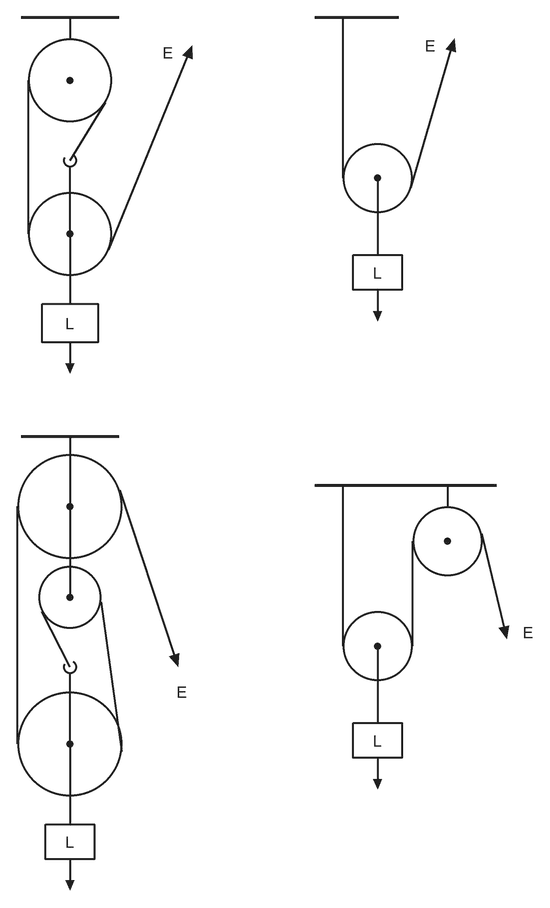
- 21 mark
Question 2
Competency: Understanding
During his experiments with a single movable pulley, Jas determined the effort, mechanical advantage and efficiency as X, Y & Z, respectively. Subsequently, after lubricating the pulley thoroughly, he recalculated the effort, MA and efficiency as X', Y' & Z' respectively. Which of the following relationships accurately represents the scenario?
- 32 marks
Question 3
Competency: Understanding & Analysis
The graph shows load against effort for a lever with load and effort on the same side of the fulcrum.
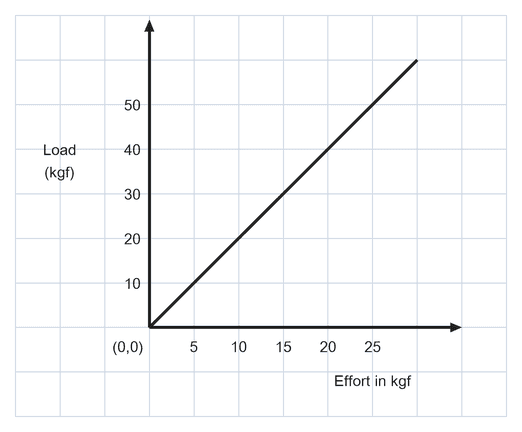
(a) Which feature of the load and effort graph must be calculated to determine mechanical advantage?
(b) Which class does this lever belong to?
- 42 marks
Question 4
Competency: Analysis & Application
Match the columns by choosing the body part and corresponding mechanical lever of the same class.
Human body part Mechanical lever i. Nodding head (a) Bottle Opener ii. Lifting body weight on your toes. (b) Tongs (c) See-Saw - 54 marks
Question 5
Competency: Analysis & Application
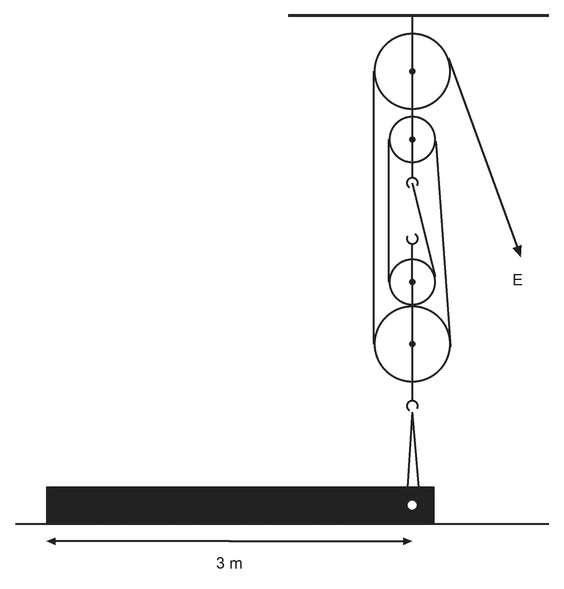
The diagram above shows a pulley used to lift an iron beam of length 3 m and weight 100 kgf, lying on the ground.
(a) Calculate the minimum effort needed to just lift the beam off the ground. [Assume no loss of energy]
(b) When the beam is being lifted from the ground, with the other end touching the ground, state with a reason whether the effort needed keeps on increasing, decreasing or remains constant.
- 61 mark
Question 6
Competency: Application & Analysis
A mechanic tests a chain hoist. When he pulls 6 m of chain through his hands, the engine block hanging from the hoist rises by 1.5 m. The engine block weighs 900 N and he has to pull with a steady force of 300 N. Which conclusion about the hoist is correct?
- 71 mark
Question 7
Competency: Application
A mason of weight 600 N stands on the ground and pulls down on a rope that passes over a single fixed pulley attached to a beam overhead. The other end of the rope is tied to a bucket of wet cement. Neglecting friction and the weight of the rope, the weight of the heaviest bucket he can raise in this way is :
- 81 mark
Question 8
Competency: Understanding
Assertion (A): A fishing rod is a useful machine even though the effort applied by the hand is greater than the weight of the fish it lifts.
Reason (R): In a machine whose mechanical advantage is less than 1, the load moves through a larger distance than the effort in the same time, so there is a gain in speed.
- 91 mark
Question 9
Competency: Understanding & Application
Assertion (A): When a load is raised through 2 m with a single movable pulley, the free end of the string has to be pulled through 1 m.
Reason (R): In a single movable pulley, the load is supported by two segments of the string.
- 102 marks
Question 10
Competency: Application
The handle of a village hand pump is a straight bar that turns about a pin. The piston rod is joined to the bar 12 cm from the pin on one side, and a girl pushes down on the bar at a point 60 cm from the pin on the other side. To raise the piston with the water above it, a force of 200 N is needed at the piston rod.

(a) Find the least effort the girl must apply. Neglect friction and the weight of the handle.
(b) If her hand moves down through 30 cm, through what distance does the piston rod rise? State what she gains and what she loses by using the handle.
- 112 marks
Question 11
Competency: Analysis & Evaluation
An advertisement for a hand winch reads: "Lifts a load of 1200 N with a pull of only 200 N. Pull just 5 m of rope to raise the load by 1 m." Use the figures in the advertisement to decide whether the claim can be true. Give a reason for your answer.
- 124 marks
Question 12
Competency: Analysis & Evaluation
Case study: A garage uses a block and tackle system with two pulleys in the fixed upper block and two pulleys in the movable lower block to lift engine parts. The effort is applied downwards. A trainee records the effort needed to raise different loads steadily:
Load (N) 200 400 600 800 Effort (N) 70 120 170 220 (a) State the velocity ratio of the system, giving a reason.
(b) Calculate the efficiency of the system for the 200 N load and for the 800 N load.
(c) The trainee writes, "The efficiency of a machine is a fixed number." Do his readings support this? Assuming that friction is negligible, use the readings to find the weight of the lower block, and explain the trend in the efficiency.
- 134 marks
Question 13
Competency: Application & Analysis
Case study: A physiotherapist explains "text neck" to a class. The head is a lever that turns about the joint at the top of the spine. The weight of the head, about 50 N, acts at a point in front of this joint. The muscles at the back of the neck pull downwards behind the joint and keep the head from dropping forward. She gives these distances, measured horizontally from the joint:
Position of the head Weight of the head acts at Neck muscles pull at Upright 2 cm in front of the joint 5 cm behind the joint Bent forward over a phone 10 cm in front of the joint 5 cm behind the joint (a) Name the class of lever formed by the head, and identify its fulcrum, load and effort.
(b) Calculate the force exerted by the neck muscles in each position.
(c) Find the mechanical advantage of this lever in each position, and use your results to explain why looking down at a phone for a long time tires the neck.
- 144 marks
Question 14
Competency: Analysis & Evaluation
Case study: Two workers on a building site each raise a bucket of sand of weight 240 N through a height of 6 m. Asif uses arrangement X, a single fixed pulley; because of friction at its axle he has to pull down with a force of 250 N. Bela uses arrangement Y, a single movable pulley of weight 20 N that turns without friction; she pulls the free end of the rope upwards.
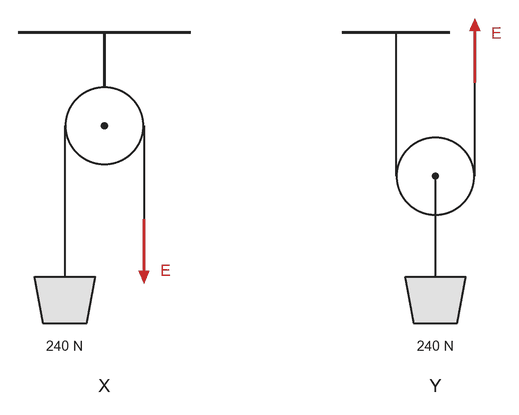
(a) Find the effort Bela applies, and the length of rope each worker has to pull.
(b) Calculate the work done by each worker and the efficiency of each arrangement.
(c) Bela says, "My arrangement is the better machine because I use about half the effort." Evaluate her claim.
- 154 marks
Question 15
Competency: Application & Creation
Case study: A student is designing a pedal bin. A straight, light bar under the bin is to work as a lever: the foot presses down on one end of the bar (the pedal), and the other end pushes a vertical rod upwards to open the lid. The design has to meet these conditions:
- the bar is 40 cm long;
- the rod needs an upward push of 8 N and must rise by 9 cm to open the lid fully;
- the pedal end can move down by only 3 cm before it touches the floor.
(a) Decide which class of lever the bar must be and where its fulcrum should be placed. Show that your design opens the lid fully.
(b) Calculate the effort the foot must apply in your design, and state whether the bar works as a force multiplier or as a speed multiplier.
(c) A classmate suggests shifting the fulcrum so that an effort of only 16 N is enough, while the lid still opens fully with 3 cm of pedal movement. Explain, with a calculation, why no position of the fulcrum can do this.
- 161 mark
Question 16
Competency: Application & Understanding
Three devices are in everyday use. P is a rope passing over a pulley fixed at the top of a school flagpole. Q is a claw hammer used to pull a nail out of a plank. R is a pair of sugar tongs used to pick up a lump of sugar.
A machine may be used to multiply the force, to change the direction of the force, or to gain speed and convenience at the cost of a larger effort. Which option states the main purpose of each device correctly?
- 171 mark
Question 17
Competency: Understanding & Analysis
A village hand pump is tested. Over 20 strokes, the total work done by the effort on the handle is 800 J, and the useful work done in lifting the water is 600 J. After many strokes the metal pivot of the handle feels warm. (Hypothetical data.)
Which statement correctly accounts for the energy and for the warm pivot?
- 181 mark
Question 18
Competency: Analysis & Application
In a hand-operated car jack the end of the handle moves along a circle of circumference 1.2 m in each full turn, and the car then rises by 3 mm. A mechanic applies a steady effort of 25 N, and the jack raises one corner of a car, which presses down on the jack with a force of 4000 N. (Hypothetical data.)
For one full turn of the handle, which option gives the velocity ratio of the jack and the energy wasted?
- 191 mark
Question 19
Competency: Analysis & Application
Two lifting machines P and Q are each built with several different velocity ratios, and the mechanical advantage of every version is measured. The best straight lines through the readings are drawn below, with one point marked on each line, together with a dashed line for an ideal machine. (Hypothetical data.)

Which statement about the graph is correct?
- 201 mark
Question 20
Competency: Application
A vegetable seller carries two baskets hung from the ends of a light bamboo pole 1.5 m long, which rests on his shoulder. The basket at one end weighs 20 kgf and the basket at the other end weighs 30 kgf. The weight of the pole can be neglected. (Hypothetical data.)
At what distance from the lighter basket must his shoulder be, so that the pole stays horizontal without any help from his hands?
- 211 mark
Question 21
Competency: Analysis
Inside a machine, a light straight lever is partly hidden behind a cover, so its fulcrum cannot be seen. A student marks two points on the visible part: the point where the effort is applied and the point where the load is attached. When the effort point is pushed upwards through 6 cm, the load point moves upwards through 2 cm. (Hypothetical data.)
Which statement about this lever is correct?
- 221 mark
Question 22
Competency: Analysis & Application
Ruchi carries a bag of weight 40 N. First she holds it in her hand, 35 cm from her elbow. Then she hangs the handle of the bag on her forearm at a point 15 cm from the elbow. In both cases her forearm is horizontal and the bag hangs vertically. The biceps muscle pulls vertically upwards on the forearm at a point 5 cm from the elbow. (Hypothetical data; neglect the weight of the forearm.)
How does the force needed from the biceps change when she moves the bag from her hand to the point 15 cm from the elbow?
- 231 mark
Question 23
Competency: Evaluation & Analysis
A load of 200 N is raised steadily through 2 m in two ways. In arrangement X the rope is simply passed over a fixed horizontal iron pipe, and the effort needed is 250 N. In arrangement Y the rope passes over a single fixed pulley that turns freely on its axle, and the effort needed is 210 N. In both cases the free end of the rope is pulled straight down. (Hypothetical data.)
Which conclusion is correct?
- 241 mark
Question 24
Competency: Understanding & Analysis
A girl raises a bucket of water steadily from a well by pulling down on a rope that passes over a single fixed pulley. The pulley turns on its axle with a little friction.
Assertion (A): The girl has to pull with a force slightly greater than the weight of the bucket of water.
Reason (R): Friction at the axle makes the velocity ratio of an actual single fixed pulley slightly less than 1.
- 251 mark
Question 25
Competency: Understanding & Analysis
Two children sit on opposite sides of the pivot of a light see-saw plank, and the plank balances in a horizontal position.
Assertion (A): The heavier child must sit nearer to the pivot than the lighter child.
Reason (R): The plank balances when the clockwise moment and the anticlockwise moment about the pivot are equal, where moment = force × perpendicular distance from the pivot.
- 262 marks
Question 26
Competency: Analysis & Application
In an experiment, a student lifts a load of 100 N steadily with a single movable pulley whose own weight is 6 N. One end of the string is tied to a rigid support and the other end is pulled vertically upwards with a spring balance, which reads 55 N. The weight of the string can be neglected. (Hypothetical data.)
(a) Find the effort that would be needed if there were no friction.
(b) How much of the 55 N effort is used to overcome friction, and what is the efficiency of the pulley?
- 272 marks
Question 27
Competency: Understanding & Application
In a godown, a bucket of grain hangs from a rope that passes over a fixed pulley A, runs level to a second fixed pulley B on the same beam, and then hangs down on the far side, as shown. A worker standing away from the bucket pulls the free end downwards.
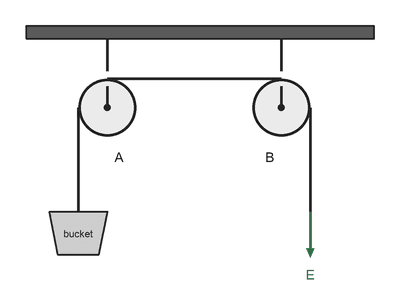
(a) State the velocity ratio and the ideal mechanical advantage of this arrangement.
(b) Give one reason why this arrangement is more convenient than a single fixed pulley fixed above the bucket.
- 282 marks
Question 28
Competency: Evaluation & Analysis
A beam balance has a light beam whose pivot is not exactly in the middle: the left arm is 24 cm long and the right arm is 25 cm long. The two pans are identical and light. A shopkeeper puts the standard 1 kg mass in one pan and flour in the other until the beam is horizontal. (Hypothetical data.)
(a) The flour is on the left pan. Find its mass.
(b) Find the mass of the flour if it is on the right pan instead. Which placement would a dishonest shopkeeper prefer?
- 292 marks
Question 29
Competency: Analysis & Evaluation
A pulley system of velocity ratio 5 lifts a load of 45 kgf when an effort of 250 N is applied. (Hypothetical data.) A student writes:
"M.A. = load ÷ effort = 45 ÷ 250 = 0.18, so efficiency = 0.18 ÷ 5 = 3.6%."
(a) Find the mistake in his working.
(b) Find the correct mechanical advantage and efficiency. (Take 1 kgf = 10 N.)
- 302 marks
Question 30
Competency: Application & Analysis
A bottle opener rests on the top of the cap at one end; this point acts as the fulcrum. The hook that lifts the rim of the cap is 1.5 cm from the fulcrum, and the hand lifts the handle at a point 9 cm from the fulcrum on the same side as the hook. A force of 54 N at the hook is needed to lift the cap, and the hand has to apply an effort of 10 N. (Hypothetical data.)
(a) State the class of the lever and find its velocity ratio from the distances.
(b) Calculate the mechanical advantage and the efficiency of the opener.
- 312 marks
Question 31
Competency: Application & Analysis
A shop demonstrates a block and tackle. When the salesman pulls the free end of the rope downwards through 4.5 m, the load rises by 0.75 m. (Hypothetical data.)
(a) Find the velocity ratio, and state how many strands of the rope hold up the load.
(b) How many pulleys does the block and tackle have in all, and how many are in each block?
- 323 marks
Question 32
Competency: Evaluation & Application
A labourer has to raise a load of 960 N through 3 m with a hand-operated lifting machine. He can pull with a force of at most 150 N, and at most 35 m of chain can be pulled. Four machines are available:
Machine V.R. Efficiency A 3 90% B 8 60% C 10 65% D 12 55% (Hypothetical data.)
For each machine find the effort needed and the length of chain to be pulled. Hence choose the machine that can do the job, and give a reason for rejecting each of the others.
- 333 marks
Question 33
Competency: Application & Analysis
A light bar 120 cm long carries a load of 60 N at its 100 cm mark. The effort is always applied at the 40 cm mark (marks measured from the left end). The bar is balanced with the fulcrum F in three positions in turn: at the 0 cm mark (a), at the 70 cm mark (b) and at the 120 cm mark (c). In (a) the fulcrum is a hinge fixed to a wall, which can hold the end of the bar down. The weight of the bar can be neglected. (Hypothetical data.)

For each position of F, state the class of the lever, its mechanical advantage and the effort needed.
- 343 marks
Question 34
Competency: Analysis & Evaluation
A load of 60 N is raised steadily in three ways: (a) with a single fixed pulley, (b) with a single movable pulley whose free end is pulled upwards, and (c) with a single movable pulley and a single fixed pulley, the free end being pulled downwards. The pulleys and the strings are light and frictionless, and the parts that are fixed hang from a strong horizontal beam. (Hypothetical data.)

Find the total downward force that the beam has to bear in each set-up, and state in which set-up the beam bears the largest force.
- 353 marks
Question 35
Competency: Analysis & Application
Anita has four pulleys, two in an upper block fixed to a beam and two in a lower block that carries a load of 600 N. She can thread one string through them in two ways. In figure (1) one end of the string is tied to the upper block, and in figure (2) it is tied to the lower block. Treat the pulleys and the string as ideal. (Hypothetical data.)
Figure (1):

Figure (2):
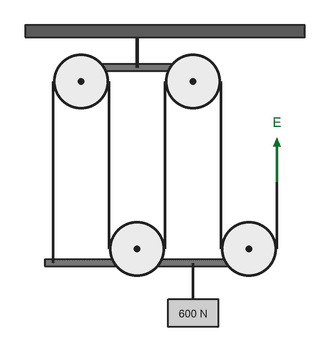
(a) Find the number of strands holding up the lower block in each arrangement.
(b) Find the velocity ratio and the ideal effort for each arrangement.
(c) Which arrangement needs the smaller effort, and why is the other still often preferred?
- 363 marks
Question 36
Competency: Analysis
A student hangs a load of 200 N at one end of a light metre rule (the 0 cm mark). A fulcrum is placed at a distance from the load, and the effort is applied downwards at the other end (the 100 cm mark). The effort needed to keep the rule horizontal is noted for different values of :
(cm) 10 20 30 40 50 Effort (N) 22 50 86 133 200 (Hypothetical data; the efforts are rounded to the nearest newton.)
(a) State the class of the lever, and say how the effort changes as the fulcrum is moved away from the load. Give the reason.
(b) For what value of is the mechanical advantage 1?
(c) Find the largest value of for which the effort is not more than 120 N.
- 374 marks
Question 37
Competency: Evaluation & Analysis
Case study: A contractor has to lift 600 N loads of tiles to a roof and wants to buy a block and tackle. An engineer tests systems with different numbers of pulleys. In every test the same load of 600 N is raised steadily, the effort is applied downwards, and the string passes round all the pulleys so that V.R. equals the number of pulleys . The efforts she records are:
Number of pulleys 2 3 4 5 6 Effort (N) 330 230 180 150 130 (Hypothetical data.)
(a) Find the velocity ratio and the mechanical advantage of the system with 4 pulleys.
(b) Calculate the efficiency of the system with 5 pulleys.
(c) The workers can pull with at most 200 N and want the highest efficiency. Which system should the contractor buy? Support your choice with calculations, and give one reason why the efficiency falls as more pulleys are used.
- 384 marks
Question 38
Competency: Application & Analysis
Case study: A well-sweep is a long pole balanced on a post and used to draw water from a well. A stone is hung at the short end of the pole and a bucket is hung from the long end. On one farm the pole is 5 m long and the post is 1.0 m from the stone end. The stone weighs 400 N. The bucket, with its rope, weighs 15 N when empty and 90 N when full of water. The weights of the pole and of the rope can be neglected. (Hypothetical data.)

(a) State the class of this lever, and name the part that is the fulcrum.
(b) Find the downward pull the farmer must apply on the bucket end to keep the full bucket at rest.
(c) Find the downward pull that just balances the stone when the bucket is empty, and explain why the stone helps in raising the full bucket but makes it harder to lower the empty one.
- 395 marks
Question 39
Competency: Creativity & Analysis
Case study: A vegetable seller in a village weighs onions on a steelyard. It is a light rod hung from a hook, which acts as the pivot. A pan hangs from the rod 5 cm to the left of the pivot, and a sliding weight called the poise can be moved along the right arm, which is 60 cm long. The rod hangs level when the pan is empty and the poise is taken off. To test the steelyard, standard masses are put in the pan, and the poise is slid along the arm until the rod is level:
Mass in the pan (kg) 1 2 4 Distance of the poise from the pivot (cm) 10 20 40 (Hypothetical data.)
(a) Name the class of this lever, and state which part acts as the fulcrum, which as the load and which as the effort.
(b) Use the readings to find the mass of the poise. What mass of onions is in the pan when the rod is level with the poise 35 cm from the pivot?
(c) The seller wants to weigh loads of up to 12 kg on the same 60 cm arm. Suggest two different changes to the steelyard that would allow this, support each with a calculation, and state one disadvantage that both changes share.
- 404 marks
Question 40
Competency: Creativity & Application
Case study: To understand why the muscles of the arm work hard, a class makes a model of the forearm. A light strip of wood 30 cm long is hinged at one end to a stand; the hinge stands for the elbow. A spring balance, which stands for the biceps muscle, pulls the strip vertically upwards at the 5 cm mark, and a weight is hung at the far end, like an object held in the hand. The balance is used to raise the strip slowly and steadily from the horizontal position, and its reading is noted for different weights:

Weight hung (N) 0.5 1.0 1.5 2.0 Reading of the balance (N) 3.1 6.1 9.2 12.1 (Hypothetical data.)
(a) Name the class of lever that the model shows, and say which part of the model is the fulcrum, the load and the effort.
(b) Using the readings for the 2.0 N weight, calculate the mechanical advantage and the efficiency of the model. The velocity ratio can be found from the distances in the figure.
(c) A student moves the spring balance to the 10 cm mark. Predict the reading for the 2.0 N weight, and say what is gained and what is lost. Which change in the model is like the muscle being attached nearer to the elbow?