
Opening your dashboard
Class 10 Maths Chapter 21 Trigonometrical Identities: Competency-Based Questions (CBQ)
40 questions on Chapter 21, each worked through on its own page with the AI tutor. Class 10 Maths, ICSE 2026-27.
40 questions
1–5 marks · Mixed difficulty
- 11 mark
Question 1
Competency: Understanding & Analysis
A slope-measuring app on a phone shows the sine and cosine of the angle that a hillside makes with the horizontal, where is acute. Only one of the following displays can be correct. Which one?
- 21 mark
Question 2
Competency: Analysis
In , .
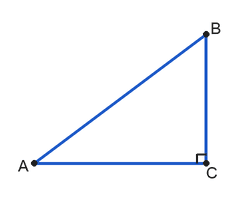
Which of the following is, in general, not equal to ?
- 31 mark
Question 3
Competency: Application
A tin roof rises 3 m for every 4 m of horizontal run.

If is the angle that the roof makes with the horizontal, then is equal to :
- 41 mark
Question 4
Competency: Understanding & Analysis
Assertion (A) : For every acute angle , .
Reason (R) : Dividing both sides of by gives .
- 51 mark
Question 5
Competency: Understanding & Evaluation
Naina claims that , because is twice . Which of the following is the quickest correct reason, using no tables, to reject her claim?
- 61 mark
Question 6
Competency: Application & Analysis
If is a number such that and are acute angles and , then is :
- 72 marks
Question 7
Competency: Application
A rafter of a roof is 6·5 m long and makes an acute angle with the horizontal, where . Using the relations between ratios (without drawing a triangle), find and . Hence find how high the top of the rafter is above its lower end.
- 82 marks
Question 8
Competency: Analysis & Evaluation
Aarav simplifies as shown.
Step 1 :
Step 2 :
His teacher says the answer is wrong. Find the step in which the mistake first occurs, and give the correct simplification in terms of only.
- 92 marks
Question 9
Competency: Understanding & Application
Sia says that in every triangle ABC, .
Is Sia right? Give a reason, and check it for a triangle with and .
- 102 marks
Question 10
Competency: Understanding & Application
For an acute angle , . Reema finds by drawing a right triangle. Sameer finds it by using .
Find by Sameer's method. Why does he take only the positive square root?
- 113 marks
Question 11
Competency: Understanding & Analysis
Karan proves that . He forgets to write the reasons for Steps 2, 3 and 4. Supply them.
Step 1 : L.H.S. [writing and in terms of and ]
Step 2 :
Step 3 :
Step 4 :
Step 5 : R.H.S.
- 123 marks
Question 12
Competency: Analysis & Evaluation
Ritu says, "The value of is the same for every acute angle ."
(a) Show that she is right and find the constant value.
(b) Check your result by working out the expression directly for .
- 133 marks
Question 13
Competency: Creativity
Frame a problem. Write a short real-life word problem (for example about a roof, a ramp or a ladder) in which the only information about the angle is the value of for an acute angle (one length may also be given), and the answer is found with the help of the identity . The answer must be a single exact number. Then solve your own problem.
- 145 marks
Question 14
Competency: Application & Analysis
Case study: A skate park builds a straight ramp. The ramp rises 3 m over a horizontal run of 5 m, and is the angle it makes with the ground.

Meena has only this part of a table of natural trigonometric values (correct to four decimal places).
Angle sin cos tan 0·4695 0·8829 0·5317 0·4848 0·8746 0·5543 0·5000 0·8660 0·5774 0·5150 0·8572 0·6009 0·5299 0·8480 0·6249 0·5446 0·8387 0·6494 (a) Find for the ramp. From the table, read the angle to the nearest degree.
(b) For , use the table values to check that is very close to 1, and that is very close to . (Work to 4 decimal places.)
(c) The table has no entry for . Use complementary angles to find and from it. (Give to 3 decimal places.)
- 155 marks
Question 15
Competency: Analysis & Evaluation
Case study: A carpenter wants right-angled triangular frames whose three sides are all whole numbers. She picks two whole numbers and an acute angle with
(a) Use to show that .
(b) For and , find , and .
(c) She needs a frame with . Find whole numbers and that give this value, then find and check your answer with .
- 161 mark
Question 16
Competency: Understanding & Analysis
A ladder leaning against a wall makes an acute angle with the ground. Working from the ladder's measurements, Kavya finds that . What is the value of ?
- 171 mark
Question 17
Competency: Understanding & Analysis
Ishaan lists four values that his calculator might give for ratios of acute angles. Only one of them can never be the value of a trigonometrical ratio of any acute angle. Which one?
- 181 mark
Question 18
Competency: Application
Each step of a flight of wide garden steps rises 15 cm and goes 36 cm forward. The straight line through the front edges of the steps makes an acute angle with the ground. (Hypothetical data.) What is the value of ?
- 191 mark
Question 19
Competency: Application & Analysis
A road sign gives the gradient of a hill road as : the road rises metres for every 1 metre of horizontal distance. So, if is the acute angle that the road makes with the horizontal, then . Which expression gives , the rise for every 1 metre travelled along the road?
- 201 mark
Question 20
Competency: Analysis & Evaluation
Meera tests three statements for every acute angle .
Statement 1 :
Statement 2 :
Statement 3 :
Which of the following is correct?
- 211 mark
Question 21
Competency: Understanding & Analysis
Assertion (A) : For every acute angle , .
Reason (R) : is the ratio of the hypotenuse to the side opposite the angle .
- 221 mark
Question 22
Competency: Application
A table of natural sines gives and . Within one degree the sine rises almost evenly, in proportion to the angle. What is the best estimate of ?
- 231 mark
Question 23
Competency: Analysis
The pitch of a roof is an acute angle . A builder's app shows that for this roof. Which of the following must be true?
- 241 mark
Question 24
Competency: Evaluation
Assertion (A) : .
Reason (R) : .
- 251 mark
Question 25
Competency: Application & Analysis
For an acute angle , . Without finding or drawing a triangle, find the value of
- 262 marks
Question 26
Competency: Application & Evaluation
Two footpaths go up the same hill. On path P, a walker who covers 13 m along the path rises 5 m. On path Q, a walker who covers 5 m horizontally rises 3 m. (Hypothetical data.)
Which path makes the greater angle with the horizontal? Show how you decided.
- 272 marks
Question 27
Competency: Analysis
Without using tables, arrange the following in ascending order (smallest first):
, , ,
- 282 marks
Question 28
Competency: Creativity
Design a test.
(a) Write an equation in that is a trigonometric identity (true for every acute angle ), other than the three square relations, and prove it.
(b) Write an equation that is true for but is not an identity, and show an acute angle for which it fails.
- 292 marks
Question 29
Competency: Understanding & Application
Sana needs the acute angle for which , but she has only a table of natural sines. Her table shows and .
(a) Find .
(b) Find , correct to 3 decimal places.
- 302 marks
Question 30
Competency: Analysis & Evaluation
Without using tables, decide whether is less than 1 or more than 1. Give a reason that uses an identity.
- 312 marks
Question 31
Competency: Analysis & Evaluation
Divya simplifies for an acute angle as follows.
Line 1 :
Line 2 :
Line 3 :
Line 4 :
(a) In which line does her first mistake occur? Explain what is wrong.
(b) Find the correct value of the expression.
- 323 marks
Question 32
Competency: Analysis
In a phone game, a throw made at an acute angle earns the score . (The scoring rule is hypothetical.)
(a) Use an identity to show that .
(b) Arjun scores . Find his angle .
(c) Riya says that with the right angle she can score . Is she right? Give a reason.
- 333 marks
Question 33
Competency: Application & Analysis
Three students each describe the acute angle of their own model ramp by giving one ratio. (Hypothetical data.)
- Asha:
- Bala:
- Charu:
(a) Show that Asha's and Bala's ramps make the same angle.
(b) Does Charu's ramp make the same angle? Explain, and say how her angle is related to Asha's.
(c) Without finding any angle, find the cosecant of Charu's angle.
- 343 marks
Question 34
Competency: Analysis & Evaluation
Aarti prepares a table of the ratios of four acute angles. Exactly one row contains a wrong entry. (Hypothetical data.)
Row 1 2 3 4 (a) Which row is wrong? Show the check that exposes it.
(b) In that row, the check looks fine. Explain why this check did not catch the error.
(c) Write the correct entry and the value of for that row.
- 353 marks
Question 35
Competency: Creativity
Frame a problem. Write a short real-life problem in which a student has a card of sine and cosine values only for angles from to , but needs the sine of an angle larger than . The solution must use the complementary-angle rule, and you must give your own card values and the final answer.
- 363 marks
Question 36
Competency: Application
A workshop shelf rests on a triangular steel bracket. The bracket's horizontal arm under the shelf is 56 cm long, its vertical arm against the wall is 33 cm long, and a straight brace joins the free ends of the two arms. Let be the angle between the brace and the horizontal arm. (Hypothetical data.)
(a) Find the length of the brace, and then find and .
(b) Verify that for this bracket.
(c) The brace makes an angle of with the wall. Write down without measuring that angle.
- 375 marks
Question 37
Competency: Application & Analysis
Case study: A cycling club measures three sections of a road. For each section, the rise in height is given for every 100 m of road length. (Hypothetical data.)
Section P Q R Rise per 100 m of road m m m The club has this part of a table of natural sines and cosines.
(a) Find the angle that each section makes with the horizontal, to the nearest degree.
(b) For section R, find the horizontal distance covered per 100 m of road. By how much is it shorter than the road length?
(c) A sign says that no section may make an angle of more than with the horizontal. A new section rises 15 m per 100 m of road. Using only the table, decide whether it breaks the rule.
- 384 marks
Question 38
Competency: Application & Analysis
Case study: A builder is planning the roof of a house 8 m wide. Each sloping rafter covers half the width, 4 m, horizontally, and rises to the ridge at the pitch angle with the horizontal. The builder has this part of a table of natural values. (Hypothetical data.)
(a) Find the height of the ridge above the lower ends of the rafters for a pitch of and for a pitch of (in metres, correct to 2 decimal places).
(b) Find the length of one rafter for a pitch of , correct to 2 decimal places.
(c) The owner wants the ridge exactly 3 m above the lower ends of the rafters. Find , use the identity to find the rafter length without finding , and say between which two pitches in the table this roof lies.
- 395 marks
Question 39
Competency: Application & Evaluation
Case study: A playground swing hangs by a chain PS of length 2·5 m from a fixed pivot P. The figure shows the chain when the seat S has swung to one side. H is the point on the vertical through P that is level with the seat, and is the angle between the chain and the vertical. (Hypothetical data.)
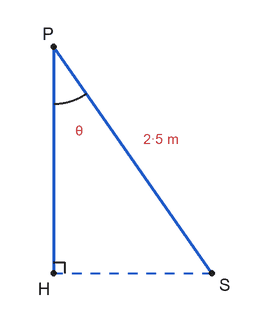
(a) At one instant the seat is 2·4 m below the pivot. Find , and , and the horizontal distance HS of the seat from the vertical through P.
(b) At the highest point of the swing the seat is 1·8 m to one side of the vertical. Find there, and how far below P the seat is (correct to 2 decimal places).
(c) The playground rule says that the chain must never swing more than from the vertical. Use to decide if the swing obeys the rule at its highest point.
- 404 marks
Question 40
Competency: Analysis & Evaluation
Case study: Zoya makes a table of the ratios of four acute angles, correct to 4 decimal places.
(a) Which of the three ratios increase and which decrease as goes from to ?
(b) Use the table to show that , and find both values correct to 2 decimal places.
(c) Explain, using a right triangle, why can never be more than 1 but can be larger than any number. Between which two table angles does become 1, and what is that angle?