
Opening your dashboard
Class 10 Chemistry Chapter 2 Chemical Bonding: Competency-Based Questions (CBQ)
40 questions on Chapter 2, each worked through on its own page with the AI tutor. Class 10 Chemistry, ICSE 2026-27.
40 questions
1–5 marks · Mixed difficulty
- 11 mark
Question 1
Cognitive domain: Understanding & Application · CISCE Competency-Focused Practice Questions 2024, Q9
Element Y is in Group IIA of the Periodic Table. Y reacts with element Q to form an ionic compound. Which equation shows the process that takes place when Y forms ions?
- 21 mark
Question 2
Cognitive domain: Recall & Understanding · CISCE Competency-Focused Practice Questions 2024, Q13
Which element forms a stable ion with the same electronic configuration as argon?
- 31 mark
Question 3
Cognitive domain: Recall & Application · CISCE Competency-Focused Practice Questions 2024, Q19
Given below are four covalent molecules.
A:
B:
C:
D:
Which of the following represents the correct order when they are arranged in their increasing number of covalent bonds?
- 41 mark
Question 4
Cognitive domain: Application & Analysis · CISCE Competency-Focused Practice Questions 2024, Q23
Ramu makes a detailed study on the values of electronegativity and the formation of compounds. Accordingly, he draws the following conclusion:
The larger the electronegativity (EN) difference between the combining atoms, the more ionic bonds will form.
If the EN difference is negligible, covalent bonds will form. So, which of the following values refers to covalent bonds?
P: 3.0 and 3.0
Q: 0.9 and 3.0
- 51 mark
Question 5
Cognitive domain: Understanding & Application · CISCE Competency-Focused Practice Questions 2024, Q30
The electronic configuration of X is 2,8,6. It gains 'Y' electrons into its valence shell to attain the nearest noble gas electronic configuration and gets converted to an ion Z.
X, Y, and Z, respectively, are:
- 61 mark
Question 6
Cognitive domain: Understanding · CISCE Competency-Focused Practice Questions 2024, Q44
Fill in the blanks:
Cations are ________ (oxidised / reduced) ions due to the ________ (gain / loss) of electrons by the neutral atom.
- 75 marks
Question 7
Cognitive domain: Understanding & Application · CISCE Competency-Focused Practice Questions 2024, Q58
Match the column A with column B:
Column A Column B (a) Neon (i) Ammonium ion (b) Methane (ii) Hydronium ion (c) Ammonia gas in water (iii) Magnesium hydroxide (d) An ion with a lone pair of electrons (iv) Non-polar covalent compound (e) A weak electrolyte (v) Zero electron affinity - 81 mark
Question 8
Cognitive domain: Application · CISCE Competency-Focused Practice Questions 2024, Q71
Magnesium ribbon is added to dilute . A gas is liberated along with the formation of a compound. Draw an electron dot diagram to show the structure of the compound that is formed.
- 91 mark
Question 9
Cognitive domain: Recall & Application · CISCE Competency-Focused Practice Questions 2024, Q73
Calcium hydroxide dissolves in water and forms a positive ion and a negative ion. Draw the structure of the negative ion.
- 101 mark
Question 10
Cognitive domain: Understanding · CISCE Competency-Focused Practice Questions 2024, Q75
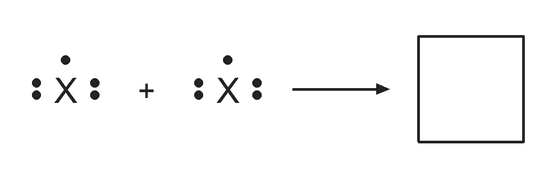
The equation given above represents the molecule formation of element X. Fill in the box with the electron dot structure of the molecule.
- 113 marks
Question 11
Cognitive domain: Understanding & Application · CISCE Competency-Focused Practice Questions 2024, Q120
Atomic number of element M is 12 and it forms an ionic compound with element L.
(a) Which of the following atomic numbers will match L?
(i) 14
(ii) 10
(iii) 8
(b) What is the name given to the members of the group to which element M belongs?
(c) Draw the electron dot structure of the compound formed between M and L.
- 121 mark
Question 12
Cognitive domain: Understanding
Naphthalene is a covalent compound of carbon and hydrogen. Rock salt is sodium chloride.
Assertion (A): Naphthalene balls kept in a cupboard slowly become smaller and finally disappear, but a lump of rock salt kept in the same cupboard stays unchanged for years.
Reason (R): The molecules of a covalent solid are held together by weak forces, while the ions of an electrovalent solid are held together by strong electrostatic forces.
- 131 mark
Question 13
Cognitive domain: Analysis
Kerosene is a mixture of covalent compounds of carbon and hydrogen.
Assertion (A): Kerosene spilt on a rain puddle does not dissolve in the water; it stays as a separate layer.
Reason (R): Covalent compounds have low melting points and low boiling points.
- 142 marks
Question 14
Cognitive domain: Creativity
For the school science exhibition, Zoya has to explain to Class 8 visitors how a coordinate bond differs from an ordinary covalent bond. She wants to use an everyday situation instead of electron dot diagrams.
(a) Devise an everyday analogy that shows both kinds of bond. Make clear what stands for the shared pair of electrons, and who is the 'donor' and who is the 'acceptor'.
(b) State one way in which your analogy falls short of what really happens when a hydronium ion is formed.
- 154 marks
Question 15
Cognitive domain: Application
During a summer heat wave, the health centre in Meena's village gives out packets of oral rehydration salts (ORS). The label lists, among other things, glucose, sodium chloride and potassium chloride, to be dissolved in one litre of clean drinking water. Meena, a Class 10 student, wonders what is actually present in the clear solution. In the school laboratory she dissolves a little of each substance separately in distilled water and tests each solution in a circuit with a 6 V battery, a bulb and two graphite electrodes. Glucose is a covalent compound made of molecules, and it does not ionise in water.
Solution in distilled water Bulb Glucose does not glow Sodium chloride glows Potassium chloride glows (a) Name the particles of the dissolved substance that are present in the sodium chloride solution and in the glucose solution.
(b) Dry sodium chloride crystals from the packet do not make the bulb glow, but their solution does. Explain what water does to the crystals, and write the equation for the change.
(c) Meena now dissolves a whole packet of ORS in water and tests the solution. Predict what she observes, and state which of the three substances carry the current and which does not. Give a reason.
- 164 marks
Question 16
Cognitive domain: Analysis
Farhan is a trainee at his town's water-testing laboratory, where samples are checked for chloride. He adds a few drops of silver nitrate solution to each sample. Silver ions combine with chloride ions to give a white precipitate of silver chloride, which is insoluble in water. To understand the test better, he tries it on some laboratory liquids as well. Carbon tetrachloride is a covalent liquid whose molecule contains four chlorine atoms. Hydrogen chloride is a covalent gas, and its solution in water is hydrochloric acid.
Sample On adding silver nitrate solution Common salt solution thick white precipitate at once Tap water faint white cloudiness at once Carbon tetrachloride no precipitate; two separate layers Dilute hydrochloric acid thick white precipitate at once (a) Write the ionic equation for the formation of the precipitate. What does the result for tap water show?
(b) A carbon tetrachloride molecule contains four chlorine atoms, yet the liquid gives no precipitate and forms a separate layer. Account for both observations.
(c) Hydrogen chloride is covalent, like carbon tetrachloride, but hydrochloric acid gives the precipitate. Explain the difference with the help of an equation, and state why the precipitate appears at once.
- 175 marks
Question 17
Cognitive domain: Evaluation
While revising, Ishaan writes this in his notebook:
"Chlorine has seven valence electrons, so it always gains one electron from the other atom. Therefore every chloride is an electrovalent compound."
His teacher gives him the following data on the chlorides of four elements of Period 3 and asks him to test his claim.
Element (number of valence electrons) Chloride State at room temperature Melting point (°C) Does the liquid chloride conduct electricity? Sodium (1) solid 801 yes Magnesium (2) solid 714 yes Silicon (4) liquid −69 no Phosphorus (5) liquid −94 no (a) Which chlorides in the table support Ishaan's claim? Give two pieces of evidence from the table.
(b) Which chlorides go against his claim? State the type of bonding in them and the evidence for it.
(c) Explain why silicon and phosphorus do not transfer their valence electrons to chlorine, although sodium and magnesium do.
(d) Judge Ishaan's claim, and rewrite it so that it is correct.
- 181 mark
Question 18
Cognitive domain: Understanding
In a class game, Tara holds five 'ion cards': , , , and . She must pick every card whose ion has the same electron arrangement as a neon atom. (Atomic numbers: O = 8, Na = 11, Mg = 12, Al = 13, Cl = 17.)
How many cards should she pick?
- 191 mark
Question 19
Cognitive domain: Application
Aluminium pans stay shiny because a thin, hard layer of aluminium oxide, , forms on them when aluminium (electronic configuration 2, 8, 3) reacts with the oxygen (2, 6) of the air.
How many electrons are transferred in the formation of one formula unit of aluminium oxide?
- 201 mark
Question 20
Cognitive domain: Evaluation
When a magnesium ribbon burns in oxygen, each magnesium atom (atomic number 12) changes into a magnesium ion. Four students describe this change.
Asha: 'The atom gains two electrons, so the ion has 14 electrons and a charge of 2−.'
Binu: 'The ion has 12 protons and 12 electrons, so it is neutral, just like the atom.'
Chitra: 'The atom loses two protons, so the ion has 10 protons and 10 electrons.'
Dev: 'The ion has 12 protons and 10 electrons. The atom has lost electrons, so it is oxidised.'
Which student is correct?
- 211 mark
Question 21
Cognitive domain: Application
Carbon disulphide, , is a covalent liquid used in making viscose rayon. In its molecule a carbon atom (electronic configuration 2, 4) is joined to two sulphur atoms (2, 8, 6), and every atom completes its octet.
Which description of a molecule of carbon disulphide is correct?
- 221 mark
Question 22
Cognitive domain: Analysis
In a fume cupboard, a student heats a small sample of a white solid P slowly in a boiling tube that stands in an oil bath on a hot plate, stirring it gently, and records its temperature every minute. The readings are plotted below. (Hypothetical data.)
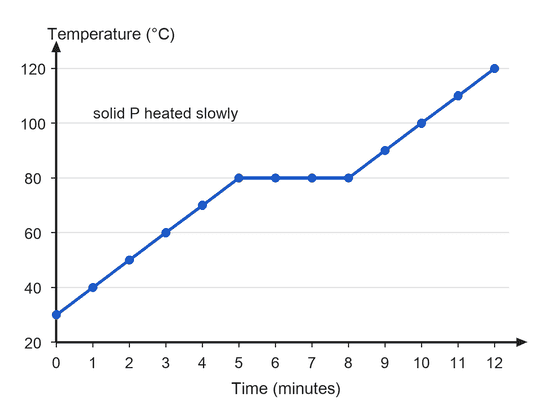
She has four labelled bottles from which P may have come. The melting points are: sodium chloride 801 °C, naphthalene 80 °C, magnesium oxide 2852 °C and calcium chloride 772 °C.
Which statement about P is correct?
- 231 mark
Question 23
Cognitive domain: Application
Carbon tetrachloride, , was once used as a dry-cleaning liquid. Carbon has the configuration 2, 4 and chlorine has 2, 8, 7. In the molecule, carbon is joined to four chlorine atoms by single covalent bonds.
How many lone pairs of electrons are present in the whole molecule, counting the lone pairs on all five atoms?
- 241 mark
Question 24
Cognitive domain: Analysis
Marsh gas is mostly methane, . Bubbles of marsh gas rise through the acidic water of a pond, which contains hydrogen ions. The gas does not combine with the hydrogen ions. (Atomic numbers: H = 1, C = 6.)
Assertion (A): A methane molecule does not form a coordinate bond with a hydrogen ion in the pond water.
Reason (R): All four outer electrons of the carbon atom in methane are used in shared pairs, so the carbon atom has no lone pair to donate.
- 251 mark
Question 25
Cognitive domain: Analysis
Sodium chloride is melted in a crucible and two graphite rods, joined to a battery and a bulb, are dipped into the molten liquid. The bulb glows.
Assertion (A): Molten sodium chloride conducts electricity.
Reason (R): Molten sodium chloride contains free electrons that carry the current.
- 261 mark
Question 26
Cognitive domain: Application
Calcium (atomic number 20) reacts with a non-metal G to form an electrovalent compound of formula . The ion of G has the same electron arrangement as an inert gas.
What is the electronic configuration of an atom of G?
- 272 marks
Question 27
Cognitive domain: Understanding
Lithium fluoride is added to some special glass and ceramic mixtures. It is formed when lithium (atomic number 3) combines with fluorine (atomic number 9).
(a) Write the equations for the formation of the two ions, and give the electron arrangement of each ion and the noble gas it resembles.
(b) The lithium ion does not have eight electrons in its outer shell, yet it is stable. Explain why.
- 282 marks
Question 28
Cognitive domain: Creativity
Mr Rao asks his Class 10 students to build a bead model that shows how calcium fluoride is formed from calcium (2 outer electrons) and fluorine (7 outer electrons). The class has red beads, blue beads, coloured thread and card.
(a) Describe your model: how many atoms of each element you would use, what the beads stand for, and how you would show what happens to the electrons.
(b) State one way in which your model could mislead a viewer.
- 292 marks
Question 29
Cognitive domain: Application
Phosphorus trichloride, a liquid used to make other chemicals, is a covalent compound. Phosphorus has the configuration 2, 8, 5 and chlorine has 2, 8, 7.
(a) Draw the electron dot structure of a molecule of phosphorus trichloride, showing the electrons of phosphorus as dots and those of chlorine as crosses.
(b) How many lone pairs does the phosphorus atom have in the molecule?
- 302 marks
Question 30
Cognitive domain: Application
A pack of moth balls was spilled into a tin of common salt. The moth balls are made of naphthalene, a covalent compound. Meera has a hot plate, a china dish, a glass funnel, filter paper and clean water, and wants to get the salt back free from naphthalene.
(a) Suggest a method that uses only heat and a cool surface, and explain why it works.
(b) Suggest a second method that uses water, and explain why it works.
- 312 marks
Question 31
Cognitive domain: Analysis
A water molecule can take up a hydrogen ion to form a hydronium ion. (Atomic numbers: H = 1, O = 8.)
(a) Complete the table for the oxygen atom in each particle.
Water molecule Hydronium ion Shared pairs on oxygen Lone pairs on oxygen Total electrons around oxygen (b) Explain why oxygen has the same total number of electrons around it in both particles, even though it forms an extra bond in the hydronium ion.
- 322 marks
Question 32
Cognitive domain: Understanding
In the school laboratory, a few violet-black crystals of iodine are shaken with water in one test tube and with carbon tetrachloride in another. In water the crystals dissolve only a little and give a pale brown liquid. In carbon tetrachloride they dissolve easily and give a deep violet solution. Iodine is a covalent substance made of molecules.
(a) Explain why iodine dissolves much better in carbon tetrachloride than in water.
(b) Sodium iodide, an electrovalent compound, is shaken with each liquid in the same way. Predict what you will see in each case, giving a reason.
- 333 marks
Question 33
Cognitive domain: Application
Sodium sulphide is used in leather factories to remove hair from animal hides. It is an electrovalent compound formed from sodium (electronic configuration 2, 8, 1) and sulphur (2, 8, 6).
(a) Write the equations for the formation of the two ions.
(b) Explain, in terms of electrons, why the formula of sodium sulphide is .
(c) Find the total number of electrons in the ions of one formula unit of sodium sulphide, and name the noble gas that each kind of ion resembles. (Atomic numbers: Na = 11, S = 16.)
- 343 marks
Question 34
Cognitive domain: Analysis
The energy needed to break the bonds in one mole of a diatomic molecule is a measure of how strong the bond is. A teacher gives these approximate values for three gases. (Atomic numbers: F = 9, O = 8, N = 7.)
Molecule Energy to break the bond (kJ per mole, approximate) Fluorine, 158 Oxygen, 498 Nitrogen, 945 (a) For each molecule, state the number of shared pairs and the number of lone pairs on each atom.
(b) Describe the pattern between the number of shared pairs and the energy needed to break the bond.
(c) The nitrogen of the air hardly reacts with other substances at room temperature. Use the data to suggest a reason, and say how many times more energy is needed to break the bond in nitrogen than in fluorine.
- 353 marks
Question 35
Cognitive domain: Application
Magnesium metal is made in industry by passing electricity through molten magnesium chloride between two inert electrodes. Solid magnesium chloride does not conduct, but the molten salt does.
(a) Name the ions present in the molten salt, and state to which electrode each kind of ion moves.
(b) Write the equation for the change at each electrode, showing the electrons.
(c) State which change is oxidation and which is reduction, and give a reason for each.
- 363 marks
Question 36
Cognitive domain: Evaluation
Aarav draws the electron dot diagram of the ammonium ion present in the fertiliser ammonium chloride. (Atomic numbers: N = 7, H = 1.) He draws an arrow from the hydrogen ion to the nitrogen atom to show the coordinate bond, and writes: 'The hydrogen ion donates its pair of electrons to nitrogen.'
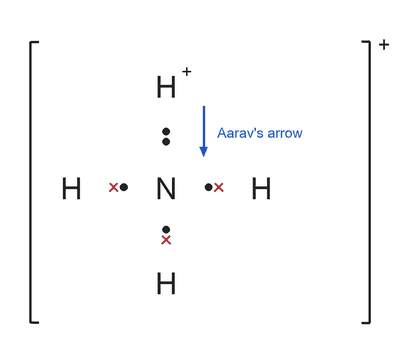
(a) Is Aarav's statement correct? Support your answer by counting the electrons of the hydrogen ion.
(b) Write the correct statement, and say how the arrow should be drawn.
(c) How many of the four N–H bonds in the ion are coordinate bonds, and can they be told apart from the others once the ion has formed?
- 373 marks
Question 37
Cognitive domain: Analysis
A chemistry club tests how the difference in electronegativity (EN) of two atoms decides the kind of bond between them. The rule it uses is: a difference above about 1.7 gives an ionic bond, a difference between 0 and 1.7 gives a polar covalent bond, and a difference of 0 gives a non-polar covalent bond. The approximate EN values are: potassium 0.8, hydrogen 2.1 and bromine 2.8.
(a) Find the EN difference in potassium bromide, hydrogen bromide and bromine, and state the type of bond in each.
(b) Which of the three has the highest melting point? Give a reason.
(c) Say which of the three conduct electricity when melted or when dissolved in water. Give the reason for each.
- 385 marks
Question 38
Cognitive domain: Analysis
At a village water-testing camp, a technician explains that a conductivity meter reads higher when a water sample holds more free ions. To show this, she mixes sea water with distilled water in different proportions and reads the meter for each mixture. She also measures water from the village hand pump. Sea water is rich in dissolved sodium chloride and other ionic salts. (Hypothetical data.)
Share of sea water in the mixture (%) 100 50 25 10 Meter reading (µS/cm) 52000 26100 13000 5250 Water from the hand pump reads 620 µS/cm.
(a) Calculate the reading per one per cent of sea water for each mixture, and state what it shows.
(b) Explain in terms of ions why the reading falls as the sea water is diluted.
(c) Use your result in (a) to estimate what share of sea water would give the hand-pump reading, and state what this tells you, and what it does not tell you, about the hand-pump water.
- 394 marks
Question 39
Cognitive domain: Evaluation
Roopa's teacher asks the class to show the formation of magnesium oxide, the white powder left when a magnesium ribbon burns, with an electron dot diagram. Magnesium has atomic number 12 and oxygen has atomic number 8. Roopa draws the diagram below and writes under it: 'Magnesium and oxygen share two pairs of electrons, so every atom has eight electrons.' Her teacher says that the diagram is wrong in more than one way.
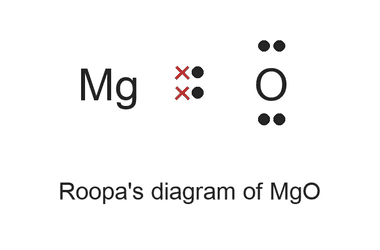
(a) State two errors in Roopa's diagram and statement.
(b) Draw the correct electron dot diagram of magnesium oxide.
(c) Give the electron arrangement of each ion in magnesium oxide and name the noble gas that each ion resembles.
- 404 marks
Question 40
Cognitive domain: Creativity
Anaya's class is making a wall chart called 'Bonding in my kitchen'. For each item, the chart must show the type of bonding it contains and one property that a visitor could check safely at home. The shortlist is common salt, candle wax, pure water and cooking gas (mainly methane). The class has a battery-and-bulb tester, glasses, spoons and clean water, and follows one safety rule: nothing is ever tasted.
(a) State the type of bonding in each of the four items, with a reason.
(b) Design a safe home check that tells common salt from candle wax, and state what a visitor should see in each case.
(c) Create a short slogan for the chart that helps visitors remember the difference between electrovalent and covalent compounds, and explain in one sentence why it is correct.