
Opening your dashboard
Class 10 Biology Chapter 9 The Excretory System: Competency-Based Questions (CBQ)
40 questions on Chapter 9, each worked through on its own page with the AI tutor. Class 10 Biology, ICSE 2026-27.
40 questions
1–5 marks · Mixed difficulty
- 11 mark
Question 1
Cognitive domain: Application
A small stone blocks Mr. Khan's common bile duct, so bile juice can no longer reach his duodenum. Within a few days his faeces lose their usual yellowish brown colour and turn pale. Which waste is failing to reach his intestine ?
- 21 mark
Question 2
Cognitive domain: Analysis
The figure shows one kidney tubule. The arrows show the direction in which the fluid flows. Tiny samples of the fluid were collected at the points P, Q, R and S.

For every mL of fluid passing P, only about mL was left at Q. Which part lies between P and Q, and which activity explains this fall ?
- 31 mark
Question 3
Cognitive domain: Application
Meera travels for eight hours in a bus on a warm day and drinks no water on the way. When she reaches home she passes only a little urine, and it is darker than usual. Which change in her body best explains this ?
- 41 mark
Question 4
Cognitive domain: Analysis
At a health camp, the urine of four persons P, Q, R and S was tested for abnormal constituents.
Person Glucose Albumin Blood Bile pigments P Absent Present Absent Absent Q Present Absent Absent Absent R Absent Absent Present Absent S Absent Absent Absent Present From the causes of these conditions given in your chapter, whose report could be the result of high blood pressure ?
- 51 mark
Question 5
Cognitive domain: Understanding
Assertion (A): The liver is counted among the accessory excretory organs although no urine is formed in it.
Reason (R): The liver detoxifies ammonia by converting it into urea, which is then excreted through urine.
- 61 mark
Question 6
Cognitive domain: Understanding
Assertion (A): The blood in the efferent arteriole is thicker than the blood in the afferent arteriole of the same Malpighian capsule.
Reason (R): After leaving the Bowman's capsule, the efferent arteriole breaks up into a secondary capillary network around the renal tubule.
- 71 mark
Question 7
Cognitive domain: Application
Both the kidneys of Mr. Rao are permanently damaged. Twice a week his blood is led from the radial artery of his arm through an artificial kidney, which does the cleaning work that his own kidneys can no longer do, and is then returned to a vein of the same arm.
So the blood going back into his arm is like the blood in the renal ______ of a healthy person, and if he keeps missing his sessions, ______ will collect in his blood to a poisonous level.
- 81 mark
Question 8
Cognitive domain: Analysis
A dietician recorded the water gained by Mr. Iyer on a day of rest: mL from drinks and mL from food. His total loss that day in urine, sweat, breath and faeces was mL, and the amount of water in his body did not change.
The remaining ______ mL of his water gain was metabolic water, which is a product of ______.
- 91 mark
Question 9
Cognitive domain: Understanding
When a speck of dust enters Anu's eye, tears wash it out and keep the eye moist. Her urine, however, carries only substances that are of no further use or are harmful to her body.
So giving out tears is an example of ______, while passing out urine is an example of ______.
- 102 marks
Question 10
Cognitive domain: Application
Mr. Verma's report shows excessive uric acid in his body. His doctor says this explains the pain in the joints of his toes, and warns him that a second problem may arise in his urinary system.
Explain the cause of the joint pain, and name the second problem with a reason.
- 112 marks
Question 11
Cognitive domain: Evaluation
Aman writes in his notebook: "The glomerular filtrate and urine are the same liquid, because both are made by the kidney from blood."
Do you agree with Aman ? Justify your answer with two pieces of evidence.
- 122 marks
Question 12
Cognitive domain: Analysis
Two healthy cousins gave urine samples for a routine check-up. For the past week one of them had been eating mostly eggs, paneer and dal, and the other mostly vegetables.
Sample pH X 5.4 Y 7.6 Which sample belongs to which cousin ? Give a reason, and state whether either value should worry them.
- 135 marks
Question 13
Cognitive domain: Application
Case: Mr. Das had a sudden sharp pain in his side. A scan showed a stone, marked X in the figure, stuck in one of the tubes B. His urine was reddish. After two days the stone slipped down into C, and later it passed out of his body.
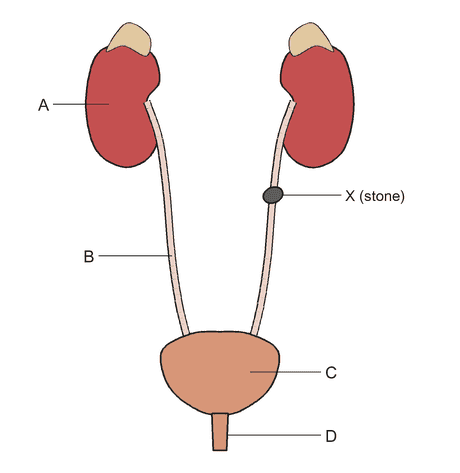
(a) Name the tube B. State the two things that normally move urine down this tube.
(b) Even while the stone was stuck, urine kept collecting in C. Explain why.
(c) Name the abnormal constituent that made the urine reddish, and the term for this condition.
(d) Describe how the stone, once inside C, passed out of the body. Name the part D and the muscle that had to relax.
- 144 marks
Question 14
Cognitive domain: Evaluation
Case: A science club wanted to test whether tea is a diuretic. Fifteen adult volunteers emptied their bladders and were then put into three groups. All of them sat in the same room for the next two hours, and the urine each one passed in that time was measured.
Group Drink given Number of volunteers Average urine passed in 2 hours (mL) 1 mL plain water 5 300 2 mL tea 5 420 3 No drink 5 90 (a) What is a diuretic ? Which two groups must be compared to decide whether tea is a diuretic, and why ?
(b) Calculate how much more urine Group 2 passed than Group 1, in mL and as a percentage of Group 1. Does the result support the idea that tea is a diuretic ?
(c) The club's report ends: "This experiment proves that tea lowers the secretion of ADH." Is this conclusion justified by the data ? Give a reason.
(d) Suggest two changes that would make the club's result more reliable.
- 155 marks
Question 15
Cognitive domain: Creativity
Case: For the school science exhibition, Zoya's group must build a working model titled "How urine is stored and released". They have: two small plastic bottles of yellow-coloured water with a hole in each cap, two narrow flexible tubes, a rubber balloon, a clothes peg (clip), a short wide tube, tape, and a tray.
(a) State which part of the human urinary system each of these should represent: the bottles, the narrow tubes, the balloon, the clothes peg and the short wide tube.
(b) Describe how the group should assemble and operate the model to show that urine is formed constantly but is passed out only from time to time.
(c) In the body, urine does not flow back towards the kidneys when the bladder contracts. Design a simple addition to the model that would show this, and say which feature of the body it copies.
(d) State two ways in which this model is unlike the real urinary system.
- 161 mark
Question 16
CISCE Competency-Focused Practice Questions (2024) · Cognitive domain: Application & Analysis
Assertion: If both kidneys fail, urea from the blood is removed by dialysis.
Reason: Accumulation of urea in the human body is toxic.
- 171 mark
Question 17
CISCE Competency-Focused Practice Questions (2024) · Cognitive domain: Understanding
In cholera, patients suffer from vomiting and watery bowels. They may die due to the:
- 181 mark
Question 18
CISCE Competency-Focused Practice Questions (2024) · Cognitive domain: Application
A person is suffering from kidney failure. He is put on a dialysis machine by the doctors. The osmotic pressure of dialysis fluid should be:
- 191 mark
Question 19
CISCE Competency-Focused Practice Questions (2024) · Cognitive domain: Analysis
Based on the given figure, identify the structural as well as the functional unit of kidney:

- 201 mark
Question 20
CISCE Competency-Focused Practice Questions (2024) · Cognitive domain: Analysis & Application
Thomas played cricket on a hot summer afternoon. His urine output was much less, though he drank plenty of water. What could be the possible cause?
P - Kidneys reabsorb a lot of water
Q - Sweat glands are active
R - Kidneys absorb less water
S - Sweat glands are inactive
- 212 marks
Question 21
CISCE Competency-Focused Practice Questions (2024) · Cognitive domain: Understanding
Why the blood flows through the glomerulus under great pressure?
- 222 marks
Question 22
CISCE Competency-Focused Practice Questions (2024) · Cognitive domain: Understanding
When is albumin passed out in urine? Name this condition.
- 231 mark
Question 23
Cognitive domain: Analysis
At a hospital laboratory, three fluids P, Q and R were collected from one healthy adult at the same time: the blood entering a kidney through the renal artery, the blood leaving it through the renal vein, and the urine made by that kidney. Each fluid was analysed. (Hypothetical data.)
Fluid Urea (mg per 100 mL) Glucose (mg per 100 mL) Plasma proteins (g per 100 mL) P Q R Which option names the three fluids correctly ?
- 241 mark
Question 24
Cognitive domain: Application
A doctor examining a boy who often has kidney infections finds that, each time his urinary bladder contracts to pass urine, a little of the urine is pushed back up one ureter towards the kidney. Which part of his urinary system is not working properly ?
- 251 mark
Question 25
Cognitive domain: Evaluation
A student read in the chapter that the oxygen demand of the kidneys is 6 to 7 times higher than that of the muscles. Four classmates gave reasons. Which reason is correct ?
- 261 mark
Question 26
Cognitive domain: Understanding
Assertion (A): A person suffering from untreated diabetes mellitus passes glucose in the urine.
Reason (R): In such a person the glomerulus cannot filter glucose out of the blood.
- 271 mark
Question 27
Cognitive domain: Understanding
Assertion (A): A healthy person passes urine only from time to time, although the kidneys form urine all the time.
Reason (R): A sphincter guards the opening of the urinary bladder into the urethra and relaxes only at the time of urination, under an impulse from the brain.
- 281 mark
Question 28
Cognitive domain: Application
On a hot day Neha ran 3 km in her school sports meet. At the end she was breathing heavily and her shirt was wet with sweat. An hour later she passed urine. Which statement correctly describes how her body got rid of wastes during this time ?
- 291 mark
Question 29
Cognitive domain: Analysis
In a health survey, four adults P, Q, R and S had the level of antidiuretic hormone (ADH) in their blood measured, and the urine each passed in 24 hours was examined. (Hypothetical data.)
Person ADH in the blood Urine in 24 hours Colour of the urine P High L Dark yellow Q Low L Very pale R High L Very pale S Normal L Pale yellow Whose results do not fit what ADH does in the kidneys ?
- 302 marks
Question 30
Cognitive domain: Application
The two kidneys of a human being together contain about million kidney tubules (nephrons), and each tubule is to cm long.
(a) Find the least possible total length of all the tubules, in kilometres.
(b) State how this great length helps the kidney.
- 312 marks
Question 31
Cognitive domain: Application
Mr. Menon's body mass is kg, and about of the mass of an adult body is water. (Hypothetical data.) On a hot afternoon he worked in the sun for several hours, lost L of water in his sweat and drank nothing. Take kg of water as L.
(a) What percentage of the water of his body did he lose ?
(b) Name the hormone whose secretion increases in his body and state its effect on his urine.
- 322 marks
Question 32
Cognitive domain: Evaluation
Priya wrote in her notebook: "When I drink a lot of water, my body secretes more ADH, so that the extra water is saved for the body."
Evaluate her statement and correct it if it is wrong.
- 332 marks
Question 33
Cognitive domain: Analysis
After leaving the Bowman's capsule, the efferent arteriole does not join a vein at once. It first breaks up into a secondary capillary network, which surrounds the renal tubule.
Give two reasons why this arrangement is useful for the working of the kidney.
- 342 marks
Question 34
Cognitive domain: Analysis
A tiny blood clot blocks the afferent arteriole of one nephron.
(a) What will happen to the formation of the glomerular filtrate in that nephron ? Give a reason.
(b) Why will the total amount of urine passed by the person hardly change ?
- 353 marks
Question 35
Cognitive domain: Analysis
For four substances in a healthy adult, a researcher measured the amount that entered the Bowman's capsules in the glomerular filtrate and the amount passed out in the urine in the same time. (Hypothetical data, in arbitrary units.)
Substance Amount in the filtrate Amount in the urine W X Y Z The four substances are glucose, plasma proteins, sodium ions, and penicillin given by injection, but not in this order.
(a) Identify W and Z, with a reason for each.
(b) Identify Y, and state by how many units it increased between the filtrate and the urine. Name the process responsible and the cells that carry it out.
(c) Identify X and find what percentage of it was reabsorbed.
- 363 marks
Question 36
Cognitive domain: Evaluation
A message forwarded in a school group says: "Drink at least 6 litres of water every day. Water flushes out the poisons from your body, so the more you drink the cleaner your body gets."
(a) Which part of this claim agrees with what you have studied ?
(b) Explain why drinking far more water than the body needs does not make the kidneys remove more of the poisons.
(c) What happens to the extra water, and what does this show about the work of the kidneys ?
- 373 marks
Question 37
Cognitive domain: Analysis
The kidneys of a healthy adult form about litres of glomerular filtrate in hours, about litre of blood flows through the kidneys every minute, and the body contains nearly litres of water.
(a) Find the volume of filtrate formed in one minute, in mL, to the nearest whole number.
(b) Find what percentage of the blood that flows through the kidneys in a minute this volume is.
(c) Suppose that no water at all were reabsorbed from the filtrate and that none were drunk. After how many hours would a volume of filtrate equal to all the water of the body have been formed ?
- 385 marks
Question 38
Cognitive domain: Analysis
Case: Both kidneys of Mrs. Nair have failed permanently. She is treated with an artificial kidney on Monday and Thursday mornings, from a.m. to noon each time. Her blood urea was measured at a.m. every day and at the end of each session. The graph shows the readings for one week and the dashed line marks the upper limit of the normal range. (Hypothetical data.)

(a) Read from the graph her blood urea just before the Thursday session and just after it. Find the percentage fall during the session, to the nearest whole number.
(b) From Tuesday a.m. to Thursday a.m. her blood urea rises steadily. Use these two readings to find the rise per day, and explain why it rises.
(c) Suppose she missed the Thursday session and her blood urea went on rising at the same rate. Predict the reading on Sunday at a.m., and state the danger.
- 394 marks
Question 39
Cognitive domain: Analysis
A teacher compares the kidney with the water-recycling plant of a housing society. Waste water is first pumped at high pressure through a fine filter that lets water and small particles pass but stops the large lumps. The water then flows into a recovery pipe, where most of the clean water and useful materials are taken back for reuse. A side pipe at the end dumps the dirt collected from the nearby pipes into the water that is going out. The outgoing water is collected in a storage tank.
(a) Name the part of the kidney that is like each of the four parts of the plant.
(b) Which feature of the nephron works like the pump that gives the high pressure ?
(c) State one way in which the kidney does the work better than the plant.
- 404 marks
Question 40
Cognitive domain: Creativity
For a school exhibition, your group will draw a comic strip titled "Two travellers in the kidney". The travellers are a glucose molecule and a urea molecule, which both enter a kidney in the blood of the renal artery.
(a) List, in order, the places visited by the glucose molecule, from the renal artery until it is back in the blood leaving the kidney. Use the names of the blood vessels and the parts of the nephron.
(b) List, in order, the places visited by the urea molecule, from the renal artery until it leaves the body.
(c) At which place do the paths of the two travellers separate ? Write a one-line caption for that panel of the strip that tells why they separate.