
Opening your dashboard
Class 10 Biology Chapter 8 The Circulatory System: Competency-Based Questions (CBQ)
40 questions on Chapter 8, each worked through on its own page with the AI tutor. Class 10 Biology, ICSE 2026-27.
40 questions
1–5 marks · Mixed difficulty
- 11 mark
Question 1
Cognitive domain: Application
Tsering, an adult man, had a red blood cell count of million per while he lived in Chennai, at sea level. He then moved to a village in Ladakh at a height of m and has lived there for a year. Which result should be expected when his blood is tested again, and why ?
- 21 mark
Question 2
Cognitive domain: Analysis
The blood reports of four adult men, P, Q, R and S, are given below.
Person RBCs (million per ) WBCs (per ) Platelets (per ) P 5.0 7,000 250,000 Q 4.9 52,000 300,000 R 5.1 6,500 40,000 S 3.0 7,500 280,000 Which of them is most likely to become breathless and tired after even a little exertion, because his blood carries too little oxygen ?
- 31 mark
Question 3
Cognitive domain: Application
After a flood, a small blood bank has units of blood of groups A and B only. Four patients need a transfusion at once; their blood groups are A, B, AB and O. Considering the ABO system alone, which of these patients can be given blood from this stock ?
- 41 mark
Question 4
Cognitive domain: Analysis
The bar below shows the events of one full heart-beat of a person at rest. P, Q, R and S are four instants during this beat. A doctor listening with a stethoscope hears the two heart sounds, "LUBB" and "DUP".
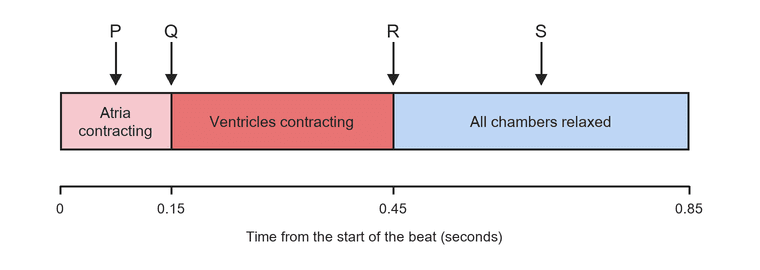
At which instant is the sound "DUP" produced ?
- 51 mark
Question 5
Cognitive domain: Understanding
Assertion (A): Blood drawn from a pulmonary vein is brighter red than blood drawn from the pulmonary artery.
Reason (R): All the veins of the body carry deoxygenated blood.
- 61 mark
Question 6
Cognitive domain: Understanding
Assertion (A): Regular physical exercise improves the flow of lymph in the body.
Reason (R): Lymph is not pumped by the heart; it is pushed along its vessels when the muscles around them contract.
- 71 mark
Question 7
Cognitive domain: Understanding
A sample of blood was left standing in a test-tube. After some time a dark red solid mass had settled, and a clear, light-yellow liquid had collected above it.
The clear liquid is ______. Unlike plasma, it contains no ______, because that protein was changed into the insoluble threads of the clot.
- 81 mark
Question 8
Cognitive domain: Application
Before a race, Anita presses a finger gently on her wrist on the side of the thumb and counts 19 beats in 15 seconds.
Her heart is beating about ______ times per minute, because each beat of the pulse is caused by one ventricular ______.
- 91 mark
Question 9
Cognitive domain: Application
A tight new shoe raised a blister on Ravi's heel. The blister was filled with a clear, watery fluid. A drop of this fluid seen under a microscope showed a few leukocytes but no red blood cells.
The fluid in the blister is ______ fluid, which is formed when the ______ of the blood leaks out through the walls of the capillaries.
- 102 marks
Question 10
Cognitive domain: Evaluation
Sonal says, "Blood clots only when it comes out of the body and meets the air." Her brother replies that their grandfather's heart attack was caused by a clot that formed inside one of his coronary arteries.
Whose view is supported by your chapter ? Justify your answer.
- 112 marks
Question 11
Cognitive domain: Application
In a study of digestion, one harmless marker was attached to the fat of a meal and another marker to its sugar. Soon after the meal, the sugar marker appeared in the blood leaving the intestine. The fat marker did not: it was first found in the fluid inside the lymph vessels of the wall of the intestine, and it reached the blood only later.
Explain why the fat marker took a different route, and state where it finally entered the blood.
- 122 marks
Question 12
Cognitive domain: Analysis
The heart rates of five mammals at rest are given below.
Animal Heart-beats per minute Whale 15 Elephant 25 Horse 40 Cat 120 Rat 250 State the relationship shown by these figures and give the reason for it. Between which two animals of the table would you expect the heart rate of a rabbit to lie ?
- 135 marks
Question 13
Cognitive domain: Analysis
Case: At a clinic, the Rh blood types of three couples, each expecting their first baby, were recorded.
Couple Mother Father 1 Rh-positive Rh-negative 2 Rh-negative Rh-positive 3 Rh-negative Rh-negative (a) What makes a person Rh-positive ? Where is this substance found ?
(b) For which couple may a second baby be at risk ? Explain what may happen.
(c) Explain why the first Rh-positive child of this couple is normal, and why the mother of couple 1 is in no such danger.
(d) After the delivery, the mother of couple 2 needs a blood transfusion. Which Rh type of blood must she be given ? Give a reason.
- 145 marks
Question 14
Cognitive domain: Evaluation
Case: In a science magazine, an inventor describes his plan for a simpler artificial heart. To save material he makes four changes to the plan of the human heart:
- Change 1: both ventricles have walls as thin as those of the atria.
- Change 2: there are no valves between the atria and the ventricles.
- Change 3: there are no pocket-shaped valves at the roots of the two large arteries.
- Change 4: the wall of the heart has no blood vessels of its own, "because the heart is always full of blood."
(a) Judge change 1. Why are the walls of the ventricles thicker than those of the atria, and why is the left ventricle the thickest ?
(b) Predict what would go wrong because of change 2 when the ventricles contract.
(c) Predict what would go wrong because of change 3 when the ventricles relax.
(d) Evaluate the inventor's reason for change 4.
- 155 marks
Question 15
Cognitive domain: Creativity
Case: For the school assembly, Class X must act out the double circulation of blood on the playground. They have chalk to mark the ground, four large hoops, red cards, blue cards and about thirty students. Each "blood" student will carry one card: red for oxygenated blood and blue for deoxygenated blood.
(a) Plan the layout. State what the four hoops and the two other marked areas should stand for, and the order in which a "blood" student must pass through them, starting from the body tissues.
(b) State the rule for changing the cards, and name the two places where they are changed.
(c) Design a simple way to show, with students, that blood cannot flow backwards through the heart.
(d) State two ways in which this play is unlike the real circulation.
- 161 mark
Question 16
CISCE Competency-Focused Practice Questions (2024) · Cognitive domain: Understanding
Assertion (A): The main pulmonary artery pumps oxygenated blood from the right ventricle into the lungs.
Reason (R): Inside the lungs, the artery divides and divides several times to form capillaries around the air sacs.
- 172 marks
Question 17
CISCE Competency-Focused Practice Questions (2024) · Cognitive domain: Evaluate
Haemorrhage frequently happens in viral dengue fever. Compare this condition with haemophilia.
- 182 marks
Question 18
CISCE Competency-Focused Practice Questions (2024) · Cognitive domain: Understanding
Why is a bicuspid valve in the human heart named so?
- 192 marks
Question 19
CISCE Competency-Focused Practice Questions (2024) · Cognitive domain: Understanding & Analysis
On a winter night, a group of workers slept in a closed room, having a burning furnace to keep themselves warm. Most of them died in their sleep. What is the reason for their fatality?
- 201 mark
Question 20
Cognitive domain: Understanding
During a long walk, a muscle cell in Rohan's leg uses up oxygen. The oxygen comes from the blood of a nearby capillary, yet the blood never touches the muscle cell, because a thin fluid-filled gap lies between them. Which route does the oxygen follow ?
- 211 mark
Question 21
Cognitive domain: Analysis
A doctor wants to find out which of four adults, P, Q, R and S, is most likely to be suffering from an allergic reaction. The percentage of each kind of white blood cell in a sample of blood from each person is given below, along with the normal range. (Hypothetical data.)
Kind of white cell Normal range (%) P Q R S Neutrophils – Eosinophils – Basophils – Lymphocytes – Monocytes – Whose report points most clearly to an allergy ?
- 221 mark
Question 22
Cognitive domain: Analysis
A hospital plans four transfusions, listed below as donor's blood group to patient's blood group. In which one will an antibody in the patient's plasma meet the matching antigen on the donor's red blood cells, so that the transfusion is unsafe ?
- 231 mark
Question 23
Cognitive domain: Application
After running in the hot sun, Meera's face turns pink. On a cold winter morning, the tips of her fingers look bluish. Which statement explains why her face turns pink in the heat ?
- 241 mark
Question 24
Cognitive domain: Analysis
Four test-tubes were set up with the substances given below. Calcium ions were present in every tube. (Hypothetical laboratory set-up.)
Tube Contents 1 fibrinogen and thrombin 2 fibrinogen and prothrombin 3 fibrinogen, prothrombin and thrombokinase 4 fibrinogen and thrombokinase In which tubes will sticky threads of fibrin form ?
- 251 mark
Question 25
Cognitive domain: Understanding
Assertion (A): A white blood cell spends most of its life inside the blood vessels.
Reason (R): White blood cells can squeeze out through the walls of the capillaries into the tissues.
- 261 mark
Question 26
Cognitive domain: Understanding
Assertion (A): Oxygen and glucose pass easily from the blood in a capillary into the fluid around the cells.
Reason (R): The wall of a capillary is only a single layer of thin cells.
- 271 mark
Question 27
Cognitive domain: Application
Mr Verma's heart sometimes beats too slowly and unevenly. His doctor finds that the natural pacemaker in the wall of his right auricle is not working well, and fits a small battery-driven artificial pacemaker in his chest. Which job does the device take over ?
- 281 mark
Question 28
Cognitive domain: Understanding
The blood of four adults was tested in a laboratory. The results are given below. (Hypothetical data.)
Person pH of the blood Plasma as a part of the blood (%) Water in the plasma (%) P Q R S The three results of only one person are all normal for human blood. Who is the person ?
- 292 marks
Question 29
Cognitive domain: Application
At a blood-donation camp, each donor gives of blood. An adult has about to litres of blood.
(a) Find the smallest and the largest percentage of a donor's blood that is given in one donation.
(b) The camp's doctor checks the blood group of every donor and of every patient. Why is this needed ?
- 302 marks
Question 30
Cognitive domain: Evaluation
A boil on Imran's arm became red, warm, swollen and painful. After some days it burst and a thick, yellowish fluid, pus, came out. His friend says, "Pus is only a heap of dead bacteria."
Is the friend correct ? Name the cells that mainly form pus and the process by which they reach the boil.
- 312 marks
Question 31
Cognitive domain: Evaluation
At a vaccination camp, Maya says, "A vaccine puts ready-made antibodies into our blood." Dev says, "A vaccine puts weakened germs, or germ substances, into the body, and the body then makes its own antibodies."
Whose statement agrees with this chapter ? Name the cells that make the antibodies and state one benefit of the vaccination.
- 322 marks
Question 32
Cognitive domain: Analysis
After an operation, the lymph vessels and glands of Sunita's left arm were removed. Within a few weeks the left arm looked more swollen than the right arm, although the blood vessels of both arms were normal.
Explain why the arm swelled, and state one other function of the lymph system that the arm has lost.
- 332 marks
Question 33
Cognitive domain: Analysis
In a patient whose kidneys have failed, the heart, the lungs and the blood vessels all work normally. Yet the amount of urea in the blood keeps rising.
What does this show about the part played by the blood in removing urea, and why does the urea still build up ?
- 343 marks
Question 34
Cognitive domain: Application
At a health check-up, a doctor measures Mr Rao's blood pressure with a sphygmomanometer and records it as (in mm of mercury).
(a) Which number is the systolic pressure ? When does the blood reach this pressure ?
(b) What does the other number show ?
(c) The normal pressure of an adult is – (systolic) and – (diastolic). What is the condition of Mr Rao called ?
- 353 marks
Question 35
Cognitive domain: Analysis
In a healthy adult about million red blood cells are destroyed every second. The adult has about red blood cells in all.
(a) Find the percentage of the red blood cells destroyed in one day, correct to .
(b) Name the organs where old red blood cells are destroyed and say what becomes of their iron.
(c) Where are new red blood cells made in an adult ?
- 363 marks
Question 36
Cognitive domain: Analysis
A laboratory sheet gives the readings of the three kinds of cells found in human blood. The names have been left out. (Hypothetical sheet, with normal values of an adult.)
Cell Number per of blood Nucleus in the mature cell Life span X to million absent about days Y to present about to days Z to absent to days (a) Name the cells X, Y and Z.
(b) State one main function of each.
(c) The number of which cell would rise far above its normal range when a serious bacterial infection sets in ?
- 373 marks
Question 37
Cognitive domain: Application
The muscle of the heart works all through life and needs oxygen at all times, although its chambers are always full of blood.
(a) Name the vessels that supply blood to the heart muscle and say where they arise.
(b) The heart muscle produces carbon dioxide. Trace its path from the heart wall to the lungs, naming the vessel that collects it, the chambers and the vessel that carry it.
- 385 marks
Question 38
Cognitive domain: Analysis
Case: To study the work of the liver, a research team took blood samples from the hepatic portal vein and from the hepatic vein of a healthy volunteer one hour after a meal of dal, rice and paneer. The graph shows the amounts of three substances in the two samples. (Hypothetical data.)
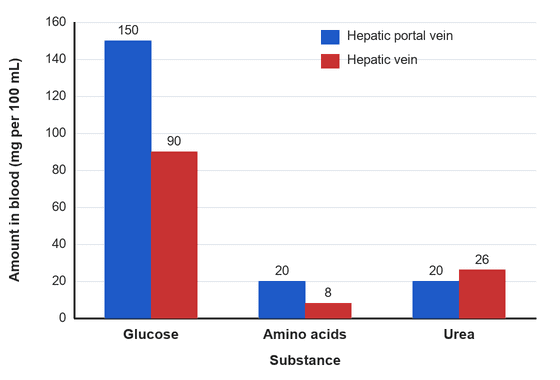
(a) Name the vessel that brings blood from the intestine to the liver. Which substance is higher in the hepatic vein than in the hepatic portal vein ?
(b) Find the percentage fall in glucose and in amino acids from the hepatic portal vein to the hepatic vein. Which fell more ?
(c) Using the functions of the liver, explain the changes in the three substances.
- 394 marks
Question 39
Cognitive domain: Evaluation
Case: Ankit, a boy of twelve, had a high fever. His platelets were counted every day, and the graph shows the result. The fever went away on the sixth day. The normal range is to thousand per . (Hypothetical data.)

(a) What was the lowest count and on which day ? What percentage of the lower limit of the normal range is it ?
(b) On how many of the ten days was the count below the normal range ?
(c) On the seventh day Ankit's friends say, "The fever has gone, so he can play football today." Is this a good idea ? Give two reasons.
- 405 marks
Question 40
Cognitive domain: Creativity
Class X is staging a short skit, "A Cut on the Finger", to show how blood clots. The characters are Platelets, Thrombokinase, Prothrombin, Thrombin, Fibrinogen and Fibrin, with Calcium ions and Red blood cells as helpers.
(a) Give the order in which the six main characters should enter the stage, with one short line of what each does.
(b) Which two steps need the help of Calcium, and which character needs vitamin K for its production ?
(c) Suggest a simple prop or action for the closing scene that shows the clot with the red cells trapped in it and the clear liquid squeezed out. Name that liquid.