
Opening your dashboard
Class 10 Biology Chapter 11 Sense Organs: Competency-Based Questions (CBQ)
40 questions on Chapter 11, each worked through on its own page with the AI tutor. Class 10 Biology, ICSE 2026-27.
40 questions
1–5 marks · Mixed difficulty
- 11 mark
Question 1
Cognitive domain: Application
Mr. Sethi's lacrimal glands have almost stopped pouring out their secretion. Every other part of his eyes is normal. Which problem is he most likely to have ?
- 21 mark
Question 2
Cognitive domain: Analysis
Anu drew a small square and a small circle side by side on a card. She closed her right eye, kept her left eye fixed on the circle all the time, and slowly brought the card nearer. She noted whether she could also see the square.
Distance of the card from the eye 50 cm 30 cm 20 cm 15 cm 10 cm Square seen ? Yes Yes Yes No Yes Which is the best explanation of her result at cm ?
- 31 mark
Question 3
Cognitive domain: Application
For a model of the inner ear, a student fixed all the three semicircular canals in the same horizontal plane. If a real ear were built like this model, what would it be least able to do ?
- 41 mark
Question 4
Cognitive domain: Analysis
The figure shows the eyeballs of three persons N, X and Y, drawn to the same scale. The cornea and the lens are alike in all three. N sees objects clearly at all distances.

Which option gives the defect and the correcting lens for X and for Y respectively ?
- 51 mark
Question 5
Cognitive domain: Understanding
Assertion (A): While reading a line on a printed page, we keep moving our eyes from word to word.
Reason (R): The yellow spot is a small area of the retina that contains the maximum number of sensory cells, particularly the cones.
- 61 mark
Question 6
Cognitive domain: Analysis
Assertion (A): In a garden on a moonlit night, a red rose and a purple flower cannot be told apart by their colours.
Reason (R): The visual purple of the rods is bleached in bright light, which reduces their sensitivity.
- 71 mark
Question 7
Cognitive domain: Application
For an eye test, drops were put into Farid's eyes that keep his pupils wide open for a few hours. He was told that sunlight would dazzle him until the effect of the drops wore off.
During this time the ______ muscles of his iris cannot narrow the pupil, so in sunlight ______ light than is needed enters his eyes.
- 81 mark
Question 8
Cognitive domain: Analysis
On a dark night Reena finds that a very faint star seems to vanish when she looks straight at it, but she can make it out when she looks a little to one side of it.
Looking straight at the star brings its image on the ______, where the cells are mostly cones; looking a little to one side shifts the image towards the periphery of the retina, where the ______ are more numerous.
- 91 mark
Question 9
Cognitive domain: Understanding
Grandmother finds it much harder to pass a thread through the eye of a needle when one of her eyes is covered with a patch after an eye check-up, although the other eye sees clearly.
Judging how far the thread is from the needle needs the simultaneous focusing of the object in ______ eyes, whose images are overlapped in the ______ to give the three dimensional effect.
- 102 marks
Question 10
Cognitive domain: Understanding
Tanvi was asleep in a dark room with her eyes closed. In a dream she "saw" a bright garden full of flowers.
No light entered her eyes, yet she had the experience of seeing. Using the steps by which we see, explain what this shows about where the sensation of sight arises.
- 112 marks
Question 11
Cognitive domain: Application
During a long study session, Kiran reads her book continuously. Every now and then she lifts her head and looks for a while at a tree far away outside the window.
Explain what happens to the ciliary muscles, the suspensory ligament and the lens of her eyes when she changes from reading the book to looking at the tree.
- 122 marks
Question 12
Cognitive domain: Evaluation
Ramesh finds it difficult to see in dim light, as during the night, though he sees well in the day. He says : "My eyes have become weak. I will ask for spectacles of a higher power and the problem will go."
Judge whether spectacles can solve Ramesh's problem. Give reasons.
- 135 marks
Question 13
Cognitive domain: Application
Case: At the Annual Day, Joseph sits near the stage while the school band plays. The figure is a simplified diagram, not drawn to scale, of the path taken by the sound in one of his ears. The balancing parts of the ear are not shown. The chain of three small bones, marked B, is numbered 1, 2 and 3.

(a) Name the parts A, C and D, and the small bones 1, 2 and 3 in order.
(b) The vibration of bone 3 is stronger than that of the part A which started it. Explain how this is brought about.
(c) Joseph has a bad cold, and the tube F of this ear is blocked. Predict the effect on part A and on his hearing, with a reason.
(d) The band plays a low-pitched drum and a high-pitched flute together, and Joseph hears both. State what happens inside D that sends impulses along E, and which feature of D lets it deal with sounds of different pitches.
- 144 marks
Question 14
Cognitive domain: Evaluation
Case: A school tested all the students of Classes 9 and 10 with cards of coloured dots that carry hidden numbers, like those printed in your chapter. A student who could not read the numbers on the cards was recorded as colour blind.
Group Number tested Number recorded as colour blind Boys 200 16 Girls 200 1 (a) Calculate the percentage of boys and of girls recorded as colour blind. State whether this result agrees with what your chapter says about this defect.
(b) A parent says : "These children became colour blind by spending too much time on mobile phones." Judge this claim.
(c) A teacher suggests giving the seventeen students vitamin A tablets to cure them. Judge this suggestion, pointing out the defect with which colour blindness is being confused.
(d) One of the boys cannot tell a ripe red tomato from an unripe green one by its colour. Name the kind of cells of the retina concerned, and explain how these cells allow a normal eye to tell colours apart.
- 155 marks
Question 15
Cognitive domain: Creativity
Case: Your chapter says that a person can judge the relative distance of objects better with both eyes open than with one eye. The Science Club wants to test this idea on its 20 members. It has plastic cups, a few coins, a metre scale, clean eye patches and a notebook.
(a) Design a simple and safe test, using these things, in which each member tries the same task under two conditions. State what will be changed and what will be measured.
(b) List three things that must be kept the same for every member so that the test is fair.
(c) Draw the blank table in which the results should be recorded, and state the result that would support the chapter's idea.
(d) Explain why the Club should test all 20 members, each several times, instead of one member once.
- 161 mark
Question 16
CISCE Competency-Focused Practice Questions (2024) · Cognitive domain: Analysis
Rajesh was told to buy a blue cloth by his craft teacher. He couldn't differentiate blue colour from green and hence brought a green cloth to class. Which medical reason could have resulted in this?
- 171 mark
Question 17
CISCE Competency-Focused Practice Questions (2024) · Cognitive domain: Understanding
The four major steps in seeing an object are:
i. interpretation by the brain.
ii. focussing of image.
iii. entry of light rays.
iv. transmission of nerve impulses from the retina & brain.
The correct sequence will be:
- 181 mark
Question 18
CISCE Competency-Focused Practice Questions (2024) · Cognitive domain: Understanding & Analysis
During light adaptation:
- 192 marks
Question 19
CISCE Competency-Focused Practice Questions (2024) · Cognitive domain: Analysis & Application
Keshav enters a dark room from a brightly lit area. He experiences difficulty in viewing objects, but gradually his vision improves.
Explain the role of the photoreceptors in this case.
- 203 marks
Question 20
CISCE Competency-Focused Practice Questions (2024) · Cognitive domain: Analysis & Application
Farhan’s classroom is very close to the compound wall of his school. He was observing two pigeons sitting on the wall. He could see one bird clearly, but the image of the second bird was blurred as the pigeon was a little away from the first.
(a) Name the defect of the eye Farhan is suffering from.
(b) Where is the image of the second pigeon formed in his eyeballs?
(c) What lens can be used to correct the defect?
- 211 mark
Question 21
Cognitive domain: Analysis
The graph shows how the number of rods and the number of cones per unit area change along a horizontal line of the retina of a normal eye, starting at the yellow spot and moving towards the nose side. Five positions, P, Q, R, S and T, are marked. (Hypothetical, simplified data.)

Which option gives the position for (i) the best colour vision, (ii) no vision at all and (iii) the best vision in very dim light, in that order ?
- 221 mark
Question 22
Cognitive domain: Analysis
Rahul looks at a candle with both eyes open and sees two flames. When he closes either eye, he sees only one clear flame. Which is the most likely reason ?
- 231 mark
Question 23
Cognitive domain: Application
Meena has a heavy cold. Her nose is blocked, so the vapour of the food does not reach the smell receptors in her nose, and her favourite curry seems tasteless. Which of the following depends on the same kind of receptors as those that are cut off in her nose ?
- 241 mark
Question 24
Cognitive domain: Analysis
The four major stages in seeing an object are : stage 1, entry of light rays; stage 2, focusing of the image; stage 3, transmission of nerve impulses from the retina to the brain; stage 4, interpretation by the brain.
Three persons have lost their sight in different ways :
- P : the cornea was scarred and has turned opaque (white).
- Q : the eyeball is longer than normal from front to back, so the image of a distant object forms in front of the retina.
- R : the optic nerve was cut in an accident, but the rest of the eye is normal.
At which stage of seeing is the process first broken in each person ?
- 251 mark
Question 25
Cognitive domain: Understanding
Aarav sits on the last bench of his classroom. He reads his notebook easily, but he cannot read the writing on the board.
Assertion (A): Aarav is most likely suffering from myopia and not from hyperopia.
Reason (R): In myopia the image of a distant object is formed behind the retina.
- 261 mark
Question 26
Cognitive domain: Understanding
After an infection, Kavya lost her hearing in the left ear because the sensory cells of her cochlea were destroyed. She can still walk along a narrow garden wall without losing her balance.
Assertion (A): Damage to the cochlea alone does not take away a person's sense of balance.
Reason (R): The parts of the inner ear that look after balance (the semicircular canals, the utriculus and the sacculus) are different from the cochlea, which looks after hearing.
- 271 mark
Question 27
Cognitive domain: Analysis
The drawing shows a yellow square on a set of lines that spread out from a point on the right. To most people the square looks distorted, as if its top and bottom edges are not parallel. Eshan checked the square with a ruler and a protractor and found that all four sides are cm and all four angles are . (Hypothetical measurements.)
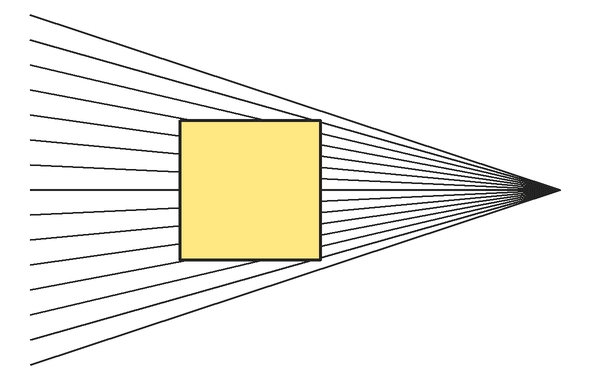
Which statement best explains why the square still looks distorted ?
- 281 mark
Question 28
Cognitive domain: Application
Rajan, aged , had the opaque lens of each eye removed by surgery for cataract, and no artificial lens was fitted. His cornea and retina are healthy. What should he wear to see clearly ?
- 292 marks
Question 29
Cognitive domain: Analysis
After working for years next to a loud machine, Kabir can follow ordinary speech, but he cannot hear a high-pitched beep from an electronic gadget that his friends hear easily. Tests show that his ear drum, his ear ossicles and his auditory nerve are normal.
Name the part of his ear that is most likely to be damaged, and explain why only some sounds are lost.
- 302 marks
Question 30
Cognitive domain: Evaluation
Mr. Nair tests the colour vision of his class with cards of coloured dots that carry hidden numbers. He does the test in the evening, in a classroom lit by a single dim bulb, and five students cannot read any number. He writes in his register : "These five students are colour blind."
(a) Judge whether his conclusion can be trusted. Give a reason.
(b) State how he should repeat the test.
- 312 marks
Question 31
Cognitive domain: Application
For a 3-D film, each scene is shot with two cameras placed side by side, about cm apart. In the cinema, special glasses let the left eye see only what the left camera filmed and the right eye see only what the right camera filmed.
(a) Why are the two cameras placed about as far apart as a person's two eyes ?
(b) Nikhil has lost the sight of one eye. Will the 3-D effect of the film work for him ? Give a reason.
- 322 marks
Question 32
Cognitive domain: Application
After a head injury, the nerve to the ciliary muscles of Farah's right eye stopped working, so those muscles cannot contract. She tests her eyes one at a time. With the left eye alone, she reads the chart on the far wall and the small print of a card held cm from her eye. With the right eye alone, she reads the far chart clearly, but the small print of the card is blurred.
Explain this difference in terms of the lens of her right eye.
- 332 marks
Question 33
Cognitive domain: Application
For the first few days in the weightlessness of a space station, a new astronaut, Meera, says that with her eyes closed she cannot tell which way is "down". She can still tell at once when her head turns or her body spins.
(a) Which parts of the inner ear normally register the position of the body with respect to gravity, and why do they not help her in weightlessness ?
(b) Which parts of the inner ear still tell her when her head turns ?
- 343 marks
Question 34
Cognitive domain: Analysis
Rohan, a boy of , wears reading glasses of power because the print of a book at the normal reading distance looks blurred to him. His friend Sunil, who cannot read the board from the last bench, tries Rohan's glasses and finds the board looks even more blurred.
(a) Name the defect that Rohan has.
(b) Name the defect that Sunil has.
(c) Explain why Rohan's glasses make the board look worse to Sunil.
- 353 marks
Question 35
Cognitive domain: Analysis
The cochlea is a closed tube filled with fluid, and it has two membrane-covered openings: the oval window and the round window, both of which lie between the middle ear and the inner ear. Fluids cannot be squeezed into a smaller space.
(a) Which of the two windows is touched by a bone of the middle ear ? Name the bone.
(b) When the stirrup pushes the membrane of the oval window inwards, what must happen at the round window for the fluid of the cochlea to move ? Give a reason.
(c) Predict what would happen to hearing if the round window were stiff and could not move.
- 363 marks
Question 36
Cognitive domain: Evaluation
A classmate writes in her notebook : "We have only five senses, sight, hearing, taste, smell and touch, because we have only five sense organs."
(a) Judge whether the statement is complete. Name two other senses mentioned in your chapter.
(b) Which kind of receptors in the skin tell us about the pressure of a heavy school-bag strap on the shoulder ?
(c) Which kind of receptors in the skin make us feel that something is hot or cold ?
- 373 marks
Question 37
Cognitive domain: Understanding
In a school hostel, many students developed red, itchy eyes. The doctor said that it was "conjunctivitis", caused by a viral infection. The white of each eye and the inner side of the eyelids looked red, but the coloured part of the eye was clear and the students could still see.
(a) Name the membrane that is infected and say which parts of the eye it covers.
(b) Why does the part of this membrane over the cornea not stop light from entering the eye ?
(c) The students were told not to rub their eyes and not to share towels. Give a reason.
- 384 marks
Question 38
Cognitive domain: Analysis
Case: At a health camp, people of different ages brought a small printed card slowly towards one eye until the print began to blur. The nearest distance at which the print was still clear was noted for one person of each age, all with healthy eyes. (Hypothetical data.)
Age (years) 10 20 30 40 50 60 Nearest distance of clear vision (cm) 8 10 14 22 40 100 (a) How many times farther is the nearest distance at age than at age ? Between which two ages in the table does it increase by the largest factor ?
(b) Using the way the eye focuses near objects, explain why the nearest distance of clear vision increases with age.
(c) A person wishes to read a newspaper at cm. From the table, at which age does this person first need spectacles, and which kind of lens is needed ?
- 395 marks
Question 39
Cognitive domain: Creativity
Case: For the Science Exhibition, your group must make a safe working model that shows (i) how sound reaches the sensory cells of the ear and (ii) why a person who is spun round and then stops feels dizzy. You may use only these things : a plastic funnel, a thin sheet of cling film, three small sticks, adhesive tape, a coiled transparent plastic tube filled with water, with both its ends closed by cling film, a clear plastic bottle with a tight cap, water and a few tiny pieces of paper.
(a) Say which of the things will represent the ear drum, the chain of ear ossicles and the cochlea, and describe how you will join them.
(b) Describe how you will use the bottle to show why a person feels dizzy after spinning round, and what the audience should observe.
(c) State one part of the real ear or one process of hearing that your model cannot show.
- 404 marks
Question 40
Cognitive domain: Evaluation
Case: A school magazine printed three "eye facts". A reader wrote to the editor that they are not all correct.
- Fact 1 : "Tears are produced only when we are sad."
- Fact 2 : "The pupil is a muscle that opens and closes to control the light."
- Fact 3 : "The blind spot is the part of the retina with the best vision."
(a) Evaluate Fact 1, giving the chapter's evidence.
(b) Evaluate Fact 2 and correct it.
(c) Evaluate Fact 3, and say what the blind spot really is.