
Opening your dashboard
Class 10 Biology Chapter 10 The Nervous System: Competency-Based Questions (CBQ)
40 questions on Chapter 10, each worked through on its own page with the AI tutor. Class 10 Biology, ICSE 2026-27.
40 questions
1–5 marks · Mixed difficulty
- 11 mark
Question 1
Cognitive domain: Application
In a laboratory study, a chemical was added to a preparation of two neurons that meet at a synapse. The chemical stopped the working of the enzyme that normally acts at the synapse, and it had no other effect. One impulse had just crossed the synapse. What is the most likely result at this synapse ?
- 21 mark
Question 2
Cognitive domain: Analysis
A nurse noted the condition of four persons P, Q, R and S. Each row was written from memory, and two of the rows were later found to be wrongly mixed up.
Person Pupil of eye Heart beat Secretion of saliva Peristalsis in intestines P Dilated Retarded Stimulated Decreased Q Dilated Accelerated Inhibited Decreased R Constricted Accelerated Inhibited Increased S Constricted Retarded Stimulated Increased Which person's row shows the working of the part of the autonomic nervous system that re-establishes normal conditions after a violent act is over ?
- 31 mark
Question 3
Cognitive domain: Application
The cerebral hemispheres of two mammals, X and Y, are of nearly the same size. The surface of X's cerebrum is almost smooth, while that of Y is thrown into many gyri and sulci. Which inference is best supported by your chapter ?
- 41 mark
Question 4
Cognitive domain: Analysis
The figure shows the charges on a short length of a nerve fibre at one instant, while an impulse is passing along it in the direction of the arrow.

Which option describes the regions P, Q and R correctly ?
- 51 mark
Question 5
Cognitive domain: Understanding
Assertion (A): A person in deep sleep goes on breathing and the heart goes on beating, although the person is not thinking about these activities.
Reason (R): Breathing movements and the beating of the heart are involuntary actions controlled by the medulla oblongata.
- 61 mark
Question 6
Cognitive domain: Analysis
Assertion (A): If only the ventral root of a spinal nerve is cut, the person can no longer feel a touch on the part of the skin supplied by that nerve.
Reason (R): Where the two roots of a spinal nerve join, the sensory fibres continue into the dorsal root and the motor fibres into the ventral root.
- 71 mark
Question 7
Cognitive domain: Application
In a physiology practical, a resting adult was found to take in mL of oxygen every minute.
Going by the share given in your chapter, his brain alone consumes more than ______ mL of this oxygen every minute, although the brain makes up only about ______ % of the total body weight.
- 81 mark
Question 8
Cognitive domain: Analysis
For a model of the spinal cord, Dev fixed threads to show the spinal nerves: 8 pairs in the neck region, 12 pairs in the thorax, 5 pairs in the lumbar region and 5 pairs in the sacral region.
His model is short of the full number by ______ pair, which should emerge in the ______ region.
- 91 mark
Question 9
Cognitive domain: Understanding
Asha walks out of a dark cinema hall into bright sunlight. At once, without her knowing it, the pupils of her eyes become smaller.
In this action the bright light is the ______, and the muscles that make the pupils smaller are the ______.
- 102 marks
Question 10
Cognitive domain: Understanding
In a cricket stadium the spectators make a "wave": each person stands up and sits down in turn, so that a wave sweeps round the stand although nobody leaves his or her seat.
A teacher says that this is a better picture of a nerve impulse than water flowing through a pipe. Explain why, using what happens on a nerve fibre.
- 112 marks
Question 11
Cognitive domain: Application
To check for meningitis, a doctor tested a little of the watery fluid taken from around the lower part of a patient's spinal cord.
Using the structure of the central nervous system, explain how a fluid collected from the back can show a disease of the coverings of the brain.
- 122 marks
Question 12
Cognitive domain: Evaluation
Neha says : "Watering of the mouth is always a conditioned reflex, because Pavlov's dog had to be trained before it salivated."
Do you agree with Neha ? Justify your answer with one example for each kind of salivation.
- 135 marks
Question 13
Cognitive domain: Application
Case: Three patients came to a nerve clinic. Tests showed that in each of them exactly one cranial nerve was damaged and that nothing else was wrong.
Patient What the patient reports 1 Cannot smell anything, although the nose is clear and its receptors are healthy 2 Sees clearly with the right eye, but cannot rotate that eyeball 3 Has lost feeling on one side of the tongue and cannot move that side of the tongue either (a) State the kind of nerve (sensory, motor or mixed) that is damaged in each patient. Give a reason for Patient 3.
(b) The smell receptors of Patient 1 are healthy and set up impulses. Explain why the patient still cannot smell.
(c) A fourth patient has one spinal nerve of the arm cut in an accident. Predict two effects on the part of the arm supplied by this nerve, with a reason.
(d) A nerve contains a large number of nerve fibres lying side by side. Explain why the impulses in neighbouring fibres do not get mixed.
- 144 marks
Question 14
Cognitive domain: Evaluation
Case: In an animal behaviour laboratory, the saliva given out by two dogs of the same breed and age, A and B, was counted in drops per minute. Neither dog had been trained before.
Stage What was done Dog A (drops per minute) Dog B (drops per minute) 1 A bell was rung; no food was shown 0 0 2 Food was presented; no bell 58 60 3 For 15 days : for Dog A the bell was rung every time food was presented; for Dog B the bell was rung daily, but never at feeding time not counted not counted 4 A bell was rung; no food was shown 46 0 (a) Name the kind of reflex shown by Dog A at Stage 2 and at Stage 4. Give a reason for each.
(b) State the purpose of Stage 1, and of including Dog B in the experiment.
(c) A student concludes : "Dog A salivated at Stage 4 because the sound of a bell is naturally a stimulus for the salivary glands." Judge this conclusion, using two pieces of evidence from the table.
(d) Another student says : "Any other dog of this breed would also give about 46 drops on hearing this bell." Is this claim sound ? Give a reason.
- 155 marks
Question 15
Cognitive domain: Creativity
Case: For the Science Week assembly, a group of six students has to act out, for Class 6 children, what happens in the body when a hand accidentally touches a hot iron. They have six blank placards, a soft ball, and a piece of chalk to draw on the floor.
(a) Decide what should be written on the six placards so that the whole pathway of this reflex, and the organ that later comes to know of it, are shown. State the order in which the students should stand.
(b) The students must show that two neurons do not touch each other, yet the impulse passes on. Design a way of showing this with the soft ball, and say what the ball stands for.
(c) Plan how the group can show that the hand is pulled away before the pain is felt. Where should the sixth student stand, and when should that student act ?
(d) Suggest one change to the role-play that would turn it into a voluntary action, and state one way in which any such role-play is unlike the real reflex.
- 161 mark
Question 16
CISCE Competency-Focused Practice Questions (2024) · Cognitive domain: Analysis
Given below are some common reflexes in humans.
i. Quick closing of the eyelids when a strong beam of light is flashed across.
ii. Apply brakes to your vehicle if anything suddenly comes in front.
iii. Playing a musical instrument.
iv. Coughing reflex, when the food is swallowed, enters the windpipe.
The conditioned reflexes are:
- 171 mark
Question 17
CISCE Competency-Focused Practice Questions (2024) · Cognitive domain: Understanding
Assertion: The nerve impulse travels from the axon of a neuron to the axon of another neuron.
Reason: The end portion of the axon has swollen ends, which store neurotransmitters.
- 182 marks
Question 18
CISCE Competency-Focused Practice Questions (2024) · Cognitive domain: Application
When an irritant enters the nose, a sneezing reflex happens. Identify the stimulus and the response.
- 193 marks
Question 19
CISCE Competency-Focused Practice Questions (2024) · Cognitive domain: Recall & Application
Manoj was writing a composition on “The importance of Education in life”.
(a) Name the part of the brain that Manoj uses for writing the composition.
(b) Is it a voluntary or involuntary action?
(c) Trace the nervous pathway using the following terms:
Muscles of the hand, Sensory nerves, Fingertips, Motor nerves, and Brain.
- 201 mark
Question 20
Cognitive domain: Application
In a tall adult, one neuron has its cell body in the gray matter of the lower part of the spinal cord. Its axon is nearly one metre long. The axon leaves the cord inside a spinal nerve, and its axon endings lie on the fibres of a muscle in the calf of the leg.
Which statement about this neuron is correct ?
- 211 mark
Question 21
Cognitive domain: Analysis
To control very severe fits in a patient, a surgeon cuts through the corpus callosum and does nothing else to the brain. (Hypothetical case.)
Which statement about the patient after the operation is best supported by your chapter ?
- 221 mark
Question 22
Cognitive domain: Application
While waiting outside the principal's office, Gurpreet felt that the hair on his arms was standing up and his skin turned pale. These changes were brought about by one part of his autonomic nervous system.
Which pair of changes is also expected in Gurpreet at that moment ?
- 231 mark
Question 23
Cognitive domain: Analysis
After a fall, Ria's brain scan showed that only one part of her brain was damaged. She thinks clearly, her body temperature is normal, she keeps her balance, and the muscles of both sides of her body work together smoothly. Her skin and her nerves are healthy, but the pain and pressure impulses that reach the brain from her skin are no longer passed on to the cerebrum.
Which part of the brain is damaged ?
- 241 mark
Question 24
Cognitive domain: Analysis
The figure shows the side view of a human brain. Four areas of the cerebrum are marked P, Q, R and S.
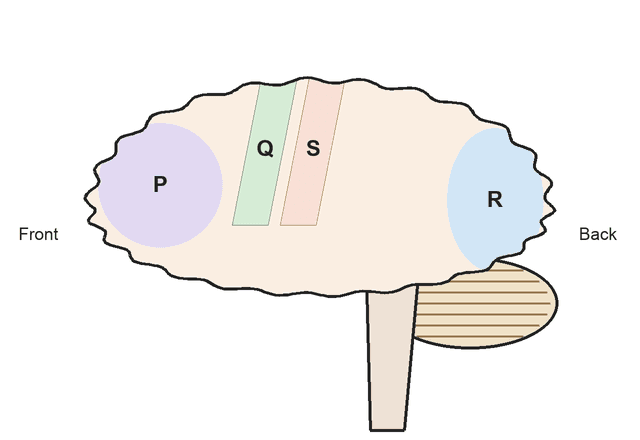
After a stroke, Neeta's eyes were found to be healthy, yet she cannot see. She still feels a touch on her skin, moves her arms and legs normally, thinks clearly and speaks well.
Which area was damaged ?
- 251 mark
Question 25
Cognitive domain: Application
Assertion (A): Damage to the hypothalamus may upset the working of the pituitary gland, even though the pituitary gland itself is healthy.
Reason (R): The hypothalamus, a part of the diencephalon of the forebrain, controls the pituitary gland as well as the body temperature.
- 261 mark
Question 26
Cognitive domain: Analysis
Assertion (A): In a person terrified by a sudden loud noise, the sympathetic system narrows the coronary vessels, so the heart muscle gets less blood.
Reason (R): In such a person the sympathetic system makes the heart beat faster and dilates the coronary vessels, so that the hard-working heart muscle gets more blood.
- 271 mark
Question 27
Cognitive domain: Understanding
A teacher wrote four events on the board and asked which kind of stimulus, as classified in your chapter, set off each response.
-
Tears flow when the fumes of frying red chillies reach the eyes.
-
A mosquito lands on an arm and the arm jerks at once.
-
The pupils of the eyes become smaller when a torch is flashed at them.
-
The hair on the arms stands up in a cold breeze.
Which option gives the kind of stimulus for events 1, 2, 3 and 4 in that order ?
-
- 281 mark
Question 28
Cognitive domain: Evaluation
Rohan was labelling a model of the nervous system. Beside the twelve pairs of nerves that arise from the brain he wrote: "Central nervous system, because these nerves come out of the brain."
Which evaluation of his label is the best ?
- 292 marks
Question 29
Cognitive domain: Analysis
Before going on stage for a debate, Ishaan felt no urge to pass urine, although he had drunk plenty of water. Soon after the debate ended, he had to hurry to the washroom.
Using the two parts of the autonomic nervous system, explain both observations.
- 302 marks
Question 30
Cognitive domain: Understanding
The axon of a neuron in the brain gives off two side branches. The main axon and each side branch end in swollen 'bulbs' lying close to the dendrites of different neurons.
(a) Name the side branches of an axon and the chemicals that the bulbs store.
(b) State one advantage of such side branches.
- 312 marks
Question 31
Cognitive domain: Evaluation
Rohit says: "The spinal cord is only a cable that carries messages between the body and the brain. It takes no decisions of its own."
Evaluate his statement, using what your chapter says about the spinal cord.
- 322 marks
Question 32
Cognitive domain: Application
Meena, a goalkeeper, sees the ball coming and dives to stop it. As she lands, a speck of dust enters her eye and tears flow at once to wash it out.
(a) Say which of the two actions is a voluntary action and which is a reflex.
(b) State two differences between these two kinds of action, one about where the commands originate and one about the kind of organ that responds.
- 332 marks
Question 33
Cognitive domain: Creativity
A teacher wants to show Class 6 children how the fluid around the brain protects it. She has two identical plastic boxes with tight lids and two boiled eggs. She fills one box completely with water, puts one egg in each box, closes both lids tightly and shakes each box firmly in the same way.
(a) Say what the box, the egg and the water stand for in the model.
(b) Predict what will be seen in each box, and say what the model shows.
- 343 marks
Question 34
Cognitive domain: Analysis
A student stained a thin slice cut across a preserved spinal cord with a dye that colours cell bodies of nerve cells only. (Hypothetical experiment.) She saw the following.
Part of the slice Dye Inner region of the cord Dark Outer region of the cord Faint Small oval swelling on the dorsal root Dark Ventral root, away from the cord Faint (a) Name the inner and the outer regions of the cord and say what each is made of.
(b) Name the oval swelling on the dorsal root and say which neurons have their cell bodies in it.
(c) The ventral root is faint, yet it carries impulses. Explain.
- 353 marks
Question 35
Cognitive domain: Evaluation
Aman read that an adult elephant's brain weighs about kg, while your chapter says that an adult human brain weighs about kg. He said: "The elephant's brain is much heavier, so an elephant must have a bigger brain for its body than a human has." (Approximate values.)
An elephant's body weighs about kg.
(a) Find the brain of the elephant as a percentage of its body weight.
(b) Compare it with the value that your chapter gives for a human, and say how many times larger the human share is.
(c) Evaluate Aman's statement.
- 363 marks
Question 36
Cognitive domain: Analysis
In a reflex arc the muscle does not contract when the skin is touched. A scientist placed electrodes E1, E2 and E3 on three neurons, as shown. (Hypothetical experiment.) She stimulated and recorded as shown in the table.

Test What was done Impulse recorded at Muscle contracts 1 The skin was touched E1: yes No 2 E1 was stimulated electrically Axon endings of the sensory neuron: yes; E2: no No 3 E2 was stimulated electrically E3: yes Yes 4 The dendrite of the association neuron, just beyond the gap, was stimulated directly E2: yes Not noted (a) What does Test 1 show about the receptor and the sensory neuron?
(b) Name the place where the fault lies, using Tests 2, 3 and 4.
(c) Name the chemical that should carry the impulse across this place.
- 373 marks
Question 37
Cognitive domain: Analysis
A health camp tested babies of months and students of years in the same city. The table shows how many in each group gave each response. (Hypothetical data.)
Response Babies Students Eyes blink when a bright torch is flashed 50 50 Mouth waters at the sight of hot gulab jamun 0 46 Sneezing when pepper powder reaches the nose 50 50 Mouth waters when the bell of an ice-cream cart rings 0 35 (a) Which two responses are natural reflexes? Which feature of the data shows it?
(b) Name the other two and explain why no baby shows them.
(c) Four students did not water at the sight of gulab jamun, although they are years old. Suggest a reason, using the definition of a conditioned reflex.
- 384 marks
Question 38
Cognitive domain: Analysis
Case: An electrician showed Kavya the underground telephone cable below her street. It holds many thin copper wires. Each wire has its own plastic coat, so the calls on neighbouring wires do not mix, and all the wires lie together inside one tough outer pipe. Kavya says that a nerve of the body is built in the same way. (The cable is only an analogy.)
(a) Match the copper wire, the plastic coat of each wire and the outer pipe with the parts of a nerve.
(b) A disease destroys the myelin sheath of many axons in a nerve. Predict the effect on the impulses in that nerve, and give the reason.
(c) A spinal nerve carries impulses from the skin to the spinal cord and also from the cord to the muscles. Say what kind of nerve it is, and why the two kinds of impulses are not confused with each other.
- 394 marks
Question 39
Cognitive domain: Application
Case: A school nurse noted what Imran did one evening. (Hypothetical record.)
Time Event 5:00 pm Reads a page of Biology and later answers a question on it from memory 5:30 pm Hears a siren on the road and knows that a fire engine is passing 6:00 pm Plays a game of table tennis 6:30 pm Lies down to rest; his heart keeps beating and his breathing goes on, although he is not thinking about either (a) Your chapter lists four major functions of the nervous system. Match each of the four events with the function that it shows.
(b) Name the part of the brain that looks after the event at 6:30 pm.
(c) Patient X has a seriously damaged cerebrum but an undamaged medulla oblongata. Patient Y has a seriously injured medulla oblongata but an undamaged cerebrum. Which patient is in greater danger of death ? Give a reason.
- 404 marks
Question 40
Cognitive domain: Evaluation
Case: Anika wrote three lines in her revision notes for the chapter on the nervous system.
Claim 1: The spinal cord runs down the whole length of the backbone, right to its lower tip.
Claim 2: Like the cerebrum, the cerebellum has gray matter on the outside and white matter inside, and in a median section its white matter looks like a branching tree.
Claim 3: Dendrites carry impulses away from the cell body, and the axon carries impulses towards the cell body.
(a) Evaluate Claim 1, and correct it if it is wrong.
(b) Evaluate Claim 2, and correct it if it is wrong.
(c) Evaluate Claim 3, and correct it if it is wrong.